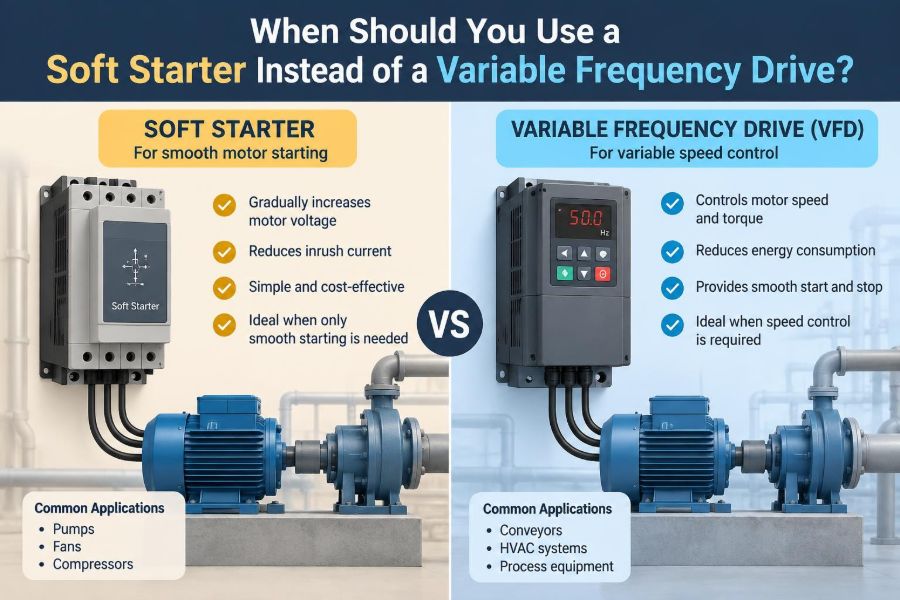

A maintenance team replaces a worn motor starter on a large pump. The motor only needs to run at full speed, but the pump line surges when it starts and the electrical supply dips enough to disturb nearby equipment. Should the team fit a soft starter, or specify a variable frequency drive?
The two devices are often discussed together because both reduce the harshness of starting an AC motor. Yet they solve different problems. Treating a soft starter as a lower-cost VFD—or a VFD as a more capable soft starter—can lead to unnecessary cost, disappointing process control, or avoidable motor-system stress.
The practical choice starts with one question: does the application need to control speed during normal operation, or does it mainly need a gentler start and stop?
That distinction sounds simple, but load behavior, duty cycle, bypass arrangements, supply quality, mechanical equipment, and safety requirements all affect the answer.
⚙️ Start With the Fundamental Difference
A soft starter controls the voltage applied to an AC motor during starting and, on many units, during stopping. It typically uses semiconductor devices called thyristors, or SCRs, to gradually increase motor voltage until the motor reaches normal speed.
A variable frequency drive, usually called a VFD, rectifies incoming AC power and then creates an output with controllable frequency and voltage. Because motor speed depends largely on supply frequency, a VFD can control speed throughout operation, not only during acceleration.
🧭 Ask What the Process Actually Needs
Use a soft starter when the process normally wants the motor at its rated speed and does not gain meaningful value from changing speed. Typical examples include fixed-speed conveyors, crushers, large fans with fixed airflow requirements, and pumps that operate against a stable system demand.
Choose a VFD when speed is a process variable: maintaining pressure, matching conveyor throughput, regulating airflow, trimming mixer speed, or adapting to changing load conditions. Starting smoothly is then a useful feature, but not the main reason for installing the drive.
🔌 How a Soft Starter Reduces Starting Stress
An induction motor connected directly across the line can draw a high inrush current while developing high starting torque. This direct-on-line method is simple, but it can cause voltage dips, belt slip, gear shock, water hammer, or mechanical jolts.
A soft starter ramps voltage over a selected time or limits current to a selected value. Reduced voltage reduces available torque, so the settings must match the load. The objective is not merely a slow start; it is a controlled start with enough torque to accelerate reliably.
🎛️ How a VFD Controls a Motor
A VFD begins at a low output frequency and raises frequency along a controlled acceleration profile. It also adjusts voltage in relation to frequency so the motor can develop useful torque without excessive magnetic flux.
This approach lets a motor start with controlled current and torque while also reaching any commanded operating speed within its usable range. Modern drives may add closed-loop feedback, braking functions, programmable logic, communication networks, and detailed diagnostics.
🚦 Use a Soft Starter for Fixed-Speed Duty
A soft starter is often the right fit when the motor starts, accelerates, then runs continuously at full speed. Once the motor reaches speed, many soft starters close an internal or external bypass contactor so current no longer passes through the power semiconductors.
That arrangement makes sense for applications such as a process conveyor that always runs at one speed. The soft starter protects the start, while the motor operates efficiently on the normal line supply afterward.
📉 Choose a VFD When Lower Speed Saves Energy
Fans and centrifugal pumps are common VFD applications because reducing speed can greatly reduce the power required by the load. Using a throttling valve or damper wastes energy by deliberately creating resistance; reducing motor speed can often meet the same demand more efficiently.
This is not automatic in every system. A pump may have minimum-flow requirements, a fan may need a fixed speed for a process, and a load may not follow the familiar centrifugal affinity relationships. Still, variable demand is a strong reason to evaluate a VFD.
💧 Pump Starting Is a Frequent Soft-Starter Case
A fixed-speed pump can create a pressure transient when it starts suddenly. The resulting surge may stress pipes, valves, couplings, and supports. A soft starter can provide a gentler acceleration, reducing the abrupt change in flow.
For stopping, a soft-starter pump-control profile can reduce the sudden loss of flow that contributes to water hammer. It is not a substitute for proper hydraulic design: check valves, surge vessels, pipe layout, pump curves, and operating sequences still matter.
🌬️ Fans Need a More Careful Decision
A large fan with a fixed airflow requirement may only need limited starting current and reduced belt or duct stress. In that case, a soft starter can be an economical choice.
If airflow changes by shift, season, occupancy, or process state, a VFD can regulate fan speed and potentially replace inefficient damper control. Also check whether the fan has critical mechanical speeds that must be passed through quickly or avoided during continuous operation.
🏗️ Conveyors Reveal the Importance of Torque
Conveyors are often fixed-speed systems, but their starting conditions vary widely. An empty, level conveyor may start easily on a soft starter. A loaded inclined conveyor may require substantial breakaway torque, and reduced-voltage starting may not supply enough torque at a safely limited current.
A VFD offers more flexible torque control and can coordinate multiple conveyor sections. However, it is not automatically necessary. A correctly selected soft starter with current limit, torque ramp, and suitable mechanical design may be entirely adequate for a constant-speed conveyor.
🪨 High-Inertia Loads Can Favor Either Device
Flywheels, large fans, centrifuges, and some mill applications take a long time to accelerate. A soft starter can help if the required torque remains available as voltage ramps up and the starter is rated for the extended start.
A VFD may be preferable when acceleration must be carefully shaped, when torque must be maintained across a speed range, or when the load needs controlled deceleration. The motor, drive, and protective settings must all be sized for the actual acceleration time rather than an assumed short start.
💪 Starting Torque Is the Constraint People Miss
For an induction motor, available torque falls sharply as applied voltage is reduced. As a useful approximation, torque changes with the square of voltage. Cutting voltage substantially can therefore leave the motor unable to overcome static friction, load torque, or an uphill load.
Before choosing a soft starter, obtain the motor torque-speed curve and the driven-load torque-speed requirement. A setting that limits supply current attractively on paper can produce a stalled motor, excessive heating, and a failed start in the field.
⚡ Consider the Electrical Supply First
Soft starters are often selected where the primary problem is excessive inrush current or an objectionable voltage dip on a limited electrical system. They can reduce the disturbance compared with direct-on-line starting without requiring continuous power conversion.
A VFD also limits starting current, but its input rectifier and DC bus introduce different power-quality considerations. Depending on the topology and installation, harmonic current, line reactors, filters, and supply impedance may need attention.
🧮 Compare Running Losses, Not Only Purchase Cost
After bypass closes, a soft starter adds very little running loss because the motor operates directly from the line. For a fixed-speed motor running many hours, this is a straightforward and efficient arrangement.
A VFD has conversion losses while operating, although those losses may be outweighed many times over if speed reduction cuts the load’s energy demand. The right comparison is not “which device uses less power?” It is “which complete motor-and-process system uses less power at the required output?”
💰 Initial Cost and Lifecycle Cost Are Different Questions
For the same motor rating, a soft starter is commonly less costly and less complex than a VFD. Its panel may require less space and fewer auxiliary components, especially where no speed control or braking is needed.
But a lower initial price is not a sufficient decision rule. Include energy use, production flexibility, process losses, maintenance access, spare-parts strategy, power-quality mitigation, and the consequences of downtime. A VFD can be justified by operating benefits that a soft starter cannot provide.
🛠️ A Bypass Contactor Changes the Soft-Starter Picture
Most soft starters are intended to conduct only during starting and stopping. An internal bypass contactor, or a properly engineered external bypass, transfers motor current away from the SCRs after acceleration.
Verify whether bypass is included, what protection remains active after bypass, and how the circuit behaves after a fault or power interruption. A bypass arrangement does not create speed control; it simply supports efficient full-speed operation.
🧲 VFD Output Can Affect the Motor and Cable
The fast switching edges from a VFD can stress motor insulation, especially with long motor cables, older motors, or higher-voltage systems. Reflected-wave effects can raise terminal voltage peaks, while common-mode voltages can contribute to bearing-current problems in some installations.
Motor suitability, cable length, grounding, output reactors, sine filters, and shaft-grounding measures should be evaluated as a system. These issues do not mean VFDs are unsuitable; they mean the installation needs deliberate engineering.
🌡️ Motor Cooling Changes at Low Speed
A standard self-cooled motor uses a shaft-mounted fan. When a VFD runs that motor slowly for long periods, the cooling fan also turns slowly, while the load may still demand substantial torque.
Check the motor’s allowable torque-versus-speed performance, ambient conditions, starts per hour, and enclosure. An independently powered blower, a larger motor, or an inverter-duty motor may be needed. A soft starter avoids this particular low-speed cooling issue because the motor normally runs at full speed.
🛑 Controlled Stopping Means Different Things
A soft starter can provide a voltage ramp-down for loads such as pumps, where a gradual reduction in torque is useful. It cannot actively command arbitrary low-speed operation, and it cannot generally absorb energy from a rapidly decelerating load.
A VFD can ramp frequency down, use DC injection in limited situations, or work with braking resistors or regenerative arrangements where the application requires controlled deceleration. Each braking method has limitations and thermal consequences that need review.
🔄 Reversing and Positioning Usually Point to a VFD
A reversing soft-starter system can be built with contactors, but frequent reversing is mechanically and electrically demanding. It also does not provide controlled low-speed positioning.
If a machine needs repeatable direction changes, creep speed, tension control, synchronization, or controlled positioning, a VFD is usually the more appropriate platform. For precision motion, servo systems may be more suitable than either conventional solution.
🧩 Process Control Integration Matters
A soft starter can offer useful signals: run status, fault indication, current measurement, and basic digital or fieldbus communication. For simple start-stop equipment, this may be all the control system needs.
VFDs commonly provide richer control features, including PID regulation, multiple speed references, process feedback, programmable interlocks, and more extensive diagnostics. Avoid selecting a VFD merely for features nobody will configure or maintain, but do not overlook functions that simplify a real control problem.
🧯 Protection Settings Still Need Engineering
Neither device eliminates the need for correct upstream protection, overload configuration, grounding, short-circuit ratings, disconnecting means, and coordination with the motor circuit. A device’s overload function is not a universal replacement for every protective requirement.
Set protective functions using motor nameplate data, application duty, cable conditions, and the manufacturer’s instructions. A qualified electrical engineer should review fault-current ratings and protective-device coordination, particularly in industrial power systems.
📦 Size for the Load Profile, Not Just Motor kW
Motor power is a starting point, not a complete selection method. Consider full-load current, service factor where applicable, overload demand, starting frequency, acceleration time, ambient temperature, altitude, enclosure cooling, and the driven equipment’s torque profile.
For a soft starter, confirm its current and start-duty rating. For a VFD, confirm continuous and overload ratings at the intended switching frequency and environment. A unit that looks correctly sized by kilowatt rating alone may derate or trip in service.
🏭 Match the Enclosure to the Environment
Dust, moisture, corrosive vapor, washdown, heat, and vibration can shorten the life of starters and drives. A clean electrical room and a wet processing area demand very different enclosure, cooling, and maintenance strategies.
VFD panels may need particularly careful thermal management because their electronics dissipate heat continuously. Soft starters also need adequate cooling during starts, especially where repeated or prolonged acceleration occurs.
🔊 Do Not Ignore Noise and Resonance
Variable-speed operation can move a machine through mechanical resonances, producing vibration or noise at certain frequencies. Drives can often skip defined frequency bands, but this requires commissioning observations and an understanding of the equipment.
A soft starter does not create a continuous variable operating-speed range, so it avoids this particular issue after startup. It may still reveal mechanical problems during a long acceleration, such as loose couplings or poor alignment.
⚠️ Common Mistake: Using a Soft Starter to Throttle a Process
A soft starter is not a practical speed controller for normal operation. Leaving it at reduced voltage while attempting to slow a motor can cause poor torque, excess motor heating, unstable speed, and losses in the starter.
If the process needs less flow, lower conveyor speed, or adjustable machine output, use a VFD or a mechanical/process control method designed for that purpose. Reduced voltage is not equivalent to controlled frequency.
⚠️ Common Mistake: Buying a VFD for Every Motor
Specifying VFDs everywhere can add avoidable capital cost, panel heat, commissioning time, electromagnetic compatibility work, and maintenance complexity. A fixed-speed motor that only needs gentle starts may be better served by a soft starter.
The goal is not maximum feature count. It is a reliable motor-control solution that fits the mechanical load and operating objective.
📝 A Practical Selection Checklist
Answer these questions before comparing model numbers:
- Must the motor run at more than one normal speed?
- Can lower speed reduce energy use or improve the process?
- What breakaway torque and acceleration time does the load require?
- Is the concern starting current, mechanical shock, water hammer, or all three?
- Does the load need controlled stopping, braking, reversing, or positioning?
- What are the cable length, motor insulation, environment, and supply-quality constraints?
- How often will the motor start, and what happens if it fails to start?
Clear answers usually make the choice much less ambiguous.
🧠 The Core Decision Rule
Use a soft starter when a motor will run at essentially fixed speed and the main requirement is to reduce electrical and mechanical stress during starting or stopping. It is especially compelling when the load can accelerate with reduced-voltage torque and a bypassed, full-speed operating mode is desirable.
Use a VFD when the application benefits from controlling speed, torque, acceleration, deceleration, direction, or process feedback during normal operation. Its broader capability brings added design responsibilities, but those responsibilities are worthwhile when variable operation creates real value.
For either choice, verify the motor, load, supply, protection, and environment as one system rather than selecting from a single nameplate number.
A soft starter manages the transition to full speed; a VFD manages the motor’s speed as part of the process. Select the device that solves the actual operating problem—not simply the one that seems more advanced. ⚡🔧🏭