
A metal-cased appliance begins to tingle when someone touches it barefoot in a damp utility room. A breaker trips whenever a particular outdoor circuit is switched on. A GFCI receptacle will not reset after heavy rain. These situations can look unrelated, but each may involve a ground fault.
Electricity normally follows the intended circuit: from the source, through conductors and a load, then back through the designated return path. Trouble begins when current finds an unintended route through equipment frames, building materials, earth, plumbing, or a person.
Ground faults matter because even a relatively small amount of current through the human body can be hazardous, especially where skin is wet or contact with ground is good. They can also damage equipment, create arcing, and turn a minor insulation defect into a fire risk.
Understanding the mechanism makes protective devices less mysterious. It also helps students, technicians, and homeowners recognize when a simple reset is reasonable—and when the circuit needs qualified diagnosis.
⚡ What a ground fault actually is
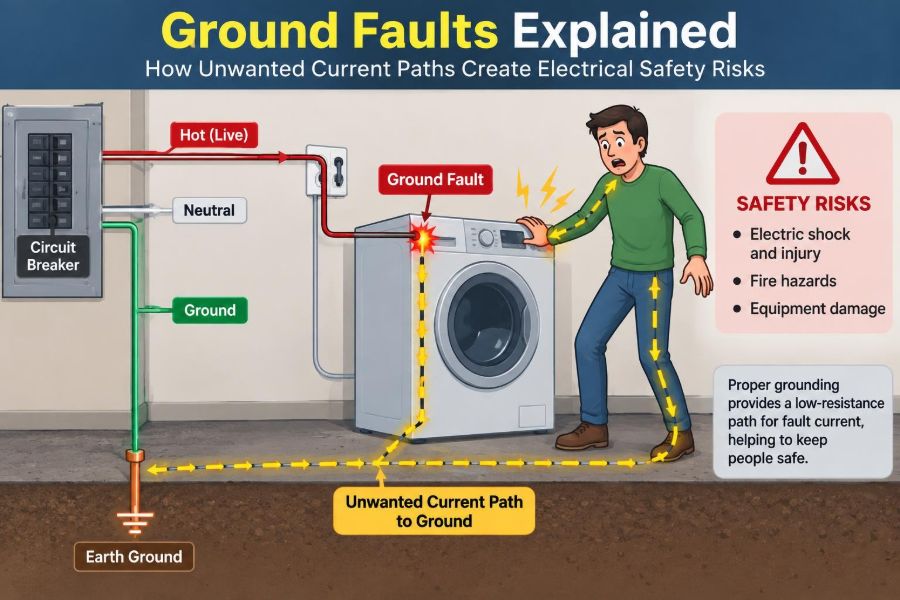
A ground fault occurs when energized current leaves its intended circuit and flows to ground or to a grounded conductive surface. “Ground” may mean the earth itself, a bonded metal enclosure, a grounding conductor, or another conductive path connected to earth through the electrical system.
The defining issue is not merely that something touches metal. It is that the contact creates an unintended path for current. The amount of current depends on voltage, resistance, source characteristics, and the available return path.
🛣️ The intended path versus an unintended path
In a normal single-phase circuit, current leaves on the ungrounded conductor, passes through a load such as a motor or heater, and returns on the grounded conductor, commonly called neutral. The circuit is designed so those conductors carry equal current in opposite directions.
A ground fault adds a detour. For example, damaged insulation may let an energized conductor contact a metal tool housing. If that housing is grounded, current can return through the equipment grounding conductor rather than through the neutral.
🌍 Why “ground” has more than one meaning
Electrical conversations often blur several related ideas. The equipment grounding conductor bonds exposed metal parts together and provides a low-impedance fault-current path. A grounding electrode system connects the installation to earth through electrodes such as rods or concrete-encased conductors.
Earth itself is not a dependable low-resistance return conductor for clearing ordinary branch-circuit faults. Protective systems are designed around metallic bonding and grounding conductors, not the assumption that soil will carry enough current to trip a breaker quickly.
🔌 Grounded conductors are not grounding conductors
The grounded conductor, usually neutral in many AC systems, is a current-carrying conductor during normal operation. The equipment grounding conductor normally carries no load current; it is there for fault conditions and bonding.
Confusing these roles leads to unsafe work. A neutral-to-ground connection in the wrong downstream location can place normal return current on metal paths, conduit, or grounding conductors. System bonding belongs only at designated locations established by the installation design.
🧭 Current always needs a complete circuit
Current does not simply “go into the ground” and disappear. It flows when a voltage source has a complete path back to its source. A person touching an energized object while also connected to earth or grounded metal can become part of that path.
This is why the surroundings matter. Dry shoes on an insulating floor can limit current in one scenario, while wet hands, damp concrete, and metal piping can create a much lower-resistance path in another.
🧱 Insulation failure is a common starting point
Wire insulation separates conductors from each other and from conductive enclosures. Heat, vibration, abrasion, ultraviolet exposure, chemicals, rodents, and age can degrade that barrier. Eventually, a conductor may contact grounded metal or moisture-contaminated material.
A cracked extension-cord jacket is an obvious example. Less visible cases occur inside motors, heating elements, cable raceways, and appliance cords, where repeated movement or heat slowly damages insulation.
💧 Water makes faults more likely and more dangerous
Pure water is not an especially good conductor, but real-world water contains dissolved minerals and contaminants. Moisture also creates films across surfaces, lowers insulation resistance, and allows leakage current to travel where it normally would not.
Bathrooms, kitchens, basements, rooftops, workshops, pools, and outdoor areas therefore deserve special attention. Water does not create every ground fault, but it often reveals marginal insulation or contaminated equipment that seemed fine when dry.
🧰 Damaged tools and appliances
A portable tool can develop a ground fault when its internal conductor rubs against the metal case, when a cord is pinched, or when conductive dust accumulates near terminals. A double-insulated tool has a different protective construction, but its cord and internal insulation can still fail.
Never treat a tingling enclosure as a harmless nuisance. Remove the equipment from service, disconnect it safely, and have it inspected. Taping over damaged insulation is not a reliable repair for cord sets or internal faults.
🏭 Industrial causes: vibration, contamination, and heat
Industrial equipment faces harsher conditions than many household loads. Motor leads vibrate, cable insulation sees oil and coolant, panels collect conductive dust, and heaters operate at elevated temperatures. These conditions can reduce insulation resistance gradually or produce a sudden fault.
Variable-frequency drives and electronic filters can also introduce normal leakage currents to ground. That does not mean every trip is a defect, but it means protection and troubleshooting must account for equipment type and manufacturer guidance.
🔥 Ground faults and short circuits are related, not identical
A short circuit is an unintended low-resistance connection between points at different voltage, often line-to-neutral or line-to-line. It can produce very high current. A ground fault is specifically an unintended connection involving ground, grounded metal, or an equipment grounding path.
One event can be both: a line conductor contacting a grounded enclosure may create a low-impedance ground fault that resembles a short circuit in its high current. Other ground faults have higher resistance and produce only leakage current.
| Condition | Typical unintended path | Likely protective response |
|---|---|---|
| Overload | Normal circuit path carries too much load current | Breaker or fuse responds over time |
| Line-to-neutral short | Direct connection between supply conductors | High-current breaker or fuse operation |
| Low-impedance ground fault | Line conductor to bonded metal enclosure | Breaker or fuse may operate quickly |
| Leakage ground fault | Line conductor through moisture, insulation damage, or a person | GFCI/RCD may respond before breaker |
📉 High-resistance faults can evade ordinary breakers
Conventional circuit breakers are primarily sized to protect conductors against overloads and high fault currents. A leakage path through wet insulation or a person may be far below the breaker’s trip threshold while still presenting a shock hazard.
This is the central reason ground-fault protection exists. It watches for an imbalance in current rather than waiting for current to become large enough to threaten the branch-circuit wiring.
🛡️ How a GFCI or RCD detects danger
A GFCI, called an RCD in many regions, compares the current leaving on the live conductor with the current returning on the neutral. Under normal conditions, their magnitudes match. If some current takes another route, the device senses the difference and disconnects the circuit.
These devices are designed for rapid response to specified imbalance conditions, but exact trip characteristics vary by device type and applicable product requirements. They reduce shock risk; they do not make contact with energized parts safe.
🧲 Why grounding and GFCI protection work differently
Equipment grounding encourages a fault on a metal enclosure to return by a low-impedance metallic path. That can produce enough current for an overcurrent protective device to operate. It helps keep exposed conductive parts from remaining energized.
A GFCI does not require the equipment grounding conductor to sense a current imbalance. This is useful for detecting leakage through paths that do not carry enough current to trip a breaker. In many settings, the protections complement rather than replace each other.
🧪 A simple hypothetical fault scenario
Imagine a corded metal-cased drill with a damaged internal conductor touching its housing. If the housing is properly grounded, the fault current may return on the grounding conductor and cause the branch breaker to open.
Now imagine the grounding path is broken and a person holding the drill touches a grounded pipe. Part of the return path may pass through the person. A GFCI can detect the missing return current and trip, but safe practice is to prevent the fault and maintain grounding—not to rely on protective operation as a routine control.
👤 Why the human body is a particularly risky path
Body resistance varies widely with skin condition, contact area, pressure, pathway, and environment. Wet or broken skin can substantially reduce resistance. Current through the chest is especially concerning because it can interfere with normal heart rhythm.
Voltage alone does not describe the complete hazard, but it provides the force that drives current through available resistance. Treat exposed energized conductors and suspicious metal enclosures as hazardous regardless of whether prior contact seemed uneventful.
🏠 Household locations with elevated exposure
Areas combining electricity, water, grounded surfaces, and portable equipment deserve careful design and maintenance. Common examples include receptacles near sinks, laundry areas, garages, unfinished basements, exterior outlets, and temporary outdoor setups.
- Use equipment rated for the environment, particularly outdoors or in wet locations.
- Keep cord connections off wet ground and protected from rain.
- Replace cracked cords, loose receptacles, and damaged covers promptly.
- Test installed GFCI protection using its test function according to manufacturer instructions.
🏗️ Construction sites add temporary-power hazards
Temporary wiring is moved, stepped on, exposed to weather, and connected to changing loads. Cords can be run through doorways, over sharp edges, or across wet surfaces. These are practical reasons construction electrical safety programs emphasize inspection and appropriate ground-fault protection.
A working protective device does not excuse poor cord management. Physical protection, suitable cable type, inspections, and prompt removal of damaged equipment prevent faults before a worker becomes the path.
⚙️ Motors, heaters, and leakage to ground
Motor windings and heating elements operate near metal frames and may experience heat cycling. When their insulation weakens, current can leak from windings or elements to the grounded sheath or enclosure. The fault may appear only after the equipment warms up.
This intermittent behavior is diagnostically useful. A device that trips protection only during heating, vibration, or humidity changes may have insulation deterioration rather than a simple wiring error.
🌩️ Surge damage and hidden insulation stress
Surges from switching events or lightning-related disturbances can stress insulation and sensitive electronics. A surge does not always produce an immediate visible failure; it may weaken components and leave equipment more vulnerable to later leakage or breakdown.
Surge protective devices can reduce exposure to some transient events, but they are not substitutes for correct grounding, bonding, wiring methods, or fault protection. Their effectiveness depends on proper selection and installation.
📏 Insulation resistance and professional testing
Qualified technicians may use insulation-resistance testing to look for deteriorated insulation between conductors and ground. The test applies a controlled DC voltage and measures resistance, so it must be performed with equipment isolated and in accordance with its instructions.
This is not a casual test for connected electronics. Applying an insulation tester to equipment that cannot tolerate the test voltage can cause damage. Continuity checks, clamp measurements, visual inspection, and manufacturer procedures may be more appropriate depending on the circuit.
🔎 A sensible troubleshooting sequence
When ground-fault protection trips repeatedly, resist the urge to keep resetting it. Disconnect loads, inspect for moisture and physical damage, and identify whether the trip follows a particular appliance or branch condition.
- De-energize before opening enclosures or handling suspect wiring.
- Check cords, plugs, covers, and visible wiring for damage or water intrusion.
- Disconnect portable loads and reconnect one at a time if it is safe to do so.
- Record when the trip occurs: immediately, under load, when wet, or after warming.
- Call a qualified electrician when fixed wiring, panel equipment, or unresolved trips are involved.
Never bypass a GFCI, remove a grounding pin, or substitute a larger breaker to stop tripping. Those actions conceal the symptom while reducing protection.
🚫 Common fixes that create bigger hazards
Defeating protective devices is one of the most dangerous responses to nuisance tripping. A GFCI that will not reset may be detecting a downstream fault, a wiring issue, moisture, or a failed device. The answer is diagnosis, not circumvention.
Another mistake is assuming a three-prong plug guarantees a safe ground. The receptacle, branch-circuit wiring, bonding connections, and equipment grounding path all have to be intact. A plug shape alone verifies none of them.
🧩 Nuisance tripping versus a real warning
Repeated tripping does not automatically mean the protective device is defective. Electronic equipment, long cable runs, moisture, and cumulative leakage from several loads can contribute to imbalance. Some circuits require devices selected for particular equipment characteristics.
Still, “nuisance” should not become a dismissive label. A qualified person should determine whether the leakage is expected, whether circuit loading and device compatibility are appropriate, and whether insulation or wiring defects are present.
🪛 The role of bonding in fault clearing
Bonding intentionally connects conductive parts so they remain at substantially the same electrical potential during a fault. Metal enclosures, raceways, cable trays, and other conductive parts may need bonding so a fault has a dependable path back to the source.
A loose bonding connection can leave one metal component energized relative to another or relative to earth. Good workmanship—correct connectors, clean contact surfaces where required, proper torque, and suitable materials—is therefore a safety function, not merely neat installation.
📐 System design affects fault behavior
Fault current and protective response depend on the system. Supply transformer characteristics, conductor length, conductor size, grounding arrangement, and available fault current all influence whether an overcurrent device clears a fault promptly.
This is why engineering calculations matter in larger installations. A grounding conductor is not selected only by appearance or convenience; the complete fault path and protective-device behavior must be considered under applicable codes and design practices.
🏥 Sensitive locations require layered protection
Healthcare spaces, laboratories, data facilities, and process plants may have additional concerns: continuity of service, sensitive electronics, leakage monitoring, and specialized equipment. A simple residential rule cannot be transferred directly to every environment.
Designers may use coordination studies, isolation approaches, monitoring, selective protection, and equipment-specific requirements. The shared principle remains the same: identify unwanted current paths and control both shock and equipment risks without creating unnecessary loss of service.
📚 What standards and codes can—and cannot—do
Electrical codes and product standards establish minimum requirements for wiring methods, grounding, bonding, protective devices, and locations requiring added protection. Requirements differ by jurisdiction, system type, building use, and the edition adopted locally.
Compliance is not a substitute for maintenance. Equipment can be installed correctly and later become unsafe through corrosion, alteration, abuse, water intrusion, or failed components. Inspecting and maintaining the installation keeps its protective features functional.
🧠 A practical mental model for diagnosing faults
Ask three questions: Where did current leave the intended conductor? What path did it take? Why did protection respond—or fail to respond? This framework connects symptoms to circuit behavior instead of treating trips as random events.
For example, a trip only during rain suggests an environmental path. A trip when one appliance is connected points toward that load or its cord. A metal case with a shock sensation demands immediate removal from service, even if no breaker has tripped.
✅ Preventing ground faults before they occur
Prevention starts with installation quality and continues with routine care. Use appropriate enclosures and wiring methods, protect cables from physical damage, preserve grounding and bonding connections, and match equipment to the environment.
For users, the habits are straightforward: inspect before use, keep electrical connections dry, avoid overloaded temporary wiring, and stop using equipment that is damaged, warm in unusual ways, sparking, or causing tingling. Qualified inspection is the right next step when fixed wiring or protective devices behave unexpectedly.
🎯 The core takeaway: control the path of current
Ground faults are dangerous because they redirect electrical current through paths not intended to carry it. Those paths may include metal equipment frames, wet building surfaces, grounding conductors, or people.
Safe electrical systems use insulation to prevent unintended contact, bonding and grounding to provide predictable fault paths, overcurrent devices to protect conductors, and GFCI/RCD protection to detect harmful imbalance. No single layer is perfect on its own; effective safety comes from their combined operation.
The safest response to a suspected ground fault is to remove the hazard from service and restore the intended current path through proper repair—not to defeat the protection that exposed the problem. ⚡🔌🛡️