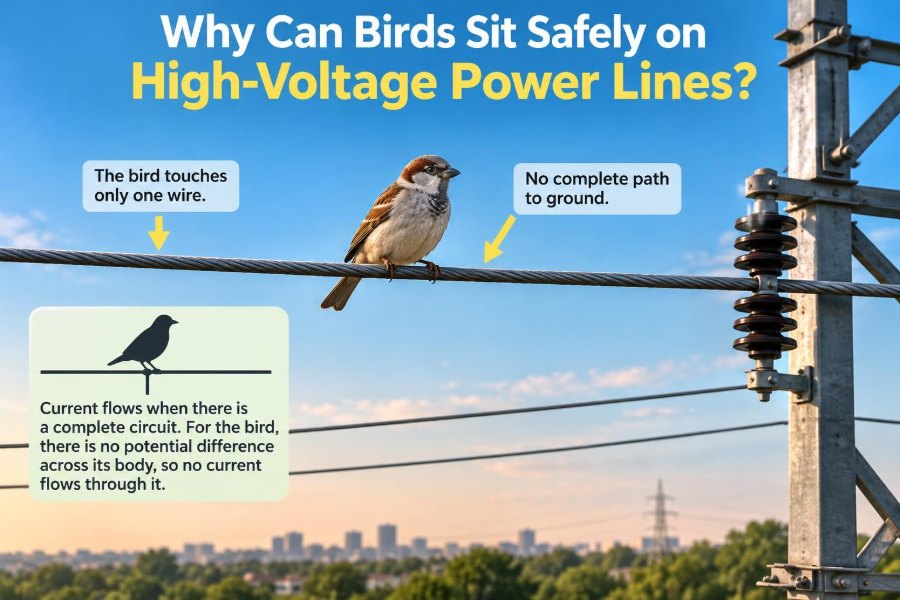

A bird settles on a power line above a road, shakes its feathers, and looks entirely unconcerned. Beneath it, the line may carry electricity at a voltage high enough to be extremely dangerous to a person.
The scene can feel like a contradiction. We are taught that electricity and water are hazardous, that exposed conductors must be avoided, and that power lines demand respect. So why does the bird appear safe?
The answer is not that birds are immune to electricity, or that power lines are harmless. It comes down to a central electrical idea: voltage difference across a body. Current only has a meaningful reason to pass through the bird if it can enter at one point and leave at another point with a different electric potential.
That principle explains the bird, the danger of touching two conductors, the purpose of insulation, and many everyday electrical safety rules.
⚡ The Short Answer: One Wire, One Potential
A bird perched on a single power line usually has both feet at nearly the same electric potential, meaning nearly the same voltage. Because there is almost no voltage difference from one foot to the other, very little current flows through its body.
Electric current needs a complete path. If the bird touches only one conductor and is not connected to ground or another conductor at a different voltage, it has not created a useful path through itself.
The line can be at a very high voltage relative to Earth, but that fact alone does not force dangerous current through the bird. Voltage is always a difference between two points.
🔌 Voltage Is Electrical “Push”
Voltage, also called electric potential difference, describes the energy available to move electric charge between two locations. A useful analogy is water pressure: pressure matters when there is a difference between one place and another.
A conductor might be 11 kilovolts, 132 kilovolts, or more relative to ground. But if both of the bird’s feet contact essentially the same part of that conductor, the difference in voltage across its body remains tiny.
Calling an object “high voltage” is convenient, but incomplete. The engineering question is always: high voltage relative to what?
🌊 Current Is What Causes Injury
Voltage creates the conditions that can drive current, while current is the movement of electric charge. Electrical injuries occur when enough current passes through the body, particularly when it crosses the chest, affects the nervous system, or causes heating at contact points.
Ohm’s law summarizes the relationship:
Current = Voltage difference / ResistanceIf the voltage difference across an animal is close to zero, the resulting current is also close to zero, even if the animal has finite body resistance. This is why the small voltage difference between a bird’s feet is the key fact.
🐦 Why a Bird’s Two Feet Usually Match
The two feet of a small bird are close together, perhaps separated by only a few centimetres. Along a good metal conductor, voltage changes only slightly over such a short distance because the wire has low resistance.
Transmission and distribution conductors do have resistance, so their voltage is not perfectly identical everywhere. A line carrying load experiences a gradual voltage drop along its length. Across the tiny spacing of a bird’s feet, however, that drop is normally far too small to produce harmful current.
A larger animal spanning a greater distance could encounter a larger potential difference. Size and contact geometry therefore matter.
🧭 Electric Potential Is Not the Same as “No Electricity”
The bird is not sitting in an electrically inactive place. Its entire body rises to nearly the potential of the wire once it makes contact. Relative to the ground below, the bird may be at a substantial voltage.
Yet the bird has no second connection at ground potential. There is no large potential difference through its body, so there is little conduction current through it.
This distinction is fundamental: an object may be at a high potential relative to Earth while still being safe to touch from its own potential level. Utility workers use this idea in specialized live-line work, under tightly controlled procedures.
🛤️ The Complete Circuit Requirement
Electrical circuits are often drawn as loops because charge must have a return path. At a power station, generators drive current out through conductors and back through other conductors as part of the network.
A bird on one phase conductor does not generally provide that return route. Its body is simply connected to one point in the circuit.
Ground is often part of a fault path, but it is not a magical sink that electricity always seeks. Current follows all available paths according to voltage differences and impedances, which include resistance and the effects of AC frequency.
🌍 Why Touching the Ground Changes Everything
Imagine the same bird somehow touching the energized line and a grounded metal pole at the same time. The pole is intentionally connected, directly or indirectly, to Earth potential. The bird would then bridge two points with a large voltage difference.
Current could flow from the line, through the bird, into the pole and grounding system. That is a dangerous fault path, and the outcome could be fatal.
The same principle explains why a person standing on the ground must never touch a fallen or damaged line. The person could become part of the path between the conductor and Earth.
↔️ Touching Two Wires Is Even More Dangerous
Many overhead systems use three phase conductors. Each phase has a changing voltage relative to the others. A bird touching two different phase wires at once can bridge a substantial phase-to-phase voltage.
That can cause a severe arc fault and electrocute the animal. It can also interrupt service or damage equipment, depending on the system and protection settings.
A bird is normally safe because the conductors are deliberately spaced far apart. The spacing is not decorative: it reduces the likelihood of flashover, accidental contact, and faults between phases.
🧱 Insulators Keep Conductors Away From Structures
Look at a utility pole or transmission tower and you will see insulators between the energized conductor and the support structure. Their job is to prevent current from taking a shortcut into the grounded pole or tower.
Porcelain, glass, and polymer insulators are selected and shaped to withstand electrical stress, weather, contamination, and mechanical loading. Their long, ribbed surfaces increase the distance current would need to travel along the outside.
Without insulation, the line would energize the supporting structure or fault to ground. A bird needs no insulating shoes when touching only one conductor because it is not bridging that conductor to the support.
☁️ Air Is an Insulator—Until It Is Not
Dry air normally resists current flow, which is why overhead conductors can be bare and still operate safely when separated by sufficient distance. But air can break down when the electric field becomes strong enough.
When breakdown occurs, an arc forms: ionized air becomes conductive, producing a bright, hot discharge. Lightning is a large natural example; small switching arcs are familiar examples in equipment.
A bird does not always need to physically touch two points to be in danger. If it gets close enough to another phase, grounded hardware, or a damaged component, an arc may bridge the air gap.
📏 Clearance Depends on More Than Distance
Safe separation distances are engineered around voltage, conductor movement, equipment geometry, altitude, weather, pollution, and expected fault conditions. There is no single safe distance that applies to every line.
Wind can make conductors swing. Ice can change sag and loading. Wet or contaminated surfaces can allow leakage current to travel farther than a clean, dry surface would permit.
This is why people should not try to judge electrical safety by eye. A wire may be energized even when it appears quiet, intact, and well above the ground.
💧 Rain Does Not Make Every Perched Bird a Conductor
Rain can increase leakage over dirty insulation and across wet surfaces, and it can make electrical conditions less predictable. But rain alone does not automatically create a dangerous circuit through a bird sitting on one wire.
Water on feathers, feet, or a line may change surface conductivity and capacitance. The decisive concern remains whether a significant voltage difference exists across a conductive path through the bird.
In real outdoor systems, wet conditions do raise risks of arcing and insulation problems. That is one reason electrical designs account for harsh weather rather than relying on ideal dry-air assumptions.
🪶 A Bird Is Not “Naturally Insulated”
Feathers can provide some insulation, but they are not the main reason a perched bird survives. A bird with wet feathers, damaged skin, or bare feet is still usually safe on one conductor for the same basic reason: nearly equal potential at both contact points.
It is misleading to say birds are protected simply because their feet are dry or because they are light. A person suspended from and touching only one suitably isolated conductor could also avoid a large body current, although attempting anything like this is extraordinarily dangerous.
Topology—the pattern of electrical connections—matters more than species.
🧍 Why Humans Face a Different Everyday Risk
A person usually approaches electrical equipment while standing on the ground, holding a grounded object, or near conductive structures. Those ordinary circumstances provide a second potential that a bird on a lone wire lacks.
Human hands can also reach widely spaced points: a wire and a pole, two terminals, a live component and a grounded enclosure. The body can then become the bridge across a dangerous voltage difference.
Human skin resistance varies greatly. Sweat, cuts, moisture, pressure, and metal contact can lower it substantially, so assumptions based on “high body resistance” are not a safety strategy.
🧤 Why Gloves Alone Are Not a Simple Solution
Electrical insulating gloves used by qualified workers are specialized protective equipment, tested and maintained for particular voltage classes. Ordinary work gloves, gardening gloves, or dry-looking fabric gloves are not dependable electrical insulation.
Even correctly rated gloves are only one part of a planned safety system. Workers may also require insulated tools, protective clothing, approved work methods, training, clearance controls, and rescue planning.
The bird’s situation cannot be copied by casually wearing gloves. It is the absence of a hazardous second connection—not a pair of feet—that provides the usual protection.
🏗️ The Surprising Case of Live-Line Work
In certain utility operations, trained lineworkers may perform work on energized equipment using methods commonly described as hot-stick, rubber-glove, or barehand techniques. The method depends on voltage level, task, equipment, and rules set by the utility and regulator.
In barehand work, a worker may be brought to the same potential as the energized conductor while remaining isolated from ground and other phases. From that limited electrical perspective, the worker resembles the perched bird.
But this work is highly engineered and controlled. It involves strict approach distances, bonding, field management, weather restrictions, and competent crews. It is an illustration of the principle, not a model for personal experimentation.
🔄 Alternating Current Adds Capacitive Effects
Most overhead power systems carry alternating current (AC), so their voltage changes direction repeatedly. Even without direct contact, AC electric fields can couple energy through capacitance.
Capacitance is the ability of separated conductors to store charge in an electric field. A bird near a high-voltage line has a small capacitance to the line and to ground, which can permit a very small AC current.
For a small perched bird under ordinary conditions, this capacitive current is generally far below a harmful level. At very high voltages or with larger objects, however, induced and capacitive effects become more significant engineering concerns.
📡 Induction Can Energize Nearby Objects
A conductor does not need direct contact to influence nearby metal. Electric fields can create induced voltage, while changing magnetic fields can induce voltage in loops or long parallel conductors.
This is why utility procedures treat disconnected lines, fences, vehicles, and long conductive objects carefully when they are near energized equipment. A disconnected conductor may still acquire a voltage that requires grounding before work begins.
For the bird question, induction is a useful reminder: “not touching” is not always identical to “electrically irrelevant.” Engineers evaluate the specific geometry and system conditions.
🦅 Larger Animals Face Greater Exposure
Large birds such as raptors can have wingspans large enough to approach nearby equipment while perched or taking off. Their greater reach raises the chance of simultaneously contacting a conductor and grounded hardware, or two energized parts.
Squirrels, snakes, and climbing animals can also bridge energized hardware in substations and distribution equipment. Such incidents may cause outages because protective devices detect the fault and disconnect part of the system.
Utilities use wildlife guards, covered jumpers, perch deterrents, and modified equipment layouts in locations where animal contacts are frequent. These measures improve reliability while reducing harm to wildlife.
🪜 Birds Can Still Be Electrocuted
The statement “birds can sit on power lines safely” needs an important qualifier: they can be safe when they touch only one conductor and remain clear of everything at a different potential.
Electrocution can occur when a bird spans phase-to-phase conductors, phase-to-ground equipment, or an arc gap. It can also occur on compact structures where energized components and grounded metal are close together.
Therefore, a bird perched on a wire is not evidence that the line is safe to approach, touch, or work near. It only reveals that the bird has not completed a dangerous circuit at that moment.
🚗 The Same Principle Explains a Car Near a Line
If a power line falls onto a vehicle, the vehicle body may become energized. Occupants who remain inside are often safer than someone who steps out, because the metal body can keep much of the interior at a similar potential.
The major danger arises when a person simultaneously contacts the vehicle and the ground, creating a path between two potentials. Emergency instructions can vary by situation, but the general advice is to stay inside if safe to do so and contact emergency services.
If escape is unavoidable because of immediate danger such as fire, trained guidance generally emphasizes avoiding simultaneous contact with the vehicle and ground, then moving away without taking normal steps. This is an emergency scenario, not something to practice.
👣 Step Potential Makes the Ground Hazardous
When fault current enters the ground, voltage is not identical everywhere around the entry point. It typically decreases with distance, creating a voltage gradient across the soil.
If a person’s feet are separated across that gradient, a voltage difference can exist from one foot to the other. This is called step potential. A person touching an energized object while standing nearby can also experience touch potential.
These hazards explain why staying far away from downed lines matters. The danger is not limited to direct contact with the wire itself.
🔧 Power Lines Are Not All the Same
The term “power line” covers a broad range of systems. A service drop to a building, a distribution feeder on a roadside pole, and a transmission line on a steel tower may operate at very different voltages and use different construction.
| Line type | Typical role | What the bird principle means |
|---|---|---|
| Service conductors | Deliver power to a building | One-contact safety logic still applies, but proximity to structures increases hazards. |
| Distribution lines | Carry power through neighborhoods and towns | Phase spacing and grounded hardware can create animal-contact risks. |
| Transmission lines | Move bulk power over long distances | Higher electric fields, large clearances, and induced effects require extra attention. |
Never infer voltage from the height, thickness, or appearance of a line. Only the utility can verify its status and configuration.
🧠 Common Misconceptions to Leave Behind
- “Electricity always goes to ground.” It flows through available paths in response to voltage differences and circuit conditions.
- “A bird is safe because it has feathers.” Feathers are not the core explanation; equal potential at the feet is.
- “High voltage cannot hurt you unless you touch ground.” Touching another phase or conductive object at a different potential can be equally dangerous.
- “Rubber shoes make line contact safe.” Ordinary footwear is not reliable protection against power-system hazards.
- “No sparks means no danger.” A conductor can be energized without visible signs.
🛑 Safe Responses Around Overhead Lines
Electrical safety is most effective when it prevents contact in the first place. Keep ladders, poles, kites, drones, machinery, and recreational equipment well clear of overhead lines.
If you see a downed line, damaged pole, or line contacting a tree, vehicle, or fence, keep people and animals away and notify the utility or emergency services. Treat every line as energized unless the responsible utility confirms otherwise.
Do not attempt to move a line with a stick, rope, tool, or vehicle. Materials that appear nonconductive can become hazardous when wet, contaminated, damaged, or brought near a high-voltage field.
🧰 What Engineers Design For
Power-system engineers design around normal operation and credible abnormal conditions. They consider conductor sag, insulation coordination, lightning, switching surges, fault current, grounding, protective relays, maintenance access, and public clearance.
Wildlife interaction is also a practical reliability issue. Equipment designs may include insulated covers in targeted locations, increased separation, animal barriers, and perching arrangements that keep large birds away from hazardous gaps.
No design eliminates every possible failure. Good engineering layers physical spacing, insulation, grounding, protection, inspection, and operating procedures so that one problem does not automatically become a severe accident.
🧪 A Simple Thought Experiment
Picture a battery with a metal strip connected to only its positive terminal. Touching one point on that strip does not complete a circuit through your body because you are not also connected to the negative terminal.
Now touch the positive terminal with one hand and the negative terminal with the other. The battery’s voltage difference is applied across your body, and current can flow. A power line is governed by the same circuit logic, although the available voltage and fault energy can be vastly more dangerous.
The bird is equivalent to touching one point of the strip, not bridging positive and negative terminals.
📚 The Core Principle to Remember
A bird can sit on a high-voltage line because both feet are usually at almost the same voltage, and it is not connected to ground or another conductor. With almost no voltage difference across its body, there is almost no current through it.
The moment it bridges two different potentials—line to ground, one phase to another, or a conductor to nearby hardware—the situation changes. Physical contact, air gaps, wet conditions, body size, and system voltage all influence the risk.
The lesson reaches far beyond birds: electrical danger depends on the path current can take through a body, not merely on being near something labeled “high voltage.”
Respect every power line, because the bird’s safety comes from its electrical connections—not from any special immunity to electricity. ⚡🐦🔒