
A storm rolls through a neighborhood, bringing down power lines several miles away. Homes, stores, and traffic signals go dark. Yet a nearby hospital campus keeps its lights, critical equipment, refrigeration, and communications running.
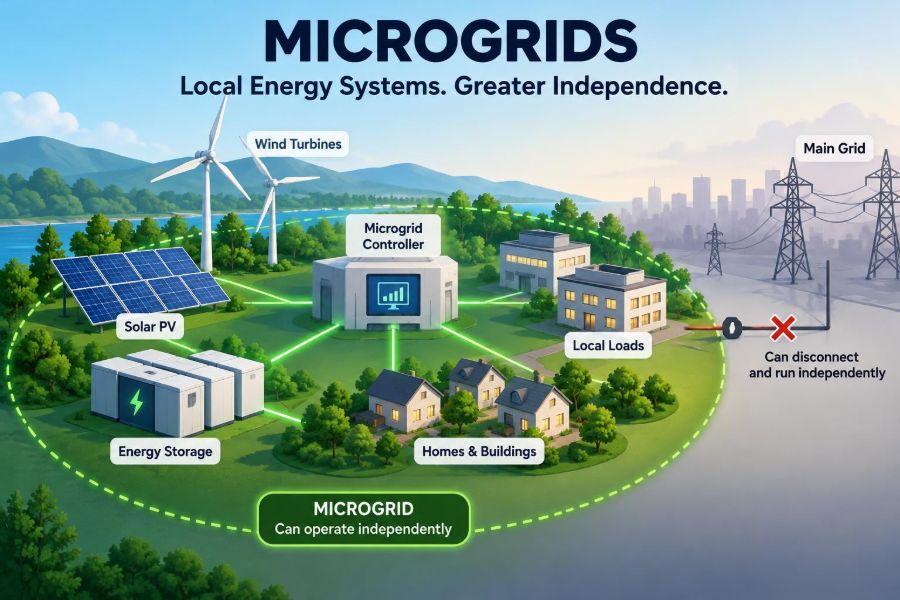
That difference is not necessarily because the hospital has a larger emergency generator. It may be operating as a microgrid: a local energy system designed to serve a defined area and, when necessary, separate safely from the wider utility network.
Microgrids are becoming relevant far beyond hospitals. They can support remote communities, university campuses, industrial facilities, military sites, apartment developments, and groups of public buildings. They also raise difficult engineering questions about protection, stability, economics, and control.
Understanding microgrids starts with a simple idea: electricity does not always have to travel one way from a distant power station to a passive customer. A well-designed local system can generate, store, manage, and sometimes share power close to where it is used.
🔌 What a Microgrid Actually Is
A microgrid is a coordinated group of electrical loads and distributed energy resources within clearly defined electrical boundaries. Distributed energy resources, often shortened to DERs, include smaller generation sources, energy storage systems, and controllable loads located near customers.
The defining feature is that the system can operate in two modes: grid-connected, while linked to the utility grid, and islanded, while electrically separated from it. Not every site with solar panels and a battery is automatically a microgrid; the assets must be controlled as a system capable of maintaining a usable local supply.
🗺️ The Boundary Makes It a Local System
A microgrid has a practical boundary, such as a campus service entrance, a neighborhood feeder, or the point where a remote village connects to a utility line. Switches and breakers at that boundary determine whether the local network is connected to the main grid.
Inside the boundary, designers identify which loads are essential, which generation sources are available, and which circuits can be disconnected. This clarity matters during an outage: the microgrid cannot support every possible load unless it was sized, supplied, and controlled to do so.
⚖️ Microgrids Are Not Just Backup Generators
A conventional standby generator usually starts after an outage and feeds selected emergency circuits. It is valuable, but it often has limited awareness of building-wide demand and does not normally coordinate multiple energy sources.
A microgrid can combine generators, batteries, solar photovoltaic arrays, flexible loads, and utility power under a supervisory controller. It can decide which resources should operate, how batteries should charge or discharge, and whether noncritical demand must be reduced.
The distinction is functional: a generator supplies power; a microgrid balances an electrical system.
🌐 Grid-Connected Operation: The Normal Mode
Most microgrids spend much of their time connected to the main grid. In this mode, the utility network establishes voltage and frequency, while local resources may reduce purchased electricity, absorb solar production, or provide site-level resilience.
For example, a factory may buy power from the grid overnight, use its solar generation at midday, and discharge a battery during an expensive peak-demand period. The controller follows operating rules that account for equipment limits, tariffs, load forecasts, and any agreement with the utility.
🏝️ Islanded Operation: Becoming Electrically Independent
When the external grid experiences a fault or planned outage, the microgrid opens its point of common coupling—the controlled connection between the local system and utility network. This prevents the local system from unintentionally energizing utility lines.
After separation, one or more local resources must establish voltage and frequency. The controller may shed lower-priority loads immediately, start dispatchable generators, and command storage inverters to support the local network.
Islanded does not mean unlimited power. It means the site can continue operating within the limits of local generation, storage, fuel, and demand management.
🔄 The Challenge of Switching Between Modes
Transitioning into island mode is one of the hardest parts of microgrid engineering. A disturbance can cause rapid voltage and frequency changes, so protection devices, controllers, generators, and inverters must react in a coordinated sequence.
Returning to grid-connected operation is also controlled carefully. Before closing the interconnection switch, the microgrid must synchronize its voltage magnitude, frequency, and phase angle with the utility supply. Closing out of synchronism can create damaging transient currents and mechanical stress on rotating machines.
⚡ Why Frequency Must Stay Near Its Target
In alternating-current power systems, frequency reflects the balance between generation and load. If demand suddenly exceeds available generation in an islanded microgrid, frequency tends to fall. If generation exceeds demand, frequency tends to rise.
A large interconnected grid has many generators and loads, so it has substantial aggregate inertia and regulation capability. A small microgrid has fewer resources and may experience faster changes. Fast controls, batteries, and carefully staged load shedding are therefore especially useful.
📏 Voltage Control Is a Separate Problem
Frequency is system-wide, but voltage can vary from one part of a microgrid to another. Cable impedance, transformer settings, motor starts, and reactive power flows all influence local voltage.
Reactive power does not perform useful mechanical work in the way real power does, but it is essential for maintaining electromagnetic fields in many AC devices. Inverters, capacitor banks, synchronous generators, and transformer tap changers can all help manage voltage, depending on the design.
☀️ Solar Power Brings Value and Variability
Solar photovoltaic generation is often a natural microgrid resource because it can reduce daytime energy purchases and generate power near the load. Its output, however, changes with sunlight, weather, shading, and time of day.
A solar-only system cannot promise power through the night or during a long period of poor weather. In island mode, solar usually needs support from storage, dispatchable generation, load flexibility, or a combination of these resources.
🌬️ Wind and Other Local Generation Options
Wind turbines may fit some remote or coastal microgrids where the local wind resource is suitable. Small hydroelectric systems can offer relatively steady energy in locations with dependable water flow, while combined heat and power units can serve facilities with simultaneous electricity and thermal needs.
Resource choice depends on the site rather than fashion. A cloudy urban campus, a windy island, and a wastewater treatment plant have different energy profiles, available fuels, operating constraints, and maintenance capabilities.
🔋 Batteries Respond Quickly, but Energy Is Finite
Battery energy storage can respond within fractions of a second, making it useful for frequency support, voltage support, transition through brief disturbances, and smoothing rapid solar fluctuations. It can also shift energy from one time of day to another.
But batteries have two separate ratings: power capacity, measured in kilowatts or megawatts, and energy capacity, measured in kilowatt-hours or megawatt-hours. A battery may deliver high power briefly but be unable to sustain that output for many hours.
Battery performance is also affected by temperature, state of charge, aging, safety systems, and reserve margins. A controller must preserve enough stored energy for credible outage scenarios rather than using all of it for routine cost savings.
🔥 Dispatchable Generation Extends Island Duration
Dispatchable generation is generation that operators can call on when needed. Diesel or natural-gas generators are common examples, though fuel cells, biogas engines, microturbines, and certain hydro resources can also be dispatchable.
These sources can provide sustained energy when solar output falls and batteries become depleted. Their trade-offs include fuel supply, emissions, noise, maintenance, starting time, and minimum loading limits.
For resilience planning, fuel logistics deserve the same attention as electrical capacity. A generator with an undersized or inaccessible fuel supply may not meet the intended outage duration.
🧩 Inverters Are the Interface for Modern Resources
Solar arrays and batteries generally connect through power electronic inverters. An inverter converts direct current into alternating current and controls how that power is delivered to the local AC system.
Grid-following inverters use an existing voltage waveform as a reference. They work well when the main grid or a generator is already setting frequency and voltage. Grid-forming inverters can establish that reference themselves, which makes them especially significant for islanded microgrids with high levels of inverter-based resources.
The exact behavior depends on controls and settings, not merely the equipment label. Engineers must verify performance for faults, overloads, black-start conditions, and transitions.
🧠 The Microgrid Controller Is the Decision Layer
A microgrid controller receives measurements from meters, protective relays, generators, batteries, weather systems, and building controls. It uses those inputs to make operational decisions according to programmed priorities.
Typical decisions include whether to import or export power, when to charge storage, how to dispatch a generator, and which loads to curtail during an outage. The controller does not eliminate the need for sound electrical design; it turns the design into a coordinated operating system.
📊 Forecasting Helps the Controller Plan Ahead
Good control is not only reactive. A controller can use forecasts of building demand, solar availability, weather, electricity pricing, and planned outages to prepare the microgrid.
Suppose a facility expects a hot afternoon with high cooling demand and a severe-weather warning in the evening. It may choose to charge batteries before conditions worsen, even if that decision is less economical in the short term. Resilience objectives can appropriately override routine optimization.
🚦 Load Priorities Determine What Stays On
During a long outage, maintaining supply often requires reducing demand. Engineers divide loads into tiers based on safety, operational consequence, and electrical characteristics.
- Critical loads: life-safety systems, medical equipment, essential communications, critical controls, and selected refrigeration.
- Priority loads: functions that should continue when capacity permits, such as limited lighting, data services, or process equipment.
- Flexible or noncritical loads: loads that can be delayed, reduced, or disconnected, including some HVAC, vehicle charging, and discretionary equipment.
Load shedding is not a design failure. It is a planned method for preserving the most valuable functions when supply is constrained.
🏭 Different Loads Behave Differently During an Outage
Electrical demand is not just a number on a meter. Motors can draw high inrush current while starting, power electronics can be sensitive to voltage quality, and some industrial processes cannot safely stop without a controlled sequence.
A microgrid that handles steady lighting may struggle when a large chiller, pump, or compressor starts. Designers may use soft starters, variable-frequency drives, staggered starts, or operational rules to limit these abrupt demands.
🛡️ Protection Must Work in Both Operating Modes
Protection systems detect faults and isolate damaged equipment before heat or mechanical forces cause wider damage. In a conventional grid, fault current may be high because several large generators feed the fault through the network.
Inverter-based resources may contribute limited and differently shaped fault current. A protection scheme that works while grid-connected may fail to detect or selectively clear faults after islanding unless it is specifically designed for both conditions.
Relays, fuses, breaker settings, communication-assisted protection, and grounding arrangements must be studied together. This is one reason microgrids require detailed engineering rather than simple equipment aggregation.
🌍 Grounding and Power Quality Need Deliberate Design
Grounding affects personnel safety, fault detection, and overvoltage behavior. When a microgrid islands, its grounding reference can change depending on transformer connections, generator neutral arrangements, and switching configuration.
Power quality includes voltage sags, harmonics, imbalance, flicker, and interruptions. Sensitive laboratory instruments, data centers, and manufacturing equipment may need tighter power-quality performance than ordinary office loads. Filters, suitable inverter settings, and careful distribution design can help, but each solution must fit the actual disturbance.
🚫 Anti-Islanding Protects Utility Workers
Unintentional islanding occurs when distributed generation continues energizing a portion of the utility network after the utility source has been removed. This can expose line workers to unexpected voltage and complicate restoration.
Grid-interactive equipment is therefore designed to detect abnormal conditions and disconnect when required. An intentional microgrid is different because it separates at a controlled boundary and supplies only its defined local network under an engineered operating plan.
🏥 Where Microgrids Provide the Clearest Value
Hospitals and emergency facilities are obvious candidates because interruption can threaten safety and disrupt critical care. Yet microgrids can also be useful where downtime has high practical consequences: water and wastewater plants, data facilities, ports, telecom sites, campuses, remote communities, and manufacturing operations.
For a grocery distribution facility, maintaining refrigeration may prevent product loss. For a community resilience hub, keeping communications, limited cooling or heating, and charging available can support residents during a prolonged outage. The value comes from the specific consequence of lost power, not from the technology itself.
🏘️ Community Microgrids Require Coordination
A community microgrid may serve multiple buildings, customers, or public services. It can potentially share resources more effectively than isolated building systems because demand peaks do not always occur at the same time.
However, shared systems introduce questions about ownership, billing, service obligations, land access, and restoration priorities. Technical feasibility alone is not enough; the operating and governance model must be clear before construction begins.
💰 Economics Are About More Than Energy Savings
A microgrid may create value through reduced peak demand, local energy use, resilience, deferred infrastructure upgrades, participation in permitted grid services, or avoided disruption. The relevant value streams vary widely by location and utility rules.
Costs include generation and storage equipment, switchgear, controls, protection upgrades, civil work, communications, engineering studies, permitting, insurance, maintenance, and eventual replacement. A project based only on attractive solar output may overlook the cost of making the system safely islandable.
Resilience is especially difficult to price because rare outages can have very different consequences for different organizations. Transparent assumptions are better than pretending every benefit can be calculated with certainty.
📜 Interconnection Rules Shape the Design
Connecting local generation to a utility grid involves technical requirements for safety, protection, voltage behavior, communications, and disconnection. Applicable rules differ by jurisdiction, utility, equipment type, and project scale.
Engineers should involve the utility early, particularly when a project may export power, operate in parallel with the grid, or use a nonstandard protection arrangement. A design that is technically elegant but incompatible with interconnection requirements can face costly redesign.
🔐 Cybersecurity Is Part of Electrical Reliability
Microgrids rely on digital communications among controllers, meters, relays, building systems, and remote interfaces. That connectivity improves visibility but creates potential cyber risks.
Practical measures include network segmentation, strong access control, software update procedures, event logging, secure remote access, and the ability to operate safely if an external communication link fails. The aim is not to make a system invulnerable; it is to reduce exposure and prevent a digital problem from becoming an electrical outage.
🧪 Testing Reveals Problems Before an Emergency
A microgrid should be tested in the modes it is expected to use. Functional testing can verify generator starts, battery response, controller logic, protection coordination, load-shed sequences, and safe reconnection.
Operators also need training and documented procedures. A site may technically possess all the necessary equipment yet perform poorly if staff do not understand alarms, fuel management, manual overrides, or the sequence for planned islanding.
Periodic exercises are valuable because batteries age, building loads change, software is updated, and operating assumptions drift over time.
⚠️ Common Design Mistakes
Several recurring errors undermine microgrid performance. Most occur when project teams treat resilience as a simple equipment purchase instead of a system-level requirement.
- Sizing resources from average consumption instead of critical peak demand and starting currents.
- Assuming battery nameplate energy is fully available under every temperature, aging, and reserve condition.
- Neglecting fuel resupply, maintenance access, and emissions constraints for generators.
- Designing protection for grid-connected operation but not for islanded faults.
- Leaving critical-load definitions vague until an emergency forces an improvised decision.
- Adding controls late, after generation and distribution choices have already limited operating options.
🧮 A Simple Planning Sequence
Early planning should begin with the mission, not with a preferred technology. Ask what must remain energized, for how long, and with what acceptable level of service.
- Measure load profiles and identify critical, priority, and flexible circuits.
- Assess local energy resources, fuel availability, space, and environmental constraints.
- Define outage scenarios, including short disturbances and extended grid loss.
- Model generation, storage, distribution, protection, and controls together.
- Engage utility, permitting, operations, and cybersecurity stakeholders early.
- Commission, test, maintain, and update the operating plan after deployment.
This sequence does not replace detailed studies, but it prevents teams from skipping foundational questions.
📚 Skills Electrical Engineers Need for Microgrids
Microgrid work sits at the intersection of power systems, power electronics, controls, communications, and project delivery. Engineers need familiarity with load flow, short-circuit analysis, protection coordination, grounding, inverter behavior, and power quality.
They also benefit from learning to communicate across disciplines. Facilities staff understand process consequences, IT teams understand network constraints, and utility engineers understand interconnection requirements. The strongest designs reflect these perspectives rather than treating them as separate projects.
🔭 The Future Is More Coordinated, Not Necessarily More Isolated
Microgrids are sometimes described as a move away from the main grid. In practice, many are designed to remain connected most of the time and cooperate with it when conditions are normal.
The broader direction is toward more flexible local systems: buildings that can adjust demand, batteries that support short-term balance, inverters that participate in voltage and frequency control, and local resources that sustain essential loads during disruptions. Whether this improves a particular site depends on design quality, operating needs, and local rules.
✅ The Core Principle: Balance Supply, Demand, and Control
A microgrid succeeds when it can keep supply and demand balanced while maintaining safe voltage, frequency, protection, and operating boundaries. Solar panels, batteries, generators, and software are all tools toward that outcome, not substitutes for it.
The most resilient design is rarely the one with the most equipment. It is the one that clearly defines its critical loads, understands its credible outage conditions, coordinates its resources, and has been tested under realistic operating scenarios.
Microgrids make local independence possible only when electrical engineering, operational planning, and safety protection work as one system. For students and professionals alike, that systems view is the key to evaluating every microgrid proposal. ⚡🔋🌐