
A thunderstorm passes nearby, a large motor switches off in an industrial workshop, or utility power returns after an outage. In each case, the wiring that normally delivers steady electrical energy can briefly carry a much higher voltage than connected equipment expects.
That brief event may last only microseconds or milliseconds, yet it can stress insulation, damage semiconductor junctions, corrupt data, or shorten the life of equipment without producing an immediate, obvious failure. A router that becomes unreliable months later may have experienced several smaller surge events rather than one dramatic strike.
Surge protection devices, usually called SPDs, are designed to reduce this risk by creating a controlled path for excess transient energy. They do not make an electrical installation invulnerable, but, when selected and installed correctly, they are a crucial layer in a coordinated protection strategy.
Understanding what an SPD can do—and what it cannot—helps engineers, electricians, facility teams, and homeowners protect modern electronics more effectively. ⚡
⚡ 1. What Is a Voltage Surge?
A voltage surge is a temporary rise in voltage above the normal level expected by an electrical system. It is also commonly called a transient overvoltage.
Unlike a sustained overvoltage, a surge is short-lived. Its short duration does not make it harmless: electronic components can react far faster than circuit breakers or fuses, and their voltage tolerances may be limited.
Surges may appear between phase and neutral, phase and earth, neutral and earth, or across signal conductors. Protection must therefore consider every relevant current path, not only the supply line.
🌩️ 2. Where Transients Come From
External and internal events can generate transient overvoltages. Lightning is the best-known source, but switching events inside a building are often more frequent.
- Lightning: direct strikes, nearby strikes, and induced voltages on conductors.
- Utility switching: changes in distribution networks and restoration after faults.
- Load switching: motors, transformers, contactors, relays, and capacitor banks.
- Electrostatic discharge: a localized event that can affect sensitive electronic circuits.
A useful design question is not simply “Will lightning strike?” but “What transient energy can reach this equipment through any connected conductor?”
📈 3. Surge, Spike, Sag, and Sustained Overvoltage
These terms are often used loosely, but they describe different power-quality conditions. Choosing the wrong protective device can leave the real problem unresolved.
| Condition | Typical behavior | Common response |
|---|---|---|
| Transient surge or spike | Brief high-voltage event | SPD and coordinated earthing |
| Voltage sag | Temporary reduction in voltage | UPS, ride-through equipment, voltage regulation |
| Sustained overvoltage | Voltage remains too high | Monitoring, disconnection, regulation, fault correction |
| Outage | Loss of supply | UPS, generator, backup power |
An SPD is intended for transients. It is not a substitute for a voltage regulator, an uninterruptible power supply, or proper correction of a supply fault.
🧱 4. Why Modern Electronics Are Vulnerable
Older resistive loads such as incandescent lamps can tolerate conditions that would seriously stress modern electronics. Digital systems use small semiconductor structures operating at low internal voltages.
Power supplies provide some isolation and filtering, but their input stages still have limits. Ethernet ports, data lines, sensor wiring, and communication interfaces can also provide routes for damaging energy to enter equipment.
Even when a transient does not cause immediate breakdown, repeated stress can degrade components. This is why protection is valuable for both catastrophic events and long-term reliability.
🛡️ 5. The Basic Job of an SPD
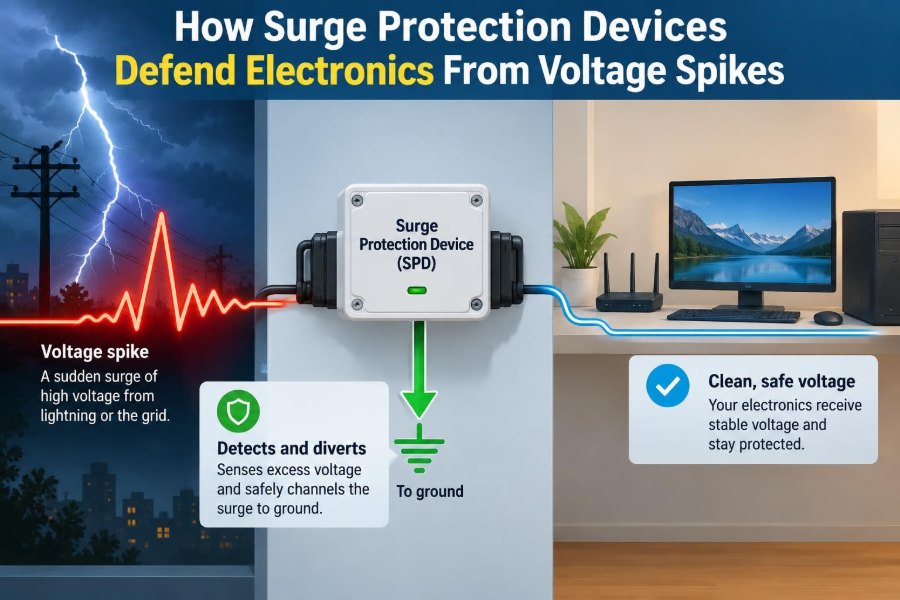
An SPD normally presents a high impedance during ordinary operating conditions. When voltage rises above its response threshold, it changes state and diverts surge current away from the protected circuit.
Its goal is to limit the voltage seen by downstream equipment to a level the equipment has a better chance of withstanding. This limited value is often described as the residual, clamping, or protection voltage.
The SPD does not “absorb all electricity.” It manages an abnormal event by steering current through an intended route, usually toward the protective earthing system.
🔀 6. Diversion, Clamping, and Crowbar Action
SPD technologies respond differently, but most can be understood through two broad behaviors. A clamping device gradually becomes more conductive as voltage rises, while a switching or crowbar device changes rapidly to a low-impedance state.
Clamping action is associated with components such as metal-oxide varistors. Spark gaps and gas discharge devices are examples of switching behavior.
Neither approach is universally best. Performance depends on surge environment, coordination, follow-current behavior, line voltage, and the equipment being protected.
🧩 7. Metal-Oxide Varistors
A metal-oxide varistor, or MOV, is widely used in AC power SPDs. At normal voltage it has high resistance; as its voltage threshold is exceeded, its resistance decreases sharply.
MOVs can respond quickly and handle substantial transient current when properly designed into an SPD. They are commonly used in plug-in strips, panel-mounted devices, and equipment input protection.
Each significant event can age an MOV slightly. Quality SPD designs include thermal protection or disconnection features because an overstressed MOV can fail and should not remain connected unsafely.
💨 8. Gas Discharge Tubes and Spark Gaps
Gas discharge tubes use a sealed gas-filled gap that ionizes when a sufficiently high voltage is applied. Once conducting, they can carry significant surge current with a low voltage drop.
They are useful in many telecommunications, RF, and power applications, particularly where high surge-current capability is valuable. Their ignition voltage and response characteristics must be considered carefully.
After operation, a discharge device may remain conductive briefly if the available supply current can sustain the arc. The circuit design must account for this possible follow current.
🔧 9. TVS Diodes for Sensitive Circuits
Transient-voltage-suppression diodes, often called TVS diodes, are semiconductor devices used close to sensitive electronic inputs. They can react very quickly and provide tightly controlled clamping compared with many larger protection technologies.
Their energy-handling capacity is generally lower than that of devices intended for building service entrances. For this reason, TVS diodes often form the final protection layer after larger upstream SPDs reduce most of the surge energy.
Designers use them on data ports, low-voltage rails, automotive electronics, and interface circuits where low residual voltage matters.
🏢 10. Protection Starts at the Service Entrance
The first major opportunity to manage incoming surge energy is near the electrical service entrance or main distribution point. An SPD at this location can divert a substantial portion of externally induced energy before it travels deeper into the installation.
This location is especially important where overhead lines, exposed sites, lightning protection systems, or critical building services increase surge exposure. It also reduces stress on downstream protective devices.
Service-level protection must be matched to the supply configuration, including voltage, number of phases, neutral arrangement, and earthing system.
🗂️ 11. Distribution Boards Need Their Own Layer
Surges can be generated inside a facility as well as arrive from outside. A device near a main switchboard cannot fully protect every circuit branch, especially when cable runs are long.
Installing SPDs at distribution boards provides another protective stage. This layer helps manage transients from local switching loads and reduces the voltage that can propagate toward final circuits.
In larger facilities, the electrical layout naturally supports a layered approach: main intake, distribution level, and protection near sensitive loads.
💻 12. Point-of-Use Protection Has a Role
A point-of-use SPD is installed close to the equipment it serves, such as a workstation, medical instrument, controller, or network rack. Its proximity can reduce the effect of wiring inductance between the device and the load.
Plug-in protectors can be useful, but only if they are appropriate for the installation and include a dependable earth connection where their design requires one. They should not be treated as the sole defense for an entire building.
For valuable equipment, point-of-use protection is best viewed as the final layer rather than a replacement for upstream protection.
🏰 13. Coordinated Protection Is the Core Strategy
Coordination means arranging SPDs so that each device handles the portion of a surge appropriate to its location and technology. A robust system does not expect one small device to handle every possible event.
An upstream SPD may take high-energy current, while a downstream device further lowers the remaining voltage. The final equipment-level protector then manages the residual transient at sensitive terminals.
Coordination also requires suitable separation, conductor routing, and device characteristics. Installing several random protectors does not automatically create a coordinated system.
📏 14. Voltage Protection Level Matters
An SPD begins conducting above a certain voltage, but it cannot reduce a surge to zero. During current flow, a voltage remains across the SPD and its connecting conductors.
The resulting voltage protection level must be compatible with the impulse withstand capability of downstream insulation and equipment. Lower is not always the only consideration; the device must also survive the expected surge environment.
Read product documentation as a complete set of performance information rather than focusing on one attractive number on a package.
🌊 15. Surge Current Ratings Describe Capability
SPDs are specified with surge-current and impulse-related ratings that indicate the test conditions they can withstand. These values help engineers compare devices intended for different installation locations and risk levels.
A larger rating does not automatically mean better protection at a sensitive load. It may indicate stronger energy-handling ability, while residual voltage, coordination, and installation quality determine the actual protection delivered.
Selecting an SPD requires both questions: can it survive the surge, and will it limit the voltage sufficiently for the protected system?
🔌 16. Select the Correct System Configuration
An SPD must match the electrical system. Single-phase, split-phase, three-phase, delta, wye, and systems with different neutral or earth arrangements require different connection schemes.
The device’s continuous operating voltage must suit the normal maximum system voltage. A device selected too close to ordinary operating voltage may age prematurely or operate unnecessarily.
Connection modes also matter. Depending on the system, protection may be needed line-to-neutral, line-to-earth, neutral-to-earth, or line-to-line.
🌍 17. Earthing Is Part of the Protection Path
An SPD cannot perform well without a low-impedance path to the earthing and bonding network. During a fast transient, impedance includes inductive effects, not merely the DC resistance measured by an ohmmeter.
Protective earthing, equipotential bonding, and sensible conductor routing help keep different exposed conductive parts and signal references from developing dangerous voltage differences.
Earth is not an infinite sink that magically removes all risk. It is part of a designed current-return path whose geometry and connections strongly affect transient performance.
📐 18. Short, Straight Leads Improve Results
Every length of connecting conductor adds inductance. When surge current rises rapidly, even a short lead can develop a meaningful voltage, increasing the voltage that reaches protected equipment.
Install SPD conductors as short and straight as practical, avoid unnecessary loops, and follow the manufacturer’s connection guidance. Neat routing is not just cosmetic in surge protection.
Long, tangled leads can undermine an otherwise capable SPD because the installation itself adds residual voltage. ⚙️
🧯 19. Overcurrent Protection and Safe Failure
An SPD may require a dedicated fuse, circuit breaker, or specified upstream protective device. This protection isolates the SPD if it fails or if a sustained abnormal condition causes excessive current.
It is important not to assume that any breaker size is acceptable. The required arrangement depends on the SPD design, available fault current, conductor size, and manufacturer instructions.
Thermal disconnection indicators are also valuable. They can show that an MOV-based unit has been disconnected after end-of-life stress, even though the circuit it once protected still has power.
👁️ 20. Status Indicators Must Be Checked
Many SPDs include LEDs, flags, alarms, or remote contacts. These features make it easier to identify a unit that has reached end of life or lost a protection mode.
A glowing power indicator alone may not prove that protection remains active. Users should understand what each status signal means and include inspection in maintenance routines.
For critical systems, remote monitoring contacts can report SPD condition to building management or supervisory systems before a protection gap goes unnoticed.
🧪 21. SPDs Are Tested for Specific Duties
Responsible selection relies on recognized product testing and installation requirements applicable in the local jurisdiction. These requirements address matters such as surge tests, safety, enclosure suitability, markings, and installation categories.
Engineers should verify that the selected device is suitable for its intended location and system rather than relying on generic marketing terms such as “heavy duty” or “lightning proof.”
Local electrical codes and the authority having jurisdiction govern installation details. When the consequences of failure are high, qualified electrical design and installation are essential.
🏭 22. Industrial Loads Create Internal Surges
Factories and commercial buildings often contain frequent transient sources: variable-speed drives, solenoids, welders, large motors, transformers, contactors, and switching power converters.
Suppressing transients at the source can complement panel-level SPDs. For example, suitable suppression across relay coils or contactor coils can reduce the transient generated when they are de-energized.
Equipment segregation also helps. Keeping sensitive instrumentation wiring away from noisy power conductors reduces coupling paths that an SPD alone may not address.
📡 23. Protect Data and Signal Lines Too
Power protection alone may not protect a connected system. A surge can enter through Ethernet, telephone, antenna, coaxial, fieldbus, sensor, or control wiring and then damage a device through its communication port.
Signal-line protectors must match the signal voltage, frequency, bandwidth, impedance, and grounding arrangement. An unsuitable protector can degrade communication or create unwanted leakage paths.
All incoming conductive services should be considered in the protection plan. Otherwise, protected power equipment may still be exposed through a data cable.
🏠 24. A Practical Approach for Homes and Small Offices
A layered approach remains useful at small scale. A correctly selected panel-level SPD can address incoming disturbances, while quality point-of-use protection can support particularly sensitive or valuable equipment.
Protect network equipment as a system. If a modem, router, switch, computer, and cable connection are electrically linked, protecting only one AC outlet may leave another entry path open.
After severe weather or a known electrical event, inspect indicators. Replace protectors that show fault or end-of-life status instead of assuming they remain effective.
⚠️ 25. Common Misunderstandings to Avoid
Several assumptions lead to weak protection designs:
- “A power strip protects everything.” It may protect only the outlets connected to it and may not address other incoming conductors.
- “A bigger rating solves every problem.” Energy capability and low residual voltage are different design goals.
- “The breaker will stop a surge.” Breakers respond far too slowly to limit a fast transient.
- “One SPD is permanent protection.” Some components degrade, and status must be monitored.
- “Grounding is optional.” Poor bonding and long leads can greatly reduce effectiveness.
Clear thinking about current paths is more useful than relying on a single product label.
🧭 26. A Simple Selection Workflow
Start by identifying the system and the equipment that matters most. Map every conductor that enters or connects between zones, including power, data, control, and antenna paths.
- Assess likely external and internal surge sources.
- Choose appropriate protection locations: entrance, distribution, and load.
- Match voltage, configuration, and connection modes to the electrical system.
- Check energy capability, voltage protection level, safety features, and coordination.
- Plan short connections, sound bonding, overcurrent protection, and inspection.
This workflow turns surge protection from an afterthought into an engineering decision.
✅ 27. The Core Principle: Control the Path and Limit the Voltage
The central idea is straightforward: an SPD protects electronics by giving surge current a deliberate, low-impedance path while limiting the transient voltage that reaches vulnerable equipment.
Effective results depend on layers, not a single component. Correct device selection, good earthing and bonding, short lead lengths, protection of signal paths, and ongoing status checks all contribute to the final outcome.
When surge energy is managed before it reaches sensitive circuits, electronics are far more likely to keep doing the job they were designed to do. 🛡️⚡🔌