
Your phone reaches full charge while you make coffee. A lift carries people several floors with a button press. Across town, a factory keeps motors turning at nearly constant speed while the electricity feeding it may have traveled hundreds of kilometers.
These ordinary moments depend on electrical systems making fast, tightly controlled decisions about voltage, current, frequency, heat, and safety. The results often feel invisible precisely because good engineering makes them reliable.
Electrical engineering is full of facts that sound surprising at first: power can move with almost no visible motion, a motor and generator are closely related, and a grid must balance supply and demand essentially as they happen. Understanding these ideas makes everyday technology—and the limits behind it—much easier to read.
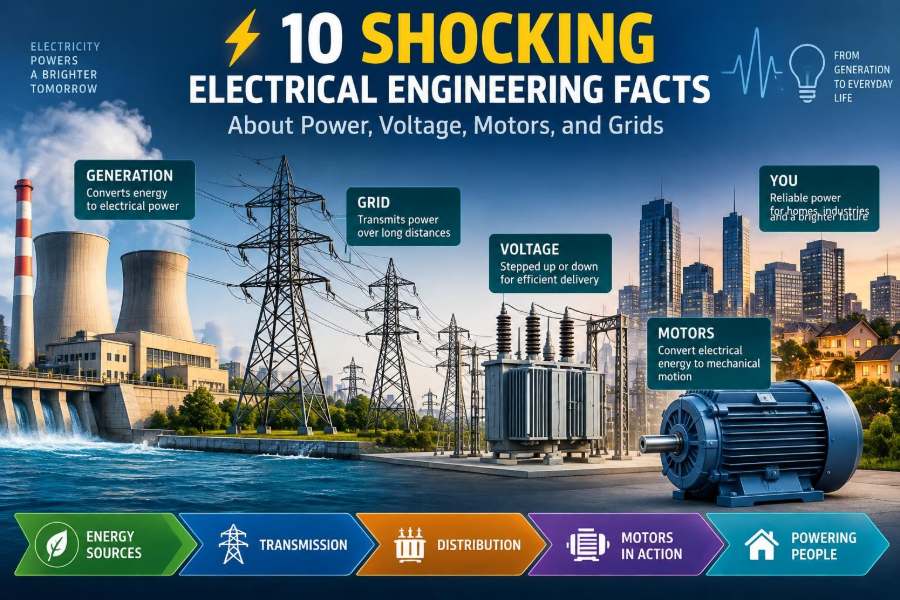
Here are ten connected facts about power, voltage, motors, and grids, broken down into the mechanisms that make them useful in the real world.
⚡ 1. Electricity Is Not the Same Thing as Energy
People often say that electricity “flows,” but electrical engineering separates several related quantities. Electrical energy is the capacity to do work, usually measured in joules or kilowatt-hours. Electric current is the movement of electric charge, measured in amperes.
A useful water analogy is limited but helpful: voltage resembles pressure difference, current resembles flow rate, and energy is the total amount delivered over time. A large current for a brief instant and a small current for many hours can both transfer meaningful energy.
This distinction explains why a battery label may state both voltage and capacity. Neither number alone tells the whole story of how long it can power a device.
🔋 Power Is the Rate of Energy Transfer
Power, measured in watts, tells us how quickly energy is being converted or delivered. A 60-watt lamp uses energy at roughly twice the rate of a 30-watt lamp when both operate under their intended conditions.
For direct-current circuits, the basic relationship is P = VI, where P is power in watts, V is voltage in volts, and I is current in amperes. Alternating-current systems add factors such as phase angle and waveform shape, but voltage and current remain central.
Your utility bill generally records energy, commonly in kilowatt-hours, not instantaneous power. Running a 2-kilowatt heater for one hour uses about 2 kilowatt-hours; running it for ten minutes uses much less energy even though its power rating is unchanged.
🌡️ 2. High Current Creates a Heat Problem
Every real conductor has resistance. When current passes through that resistance, some electrical energy turns into heat. This effect is described by Ploss = I²R: resistive loss rises with the square of current.
That squared relationship is a major engineering fact. Doubling the current through the same conductor produces four times the resistive heating, not twice as much. It affects wire sizing, connector design, transformer ratings, battery packs, and data-center power systems.
Heat is not automatically a failure. Toasters, electric heaters, and fuse elements use resistive heating deliberately. In cables, terminals, and motor windings, however, excess heat can degrade insulation and shorten equipment life.
📏 Wire Size Is a Thermal and Voltage-Drop Decision
A thicker wire generally has lower resistance per meter, so it wastes less power and warms less for a given current. But it is heavier, more expensive, and harder to route. Selecting conductor size is therefore a practical trade-off, not simply a rule to make every wire as large as possible.
Long cable runs introduce another issue: voltage drop. A device at the far end of a long, undersized cable receives less voltage while the cable itself dissipates energy. Motors may struggle to start, lights may dim, and sensitive electronics may behave unpredictably.
Installation rules depend on conductor material, insulation temperature rating, bundling, ventilation, ambient temperature, fault protection, and local electrical codes. Safe conductor selection should follow the applicable code and manufacturer data, not an online shortcut.
🏔️ 3. Transmission Lines Use High Voltage for a Powerful Reason
To transmit a fixed amount of power, engineers can choose high voltage and lower current, or lower voltage and higher current. Since line heating depends strongly on current, raising voltage allows the same power to travel with lower resistive loss.
For example, if voltage is increased by a factor of ten while delivering the same power, current is reduced by about a factor of ten. For the same line resistance, the I²R loss then becomes roughly one-hundredth as large. This is the basic reason transmission networks operate at voltages far above those used in homes.
High voltage is not free. It requires more insulation, larger clearances, carefully designed equipment, and control of effects such as corona discharge, where the electric field ionizes nearby air. Engineers choose voltage levels by balancing efficiency, cost, physical space, reliability, and safety.
🔄 Transformers Make AC Voltage Easy to Change
A conventional transformer uses changing magnetic flux to transfer energy between coils. Alternating current in the primary winding creates a changing magnetic field in a magnetic core, inducing voltage in the secondary winding.
The ratio of turns on the coils determines whether the transformer steps voltage up or down. Ideally, higher output voltage comes with lower output current in a corresponding proportion, so power is approximately conserved apart from losses.
This ability to transform voltage efficiently helped make AC systems practical for widespread power distribution. Modern grids also use power electronics extensively, especially where direct current, renewable generation, or variable-speed loads are involved.
🧲 4. Motors and Generators Share the Same Physics
An electric motor converts electrical energy into mechanical motion. A generator converts mechanical motion into electrical energy. Both rely on the interaction between magnetic fields and conductors carrying current.
In a motor, controlled currents and magnetic fields produce torque on a rotor. In a generator, moving a conductor through a magnetic field—or changing the magnetic field around it—induces a voltage. The two processes are closely related, which is why many machines can operate in both directions under suitable control.
This is more than a textbook curiosity. Electric vehicles use regenerative braking: during deceleration, the traction motor can act as a generator and return some kinetic energy to the battery. Recovery is limited by battery condition, traction, control strategy, and conversion losses, but it can reduce wasted energy.
🌀 Torque, Speed, and Power Are Different Motor Quantities
Torque is a twisting force, usually measured in newton-meters. Speed describes rotation, often in revolutions per minute. Mechanical power depends on both: a shaft can have high torque at low speed or lower torque at high speed.
A bicycle illustrates the distinction. Starting uphill needs substantial torque at the wheel, while moving quickly on level ground depends on sustaining power. Motors face the same reality, which is why gearboxes, drive electronics, and motor selection matter.
A motor nameplate gives useful limits, but it does not guarantee that every speed-and-torque combination is safe. Cooling, duty cycle, supply voltage, control method, and load inertia all affect real operation.
🧰 Induction Motors Run Much of Industry
Induction motors are widely used in pumps, fans, compressors, conveyors, and machine tools because they are robust and relatively simple. Their stator creates a rotating magnetic field. That field induces currents in the rotor, and the interaction produces torque.
The rotor must rotate slightly slower than the stator’s rotating field for induction to continue. This difference is called slip. It is not necessarily a defect; it is fundamental to conventional induction-motor operation.
Older systems often ran these motors directly from a fixed-frequency supply. Today, variable-frequency drives can control the motor’s applied frequency and voltage, allowing adjustable speed and often improving process control.
🎛️ Variable-Speed Drives Can Save Energy—When the Load Fits
Fans and centrifugal pumps are common candidates for variable-speed control. Reducing speed can dramatically reduce the required power because the fluid-flow relationships are nonlinear. In many cases, slowing the machine is more efficient than running it at full speed and throttling flow with a valve or damper.
That benefit is not universal. Some loads need nearly constant torque, some processes have minimum-speed requirements, and drives introduce their own losses, harmonics, cooling needs, and electromagnetic-compatibility concerns.
A good engineering question is not “Can this motor use a drive?” but “What does the load require across its operating range?” The answer determines whether variable speed genuinely improves energy use, reliability, or controllability.
📈 5. AC Frequency Is a Real-Time Health Signal for a Grid
In an interconnected AC power system, generators and large loads must remain closely coordinated. The system frequency—commonly 50 or 60 hertz depending on the region—reflects the balance between mechanical input to generators and electrical demand.
If demand suddenly exceeds generation, generators slow slightly and frequency tends to fall. If generation exceeds demand, frequency tends to rise. Grid operators and automated controls respond by adjusting generation, using stored energy, managing interconnections, or in severe conditions reducing load.
Frequency is therefore not merely a number printed on equipment. It is one visible sign of a continuously managed balancing act.
⚖️ Electricity Supply and Demand Must Balance Almost Instantly
Unlike water in a large tank, electricity in conventional grids is not usually stored in large quantities throughout the network. At every moment, generation, consumption, losses, and energy moving into or out of storage must be balanced closely enough to maintain stable operation.
Grid operators forecast demand using weather, time of day, season, and expected activity. They also plan for outages and unexpected changes. Fast-acting resources, reserve capacity, batteries, and responsive loads can all help manage short-term differences.
The challenge grows when weather-dependent generation changes quickly. That does not make wind or solar unusable; it means planning, forecasting, transmission, flexible resources, and system controls become more valuable.
🏭 Large Generators Add Inertia, but Modern Grids Need Other Fast Tools Too
Traditional synchronous generators have heavy rotating masses. Their stored rotational energy provides physical inertia, which naturally resists rapid frequency changes after a disturbance.
Many modern resources connect through power electronics rather than directly through large spinning generators. These inverter-based resources do not contribute inertia in exactly the same physical way, but their controls can respond very quickly when designed and configured to do so.
The engineering question is not whether one technology is always superior. It is how to maintain stable voltage, frequency, fault behavior, and recovery performance as the mix of generation and loads changes.
🌐 6. The Grid Is a Network, Not a Single Pipe
It is tempting to picture electricity traveling from the nearest power station directly to a home. Real transmission networks are meshed systems with many connected lines, substations, generators, and loads. Power flows according to network impedances and voltage angles, not according to a simple route chosen by an operator.
Opening or overloading one line can alter flows elsewhere. This is why system studies examine contingencies: engineers model what happens if a line, transformer, generator, or other critical component becomes unavailable.
Transmission capacity is constrained by more than conductor heating. Voltage limits, equipment ratings, stability margins, protection settings, and maintenance needs can all restrict how much power can safely move through part of a network.
🧭 Reactive Power Supports Voltage but Does Not Do Useful Work by Itself
In AC systems, some equipment stores and releases energy each cycle in electric or magnetic fields. Capacitors and inductors are the classic examples. This exchange is associated with reactive power, usually measured in volt-amperes reactive, or var.
Reactive power does not represent net energy delivered to heat a room or turn a shaft over a complete cycle. Yet it strongly affects voltage control and current levels, making it essential to system operation.
Motors and transformers often need magnetizing current, while capacitor banks and other compensating devices can help support voltage locally. The right solution depends on the network; indiscriminately adding capacitors can create overvoltage or resonance problems.
📐 Power Factor Explains Why Amps Alone Can Mislead
For sinusoidal AC conditions, real power can be approximated by P = VI × power factor in a single-phase system. Power factor describes how effectively apparent power—volt-amperes—is converted into real power.
A low power factor can mean more current is required to deliver the same useful power, increasing losses and demanding more from cables and transformers. It can result from phase shift, waveform distortion, or both.
Modern electronic loads complicate the simple textbook picture because their current waveforms may not be sinusoidal. Engineers may evaluate displacement power factor, total power factor, and harmonics rather than relying on one oversimplified number.
🔌 7. Plugs Are Not Just Smaller Versions of Power Lines
Household wiring is designed around a specific nominal voltage, frequency, grounding arrangement, connector type, protective devices, and expected load range. These details vary by country and installation standard.
A plug and socket system must prevent accidental contact with live parts, maintain reliable connection pressure, limit overheating, and coordinate with circuit protection. Adapter convenience does not guarantee electrical compatibility.
Before connecting equipment across regions, check the device input rating. Many electronic chargers accept a wide voltage range, while heaters, older appliances, and motor-driven products may require the correct supply voltage and frequency.
🛡️ Grounding and Bonding Serve Different but Related Jobs
Grounding connects parts of an electrical system to earth or an established reference point. Bonding connects conductive parts together so they remain at nearly the same electrical potential. Terminology and exact practices vary by code, but the distinction is useful.
Protective bonding helps ensure that if a live conductor faults to an exposed metal enclosure, a sufficiently large fault current can flow to operate a fuse or circuit breaker quickly. Earth itself is not a dependable low-impedance fault path in many installations.
Grounding does not make unsafe work safe. De-energizing, locking out energy sources, verifying absence of voltage with appropriate methods, and following qualified procedures remain essential in professional settings.
🚨 8. Circuit Breakers Protect Wiring, Not Every Device
A breaker or fuse is selected primarily to protect conductors and equipment from excessive current under defined fault and overload conditions. It does not necessarily detect every dangerous situation, every arc, or every failure inside an appliance.
Different protective devices address different hazards:
- Fuses and circuit breakers respond to excessive current.
- Ground-fault or residual-current devices can detect unintended current paths and disconnect rapidly under specified conditions.
- Arc-fault protective devices are intended to identify patterns associated with certain hazardous arcing conditions.
- Surge protective devices limit transient overvoltage but cannot make all equipment immune to surges.
Protection must be coordinated. A device with the wrong rating may trip unnecessarily, fail to clear a fault as intended, or allow conductors to overheat.
🔥 Loose Connections Can Be More Dangerous Than Obvious Overloads
A loose terminal, damaged plug, corroded contact, or worn connector can create a small area of high resistance. Current through that resistance produces localized heat, sometimes without drawing enough current to trip the upstream breaker promptly.
Warning signs include discoloration, a hot outlet or plug, crackling, a burning smell, intermittent operation, or repeated tripping. These are reasons to stop using the affected equipment and have the cause assessed by a qualified person.
Never “fix” a tripping circuit by fitting a larger fuse or breaker without verifying conductor size, load, and fault conditions. That can remove the protection margin the installation was designed to provide.
🌩️ 9. Voltage Surges Are Brief but Can Be Damaging
A surge is a short-duration increase in voltage. Lightning, switching of inductive loads, utility disturbances, and faults can produce transients that travel through electrical systems. Their duration may be brief, but sensitive electronics can still be affected.
Surge protection is usually layered. Service-level devices can reduce large incoming transients, while point-of-use protection can help protect sensitive equipment closer to the load. Good bonding and correct installation are critical to performance.
No surge protective device is a universal shield. A nearby lightning event, poor grounding arrangement, degraded components, or an unprotected signal cable can still create damage paths. Critical facilities use coordinated protection and maintenance rather than relying on one plug-in strip.
🔊 Harmonics Can Make a Clean-Looking Waveform Less Clean
An ideal AC supply is represented as a smooth sine wave. Nonlinear devices, including many electronic power supplies, variable-speed drives, and LED drivers, can draw current in pulses rather than in a smooth sine pattern. These distortions are called harmonics.
Harmonics can increase heating in conductors and transformers, interfere with equipment, and complicate capacitor-bank performance. They are not automatically harmful at every level; the concern depends on magnitude, system impedance, equipment sensitivity, and the network design.
Engineers measure waveform quality and may use filters, line reactors, multi-pulse arrangements, active front ends, or better load distribution. The appropriate remedy begins with measurement, not guesswork.
🔋 10. Batteries Store Chemical Energy, Not “Electricity” in a Tank
A battery stores energy through electrochemical reactions. When connected to a load, those reactions create a voltage difference that drives current through the circuit. Its behavior changes with temperature, state of charge, age, discharge rate, and internal resistance.
Battery capacity is often expressed in ampere-hours, but energy depends on voltage as well. Comparing packs only by ampere-hours can mislead when their nominal voltages differ. Watt-hours give a more direct energy comparison.
As a battery supplies high current, internal resistance causes voltage drop and heat. This is one reason a battery may perform differently in a high-power tool than in a low-power sensor, even if the nominal capacity sounds substantial.
🧪 Battery Management Is a Safety and Longevity System
Lithium-ion battery packs commonly use a battery management system, or BMS, to monitor cell voltages, temperature, current, and operating limits. Cells in a series string must be managed carefully because one weak or overcharged cell can limit the pack.
The BMS may balance cells, stop charging or discharging outside permitted ranges, and communicate with a charger or host device. It cannot overcome physical damage, incompatible chargers, poor thermal design, or misuse.
Use chargers specified for the battery system, avoid damaged packs, and follow manufacturer instructions for storage and disposal. Battery repairs and modifications can involve serious electrical, chemical, and fire risks.
🌞 Power Electronics Are the Translators of Modern Energy Systems
Solar panels produce DC, batteries store DC, many loads use DC internally, and the grid is often AC. Power electronics—converters, inverters, rectifiers, and controllers—translate between these forms while controlling voltage, current, and frequency.
An inverter can create AC from DC; a rectifier converts AC to DC. A modern motor drive can rectify incoming AC, create a controlled DC link, and synthesize a variable-frequency AC output for the motor.
These systems enable efficient control, but switching devices create heat and electromagnetic noise. Their design includes filters, isolation where needed, protective functions, thermal management, and carefully written control software.
🧠 Measurement Changes the Quality of Troubleshooting
Electrical faults often look similar from the outside. A motor that will not start might have a mechanical jam, an undervoltage condition, a failed control signal, a damaged winding, an open protective device, or an incorrect drive setting.
Good troubleshooting moves from safe, simple checks toward more specific tests. It uses drawings, nameplate data, visual inspection, verified measurements, and an understanding of normal operating behavior.
- Measure voltage at the equipment, not only at the source.
- Compare current across phases where appropriate.
- Check connections for heat damage and correct torque procedures.
- Use instruments rated for the environment and expected fault category.
- Record conditions before changing settings or replacing parts.
Measurements must be made safely by competent people. A meter on the wrong range, a damaged test lead, or an unsuitable measurement category can create a serious hazard.
📚 The Core Principle: Electrical Systems Are About Controlled Trade-Offs
The surprising facts of electrical engineering connect through a small set of principles. Higher voltage can reduce transmission current, but demands stronger insulation. Faster motor control can improve a process, but adds converter complexity. Storage can support the grid, but has finite energy and thermal limits.
Reliable systems do not come from maximizing a single number. They come from balancing efficiency, cost, controllability, maintenance, fault behavior, safety, and environmental conditions. That mindset applies equally to a phone charger, an industrial drive, and a regional power network.
When you see a watt rating, a high-voltage line, a spinning motor, or a breaker panel, look for the underlying question: where is energy going, how is it controlled, and what protects the system when conditions change?
Electrical engineering becomes far less mysterious when power, voltage, current, magnetism, and protection are seen as one connected system of energy conversion and control. ⚡🔧🌐