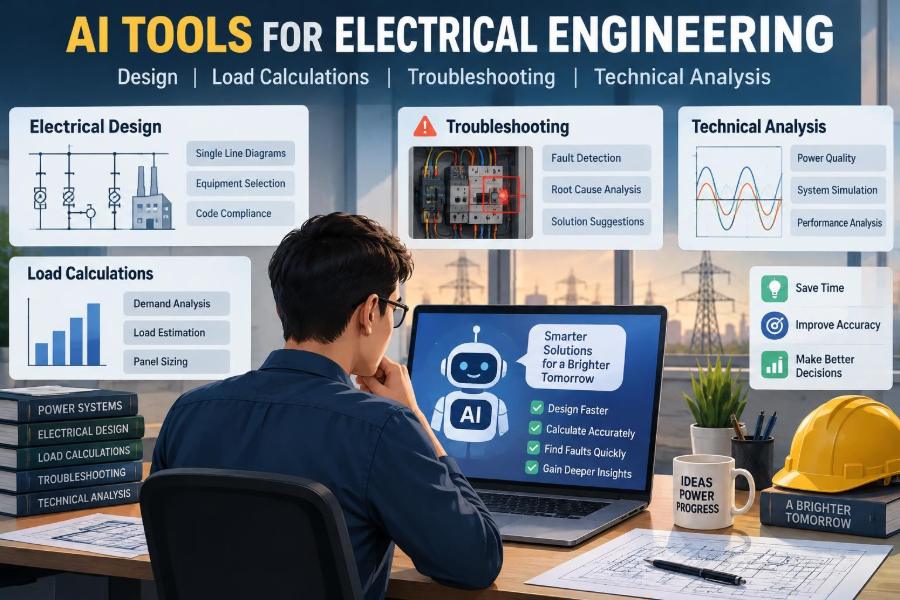

A design review is due in the morning. The panel schedule has changed twice, the motor list now includes a larger pump, and someone has sent a photo of a tripped breaker with almost no context. The familiar question is not whether there is enough work to do; it is where to start.
Electrical engineers and technicians already use powerful software: CAD platforms, calculation packages, power-system models, instrument software, and spreadsheets. Artificial intelligence tools add another layer. They can help organize inputs, draft calculations, explain waveforms, search a large document set, and turn a rough fault description into a sensible investigation plan.
That does not make AI an engineer of record, a protection specialist, or a qualified person under a safety program. Electrical work has consequences that range from nuisance downtime to fire, arc-flash injury, equipment damage, and loss of critical service.
The useful question is therefore not, “Can AI do electrical engineering?” It is, “Which parts of electrical work become clearer, faster, and more reliable when AI is used with verified inputs and professional judgment?”
⚙️ Start With the Right Definition of an AI Tool
In this context, an AI tool is software that can interpret language, recognize patterns in data or images, generate drafts, classify information, or assist decisions. A conversational assistant is one type, but not the only one.
Useful tools may be embedded in familiar products: document search systems, spreadsheet assistants, anomaly detectors, computer-vision inspection systems, or simulation environments with automated optimization. Their value comes from the task they improve, not from the AI label.
🧭 Separate Assistance From Engineering Authority
AI can prepare a first-pass panel schedule, extract ratings from equipment datasheets, or suggest why a variable-frequency drive faults during acceleration. It cannot establish responsibility for the design, confirm field conditions, or approve a safety-critical setting.
The accountable engineer or qualified technician must remain able to explain, reproduce, and defend the final decision. Treat AI output as a junior assistant’s draft: potentially useful, sometimes insightful, and always subject to review.
📋 Identify Tasks That Actually Benefit
The strongest early applications are repetitive, text-heavy, data-heavy, or comparison-heavy tasks. These are often bottlenecks because the engineering reasoning is simple but the amount of material is large.
- Converting equipment lists into structured load schedules
- Checking whether naming conventions are consistent across drawings
- Summarizing fault logs, relay event reports, or maintenance notes
- Creating calculation templates and review checklists
- Explaining a technical concept at the level needed by a client or trainee
Tasks requiring a site observation, measurement, code interpretation in a specific jurisdiction, or a final protective-device setting need much tighter human control.
🧱 Build a Trustworthy Input Package First
An AI system cannot repair a project with conflicting source data simply by sounding confident. Before requesting a calculation or analysis, assemble the source voltage, frequency, grounding arrangement, conductor data, equipment ratings, operating modes, ambient conditions, and applicable design basis.
State what is known, what is assumed, and what is missing. For example, “motor full-load current is from the nameplate” is different from “motor current estimated from rated kW and an assumed efficiency.” This distinction makes a result reviewable.
🔒 Protect Drawings, Data, and Client Information
Single-line diagrams, protection settings, building plans, process descriptions, and outage records can contain confidential or security-sensitive information. Do not paste them into a public tool without understanding the organization’s data-handling rules.
Practical safeguards include removing client identifiers, excluding network addresses and credentials, using approved enterprise environments, and uploading only the pages needed for the task. A useful prompt should be specific, but it does not need to expose a complete facility.
🧮 Use AI to Organize Load-Calculation Inputs
Load calculations begin with correct categorization. AI is particularly good at converting a messy equipment register into columns such as connected load, duty, starting method, continuous operation, standby status, voltage, phase, and power factor.
It can also flag ambiguous entries. A row reading “heater 12” might mean twelve heaters, a 12 kW heater, or a heater tagged H-12. That flag is valuable because silent interpretation is a common source of spreadsheet error.
🔢 Keep the Electrical Equations Visible
AI may generate formulas, but the governing relationships should remain visible in the workbook or calculation note. For a balanced three-phase load, real power is commonly related to line voltage and current by:
P = √3 × VL-L × I × PFFor a simple single-phase load, the corresponding relationship is:
P = V × I × PFThese equations do not by themselves determine feeder size, service capacity, or protective-device ratings. Demand, diversity, continuous loading requirements, temperature correction, installation method, motor starting, harmonics, and governing rules may all affect the design.
📈 Apply Demand and Diversity With Care
Connected load is the sum of nameplate or assigned loads. Maximum demand is the load expected to operate simultaneously under the design scenario. Diversity recognizes that different loads may peak at different times.
AI can help create scenario tables: normal operation, peak production, emergency operation, future expansion, and maintenance bypass. It should not invent demand factors. Those factors must come from applicable rules, measured operating data, a documented operating philosophy, or a defensible engineering assumption.
🏭 Model Operating Modes Instead of One “Worst Case”
A facility rarely has one permanent load state. A pumping station may alternate pumps; a commercial building may have daytime cooling peaks and nighttime battery charging; a plant may have a maintenance mode that energizes unusual combinations of equipment.
Ask the tool to organize each mode separately, then review which one governs the transformer, generator, feeder, or switchboard decision. A single inflated total can conceal the real operational question.
🔌 Check Motors, Drives, and Starting Conditions
Motors deserve separate treatment because running load and starting behavior are different problems. A motor starter can impose high current during acceleration, while a variable-frequency drive may limit starting current but introduce harmonic considerations.
AI can produce a motor schedule and identify simultaneous-starting scenarios, but it needs the actual starting method, sequence, driven-load behavior, and source impedance. A large motor starting across the line on a weak source may cause an unacceptable voltage dip even when steady-state capacity looks adequate.
🔋 Treat Backup Power as a Dynamic Problem
Generator and UPS sizing depend on more than the sum of critical loads. Motor starting, rectifier input characteristics, step-load response, battery autonomy, bypass arrangements, and load-shedding priorities all matter.
A useful AI-assisted workflow is to convert a narrative emergency plan into a staged load table: what starts immediately, what starts after a delay, what can be shed, and what must never drop. The final sizing still requires manufacturer data and the relevant transient or coordination analysis.
📐 Create Transparent Spreadsheet Templates
AI is effective at drafting spreadsheet structures, formulas, data-validation rules, and conditional-formatting checks. This saves time when a team needs a consistent load list or voltage-drop register.
However, a generated workbook must be tested with known cases. Check units, locked references, blank-cell behavior, phase allocation, and whether a formula treats kW, kVA, and kvar correctly. A polished spreadsheet with one wrong cell reference can spread an error through an entire design.
🗺️ Turn Single-Line Diagrams Into Review Questions
Rather than asking an AI tool to “approve” a single-line diagram, use it to generate a structured review. It can ask whether each transformer secondary has an identified grounding method, whether source ratings are shown, whether isolating means are clear, and whether normally open ties are identified.
This approach improves coverage without pretending that image interpretation is complete. Small annotations, revision clouds, and symbol conventions are easy for automated systems to miss.
⚡ Support Short-Circuit Study Preparation
Short-circuit calculations require accurate source and equipment data: utility fault contribution or equivalent source impedance, transformer impedance, conductor lengths and characteristics, motor contribution where relevant, and network topology. AI can help build a data-request list and spot missing fields.
It can also explain why available fault current varies by location. Close to a strong source, conductor impedance is low and fault current may be high. Farther downstream, impedance limits current, which can make protective-device sensitivity more difficult.
🛡️ Never Delegate Protection Coordination Decisions
Protection coordination aims to isolate a fault with the smallest practical interruption of service while maintaining equipment protection and safety. It involves time-current curves, breaker and fuse characteristics, relay settings, equipment withstand ratings, and system operating arrangements.
An AI assistant can summarize curve terminology or help format a settings review sheet. It should not independently select final settings. An apparently reasonable adjustment can compromise selectivity, damage protection, or create a dangerous clearing-time condition.
🌡️ Use AI for Voltage-Drop and Thermal Sanity Checks
Voltage drop is influenced by current, conductor impedance, circuit length, conductor material, temperature, power factor, and AC effects in larger conductors. Thermal performance also depends on ampacity corrections, grouping, enclosure conditions, and installation method.
AI can compare several design alternatives and clearly state the assumptions behind each one. It should not substitute generic conductor values for verified manufacturer data or the values required by the calculation method being used.
🧩 Compare Design Alternatives More Systematically
Many electrical decisions involve trade-offs rather than one obvious answer: copper versus aluminum conductors, distributed versus centralized UPS systems, radial versus selective distribution, or an oversized feeder versus later expansion work.
Ask for a decision matrix that separates technical criteria from commercial assumptions. Useful columns include installation complexity, voltage drop, fault level, maintainability, losses, space, expansion flexibility, and operational consequence of failure. The matrix clarifies choices; it does not assign the priorities for the project.
📚 Search Standards and Manuals Responsibly
Document-aware AI tools can rapidly locate passages in equipment manuals, project specifications, and approved internal procedures. This is valuable when a technician needs the correct terminal diagram or an engineer needs to find a stated environmental limitation.
For codes and standards, verify the edition, jurisdiction, adoption status, and exact clause in the authoritative document. AI summaries may omit exceptions, definitions, footnotes, or conditions that change the answer.
🧠 Ask Better Technical Questions
Output quality improves sharply when the prompt establishes the engineering context. Instead of asking, “Why is this breaker tripping?”, provide observable facts and ask for ranked hypotheses.
- Equipment type, rating, and protective-device trip indication
- When the event occurs: start-up, steady load, rain, changeover, or heat
- Recent modifications, alarms, measurements, and visible damage
- What has already been tested and what was found
- Requested output: safe next checks, likely causes, or a fault tree
Request that the tool list assumptions and identify data that would change its conclusion.
🔍 Use Fault Trees for Troubleshooting
A fault tree starts with an observed failure and branches into possible causes. For a motor that will not start, branches might include loss of supply phase, control-circuit failure, overload trip, permissive not satisfied, mechanical jam, starter defect, or drive fault.
AI can draft this tree quickly and suggest discriminating tests: measurements or observations that separate one cause from another. The technician should then choose tests consistent with the equipment documentation, isolation requirements, and safe-work procedure.
📊 Interpret Logs Before Chasing Components
Modern drives, relays, building-management systems, and power meters record events with timestamps. An AI tool can sort event sequences and identify patterns, such as an undervoltage alarm immediately preceding several contactor drops.
Time correlation is not proof of causation. Clock synchronization may be poor, logs may be incomplete, and one upstream disturbance can create many downstream messages. Use the event order to guide measurement, not to close the investigation prematurely.
📉 Detect Power-Quality Clues
Power-quality analysis may involve voltage sag, swell, interruption, imbalance, transients, flicker, and harmonic distortion. AI can help classify waveform features and turn a large monitoring dataset into a concise list of suspicious intervals.
Interpretation remains contextual. A sag coinciding with motor start may be expected within a system’s tolerance; repeated sags affecting controls may indicate a source, conductor, or starting-sequence problem. Measurement location and instrument configuration matter as much as the graph.
📷 Treat Image-Based Inspection as Screening
Thermal images and photos can reveal loose connections, overloaded terminations, corroded equipment, damaged insulation, missing labels, or poor housekeeping. Computer vision can prioritize images that deserve attention, especially in large inspection programs.
But temperature alone does not establish severity. Load current, emissivity, viewing angle, ambient conditions, comparison with similar components, and equipment duty all affect interpretation. A qualified inspector must confirm any actionable finding.
🧾 Generate Useful Field Documentation
After a maintenance task or fault investigation, documentation often receives less attention than the repair. AI can turn notes, readings, and photographs into a draft report with equipment identification, symptom, tests performed, findings, corrective action, and recommended follow-up.
Keep the original readings and observations traceable. Avoid wording that implies a root cause has been proven when the team has only identified a likely cause.
🗣️ Improve Communication Across Disciplines
Electrical issues often need explanation for mechanical engineers, operators, project managers, and clients. AI can rewrite a technical conclusion at different levels without losing the main limitation or risk.
For example, “the feeder has inadequate ampacity under the stated installation conditions” can be translated into operational language: the cable may overheat if the added load is operated continuously, so the design needs revision before installation. The engineer should review the translation for accuracy and appropriate caution.
🎓 Use AI as a Learning Partner, Not an Answer Key
Students and early-career professionals can ask for a step-by-step explanation of per-unit systems, symmetrical components, transformer vector groups, or relay logic. A good learning prompt asks the tool to show assumptions, provide a small worked example, and then ask a check question.
Do not accept an answer merely because the equations look familiar. Rework the problem independently, check dimensions, and compare with a textbook, instructor, manual, or trusted calculation tool. Learning occurs in the verification, not in copying the output.
🚩 Watch for Hallucinations and False Precision
AI systems can produce convincing but incorrect details, including nonexistent clauses, incorrect equipment capabilities, and fabricated numerical certainty. This behavior is often called hallucination: generated content that is plausible in form but not supported by the provided information.
Warning signs include unexplained constants, an exact setting without a source curve, a standard reference you cannot find, or a conclusion that ignores a stated constraint. Confidence in the wording is not evidence of correctness.
✅ Establish a Verification Workflow
A disciplined review process makes AI assistance much safer. The process can be lightweight for a draft email and rigorous for a protection study, but the principle is unchanged.
- Define the decision the output will support.
- Validate source inputs and units.
- Review assumptions, exclusions, and operating scenario.
- Recalculate critical values independently or in validated software.
- Check against drawings, manufacturer information, and governing requirements.
- Record reviewer, revisions, and final basis of design.
The higher the safety, financial, or operational consequence, the more independent the verification should be.
🧰 Choose Tools by Workflow, Not Hype
A practical toolkit may include a general language assistant for drafting and explanation, a spreadsheet assistant for data cleanup, a document-search tool for approved manuals, a power-system package for formal studies, and specialized monitoring software for equipment data.
There is no requirement to use one platform for every problem. In fact, separating functions can improve traceability: the AI organizes and explains, while the validated engineering software performs the formal calculation.
👥 Define Review Roles in a Team
Teams avoid confusion when they define who prepares data, who checks calculations, who validates field information, and who approves the final deliverable. AI-generated material should be identified internally as draft assistance where that helps reviewers focus their effort.
Senior reviewers should not simply correct outputs. They should teach the reason behind corrections, such as why a neutral-load assumption fails for nonlinear loads or why a protective setting cannot be selected from full-load current alone.
🧪 Begin With Low-Risk Pilot Projects
Start where the output is easy to check and the consequence of error is limited. Examples include converting archived maintenance notes into a searchable format, drafting commissioning checklists, or cleaning a noncritical equipment register.
Measure success in practical terms: less time spent locating information, fewer transcription mistakes found during review, clearer reports, or more complete checklists. Expand only after the team understands the tool’s failure modes and review burden.
🌐 Recognize What AI Cannot See
Electrical systems exist in physical environments. A model does not feel a loose lug, hear a bearing change, see water entering a pull box, or notice that an operator routinely bypasses an interlock to keep production moving.
Field observation, safe measurement, operating history, and human experience remain essential. AI can help convert those observations into hypotheses, but it cannot replace the evidence gathered by competent people.
🎯 The Core Principle: Accelerate Thinking, Not Accountability
The best use of AI in electrical engineering is to remove low-value friction: sorting data, drafting structures, finding relevant passages, comparing options, and organizing troubleshooting evidence. That leaves more time for the work that requires engineering judgment.
Use AI when it makes the reasoning more visible and the review more thorough. Step back when it hides assumptions, introduces unsupported details, or encourages a decision that cannot be independently checked.
AI is most useful when it strengthens a verified engineering workflow rather than becoming a shortcut around one. Used that way, it can make design, analysis, documentation, and troubleshooting more deliberate—not merely faster. ⚡🧰📐