
A graduate accepts a job offer that looks strong on paper, then discovers that a former classmate in a different electrical specialization earns more with similar years of experience. Another engineer leaves a comfortable design-office role for field commissioning, trading predictable hours for travel allowances, overtime, and faster technical growth.
These comparisons can be frustrating because “electrical engineer salary” is not one market. A protection engineer, PLC programmer, solar design engineer, and semiconductor test engineer may all share an electrical engineering degree, yet their work, risk, location, and compensation structure can be very different.
The useful question is not simply which title pays the most. It is which combination of specialization, industry, responsibility, location, and working conditions fits your skills and career goals.
This guide compares power, automation, and renewable-energy paths without pretending that one salary figure applies everywhere. Pay changes by country, employer, project cycle, credentials, and the total value of the package—not just the number on a monthly payslip.
⚙️ Electrical Engineering Is a Broad Salary Market
Electrical engineering covers systems that generate, convert, transmit, control, measure, and use electrical energy. That breadth creates several labor markets under one degree title.
Utilities need engineers who understand reliability and grid rules. Manufacturers need automation engineers who can keep production moving. Renewable developers need people who can turn an energy concept into an operating plant. High-tech employers may need embedded, hardware, or test engineers instead.
Salary differences often reflect the cost of errors. A design flaw in a low-voltage panel may be contained locally; a protection setting error, major plant shutdown, or unsafe energization can have far wider consequences.
💵 Start With Total Compensation, Not Base Salary
Base salary is only one part of what a role pays. Engineers comparing offers should also examine bonuses, overtime rules, retirement contributions, health coverage, travel reimbursements, training support, and paid leave.
A commissioning role may offer a moderate base but substantial site allowances and paid travel. A utility role may have steadier hours, stronger benefits, and a pension structure that is valuable over many years. Conversely, a high base can lose appeal if it comes with unpaid overtime, expensive relocation, or irregular contract work.
- Ask whether bonuses are contractual, discretionary, or tied to project performance.
- Separate reimbursed expenses from genuine income.
- Check whether overtime, on-call work, and weekend callouts are paid.
- Compare take-home pay only after considering local tax and living costs.
📍 Location Can Change the Meaning of a Good Offer
Pay tends to rise in regions with high housing costs, scarce specialist talent, demanding project schedules, or major industrial activity. But a larger salary in a costly city or remote location does not automatically produce more disposable income.
Grid expansion, data-center construction, mining, oil and gas operations, advanced manufacturing, and large renewable build-outs can create local demand spikes. These opportunities may be temporary, so it is wise to assess whether the experience remains useful after a project ends.
Remote sites can pay premiums because they require travel, rostered work, isolation, or difficult weather. For some engineers that trade-off is attractive; for others, predictable family time matters more than the premium.
🏢 Employer Type Shapes Both Pay and Career Risk
Utilities, engineering consultants, equipment manufacturers, construction contractors, system integrators, and project developers use electrical engineers differently. Their compensation models follow their business models.
Utilities often value long-term reliability, formal training, and operational discipline. Contractors and integrators may reward delivery speed and site capability. Product companies may pay for specialized design expertise that improves a repeatable product rather than a single project.
There is no universal ranking. A well-funded specialist firm can outpay a large utility, while a public-sector or regulated employer may offer stability that a project-driven business cannot match.
🧭 The Main Reasons One Role Pays More Than Another
Higher pay usually follows a combination of scarcity, accountability, commercial impact, and inconvenience. It is rarely awarded simply because a title sounds advanced.
Employers commonly pay more when an engineer can independently make difficult technical decisions, sign off work within an approved authority structure, lead critical troubleshooting, or prevent expensive downtime. They may also pay more for travel, hazardous environments, shift work, customer-facing pressure, or hard-to-find software and domain knowledge.
The strongest salary leverage comes from being useful in a problem that is both expensive and difficult to solve.
🔌 Power-System Engineering: A Stable Core Path
Power-system engineers work with generation, transmission, distribution, substations, industrial networks, and increasingly the connection of distributed energy resources. Their work can include load flow, fault studies, equipment selection, protection coordination, grounding, and network planning.
Power roles are often attractive because electricity infrastructure must operate continuously. The work is shaped by long asset lifecycles and strict safety practices, which can favor engineers who build deep knowledge over time.
Entry-level pay may not always lead every engineering niche, but experienced power engineers can develop valuable authority in areas where errors have serious operational and safety consequences.
🛡️ Protection and Control Often Commands a Premium
Protection and control engineers design and test systems that detect abnormal electrical conditions and isolate faults. They work with relays, circuit breakers, instrument transformers, logic schemes, communications, and settings documentation.
This specialization can pay well because it combines analysis with practical consequences. A relay setting must coordinate with the wider system; it cannot be treated as an isolated spreadsheet exercise. Engineers also need to understand how equipment behaves during faults and how tests confirm the intended response.
Senior roles may involve outage planning, commissioning support, peer review, and responsibility for changes to energized networks. Those demands create a higher barrier to independent practice than many general design tasks.
🏗️ Substation Design Rewards Multidisciplinary Judgment
Substation engineers coordinate primary equipment, protection, control buildings, cable systems, grounding, civil interfaces, communications, and construction constraints. The drawings must work not only electrically but also physically on a real site.
Compensation can grow as an engineer becomes able to lead a complete package: developing specifications, resolving vendor questions, managing interfaces, and supporting construction. This is especially true where schedules are tight and replacement equipment has long lead times.
However, not every substation role is equally paid. Repetitive drafting support and routine drawing production generally offer less leverage than technical ownership of design decisions and site issues.
📊 Grid Studies Build High-Value Analytical Skills
Grid studies engineers use specialized software and network models to assess voltage performance, fault levels, stability, harmonics, protection coordination, and generator or inverter connections. Their conclusions can determine whether a project connects, what equipment is required, and what operating limits apply.
This work is valuable because it sits near investment decisions. For example, a proposed industrial load or solar plant may need network reinforcement if studies show unacceptable voltage or fault-duty impacts.
The limitation is that software proficiency alone is not enough. Employers value engineers who can explain assumptions, identify weak input data, and turn technical results into practical design recommendations.
🏭 Automation Engineering Can Pay Well Through Downtime Avoidance
Automation engineers design and support systems that control machines and processes. Typical technologies include programmable logic controllers, or PLCs, human-machine interfaces, industrial networks, variable-speed drives, sensors, and safety systems.
In a factory, a production line stopped for a few hours can waste materials, delay shipments, and consume maintenance resources. An engineer who can diagnose a controls fault safely and quickly has direct commercial value.
Automation pay is particularly competitive in sectors where uptime is costly: process plants, logistics centers, pharmaceuticals, food production, automotive manufacturing, and large facilities with complex material handling.
🧠 PLC Programming Is Valuable, but Context Matters
PLC programming is often a gateway into automation, but its salary potential depends on the kind of systems involved. Modifying a simple machine sequence is different from designing a redundant control architecture for a continuous industrial process.
Higher-value work usually includes understanding process behavior, alarm philosophy, functional safety, instrumentation, network reliability, and commissioning. An engineer who can ask why a pump is tripping—not merely change code to suppress an alarm—has broader value.
Building familiarity with more than one vendor platform can help, but chasing every software package can dilute expertise. Depth in a target industry is often more useful than a long list of introductory certificates.
🧪 Process Control and Instrumentation Add Scarcity
Process control engineers work with measurements such as pressure, flow, temperature, level, speed, and composition. They connect physical processes to control loops and operator decisions.
These roles can pay strongly in industries where poor control affects quality, energy use, safety, or environmental compliance. Tuning a loop is not merely a mathematical exercise; sensor placement, valve behavior, process delay, and operating procedures all matter.
Engineers who understand both electrical controls and process fundamentals can bridge teams that otherwise speak different technical languages. That ability becomes especially valuable during startup, troubleshooting, and plant modifications.
🦺 Functional Safety Carries Serious Responsibility
Functional safety concerns systems designed to reduce risk when normal control fails. Examples include emergency shutdown functions, safety instrumented systems, machine guards, and safety-rated control circuits.
Because safety work requires disciplined design, verification, documentation, and management of change, experienced practitioners can command higher compensation. The work also has limits: no individual should present themselves as authorized for a safety role without the appropriate competence, employer process, and local requirements.
For engineers interested in this path, strong fundamentals in risk assessment, control logic, testing, and documentation are more durable than treating safety as a short-course credential alone.
🔧 Commissioning Pays for Pressure and Practical Skill
Commissioning engineers bring equipment and systems from installation to safe operation. They inspect wiring, verify signals, test interlocks, energize equipment in stages, troubleshoot faults, and document acceptance.
This work frequently pays a premium because it occurs under schedule pressure and may require travel, shutdown windows, long shifts, or rapid decisions on site. It also develops practical judgment that is difficult to gain solely in an office.
The trade-off is real. High travel intensity can disrupt personal life, and project peaks can be exhausting. Before accepting a role, ask how often commissioning occurs, how travel is scheduled, and whether recovery time is protected.
🌞 Solar Engineering Has Several Different Salary Tracks
“Solar engineer” can mean development support, electrical design, interconnection studies, procurement, construction management, operations, or performance analysis. Comparing titles without identifying the actual responsibility can be misleading.
Design engineers may size inverters, select cable routes, coordinate protection, and prepare drawings. Development and interconnection professionals may work with land constraints, permits, and grid-connection requirements. Operations engineers focus on faults, availability, monitoring data, and maintenance strategy.
Project delivery and grid-interconnection expertise often become more valuable as plant size and electrical complexity increase. Small rooftop design and utility-scale power plant engineering are related, but not interchangeable careers.
🌬️ Wind Energy Adds Mechanical and Remote-Site Challenges
Wind projects blend electrical collection systems, substations, turbines, communications, control systems, and often remote logistics. Engineers may work on design, grid connection, commissioning, reliability, or asset management.
Pay can reflect travel, weather exposure, offshore or remote conditions, and the specialized knowledge needed to understand turbine controls and collection networks. Offshore roles in particular may have demanding safety requirements and roster patterns.
Wind is not automatically higher paid than solar or utility work. The premium, where it exists, tends to follow operational difficulty and scarce expertise rather than the renewable label itself.
🔋 Energy Storage Is Growing but Still Role-Dependent
Battery energy storage systems combine batteries, power conversion equipment, controls, thermal management, protection, and grid-integration requirements. Engineers may work on system design, controls, testing, safety analysis, commissioning, or operations.
Storage can offer strong career opportunities because it crosses power electronics, protection, software controls, and grid operation. Yet job titles vary widely, and some roles are closer to project coordination than electrical design.
Ask what the engineer will actually own: single-line diagrams, inverter settings, control sequences, site testing, grid studies, or vendor management. The answer gives a better indication of skill development and salary trajectory than the title alone.
🔄 Power Electronics Can Unlock Specialized Opportunities
Power electronics engineers design or apply converters, inverters, drives, chargers, and power supplies. Their work appears in renewable energy, electric vehicles, industrial drives, aerospace, consumer products, and data-center infrastructure.
These roles can pay well where design expertise is scarce and products require careful work in switching behavior, thermal performance, electromagnetic compatibility, control, and reliability. The path may demand deeper circuit-level knowledge than conventional power distribution work.
Application roles can be a practical bridge for engineers who enjoy customer and system problems but do not want to focus exclusively on component-level product design.
💻 Embedded and Hardware Roles Follow a Different Market
Electrical engineers who work in embedded systems, printed circuit boards, hardware verification, or test engineering may compete in markets influenced by electronics products rather than energy infrastructure. Compensation can be strong, particularly where a company’s product depends on rare technical knowledge.
These positions often reward proficiency in digital and analog design, firmware collaboration, signal integrity, test automation, and manufacturing support. They may offer less site travel than commissioning, but product deadlines can be intense.
For a student choosing between power and electronics, salary should not be the only filter. The day-to-day work—field systems versus product development, long asset cycles versus rapid iterations—feels very different.
📈 Seniority Means Decision Ownership, Not Just Years
Experience raises pay most reliably when it expands the decisions you can make safely. A senior engineer is expected to define scope, challenge assumptions, review work, manage interfaces, resolve technical disputes, and communicate risk to non-specialists.
Simply repeating the same task for many years may not produce the same salary progression. Engineers should seek assignments that expose them to system-level thinking, site conditions, failures, customer discussions, and design reviews.
A useful career question is: what high-consequence problem can I solve now that I could not solve two years ago?
📜 Licensure, Certifications, and Credentials Have Uneven Value
Professional registration or licensure can matter greatly where designs, reports, or projects require formal accountability. Its value depends on the jurisdiction, employer, and kind of work. It may be essential in one role and only mildly helpful in another.
Vendor training and platform certifications can make an engineer easier to deploy on specific work. They are most useful when backed by real projects. A credential without practical evidence of design, troubleshooting, or testing ability is rarely a lasting salary advantage.
Prioritize qualifications that match your target path: power studies, protection, industrial automation, project management, safety, or electrical design authority.
🗣️ Communication Is a Compensation Skill
Technical ability creates opportunities, but communication often determines whether an engineer is trusted with larger ones. A concise explanation of a fault, design risk, or schedule consequence can prevent expensive misunderstandings.
Engineers who write clear test procedures, produce traceable calculations, lead calm site discussions, and explain options to clients can move toward lead or management roles. This does not mean every high earner must become a manager; technical specialists also need to communicate their judgment clearly.
Documentation is especially valuable in regulated, safety-critical, and multi-contractor projects, where a technically correct decision must also be auditable.
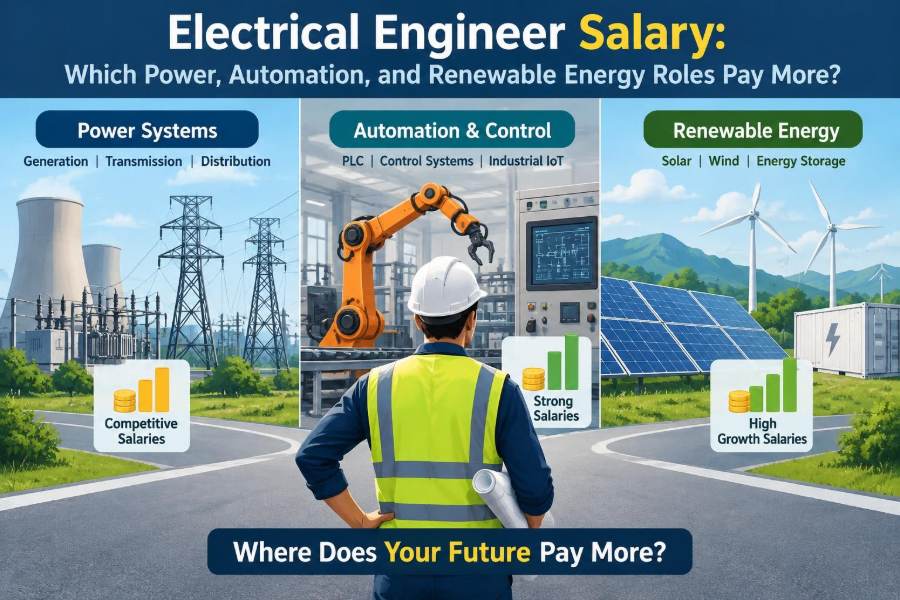
⚖️ Comparing Power, Automation, and Renewable Roles
The table shows broad patterns rather than a universal salary ranking. A strong employer, location, or niche can change any of these outcomes.
| Path | What often drives higher pay | Common trade-off |
|---|---|---|
| Power systems and protection | Grid expertise, operating responsibility, protection settings, outages | Formal processes and slower-moving asset environments |
| Automation and controls | Downtime reduction, commissioning, process knowledge, travel | Urgent troubleshooting and project deadlines |
| Renewable project engineering | Interconnection, utility-scale delivery, construction and commissioning | Project cycles and variable development pipelines |
| Energy storage and power electronics | Cross-disciplinary design, controls, specialized technology | Rapidly evolving products and requirements |
| Embedded and hardware | Product expertise, verification, scarce design skills | Intense product schedules and narrower specialization |
In practice, experienced protection, process-control, commissioning, power-electronics, and specialized hardware engineers often have strong earning potential because their skills are difficult to replace quickly. But the best choice depends on the work conditions you want to sustain.
🧾 Read a Job Description Like an Engineer
Job descriptions reveal salary potential through the problems assigned, not through adjectives such as “dynamic” or “challenging.” Look for ownership verbs: lead, approve, commission, troubleshoot, coordinate, calculate, specify, and manage.
Also identify the system scale. A role supporting a single machine differs from one involving plant-wide controls, high-voltage substations, or grid-connected generation. Larger systems do not automatically pay more, but they usually bring more interfaces and accountability.
- What electrical voltage levels and system types will you handle?
- Will you design, review, test, or merely update documentation?
- How much travel, on-call work, or site time is expected?
- Who reviews your technical work, and what progression exists?
🤝 Negotiate With Evidence, Not a Job Title
A constructive salary discussion connects your request to the work you can perform. Describe relevant projects, tools, system types, commissioning experience, design responsibility, or customer-facing results without overstating your authority.
If base pay has a fixed range, other terms may be flexible: a sign-on payment, review date, training budget, relocation assistance, extra leave, travel policy, or overtime arrangement. Get material terms in writing.
Negotiation should also include role clarity. A higher salary is not necessarily fair compensation if the employer expects constant travel, informal technical sign-off, or duties that should be shared across a team.
🚩 Common Salary Comparison Mistakes
The most common mistake is comparing a base salary from one role with total compensation from another. Another is assuming a broad title means the same duties at every company.
Engineers can also underestimate the value of early-career learning. A slightly lower-paid role with a strong mentor, real testing exposure, and disciplined design review may accelerate later earnings more than a higher-paid but narrow job.
- Do not treat online salary anecdotes as location-independent facts.
- Do not count per-diem reimbursements as permanent salary.
- Do not accept vague statements about “some travel” without asking for a realistic range.
- Do not pursue a niche solely for pay if its working pattern is unsustainable for you.
🌱 Build a Career Portfolio, Not Just a Resume
A useful career portfolio is evidence that you can contribute to real engineering outcomes. Keep non-confidential records of systems used, calculations performed, drawings reviewed, tests witnessed, faults diagnosed, and lessons learned.
For example, an automation engineer might track experience with control narratives, PLC code review, instrument checkout, drive commissioning, and alarm rationalization. A power engineer might document exposure to short-circuit studies, relay testing, grounding design, or substation acceptance tests.
This record helps during interviews and performance reviews because it turns “I have experience” into specific, credible examples.
🧩 Choose the Work Pattern Before Chasing the Premium
Some of the best-paid electrical roles are associated with travel, construction schedules, outages, emergency response, remote sites, or niche technical pressure. Those conditions are not defects; they are part of the compensation equation.
Other engineers prefer office-based design, utility planning, product development, or local industrial support. These paths can still offer excellent careers, especially when paired with strong technical depth and increasing responsibility.
The right comparison is not only “Which path pays more?” but “Which path pays enough for the life and technical identity I want to build?”
🎯 The Core Takeaway: Pay Follows Useful, Trusted Responsibility
Across power, automation, and renewable energy, the most durable salary advantage comes from becoming trusted with complex, consequential work. That may mean keeping a plant online, protecting a grid, connecting a renewable project, safely commissioning a new system, or designing technology that performs reliably.
Specialization helps, but it works best when combined with sound fundamentals, field awareness, clear communication, and a realistic understanding of the work conditions attached to higher-paying roles. Salary is a result of value, scarcity, accountability, and fit—not a permanent score assigned to a job title.
Use compensation research as a decision tool, then test every opportunity against the actual systems, responsibilities, mentorship, and lifestyle it offers.
The best electrical engineering salary path is usually the one where your growing expertise solves expensive problems while remaining sustainable for the way you want to work and live. ⚡🔧🌱