
A modern electrical grid may contain hundreds or thousands of generators operating at the same time. Large steam-turbine generators, hydroelectric units, gas turbines, diesel generators, wind turbines, battery inverters, and other sources can all contribute power to the same interconnected network. 🌍🔌
At first, this may sound surprising.
Each generator is physically separate. Its shaft is driven by its own turbine or engine. Its voltage is produced by its own electromagnetic system. Yet once connected to the grid, all of these sources must deliver alternating current in a coordinated way.
They cannot simply generate electricity independently and then be connected together whenever convenient.
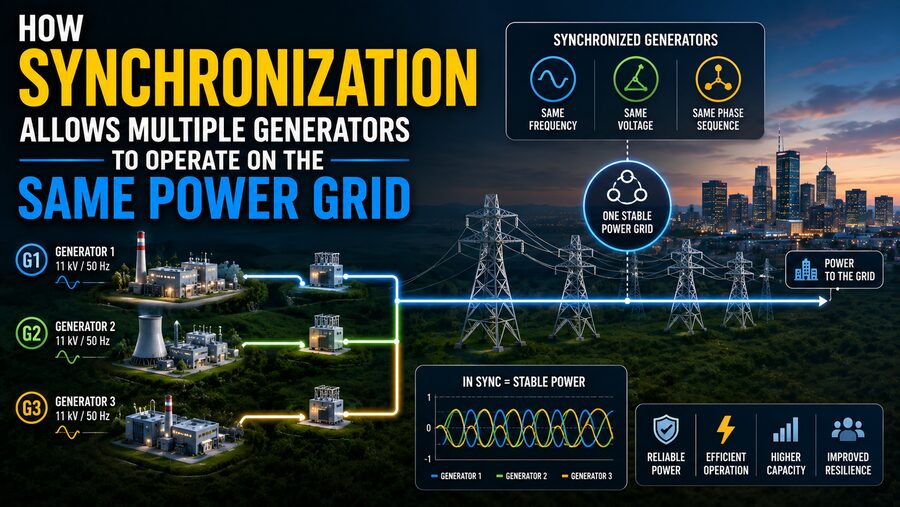
Before a synchronous generator is connected to an energized AC power system, several electrical conditions must be closely matched. This process is called synchronization.
The basic principle is:
A generator must match the grid’s voltage, frequency, phase sequence, and phase position closely enough before its circuit breaker is closed. ⚙️⚡
Once synchronized, the generator becomes electrically locked to the grid’s operating frequency and can share real and reactive power with many other generators.
Synchronization is therefore one of the fundamental mechanisms that makes large interconnected power systems possible.
🔄 1. Why AC Generators Must Be Synchronized
Alternating current continuously changes direction.
In a 50 Hz system, the voltage completes 50 electrical cycles every second. In a 60 Hz system, it completes 60 cycles every second.
If two AC sources are connected together while their waveforms are significantly different, each source may attempt to force the electrical system toward its own instantaneous voltage.
That can create extremely large currents and mechanical stresses.
Imagine one generator producing a positive voltage peak while the grid is simultaneously near a negative peak.
Connecting them at that moment would effectively place two powerful electrical sources in opposition.
The result could be severe current flow, torque shock, equipment damage, or protection-system operation. ⚠️
Synchronization prevents this by ensuring that the generator waveform and grid waveform are nearly aligned before connection.
📋 2. Four Main Conditions Must Be Matched
For a conventional synchronous generator to be connected safely to an energized grid, four major electrical conditions are checked:
- Voltage magnitude
- Frequency
- Phase sequence
- Phase angle
All four matter.
A generator can have the correct voltage but the wrong frequency.
It can have the correct frequency but the wrong phase sequence.
It can match both and still be electrically out of phase with the grid at the instant of connection.
Synchronization brings these conditions into alignment.
🔋 3. Voltage Magnitude Must Be Similar
Suppose the grid bus is operating at a certain voltage while the incoming generator is producing a significantly different voltage.
If the generator breaker closes under that condition, a large reactive current may flow immediately between the generator and the grid.
Engineers therefore adjust the generator’s excitation system so its terminal voltage is close to the bus voltage before connection.
The Automatic Voltage Regulator, or AVR, controls the generator’s field excitation.
Increasing field current generally increases generated voltage.
Reducing field current generally lowers it.
Once the generator is online, excitation also becomes an important control for reactive power and voltage support. 🔋
⏱️ 4. Frequency Must Match the Grid
Generator frequency depends on rotor speed and the number of magnetic poles in the machine.
For a synchronous generator, the relationship is:
Synchronous Speed = 120 × Frequency ÷ Number of Poles
For example, a 4-pole machine connected to a 50 Hz grid has a synchronous speed of:
120 × 50 ÷ 4 = 1,500 RPM
A 4-pole generator on a 60 Hz grid operates at:
1,800 RPM
Before synchronization, the prime mover—such as a turbine or engine—is controlled so the generator frequency is very close to grid frequency.
This is usually managed through the turbine or engine governor. ⚙️
If the generator frequency is slightly different, its phase angle relative to the grid continuously moves.
That relative motion is actually useful during synchronization because operators or automatic systems can wait for the correct phase alignment.
🔀 5. Phase Sequence Must Be Correct
Three-phase electrical systems typically use three conductors with voltage waveforms separated by 120 electrical degrees.
The phase order might be described as:
A → B → C
The incoming generator must have the same phase sequence as the grid.
If the generator sequence were reversed, such as:
A → C → B
the phases could never align correctly through ordinary speed adjustment.
Incorrect phase sequence can create extremely severe conditions when connected.
Fortunately, phase sequence is generally established during installation and commissioning rather than adjusted during every normal synchronization.
Once wiring and generator connections are correct, the sequence usually remains fixed. 🔌
🌀 6. Phase Angle Must Be Nearly Zero at Connection
Even if two systems have identical frequency and voltage, their AC waveforms can still be shifted relative to each other.
This shift is called phase angle difference.
Imagine two sine waves of the same frequency.
If their positive peaks occur at exactly the same time, they are in phase.
If one reaches its peak earlier than the other, a phase difference exists.
The ideal synchronization point occurs when the generator voltage and grid voltage are nearly aligned in phase.
At that instant, the difference between the two electrical sources is minimized.
The generator breaker can then close with relatively little electrical disturbance. 🎯
💡 7. The Traditional Synchronizing Lamp Method
Before sophisticated digital controls became common, operators could use lamps connected between the generator and bus to observe synchronization conditions.
The lamps would brighten and darken as phase difference changed.
The rate of flashing indicated the difference in frequency.
At the proper point, the operator could determine when the voltages were close to phase alignment.
Different lamp arrangements could also help verify phase sequence.
These methods are historically important and can still be encountered in some systems, but modern installations frequently rely on dedicated synchronization instrumentation and protective relays.
🕰️ 8. A Synchroscope Shows Relative Phase Motion
Another classic instrument is the synchroscope.
A synchroscope indicates the angular relationship between the incoming generator voltage and the grid voltage.
Its pointer rotates if the frequencies are different.
The direction indicates whether the incoming generator is running electrically faster or slower than the grid.
As the frequencies become nearly equal, the pointer moves slowly.
When it reaches the appropriate synchronization position, the breaker can be commanded to close.
Because real circuit breakers take a finite amount of time to close, practical systems may account for breaker operating delay rather than waiting for an absolutely perfect visual alignment.
Modern automatic synchronizers handle this timing electronically. ⚡
🤖 9. Automatic Synchronizers Perform the Job Precisely
Large generating stations frequently use automatic synchronizing systems.
These systems continuously measure:
- Generator voltage
- Bus voltage
- Generator frequency
- Grid frequency
- Phase angle
- Phase sequence
The controller can adjust governor speed and excitation automatically.
When all conditions fall within allowed limits, it issues a breaker-close command at the correct moment.
Automatic synchronization improves repeatability and reduces dependence on manual timing.
It is especially useful in plants where generating units are frequently started and stopped.
🛡️ 10. Synch-Check Relays Provide Protection
A synch-check relay acts as an additional safeguard.
The relay checks whether the generator and grid meet acceptable synchronization criteria before allowing breaker closure.
It may verify limits for:
- Voltage difference
- Frequency difference
- Phase-angle difference
If the conditions are unacceptable, the relay blocks the closing command.
This helps prevent an accidental out-of-phase connection caused by human error, control-system failure, or incorrect settings.
In high-power systems, this protection is extremely important because synchronization errors can produce enormous forces.
💥 11. What Happens During an Out-of-Phase Connection?
Connecting a large generator significantly out of phase with the grid can be extremely damaging.
The electrical system may suddenly produce:
- Very high stator current
- Strong electromagnetic torque
- Shaft stress
- Coupling stress
- Winding forces
- Voltage disturbances
A generator rotor contains enormous rotating mass.
A sudden electromagnetic torque pulse can stress the turbine-generator shaft train mechanically.
Repeated or severe events can damage windings, couplings, rotor components, transformers, or circuit breakers.
Protection systems may disconnect the generator rapidly, but avoiding the event in the first place is far better.
This is why synchronization is treated as a controlled and protected operation. ⚠️
🔒 12. After Connection, the Generator Becomes Locked to Grid Frequency
Something fascinating happens once a synchronous generator is connected to a large grid.
Before connection, the prime mover determines generator speed directly.
After connection, the rotor becomes electromagnetically coupled to the rotating magnetic field associated with the grid.
The generator now rotates at synchronous speed.
It cannot simply decide to run continuously at 49 Hz while connected to a 50 Hz grid.
The interconnected electrical system effectively constrains its average speed.
This phenomenon is sometimes described as the generator being locked in synchronism with the grid. 🔄
🏋️ 13. Increasing Turbine Power Does Not Normally Make the Generator Run Faster
This is one of the most interesting concepts in power-system operation.
Suppose a generator is already synchronized to a very large grid.
If operators increase steam flow to the turbine, one might expect the generator shaft simply to speed up.
But the grid holds the generator close to synchronous speed.
Instead, the rotor advances slightly in electrical angle relative to the grid.
This causes the generator to deliver more real power, measured in watts.
So after synchronization:
More mechanical input → more real electrical power output
rather than a sustained increase in generator frequency.
The rotor remains synchronized while carrying more load. ⚙️➡️⚡
📐 14. The Power Angle Helps Explain Load Transfer
The relative electrical angle between the generator’s internal magnetic field and the grid is often associated with a power angle or load angle.
As mechanical torque from the turbine increases, this angle changes.
Within normal limits, a larger angle allows the machine to transfer more real power into the grid.
This illustrates an important distinction:
Before synchronization, rotor speed is adjusted to match frequency.
After synchronization, mechanical input mainly determines real-power output.
This is a central idea in synchronous-machine operation.
🔋 15. Excitation Mainly Controls Reactive Power After Synchronization
Mechanical input and excitation affect different aspects of generator behavior.
After synchronization:
Prime-mover torque largely controls real power.
Field excitation strongly influences reactive power and terminal-voltage behavior.
If excitation is increased, the generator may supply more reactive power to the grid.
If excitation is reduced, its reactive-power contribution changes in the opposite direction, depending on operating conditions.
Reactive power is important because it supports voltage throughout the power system.
Thus generator operators effectively have two major controls:
Governor → real power / frequency participation
AVR → reactive power / voltage participation 🎛️
⚖️ 16. Multiple Generators Share Real Power
Imagine three synchronized generators connected to the same bus.
They all operate at the same electrical frequency, but they do not necessarily produce the same number of megawatts.
One generator might supply:
- 200 MW
another:
- 500 MW
and another:
- 800 MW
Their power output depends on their mechanical input settings, capacities, control characteristics, and dispatch instructions.
The grid’s total generation must continuously match total electrical demand plus losses.
As customer demand rises, generators must collectively increase output.
📉 17. Governor Droop Helps Generators Share Load
Generators often use a control characteristic called governor droop.
Droop allows several generators to respond to changes in system frequency without fighting each other.
If grid frequency falls slightly because demand suddenly increases, governors detect the change.
Participating generators increase mechanical input according to their droop characteristics.
This distributes the additional load across multiple machines.
Without carefully coordinated controls, generators could compete aggressively, producing unstable power oscillations.
Droop provides a predictable way for many units to share frequency response. 📊
🌍 18. Grid Frequency Reflects the Balance Between Supply and Demand
An interconnected AC grid must keep generation and consumption closely balanced.
If electrical demand suddenly becomes greater than mechanical power being supplied by generators, rotating machines begin to slow slightly.
Grid frequency falls.
If generation exceeds demand, frequency tends to rise.
This means frequency acts as a system-wide indicator of power balance.
Synchronized generators respond together because they are electrically coupled through the network.
That is why a major generator trip can influence frequency across a very large region. 🌐
🌀 19. Generator Inertia Helps Stabilize the Grid
Traditional synchronous generators contain large rotating masses.
A turbine-generator rotor stores kinetic energy.
If the grid suddenly experiences a generation deficit, these rotating machines do not slow instantly.
Their stored kinetic energy briefly helps supply the imbalance.
This property is called inertia.
Inertia slows the initial rate of frequency change, giving governors and other control systems time to respond.
This is one reason synchronous generators have historically played an important role in grid stability.
☀️ 20. Inverter-Based Resources Synchronize Differently
Not every modern energy source uses a conventional synchronous generator.
Solar photovoltaic systems, battery-storage plants, and many wind systems connect through power-electronic inverters.
These devices do not necessarily rely on a spinning synchronous rotor.
Instead, power electronics create AC waveforms electronically.
A grid-following inverter typically measures the grid waveform and synchronizes its output to it.
Control systems may use techniques such as phase-locked loops to estimate grid phase and frequency.
The inverter then injects controlled current at the correct electrical phase. ☀️🔋
🧠 21. Grid-Forming Inverters Add Another Possibility
More advanced grid-forming inverters can establish or actively support voltage and frequency rather than merely following an existing waveform.
This capability is becoming increasingly important as power systems add more renewable generation and battery storage.
Grid-forming controls can imitate some behaviors traditionally associated with synchronous machines, such as frequency support and voltage regulation.
Their synchronization principles differ in implementation, but the fundamental requirement remains: multiple electrical sources must operate in a coordinated manner rather than producing incompatible waveforms.
🏝️ 22. Synchronization Is Also Required When Reconnecting Power-System Islands
Sometimes part of a power network becomes electrically isolated from the larger grid.
This isolated section is called an island.
The island may continue operating using local generation.
Later, operators may want to reconnect it to the main grid.
But during separation, its frequency and phase may drift relative to the larger system.
Before the tie breaker can be safely closed, the two systems must again satisfy synchronization conditions.
This process is essentially synchronization on a larger scale.
Instead of connecting one generator to a grid, engineers may be connecting one energized electrical network to another.
⚫ 23. Black Start Presents a Different Situation
After a widespread blackout, there may initially be no energized grid available for a generator to synchronize with.
Certain generating units have black-start capability, meaning they can begin operating without external grid power.
A black-start unit energizes part of the network and establishes an electrical reference.
Other generating units can then be started and synchronized to that energized section.
The power system is gradually rebuilt by adding generation, transmission paths, and loads in a carefully coordinated sequence.
Synchronization is therefore fundamental not only to daily operation but also to grid restoration. 🔦⚡
🔌 24. Transformers and Transmission Lines Affect Synchronization Operations
A generator does not always connect directly to the main transmission voltage.
Large units commonly feed through a generator step-up transformer.
A power station may therefore include:
- Generator
- Generator breaker
- Step-up transformer
- Busbars
- Switchyard
- Transmission lines
Instrument transformers measure voltages on both sides relevant to the synchronization point.
Protection and control equipment ensures the measurements properly represent the electrical conditions at the breaker being closed.
The principles are simple, but real synchronization systems can involve sophisticated instrumentation.
📡 25. System Operators Coordinate Generator Output
Once generators are synchronized, their operation is coordinated at several levels.
Local plant controls regulate turbine and generator behavior.
Automatic generation control may adjust output to help maintain system frequency and scheduled power exchanges.
Grid operators dispatch generating units according to:
- Electricity demand
- Fuel cost
- Generator availability
- Transmission limits
- Reserve requirements
- Renewable output
- Security constraints
Synchronization makes all these independent units part of one interconnected electrical machine-like system.
⚠️ 26. Stability Has Limits
A synchronized generator cannot transfer unlimited power.
If disturbances become too severe, a generator’s rotor angle can move excessively relative to the rest of the system.
The machine may lose synchronism.
This condition is sometimes associated with pole slipping or out-of-step operation.
Large disturbances that can threaten stability include:
- Major faults
- Sudden line outages
- Loss of large generators
- Severe power-transfer changes
Power-system engineers therefore study transient stability to determine whether generators will remain synchronized after disturbances.
Protective systems may disconnect unstable equipment to prevent wider damage.
🌐 27. Synchronization Makes an Interconnected Grid Possible
Once many generators are synchronized, something remarkable emerges.
Thousands of machines and electronic converters located across enormous geographical distances can contribute energy to the same electrical system.
A generator in one region may help supply a load hundreds of kilometers away.
No individual generator needs to know which exact household or factory receives its electrons.
Instead, power flows according to electrical network conditions.
Synchronization creates the common AC rhythm that makes this coordinated operation possible. ⚡🌍
🧠 28. A Useful Mental Model
Imagine a group of people pushing a giant rotating wheel.
If everyone pushes at random moments, their efforts interfere.
One person may push while another effectively resists.
But if everyone moves in rhythm with the wheel, their efforts combine.
A synchronized power grid works in a comparable way.
Each generator contributes energy while remaining aligned with the electrical rhythm of the network.
The machines can provide different amounts of power, but they remain synchronized to the same system frequency.
That shared rhythm is what allows them to work together rather than against each other. 🔄
🏁 Conclusion
Synchronization is the process that allows multiple generators to operate safely and efficiently on the same alternating-current power grid.
Before a synchronous generator is connected to an energized bus, engineers ensure that four essential conditions are sufficiently matched:
Voltage magnitude 🔋
Frequency ⏱️
Phase sequence 🔀
Phase angle 🌀
Only when these conditions fall within allowable limits is the generator breaker permitted to close.
Once connected, the machine becomes electromagnetically locked to grid frequency. Increasing turbine or engine input then causes the generator to deliver more real power rather than simply accelerating continuously. Adjusting excitation changes reactive-power contribution and voltage behavior.
Governor droop, voltage regulators, protective relays, automatic synchronizers, and grid-control systems allow many generating units to share load while remaining stable.
The consequences of poor synchronization can be severe, including high currents, mechanical torque shocks, equipment damage, and system disturbances. This is why real synchronization is performed with dedicated control and protection equipment under established operating procedures. 🛡️
As power grids evolve, synchronization is no longer limited to giant rotating machines. Solar plants, batteries, and modern wind systems use sophisticated inverter controls to coordinate electronically with the network.
Yet the central principle remains unchanged:
Every source connected to an AC grid must cooperate with the electrical timing and conditions of that grid.
Through synchronization, thousands of physically separate generators can behave as parts of one vast interconnected energy system—sharing power, responding to changing demand, and supplying electricity continuously across cities, regions, and entire countries. ⚡🌍🏭