
A phone charger, an elevator motor, a neighborhood transformer, and a wind turbine may look unrelated. Yet each depends on a chain of discoveries showing that electric charge can be controlled, magnetic fields can be created, and energy can be moved across long distances.
Power systems are often introduced through equipment: generators, transmission lines, circuit breakers, and substations. Behind every one of those devices is a physical principle discovered through careful experiments, sometimes long before national electricity grids existed.
Understanding that history is more than a tour of famous names. It explains why generators use rotating magnetic fields, why transformers require alternating current, why transmission uses high voltage, and why protection systems must react in milliseconds.
The modern grid is a practical expression of electromagnetism. Its foundations were built one observation at a time.
🧭 From Curiosity to Infrastructure
Early investigations of electricity and magnetism were not aimed at building utility networks. Researchers were trying to understand sparks, attraction, chemical reactions, and the behavior of compass needles.
Over time, separate observations became a connected theory. That transition—from isolated effects to predictable laws—made engineering design possible. A power system works because its components obey relationships that can be measured, calculated, and repeatedly reproduced.
⚛️ Electric Charge: The Starting Point
Electric charge is a property of matter that produces electric forces. Like charges repel, while opposite charges attract. In metals, electrons can move through the material, creating the possibility of electric current.
This simple idea separates two concepts that are often confused. Charge is the quantity of electric property; current is the rate at which charge moves. A battery can have stored chemical energy without delivering current until a conducting path is completed.
🧲 Static Electricity Revealed Electrical Forces
Long before powered circuits, people observed that rubbed amber could attract lightweight objects. These static-electricity effects showed that electrical interactions could act without direct mechanical contact.
Static charge does not power transmission networks, but it remains engineering-relevant. Electrostatic discharge can damage sensitive electronics, and charge accumulation can create ignition hazards where flammable vapors or dust are present. Grounding and bonding practices address these risks.
🔭 Coulomb’s Law Made Force Quantifiable
Charles-Augustin de Coulomb established that the force between electric charges depends on the amount of charge and the distance between them. The force grows rapidly as objects move closer together.
This relationship helps explain electric fields around conductors, insulation stress, and the behavior of charged particles. Engineers do not usually calculate every grid component directly from Coulomb’s law, but it underlies electrostatic field analysis used in high-voltage equipment design.
🌊 Voltage Is Electrical Potential Difference
Voltage describes a difference in electric potential between two points. A useful analogy is water pressure: pressure can drive water through a pipe, while voltage can drive charge through a conductor.
The analogy has limits. Electrons do not behave exactly like water, and alternating-current systems constantly reverse direction. Still, voltage explains why a circuit needs two distinct points and why a source alone cannot supply useful power without a complete path.
🔌 Current Turned Effects into Useful Work
When charge moves through a conductor, it produces current. Current can heat a wire, produce light, create a magnetic field, or deliver energy to a motor.
Electrical systems must control current, not merely create it. Excessive current can overheat conductors, damage insulation, and generate dangerous arc energy. Fuses, circuit breakers, relays, and correctly sized conductors exist because current has thermal and mechanical consequences.
🧪 Volta’s Cell Supplied Continuous Current
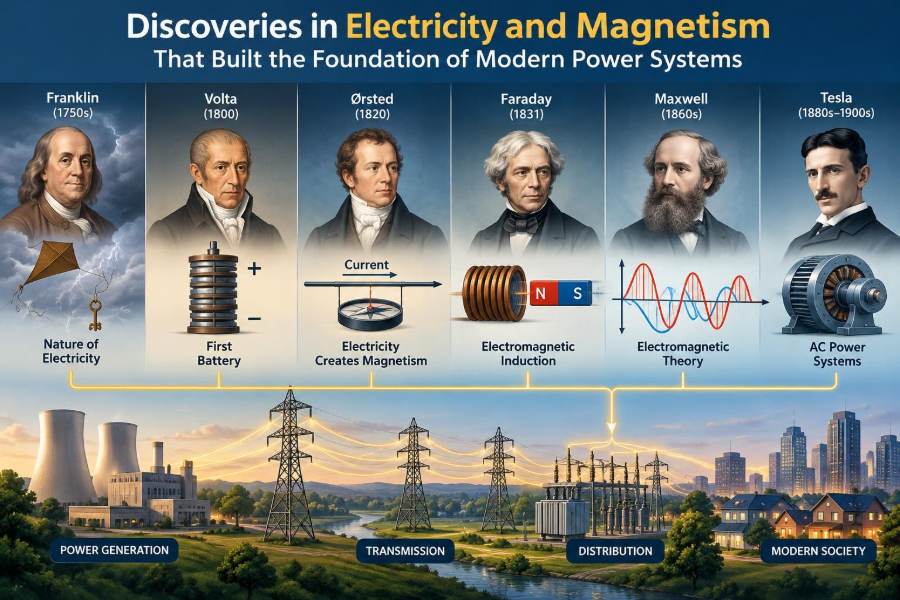
Alessandro Volta’s early battery, demonstrated around 1800, provided a more sustained source of current than static-electricity machines. It made controlled electrical experiments far more practical.
Batteries are not the original source of most grid-scale electrical energy, but their role has expanded again. Modern battery energy storage systems use electrochemical cells to support renewable integration, provide backup power, and help manage rapid changes in system demand.
🔥 Resistance Connected Electricity and Heat
Georg Ohm described the relationship among voltage, current, and resistance. In its familiar form, V = IR, it applies to many resistive circuits under appropriate conditions.
Resistance opposes current and converts some electrical energy into heat. That is useful in heaters and incandescent lamps, but it is an unwanted loss in cables and transformers. Real systems also include inductance and capacitance, so simple DC resistance alone cannot describe every AC network.
📐 Power Equations Guided System Design
Electrical power is the rate at which energy is transferred. In a basic DC circuit, power is expressed as P = VI. For a given power level, increasing voltage allows the same power to be transferred with less current.
That fact leads directly to a major power-system strategy. Conductor heating is related to current squared times resistance, often written as I²R loss. Reducing current dramatically reduces resistive losses, which is why long-distance transmission operates at high voltage.
🧭 Ørsted Linked Current and Magnetism
In 1820, Hans Christian Ørsted observed that a current-carrying conductor could deflect a nearby compass needle. Electricity was no longer just a source of sparks or chemical effects; it could create magnetism.
This observation is fundamental to motors, relays, solenoids, transformers, and generators. A conductor carrying current creates a magnetic field around it, and the field’s direction depends on the direction of current flow.
🌀 Ampère Described Magnetic Fields from Currents
André-Marie Ampère developed the mathematical and experimental understanding of forces between current-carrying conductors. His work established that currents can interact through their magnetic fields.
The unit of electric current, the ampere, honors this work. In practical engineering, current rating remains central: busbars, cables, switches, and transformer windings must withstand both normal current and much larger short-circuit currents.
🧱 Electromagnets Made Magnetism Switchable
Wrapping a wire into a coil concentrates the magnetic effect of current. Adding an iron core can strengthen the magnetic field, creating an electromagnet that can be energized or de-energized on command.
That controllability transformed machinery. Electromagnets operate contactors and relays, lift steel in industrial cranes, actuate valves, and form the magnetic circuits within many motors and transformers. Core materials must be selected carefully because they can saturate at high magnetic flux.
⚙️ Faraday Discovered Electromagnetic Induction
Michael Faraday demonstrated in 1831 that a changing magnetic environment can induce an electric voltage in a conductor. This is electromagnetic induction, one of the most productive discoveries in engineering.
A stationary magnetic field alone does not continuously generate voltage in a stationary loop. There must be changing magnetic flux: movement of a conductor, movement of a magnet, or a changing field. This distinction explains the operating principle of generators and transformers.
🔄 Generators Convert Motion into Electricity
A generator uses mechanical motion to change magnetic flux through conductors. The resulting induced voltage drives current when the generator is connected to a circuit.
Steam turbines, hydro turbines, wind turbines, diesel engines, and gas turbines differ in their energy sources, but they can all turn generator shafts. The electrical principle is the same: mechanical input is converted into electrical output through induction.
🏭 Motors Reversed the Energy Conversion
A motor uses electrical energy to produce mechanical motion. Current-carrying conductors in a magnetic field experience force, creating torque on a rotor.
This reversibility is practically valuable. Many machines can act as either motors or generators depending on operating conditions. Regenerative braking in some transportation and industrial-drive applications uses this principle to return energy rather than dissipating all of it as heat.
〰️ Alternating Current Enabled Transformation
Alternating current, or AC, changes direction periodically. Because its magnetic field changes continuously, AC can readily induce voltage in another winding through a shared magnetic core.
Direct current has important uses, including electronics, batteries, electrochemical processes, and certain transmission links. But conventional AC became dominant for broad-area networks because it could be transformed efficiently between voltage levels using comparatively simple equipment.
🔺 Transformers Made Voltage Levels Practical
A transformer has primary and secondary windings magnetically coupled through a core. AC in the primary creates changing flux, which induces voltage in the secondary. The turns ratio determines whether voltage is stepped up or stepped down.
Transformers do not create energy. Ideally, a voltage increase corresponds to a current decrease, with real losses caused by winding resistance, core effects, and other factors. Their ability to change voltage without rotating parts made layered power networks practical.
🗼 High Voltage Reduced Transmission Losses
At a generating station, transformers raise voltage for transmission. Near cities and industrial loads, substations progressively lower it for distribution and final use.
High voltage is not free of tradeoffs. It requires larger clearances, stronger insulation, specialized switchgear, and rigorous safety practices. Engineers choose voltage levels by balancing losses, equipment cost, reliability, right-of-way constraints, and expected power transfer.
🌐 Three-Phase Power Improved Delivery
Three-phase AC uses three voltage waveforms displaced in time. It delivers power more smoothly than a single-phase system and creates a naturally rotating magnetic field in many motor designs.
Large generators, transmission systems, and industrial motors commonly use three phases. Homes often receive single-phase service derived from a distribution transformer, while commercial and industrial sites may use three-phase service for higher-power equipment.
📊 AC Power Includes More Than Watts
In AC systems, voltage and current may not rise and fall together. The part that performs useful conversion to heat, light, or mechanical work is real power, measured in watts. Reactive power supports electric and magnetic fields in equipment such as motors and transformers.
Apparent power, measured in volt-amperes, combines both effects. Poor power factor can require more current for the same real-power delivery, increasing losses and equipment loading. Capacitor banks, synchronous machines, and power-electronic devices can help manage reactive power where appropriate.
📡 Maxwell Unified the Field Theory
James Clerk Maxwell brought electric and magnetic phenomena into a coherent mathematical framework. His equations showed that changing electric and magnetic fields are linked and predicted electromagnetic waves.
For power engineers, Maxwell’s work provides the deeper framework behind capacitance, inductance, wave propagation, and electromagnetic interference. At grid frequency, many problems can be modeled with circuit theory, but high-frequency transients and long lines often require more detailed field-aware models.
⚡ Insulation and Dielectrics Made High Voltage Usable
A dielectric is an insulating material that can support an electric field while limiting conduction. Air, polymers, ceramics, mineral oil, and specialized gases all appear in electrical insulation systems.
Insulation can fail through contamination, moisture, aging, overheating, or excessive electric stress. A design that works in a clean laboratory may behave differently outdoors in rain, salt spray, or industrial pollution. Clearances, creepage distance, shielding, and maintenance are therefore part of system reliability.
🛡️ Fault Currents Demanded Protection Systems
A short circuit can create currents far above normal load current. The resulting forces can deform conductors, while arcs can damage equipment and endanger people.
Protection systems detect abnormal conditions and isolate only the affected part when possible. They combine instrument transformers, protective relays, circuit breakers, communication schemes, and coordination studies. Fast operation matters, but selectivity matters too: disconnecting an entire network for a local fault can cause an avoidable outage.
🌩️ Surge Control Protects Against Transients
Lightning, switching operations, and faults can create voltage transients that are much faster than normal power-frequency behavior. These surges can stress insulation even when nominal system voltage is within design limits.
Surge arresters provide a controlled path that limits excessive voltage, while grounding and shielding help manage fault and lightning currents. No single device eliminates every transient risk; protection depends on equipment ratings, installation layout, grounding quality, and coordination.
🔁 Frequency Became a Shared Grid Signal
In an interconnected AC grid, frequency reflects the balance between generation and demand. If demand suddenly exceeds generation, frequency tends to fall; if generation exceeds demand, it tends to rise.
Governors, automatic controls, dispatch decisions, energy storage, and responsive loads all help maintain balance. Frequency control is a system-wide task, not merely a generator setting. As inverter-based resources grow, grid operators also consider how those devices contribute to stability and fault response.
🧠 Power Electronics Added Fast, Flexible Control
Semiconductor switches made it possible to convert and control power with high speed and precision. Rectifiers convert AC to DC, inverters convert DC to AC, and converters can adjust voltage, frequency, and power flow.
Power electronics enable variable-speed motor drives, solar inverters, battery systems, electric-vehicle chargers, and high-voltage DC links. They add flexibility, but they also introduce harmonic distortion and control interactions that must be studied and managed.
🔋 The Grid Is Becoming More Bidirectional
Traditional networks were designed around large central generators sending power outward to customers. Distributed solar, batteries, electric vehicles, and local generation can make power flow in either direction.
This does not replace the foundational laws; it changes how engineers apply them. Protection settings, voltage regulation, transformer loading, and fault studies may need revision when a feeder can both supply and receive power.
🧰 Practical Lessons for Engineers and Technicians
Knowing the discovery behind a device helps prevent shallow troubleshooting. If a transformer is overheating, for example, the investigation may involve load current, cooling, harmonic content, insulation condition, core losses, and connections—not just the nameplate voltage.
- Trace energy conversion: mechanical, electrical, magnetic, thermal, or chemical.
- Distinguish nominal operation from fault conditions.
- Check whether a changing magnetic field, current path, or voltage reference is actually present.
- Use measured values and approved procedures rather than assumptions around energized equipment.
- Remember that model limits matter: a simple equation may not capture transients, harmonics, or saturation.
🚧 Common Conceptual Mistakes to Avoid
One common mistake is saying that voltage “flows.” Voltage is a difference in potential; current is the movement of charge. Another is assuming that a transformer works with steady DC in normal operation. Without changing flux, the intended induced secondary voltage does not persist.
It is also misleading to treat electricity as automatically dangerous only at high voltage or automatically safe at low voltage. Hazard depends on available energy, current path, duration, environment, equipment condition, and many other factors. Electrical work should follow applicable safety rules, isolation procedures, verification practices, and qualified supervision.
🧩 A Foundation That Still Supports Innovation
Modern systems use digital relays, wide-bandgap semiconductors, advanced insulation, and automated controls. Yet the core behavior of a generator still follows induction, a motor still relies on electromagnetic force, and a transmission line still faces resistive loss and electric-field constraints.
The enduring principle is that power systems succeed when electrical and magnetic fields are created, guided, transformed, and interrupted in controlled ways. The discoveries of charge, current, fields, induction, and AC transformation remain the language engineers use to build reliable energy systems.
From the compass needle that moved beside a wire to the interconnected grid supplying entire regions, progress came from turning physical observations into dependable designs. That connection between fundamental science and careful engineering is still what keeps modern power moving. ⚡🧲🔌