
It is a hot, still evening. Air conditioners are running, lights are coming on, and electricity demand is climbing just as solar generation begins to fade. The grid must close that gap in minutes, not eventually.
On another day, strong wind may produce more electricity than local transmission lines can carry. Turbines are curtailed—deliberately turned down—even though their fuel is free. Both situations reveal the same mismatch: electricity is produced and needed at different times and often in different places.
Grid-scale batteries promise a practical bridge between those moments. They can absorb surplus electricity, hold it briefly, and return it when the system needs support. The idea sounds straightforward; building a reliable, affordable, safe power system around it is not.
The useful question is therefore not whether batteries are “the” answer. It is where they work exceptionally well, where their limits appear, and what other equipment must work alongside them.
🔋 What “grid-scale” actually means
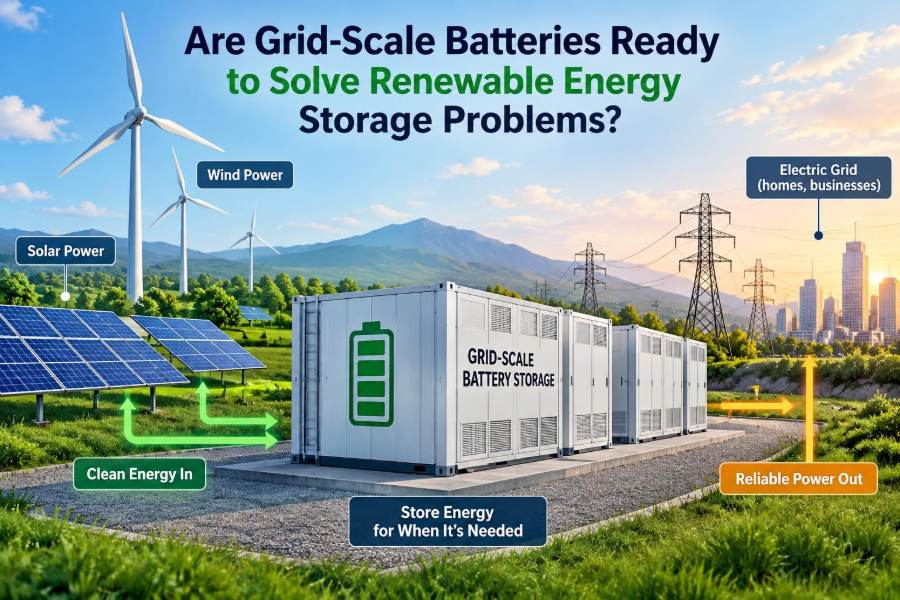
A grid-scale battery is an energy-storage system connected to the electricity network rather than a device inside a phone, car, or single home. Projects range from installations near a solar farm to large facilities connected to transmission substations.
They contain battery cells, but also racks, containers or buildings, power-conversion equipment, transformers, control systems, cooling equipment, and fire-safety infrastructure. The battery is only one part of a functioning power plant.
⚖️ Power and energy are different ratings
Battery discussions often become confusing because power and energy answer different questions. Power, measured in watts, describes how fast a system can charge or discharge. Energy, commonly measured in watt-hours, describes how much electricity it can deliver in total.
A 100-megawatt battery can supply 100 MW at a particular instant. If it stores 400 megawatt-hours, it can ideally sustain that output for roughly four hours before accounting for operating limits and losses. Duration is energy divided by power.
⏱️ Why duration changes the job a battery can do
A short-duration system may be ideal for correcting a sudden frequency disturbance or covering a sharp evening peak. That does not mean it can power a region through several windless, cloudy days.
Engineers therefore specify both MW and MWh. Calling a battery “large” without both ratings hides its capability. A four-hour system and a twelve-hour system may have the same power rating but serve very different planning needs.
🌞 The core renewable-energy mismatch
Solar output follows daylight, while demand often peaks later in the day. Wind output can change rapidly and may be strongest when demand is modest. Neither pattern automatically matches the minute-by-minute load that grid operators must serve.
Storage shifts some electricity across time. It can charge when generation would otherwise be curtailed or inexpensive, then discharge during higher-demand or lower-generation periods. This is called energy arbitrage, although a battery may provide several grid services at once.
🔄 A battery does not create extra energy
Storage moves energy through time; it does not make electricity from nothing. During charging and discharging, some energy is lost in cells, inverters, cables, and thermal management.
This round-trip efficiency matters. If a system takes in more electricity than it returns, the difference becomes heat or auxiliary consumption. Storage is still valuable when the timing, location, and reliability of returned electricity are worth more than the electricity used to charge it.
🧪 Why lithium-ion dominates current projects
Most recently deployed grid batteries use lithium-ion chemistry, especially lithium iron phosphate in many stationary applications. These batteries combine relatively high efficiency, fast response, mature manufacturing, and a supply chain built partly through the electric-vehicle market.
They are not identical to vehicle packs. Stationary projects can prioritize long life, safety margins, and lower cost over minimum weight. Still, lithium-ion systems are generally most economically suited to short- and medium-duration applications rather than storing seasonal quantities of energy.
⚙️ The inverter is a critical part of the plant
Battery cells provide direct current, while most grids distribute alternating current. A bidirectional power conversion system, usually built around inverters, controls charging and discharging and connects the battery to the grid.
Its software can respond far faster than conventional thermal power plants. The inverter also determines what electrical behavior the battery can provide: simple power transfer, voltage support, frequency response, or—in suitably designed systems—grid-forming operation.
📉 Frequency control is one of storage’s strongest uses
Grid frequency reflects the balance between generation and demand. If a large generator trips, demand briefly exceeds supply and frequency falls. If too much generation is connected, frequency rises.
Batteries can alter output within fractions of a second, helping arrest those deviations. This fast response can reduce the burden on generators that would otherwise hold capacity in reserve. It is a high-value service even when the battery delivers relatively little total energy.
🧭 Grid-forming versus grid-following operation
Traditional grid-following inverters sense an existing AC voltage waveform and inject controlled current into it. They work well when strong synchronous generators establish the grid’s frequency and voltage reference.
Grid-forming inverters can actively establish a voltage and frequency reference under defined conditions. They are a promising tool for grids with high inverter-based generation, but their controls, protection coordination, and behavior during faults require careful engineering. “Grid-forming” is not a generic label for any battery inverter.
🌡️ Voltage support can be as valuable as stored energy
Power systems need reactive power to maintain voltage, particularly around transmission corridors and substations. Inverters can provide or absorb reactive power within their design limits.
This means a battery may help solve a local voltage constraint even when its energy reservoir is not being heavily used. However, reactive-power capability does not eliminate the need for transmission upgrades where wires, transformers, or fault-duty limits are the actual bottleneck.
🚧 Congestion explains why location matters
Electricity cannot always flow from where it is cheapest to where it is needed. A crowded transmission line can prevent renewable generation from reaching customers, causing curtailment in one area while another area relies on more expensive generation.
A strategically located battery can charge on the constrained side of a line and discharge later closer to demand. But it must be placed based on power-flow studies, not simply next to the largest solar or wind plant. The best site is often where it relieves a specific network constraint.
🏭 Replacing peaker plants is possible in some hours
Peaker plants are generators that run mainly during short periods of high demand. Batteries can compete strongly for this role because they start quickly and can deliver rated power almost immediately.
The limit is duration. A battery can cover a sharp peak, but a prolonged heat wave may keep demand elevated for much longer. Resource planners must test realistic sequences of weather, outages, and demand rather than comparing only a battery’s peak MW rating with a generator’s nameplate capacity.
🌙 The daily solar-shift use case
A common application is charging around midday, when solar generation is abundant, and discharging after sunset. This can flatten the net-load ramp that other generators must follow in the evening.
It is a compelling daily cycle, but it depends on actual local conditions. A battery charged by a low-carbon surplus has a different system effect from one charged overnight by fossil-fired generation. Dispatch rules and marginal generation matter.
🌧️ Multi-day weather is a harder problem
Periods of low wind and low solar output can extend beyond the duration of many installed batteries. Storage sized for a few hours cannot, by itself, guarantee supply across every extended weather event.
This does not make short-duration batteries ineffective. It means planning needs a portfolio: diverse renewable locations, transmission, demand response, firm low-carbon resources where available, dispatchable backup, and potentially longer-duration storage. Reliability is a system property, not a single-device property.
🏞️ Seasonal storage is a separate challenge
Seasonal imbalance occurs when renewable output and demand differ across months rather than hours. In some regions, winter heating demand rises while solar output falls; elsewhere, summer cooling dominates.
Using lithium-ion batteries for very long seasonal storage would require extremely large energy capacity and long periods of low utilization. Other options—such as pumped storage, hydrogen-derived fuels, thermal storage, reservoirs, interregional transmission, or demand-side flexibility—may fit particular systems better. Their feasibility is highly location-dependent.
🧱 Long-duration alternatives deserve a closer look
“Long-duration storage” has no single universal threshold; its useful duration depends on the grid problem. Technologies under development or deployment include flow batteries, compressed-air systems, gravity-based concepts, thermal storage, and chemical energy carriers.
Each trades off efficiency, footprint, materials, siting, response speed, maturity, and cost. A lower-efficiency technology may still be useful if it stores energy economically for much longer periods. Comparing technologies by one metric alone leads to poor decisions.
💧 Pumped hydro remains an important benchmark
Pumped-storage hydropower moves water uphill when electricity is plentiful and lets it flow through turbines later. It has long operating experience and can provide large amounts of energy storage where geography and permitting allow.
Its limitations are real: suitable sites are limited, projects can take years to develop, and environmental and community impacts must be addressed. It is not a universal substitute for batteries, but it shows why a diverse storage mix is more realistic than a one-technology strategy.
🛡️ Safety requires system-level design
Lithium-ion batteries can experience thermal runaway, a failure in which heat-generating reactions accelerate and can spread to nearby cells. The risk depends on chemistry, cell design, state of charge, damage, manufacturing quality, and operating conditions.
Safe projects use layered controls: battery-management systems, thermal monitoring, separation between units, ventilation or suppression measures where appropriate, emergency planning, and tested shutdown procedures. First responders and nearby communities need clear site-specific information, not vague assurances.
❄️ Heat management affects performance and life
Cells operate best within a controlled temperature range. High heat accelerates degradation, while cold conditions can restrict charging and reduce available power. Large systems therefore use air or liquid cooling and consume some electricity to run it.
That auxiliary load is one reason nameplate energy is not the same as usable delivered energy. Site climate, enclosure design, and maintenance all influence real-world performance.
📆 Degradation is a planning input, not a footnote
Battery capacity and power capability change with age, cycling, temperature exposure, and time spent at high state of charge. This is called degradation. A project expected to serve a four-hour peak years from now may need initial oversizing, augmentation with additional battery modules, or a revised operating strategy.
Warranty terms matter, but they should be read alongside dispatch expectations. A system cycled aggressively for market revenue may age differently from one held mostly in reserve for reliability events.
🧮 Dispatch optimization can create hidden trade-offs
Control software can choose whether a battery should preserve energy for an evening peak, sell frequency response now, relieve congestion, or remain available as a contingency reserve. Those choices can conflict.
For example, repeatedly providing a lucrative fast service may leave insufficient charge for a later reliability need. Operators need clear priorities, accurate state-of-charge estimation, and constraints that protect both equipment life and system obligations.
📍 Interconnection can be slower than construction
A battery facility may be physically quick to install compared with a major generation plant, yet connection to the grid can take much longer. Studies may reveal a need for transformer upgrades, protection changes, communications equipment, or transmission reinforcement.
Interconnection queues also reflect a genuine engineering task: verifying that a new device will not create unacceptable voltage, thermal, stability, or fault-protection problems. Treating the grid connection as an administrative afterthought can derail an otherwise sound project.
📜 Market rules shape whether batteries get built
Storage earns value through the services a grid recognizes and compensates. If a market rewards only energy delivered during a narrow window, it may undervalue fast frequency response, avoided congestion, voltage support, or dependable capacity.
Conversely, poorly designed rules can encourage batteries to chase short-term price signals while ignoring local reliability needs. Tariffs, operating requirements, and capacity-accreditation methods should reflect what a storage asset can reliably contribute under stressed conditions.
♻️ Materials and end-of-life management matter
Battery supply chains involve mining, processing, manufacturing, transport, and eventual retirement. Environmental impacts vary by chemistry, supplier practices, energy sources used in manufacturing, and project lifetime.
Reusing suitable modules and recovering valuable materials through recycling can reduce waste and future demand for newly mined inputs, but neither process is effortless. Design choices that improve traceability, safe disassembly, and collection infrastructure make circularity more achievable.
🧰 Operations and maintenance are not optional
Even highly automated plants need inspection, monitoring, firmware management, calibration, spare-parts planning, and trained personnel. Sensors, cooling systems, contactors, inverters, and communications links can limit availability even when the battery cells are healthy.
Cybersecurity also belongs in operations. A grid-connected battery receives commands and exchanges operational data; secure access controls, network segmentation, patching, and incident response reduce the risk that digital weaknesses become power-system weaknesses.
📊 Comparing storage options by service, not hype
The right question is not “Which storage technology wins?” It is “What electrical service is needed, for how long, at which location, and under what operating conditions?” The table below is a simplified planning lens, not a substitute for detailed engineering.
| Need | Often suitable approach | Key limitation to check |
|---|---|---|
| Sub-second frequency response | Battery inverter systems | Control settings and sustained energy |
| Daily solar shifting | Short- to medium-duration batteries | Evening peak length and cycling economics |
| Transmission congestion relief | Strategically sited storage | Power-flow benefit at the exact node |
| Multi-day adequacy | Diverse firm resources and longer-duration options | Correlated weather and outage scenarios |
| Seasonal balancing | System portfolio, potentially chemical or thermal storage | Scale, efficiency, and infrastructure needs |
🧠 A useful planning test: model stressful days
Average annual generation can conceal reliability gaps. Better planning tests periods with high demand, low renewable output, transmission outages, generator failures, and limited battery charge at the same time.
A hypothetical example illustrates why: a battery that performs well on a typical sunny day may be empty after supporting a morning contingency when an evening heat peak arrives. Chronological modeling—following hours and days in sequence—reveals these interactions better than isolated snapshots.
👥 Communities need more than a permit notice
Battery projects affect nearby residents through construction traffic, land use, visual design, noise from cooling systems, and understandable concerns about emergency response. Early engagement gives developers a chance to explain siting, safety measures, and operational boundaries in concrete terms.
It also improves projects. Local knowledge may identify access constraints, flood risks, sensitive land uses, or emergency-service needs that a desk-based site screen missed.
🚫 Common mistakes in battery debates
- Equating MW with MWh: high power says little about how long output lasts.
- Assuming all stored electricity is clean: charging time and local marginal generation affect emissions.
- Ignoring location: a battery cannot fix congestion if it sits on the wrong side of it.
- Counting nameplate capacity as guaranteed capacity: degradation, outages, temperature, and state of charge matter.
- Expecting one technology to solve every timescale: seconds, hours, days, and seasons are distinct problems.
🔧 What engineers should ask before selecting a system
Start with the grid need, then choose technology and size. A disciplined specification asks for the required power, discharge duration, annual cycles, response time, point of interconnection, ambient conditions, expected lifetime, safety requirements, and end-of-life plan.
It should also define performance during abnormal conditions: low state of charge, high temperature, communication loss, grid faults, and islanded operation if relevant. Requirements that are measurable and testable prevent disappointing performance later.
🎓 What students and professionals can learn from storage
Grid batteries sit at the intersection of power electronics, electrochemistry, protection, controls, thermal engineering, economics, environmental assessment, and public safety. That makes them an unusually useful case study in systems engineering.
No discipline alone determines success. A chemistry choice affects cooling, a control algorithm affects degradation, a market rule affects dispatch, and an interconnection limit affects project value. Learning to trace those connections is more valuable than memorizing a single battery specification.
✅ So, are grid-scale batteries ready?
Yes—for many clearly defined grid jobs. They are already technically capable of responding quickly, shifting energy across common daily windows, supporting frequency and voltage, reducing some congestion, and replacing or supplementing peaking resources in appropriate conditions.
No—if “solve renewable energy storage problems” means independently covering every long, region-wide shortfall or seasonal mismatch. That goal requires a broader system designed around multiple timescales, geographic diversity, flexible demand, strong networks, and other firm energy options.
🌐 The central takeaway: match the tool to the timescale
Grid-scale batteries are neither a miracle device nor a minor accessory. They are flexible power-system assets whose value depends on duration, location, control strategy, safety design, and the rest of the grid around them.
The strongest energy plans identify the actual constraint first—fast imbalance, evening ramp, local congestion, multi-day scarcity, or seasonal variation—and deploy the combination of resources that addresses it honestly.
Grid-scale batteries are ready to be a major part of reliable renewable electricity, but they work best as one carefully engineered layer of a wider clean-energy system. ⚡🔋🌍