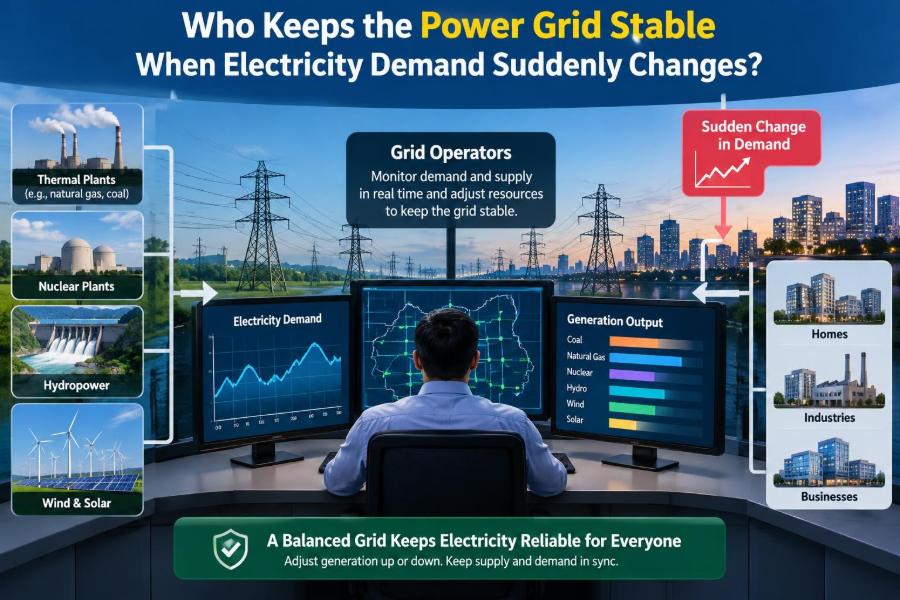

Picture a summer evening when millions of air conditioners switch on as people arrive home. Or imagine a major sports match ending, followed by kettles, ovens, and phone chargers being plugged in across a region within minutes.
Nothing dramatic may happen at the wall outlet. The lights stay on, computers keep running, and the frequency of the electrical system remains close to its target. That ordinary experience depends on a remarkable chain of automated and human decisions.
Electricity is unusual because, on a large grid, production and consumption must be balanced almost continuously. When they are not, the grid’s frequency changes—and if the imbalance becomes severe or lasts too long, equipment can disconnect and outages can spread.
So who keeps the grid stable when demand suddenly changes? The short answer is: many layers of control, acting at very different speeds. Generators, batteries, grid operators, controllable demand, and protection systems all have roles.
⚡ The Balance That Must Be Maintained
At every moment, electrical generation must closely match electrical demand plus losses in wires and transformers. If customers collectively use more power than generators supply, the missing energy is briefly taken from rotating machinery already connected to the grid.
That machinery slows down slightly. In an alternating-current system, its speed is tied to electrical frequency, so frequency falls. If supply exceeds demand, machines speed up and frequency rises.
This does not mean every appliance is directly measured and matched to a particular generator. Grid operators manage the total system balance across a large interconnected area.
🧭 Frequency Is the Grid’s Vital Sign
Most large power systems operate nominally at either 50 hertz or 60 hertz. Hertz means cycles per second: the alternating voltage changes direction that many times each second.
A small frequency deviation is a useful warning that supply and demand are out of balance. Operators and automatic controls respond before it becomes large enough to threaten reliable service.
Frequency is not the only concern. Voltage, transmission loading, and reactive power also matter, but frequency is the clearest system-wide signal of an active-power imbalance.
🏃 Why Demand Can Change So Fast
Demand is not a smooth, perfectly predictable line. It changes with weather, work schedules, television events, industrial processes, transport charging, and countless individual decisions.
A large industrial motor starting, a steel mill changing operation, or a data center load shifting can create a local step change. At regional scale, people returning home on a hot day can create a steep ramp over tens of minutes.
Forecasts reduce uncertainty, but they cannot eliminate it. Grid control is designed for both expected ramps and unexpected disturbances.
🔄 A Simple Analogy: Pedaling a Tandem Bike
Think of the grid as a very large tandem bicycle. If the riders suddenly pedal less while going uphill, the bicycle slows. If they pedal harder than needed, it speeds up.
In this analogy, generation is pedaling, electricity demand is the hill and rolling resistance, and frequency is the bicycle’s speed. The grid must correct its speed continuously, not only after it has stopped.
The analogy has limits: power systems include transmission constraints, voltage behavior, and automated protection. Still, it captures why an imbalance has an immediate physical consequence.
🌀 Inertia Buys the First Few Seconds
Traditional power plants with large steam, gas, or hydro turbines contain heavy rotating masses. Their stored kinetic energy resists a sudden change in speed. This property is called inertia.
When a generator trips or demand abruptly rises, that rotating energy initially supports the system. It does not create a lasting solution; it merely slows the rate at which frequency falls while other controls respond.
Power systems with fewer synchronous rotating machines can have less natural inertia. Their frequency may change more quickly after a disturbance, increasing the value of fast controls.
🎛️ Governors Provide the First Sustained Response
Many conventional generators use a speed governor: a control system that senses a frequency change and adjusts mechanical input to the turbine. Falling frequency tells a governor to admit more steam, water, or fuel, within the unit’s available capability.
This behavior is often called primary frequency response. It is largely automatic and begins quickly, but it does not normally restore frequency exactly to its nominal value.
Each participating unit responds according to its settings. Spreading the response across many resources avoids relying on one plant to carry the entire disturbance.
💧 Hydropower Can Move Quickly
Hydroelectric plants are often valuable balancing resources because water flow through turbines can be adjusted relatively quickly. Plants with reservoirs can also shift energy from one period to another, subject to water-management and environmental constraints.
Not every hydro station has the same flexibility. Run-of-river facilities depend more directly on available flow, while reservoir operations may have obligations beyond electricity production.
Pumped-storage hydropower adds another option: it can generate during high-demand periods and pump water uphill when there is surplus electricity.
🔥 Thermal Plants Offer Capacity, With Constraints
Gas-fired, coal-fired, biomass, and nuclear units can contribute to grid stability, but their response speeds and operating limits differ. A unit already online and part-loaded may increase output, whereas a stopped unit cannot help instantly.
Thermal equipment must respect temperature, pressure, combustion, and mechanical limits. Frequent or rapid cycling can raise maintenance needs and reduce efficiency for some plant types.
That is why operators value a portfolio of flexible resources rather than assuming all installed generation is equally dispatchable.
🔋 Batteries Are Fast, Not Bottomless
Grid-scale batteries can change output extremely quickly. They can inject power when frequency falls or absorb power when frequency rises, making them well suited to fast frequency services.
But a battery has finite stored energy. A system sized to provide a sharp response for a short interval may not be able to sustain that output through a long evening peak.
Its state of charge also matters. A battery held near full capacity has limited ability to absorb excess energy; one held nearly empty has limited ability to discharge.
🌬️ Wind and Solar Change the Planning Problem
Wind and solar output depend on weather and daylight, so operators forecast them and retain reserves for forecast error and sudden changes. A cloud passing over one solar plant is usually modest; a broad weather front can affect a much larger area.
Most modern wind and solar plants connect through power electronics rather than directly synchronized rotating machines. With appropriate controls, these inverters can support frequency, but the behavior must be deliberately designed, tested, and coordinated.
Variable generation is not simply a stability problem. It changes which resources are online and therefore changes how the grid obtains flexibility, reserves, and inertia-like response.
🖥️ Inverters Can Act Like Grid Supporters
Power electronic inverters convert DC to AC or control AC power flow. They are used in solar plants, batteries, some wind systems, and high-voltage transmission equipment.
Some inverter controls can rapidly increase or reduce power in response to frequency. Others can provide “synthetic” or “virtual” inertia-like behavior by using stored energy or temporarily changing output.
These capabilities are valuable, but they are not identical to physical rotational inertia. Their performance depends on control settings, energy availability, protection coordination, and the strength of the network around them.
📡 The Control Room Sees the Bigger Picture
Grid operators monitor generation, demand, frequency, line flows, equipment status, and weather information. Their control centers use telemetry and specialized software to identify developing problems and issue dispatch instructions.
Operators do not wait for every disturbance to become visible in customer experience. They procure reserves ahead of time, schedule resources, and prepare for credible equipment failures.
Human judgment remains important when conditions are unusual: extreme weather, transmission outages, fuel constraints, or several interacting events can make a routine control action unsuitable.
📈 Automatic Generation Control Fine-Tunes Output
After primary response arrests a frequency change, a slower supervisory system adjusts selected generators and other resources. This is commonly known as automatic generation control, or AGC.
AGC sends small, repeated control signals to participating units. Its aim is to restore frequency toward its target and, in interconnected systems, help keep scheduled power exchanges between areas on track.
This secondary control frees up the resources that provided the first response, so they are ready for the next disturbance.
🧮 Dispatch Restores the Reserve Margin
Once the immediate event is controlled, operators may start additional plants, change unit schedules, move batteries toward a useful state of charge, or arrange power transfers. This slower process is often described as replacement or tertiary reserve.
The goal is not merely to survive the last imbalance. The system must recover enough upward and downward flexibility to handle the next one.
A grid can appear stable yet be vulnerable if its fast reserves have been exhausted. Maintaining a reserve margin is therefore an operational condition, not just a planning concept.
🚧 Transmission Limits Can Complicate the Response
Having enough generation somewhere is not always enough. The power must reach the area where it is needed without overloading transmission lines or destabilizing voltage.
For example, a distant generator may be able to raise output, but a heavily loaded corridor may prevent its power from being delivered safely. Operators may then need local generation, demand reduction, or a different network configuration.
This is why grid stability cannot be reduced to a single national total of megawatts.
🔌 Voltage Control Is a Different but Related Job
Frequency mainly reflects balance in real power, measured in watts. Voltage is strongly influenced by reactive power, which helps establish electric and magnetic fields in AC equipment.
Generators, capacitor banks, reactors, transformers, and inverters can manage reactive power and voltage. A system may have acceptable frequency while still facing a serious local voltage problem.
Students often encounter these topics together because both are central to grid operation, but they should not be treated as the same control problem.
🛟 Reserves Are Prepared Capacity
Reserve is generation or demand flexibility held back, or made available, for contingencies and forecast uncertainty. Different markets and operators use different names and precise definitions, but the basic idea is consistent.
| Reserve role | Typical purpose | Possible resources |
|---|---|---|
| Fast response | Arrest a sudden frequency deviation | Batteries, responsive generators, controllable load |
| Balancing response | Restore frequency and scheduled transfers | AGC-enabled generation, storage |
| Replacement capacity | Rebuild capability after an event | Additional generators, imports, demand response |
The exact timing requirements depend on the grid. What matters operationally is that a resource promised as reserve can actually deliver under the required conditions.
🏭 Large Customers Can Help Balance the System
Demand response means reducing, shifting, or sometimes increasing electricity use in response to grid needs. A refrigerated warehouse may briefly adjust cooling, an industrial process may pause, or building controls may change temperature setpoints within agreed limits.
Demand response is not a request for households to endure discomfort whenever the grid is tight. Well-designed programs specify availability, compensation, automation, customer protections, and operational limits.
Flexible demand can be especially useful because avoiding one megawatt of load has a similar immediate balancing effect to adding one megawatt of generation.
🏠 Small Devices Can Participate Too
Smart thermostats, electric-vehicle chargers, water heaters, and home batteries can respond in aggregate. One charger changing power may be insignificant; hundreds of thousands coordinated carefully can be a meaningful grid resource.
Aggregation requires safeguards. Devices must avoid responding in a way that creates a new synchronized surge a few minutes later, and customers should retain clear control over comfort and charging needs.
Privacy, cybersecurity, communication reliability, and fair enrollment rules become more relevant as distributed flexibility expands.
🚨 Protection Systems Act When Control Is Not Enough
Protection relays detect faults and abnormal conditions, then disconnect equipment to prevent damage. They are designed to act fast and selectively where possible.
In extreme under-frequency conditions, some grids use automatic under-frequency load shedding. This disconnects predefined blocks of demand to stop a wider collapse. It is a last-resort action, not normal balancing.
The unpleasant logic is simple: temporarily losing some load may prevent the loss of much more of the system. Restoring service afterward requires careful sequencing.
🌩️ A Generator Trip: A Hypothetical Timeline
Suppose a large generating unit unexpectedly disconnects. In the first moments, system inertia slows the initial frequency decline. Governors, batteries, and fast responsive load then begin to counter the missing power.
Over the following period, AGC and dispatchable resources increase output or reduce demand. Operators check transmission loading, available reserves, and whether another unit could be lost safely.
Later, they replace used reserves and investigate the trip. The exact sequence varies by system design, but the layered structure—instant physics, fast automation, then operational recovery—is fundamental.
☀️ A Solar Ramp Is Not the Same as a Trip
A generator trip is abrupt and unplanned. A predictable afternoon decline in solar output is a ramp: it can be substantial, but operators can forecast and schedule for it.
Cloud variability and forecast error still require fast resources. Yet much of the challenge is anticipatory: commit flexible plants, preserve battery energy, arrange imports where feasible, and manage charging demand.
Confusing expected variability with sudden contingency response leads to poor planning. Both need flexibility, but not necessarily the same product or resource.
🔗 Interconnections Share Both Help and Risk
Connecting regions with transmission lines allows areas to share reserves and exchange lower-cost energy. A disturbance in one area may be supported by neighboring areas, reducing the amount each must hold alone.
Interconnection also requires coordination. Large unscheduled flows or a severe disturbance can affect multiple areas, so protection settings and operating agreements matter.
Islanding—separating part of a grid from the rest—can sometimes preserve a stable section, but each island must rapidly rebalance its own supply and demand.
🧪 Testing and Modeling Come Before the Emergency
Operators and engineers study credible contingencies, such as the loss of a generator, transformer, or transmission line. They use models to estimate frequency behavior, voltage response, fault currents, and equipment loading.
Models are only as useful as their data and assumptions. As inverter-based resources, storage, and flexible loads grow, maintaining accurate models and validating controls becomes a major engineering task.
Exercises, commissioning tests, disturbance recordings, and post-event reviews turn real operating experience into improved settings and procedures.
🛡️ Cybersecurity and Communications Matter
Fast grid coordination depends on measurements, controls, and communications. A control signal that arrives late, is corrupted, or is unavailable can reduce the effectiveness of a balancing resource.
Critical systems therefore use layered defenses, access controls, monitoring, and fallback operating modes. The details vary by organization and equipment, but resilience includes both electrical and digital design.
More connected devices can create more flexibility, yet they also expand the need for secure engineering and sensible failure behavior.
👷 What Engineers Actually Work On
Power-system engineers do far more than choose generators. They calculate reserve needs, set control parameters, study faults, plan transmission upgrades, model inverter behavior, analyze disturbance data, and design protection schemes.
Operations engineers translate those technical limits into dispatch procedures. Field teams maintain the equipment that makes control possible, from turbine governors and relays to sensors, breakers, and communications hardware.
The stable outlet in a home is the result of coordinated work across planning, construction, operations, maintenance, and regulation.
🎓 Useful Concepts for Students and New Professionals
When evaluating a proposed grid resource, ask more than “How many megawatts can it produce?” The practical questions include how quickly it responds, how long it can sustain output, where it is connected, and whether it can operate under stressed voltage and frequency conditions.
- Can it provide upward power, downward power, or both?
- What energy, fuel, water, or state-of-charge limits apply?
- Does it need a communication signal, or can it respond locally?
- What happens if it reaches a limit during a disturbance?
- Can the network deliver its output to the constrained area?
These questions reveal why no single technology is a universal replacement for every grid service.
⚠️ Common Misunderstandings About Grid Stability
One common mistake is assuming electricity is “stored in the grid.” Transmission lines contain some electromagnetic energy, but not enough to handle prolonged mismatches. Meaningful balancing comes from generators, storage, flexible demand, and controls.
Another is treating renewable generation as either automatically destabilizing or automatically stabilizing. The outcome depends on plant controls, system conditions, resource mix, network strength, and operating practices.
A third mistake is believing a stable frequency alone proves the grid is secure. Operators must also consider voltage, thermal limits, contingency exposure, fuel availability, and restoration capability.
🌍 The Grid Is Becoming More Flexible, Not Simpler
Electrification of transport and heating can increase demand while also creating new controllable loads. Storage and advanced inverters add useful response, but they introduce new coordination and lifecycle considerations.
The future grid is likely to rely on a broader mix of resources rather than a single class of large power station. That requires markets, standards, and operating tools that reward the actual services a resource provides.
Reliability is not a property of one technology. It is a property of the entire system and the way its parts behave together.
✅ The Core Principle: Balance Through Layers
Sudden changes in electricity demand are managed through a sequence of defenses: stored rotational energy or fast inverter response slows the change, automatic controls provide immediate correction, supervisory controls restore the target, and operators rebuild reserves.
Transmission, voltage support, protection, forecasting, and demand flexibility all shape whether that sequence succeeds. The resources differ, but their purpose is shared: keep supply and demand closely matched while respecting physical limits.
For anyone studying power systems, this is the central insight: grid stability is not maintained by a single control room, power plant, or battery. It is maintained by a deliberately coordinated system.
When electricity demand suddenly changes, the power grid stays stable because physics, automation, flexible resources, and skilled operators respond together at different speeds. That layered response is what makes a seemingly simple switch at the wall dependable. ⚡🔋🌐