
A summer storm knocks out power in one neighborhood, while a hospital a few blocks away continues operating on backup generation. Across town, rooftop solar panels are still producing electricity, but the local grid may not be able to use all of it at that moment.
This is the practical challenge behind the energy transition: electricity must be balanced almost instantly, even as the sources and users of that electricity become more varied, distributed, and unpredictable.
Electric vehicles, batteries, solar inverters, heat pumps, data centers, and digitally controlled substations are changing not just how electricity is generated, but how it is measured, converted, routed, and protected.
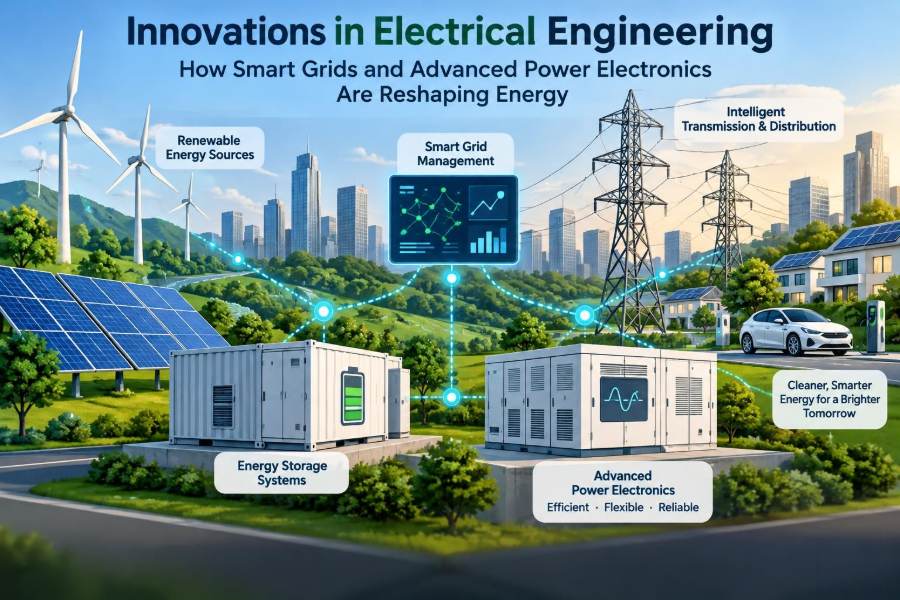
Smart grids and advanced power electronics are the technologies making that change manageable. Together, they are turning a traditionally one-way electricity network into a more observable, flexible, and actively controlled system.
⚙️ The Grid Is Becoming an Active System
The conventional power grid was designed around large power plants sending electricity outward through transmission lines and distribution networks to passive customers. Operators could forecast demand patterns reasonably well and adjust generator output to match them.
That model still exists, but it is no longer sufficient on its own. A modern grid must coordinate millions of smaller devices that can both consume and produce electricity. A home with solar panels and a battery, for example, may import power at breakfast, export solar energy at noon, and charge its battery overnight.
A smart grid is not one device. It is an electricity network enhanced with sensing, communications, automation, and control so that these changing conditions can be detected and managed.
🔌 Why Instant Balance Still Matters
Electricity is unusual because large-scale storage has historically been limited. At every moment, generation and consumption must remain closely balanced. If demand suddenly exceeds supply, system frequency tends to fall; if supply exceeds demand, frequency tends to rise.
In many power systems, nominal frequency is 50 or 60 hertz. Small deviations are expected and controlled, but larger or sustained deviations can damage equipment or trigger protective actions.
This is why grid innovation is not simply about adding renewable capacity. It is about preserving stable voltage and frequency while power flows change rapidly across the network.
🌬️ Renewable Energy Changes the Operating Problem
Wind and solar generation reduce fuel use and operational emissions, but their output depends on weather and daylight. Their variability is not inherently a flaw; it is an engineering condition that the wider system must accommodate.
A passing cloud can alter photovoltaic output across a local feeder. A broad weather pattern can influence wind production over a much larger region. Meanwhile, customer demand follows its own patterns, shaped by temperature, work schedules, and industrial activity.
Forecasting helps operators plan ahead, but forecasts are never perfect. Flexibility from storage, controllable demand, interconnections, dispatchable generation, and responsive power electronics helps close the remaining gap.
🧠 What Makes a Grid “Smart”
“Smart grid” can sound vague, so it helps to separate its core functions. A smart grid observes the system, communicates information, makes decisions, and carries out actions through controlled equipment.
- Observation: meters, sensors, and monitoring devices measure voltage, current, power flow, frequency, and equipment condition.
- Communication: secure networks move useful data between field devices, control centers, and customers.
- Decision: software and operators identify abnormal conditions, forecasts, and operating constraints.
- Action: switches, inverter controls, regulators, storage systems, and flexible loads respond.
The value comes from the closed loop. Data without a safe operating decision is merely information; automated action without trustworthy measurements can create risk.
📡 Sensors Bring Visibility to Distribution Networks
Transmission networks have long been heavily monitored because a failure can affect a wide area. Distribution networks—the circuits that deliver power to homes and businesses—have historically had less real-time visibility.
Voltage sensors, fault indicators, line monitors, and transformer-condition sensors can reveal what is happening closer to customers. They can show overloaded equipment, voltage rise from local solar generation, or the likely location of a fault.
This does not mean every wire needs an expensive sensor. Good engineering places measurement where it reduces uncertainty enough to improve a decision, such as at a feeder head, a heavily loaded transformer, or a solar-rich section of the network.
🏠 Smart Meters Do More Than Record Billing Data
Traditional meters provide a cumulative energy reading. Smart meters can record usage at intervals and communicate data remotely, which can reduce manual meter-reading and give customers better visibility into their consumption patterns.
For grid operation, aggregated meter data can improve load forecasting and outage awareness. For customers, it can reveal that an electric water heater, air conditioner, or charging habit is driving demand during costly or constrained periods.
Privacy matters. Consumption data can reveal patterns of occupancy and appliance use, so data collection, access controls, retention, and customer consent must be designed deliberately rather than treated as afterthoughts.
🔄 Advanced Metering Enables Demand Response
Demand response means changing electricity use in response to a grid need, a price signal, or an agreed control program. It is not necessarily asking people to sit in the dark. Often it means shifting flexible tasks by a short time.
For example, a commercial building might pre-cool slightly before an afternoon peak, then reduce air-conditioning demand for a limited period. A water heater or electric-vehicle charger can often pause without affecting the user if the control is designed around clear comfort and charging limits.
Demand response works best when participation is transparent and reversible. Customers need to understand what will be controlled, when it may occur, and how to override it.
🔋 Storage Adds Time Flexibility
Batteries do not create energy; they move energy through time. They charge when supply is plentiful or prices are low and discharge when the system needs support. This simple role can serve several different grid needs.
A battery may smooth a solar plant’s short-term output, reduce demand peaks at a facility, provide fast frequency support, or delay the need for a distribution upgrade. Its usefulness depends on power rating, energy capacity, control strategy, location, and state of charge.
A common mistake is to describe storage with only one number. A 10 MW battery may deliver high power, but how long it can sustain that output depends on its stored energy, usually expressed in megawatt-hours.
⚡ Power Electronics Is the Grid’s Fast-Acting Interface
Power electronics uses semiconductor switches and control circuits to convert and regulate electrical energy. It is the technology inside solar inverters, variable-speed drives, EV chargers, battery systems, high-voltage DC converters, and many modern power supplies.
Unlike a conventional transformer, which changes AC voltage through electromagnetic coupling, a power-electronic converter can actively control voltage, current, frequency, and the direction of power flow. It does this by switching semiconductor devices rapidly and filtering the resulting waveforms.
Power electronics is what allows many new energy resources to connect to the grid in a controllable form.
🔁 Rectifiers, Inverters, and DC-DC Converters
The basic converter categories are easier to understand by following the direction and form of energy conversion. A rectifier converts AC to DC, an inverter converts DC to AC, and a DC-DC converter changes one DC voltage level to another.
| Converter type | Primary conversion | Typical application |
|---|---|---|
| Rectifier | AC to DC | Battery charging, DC supplies |
| Inverter | DC to AC | Solar PV, batteries, motor drives |
| DC-DC converter | DC voltage to another DC voltage | EV systems, electronics, storage |
| AC-AC converter | AC voltage or frequency control | Some motor and power-quality systems |
Real equipment may combine several stages. An EV charger, for instance, may rectify grid AC, regulate DC power, and manage battery charging under safety and communication constraints.
☀️ Solar Inverters Turn Panels into Grid Participants
Solar panels produce DC electricity, while most public grids use AC. The solar inverter performs the conversion, but modern inverters can do far more than that.
Depending on their design and grid rules, they can adjust reactive power, limit ramp rates, reduce output during abnormal voltage, and ride through certain disturbances rather than disconnecting immediately. These functions help maintain local voltage and avoid unnecessary loss of generation.
The settings must be coordinated with the local network. An inverter that reacts aggressively without coordination may interact poorly with voltage regulators or neighboring inverters.
🧭 Grid-Following and Grid-Forming Control
Most inverters have traditionally been grid-following: they measure an existing grid voltage waveform and synchronize their output to it. This works well when strong conventional generation establishes voltage and frequency.
Grid-forming inverters are designed to establish or regulate a voltage waveform themselves within defined limits. They can be especially valuable in islanded microgrids or systems with a high share of inverter-based resources.
Grid-forming control is promising, but it is not a universal substitute for every traditional generator function. Protection design, fault behavior, energy limits, and interactions with other controls must all be evaluated for the specific system.
📉 Voltage Control Is a Local Challenge
Voltage is not identical everywhere on a distribution feeder. It changes with line impedance, loading, transformer settings, and local generation. High solar output in a lightly loaded area can sometimes raise local voltage, while heavy demand farther along a feeder can pull voltage down.
Utilities have long used tap-changing transformers, voltage regulators, and capacitor banks. Smart-grid controls add faster measurements and, increasingly, inverter-based reactive-power support.
The practical goal is not simply “higher voltage” or “lower voltage.” It is keeping voltage within the equipment and service limits applicable to that network while avoiding excessive control operations.
🌀 Reactive Power Needs a Clear Explanation
In AC systems, some equipment such as motors, transformers, and cables exchanges energy with electric or magnetic fields. This is associated with reactive power, commonly expressed in volt-amperes reactive, or var.
Reactive power does not represent the same net energy transfer as real power, measured in watts, but it strongly affects voltage and current. Poor reactive-power management can increase current, losses, and voltage problems.
A useful analogy is carrying a heavy backpack while walking forward. Your forward progress is like real power; the extra effort of supporting and balancing the load resembles the system burden associated with reactive power.
🛣️ HVDC Expands Long-Distance Options
High-voltage direct-current, or HVDC, transmission converts AC to DC for transmission and then converts it back to AC where needed. It can be attractive for long distances, submarine cables, asynchronous interconnections, and tightly controllable bulk power transfer.
HVDC is not automatically preferable to AC. Converter stations are complex and costly, so project economics and technical performance depend on distance, capacity, cable versus overhead route, and network needs.
Its precise control of power flow is especially useful when connecting systems that operate at different frequencies or when an operator needs to avoid overloading particular AC paths.
🚗 Electric Vehicles Are Both Load and Resource
EV adoption adds electricity demand, but the timing of charging matters more than the vehicle count alone. If many drivers plug in at the same evening peak, a local transformer or feeder may face a sharp new load.
Managed charging can shift some charging to lower-demand periods while still meeting a driver’s requested departure time and target battery level. Workplace, fleet, and depot charging can offer particularly useful scheduling opportunities because vehicles often remain parked for predictable periods.
Vehicle-to-grid operation, where an EV can export power back to the grid, is technically possible with suitable equipment and agreements. Its practical use depends on battery warranties, customer preferences, interconnection rules, compensation, and local network capacity.
🏭 Variable-Speed Drives Cut Waste in Motion Systems
Motors power pumps, fans, compressors, conveyors, and many industrial processes. A variable-speed drive uses power electronics to control motor speed instead of relying only on throttling valves, dampers, or on-off cycling.
For loads such as fans and centrifugal pumps, reducing speed can substantially reduce required power. The exact savings depend on the load curve and operating pattern, so engineers should evaluate the full system rather than assume a drive always delivers the same result.
Drives also introduce design considerations: harmonics, electromagnetic interference, insulation stress, cooling, and appropriate protection. Efficient operation is a system-level result.
🏘️ Microgrids Create Local Resilience
A microgrid is a defined group of loads and energy resources that can operate connected to the larger grid and, in some cases, independently from it. A campus, hospital district, military installation, or remote community may use this arrangement.
During an outage, a capable microgrid can isolate itself—often called islanding—and continue supplying selected critical loads using local generation and storage. That requires fast controls, carefully designed protection, and a realistic plan for limited fuel or stored energy.
Resilience does not mean every load remains powered indefinitely. A strong microgrid design identifies priorities: life safety, communications, refrigeration, water systems, medical equipment, and essential operations.
🛡️ Protection Must Evolve with Bidirectional Flows
Traditional distribution protection often assumes fault current flows from a substation outward. Distributed generators and batteries can change both the magnitude and direction of current during abnormal conditions.
Inverter-based resources may also limit fault current differently from synchronous generators. This can make some conventional protection assumptions unreliable, particularly on feeders with changing operating configurations.
Engineers address this with methods such as directional relays, adaptive settings, communications-assisted protection, and detailed studies of credible operating states. Protection coordination should be revisited whenever significant distributed energy resources are added.
🔍 Fault Location and Self-Healing Automation
When a tree contacts a line or equipment fails, automated switches and fault indicators can help isolate the damaged section and restore unaffected sections from another available source. This is often described as fault location, isolation, and service restoration.
Automation can reduce outage duration for customers outside the faulted section, but it must be deployed cautiously. Switching actions need verified network models, safe interlocks, and awareness of distributed generation that could energize an isolated area.
The term “self-healing grid” should not imply that the physical damage repairs itself. It means the network can detect, reconfigure, and restore service where conditions permit.
🌐 Communications Are Part of the Power System
Many smart-grid functions depend on communications with known delay, availability, and security characteristics. A control action that arrives too late—or not at all—may be useless or unsafe.
Different tasks need different communications performance. Billing data can tolerate delay; protective relaying may require extremely fast, dependable exchange of information. Engineers must match the communication architecture to the consequence of failure.
Devices also need accurate time synchronization. Correct timestamps allow operators to reconstruct events, compare measurements, and understand the sequence leading to a disturbance.
🔒 Cybersecurity Is an Engineering Requirement
Connecting field equipment creates pathways for valuable operational data and for potential attacks. Cybersecurity therefore belongs in power-system engineering, not just in an IT checklist.
Useful practices include device authentication, encryption where appropriate, network segmentation, role-based access, secure update processes, logging, and tested incident response procedures. Legacy equipment may require compensating controls if it cannot support modern security features.
Security also includes people and processes. A technically strong system can still be exposed by weak password management, uncontrolled vendor access, or untested recovery plans.
📊 Data Helps Only When It Supports Decisions
Modern electrical systems produce enormous volumes of measurements. The challenge is turning these into actionable information without overwhelming operators or creating false confidence in a dashboard.
State estimation combines measurements with a network model to infer conditions at points that are not directly measured. Asset analytics can identify trends such as abnormal transformer temperature or repeated breaker operations.
Models must be maintained. If feeder topology, equipment ratings, or distributed-generation records are outdated, a sophisticated algorithm can produce a precise-looking answer that is operationally wrong.
🧮 Digital Twins Need Grounded Models
A digital twin is a digital representation of a physical system that can be updated with operating data. In electrical engineering, it may represent a substation, feeder, motor drive, battery system, or an entire facility.
Used well, a twin supports what-if studies: What happens if a charger depot expands? Which voltage regulator settings work after new solar installations? How does a battery dispatch plan affect transformer loading?
A twin is only as trustworthy as its assumptions, input data, and validation. It should support engineering judgment, not replace field inspection, commissioning tests, or safety procedures.
🌡️ Power Quality Affects Real Equipment
Power quality describes characteristics of supplied electrical power beyond simple availability. Voltage sags, swells, flicker, harmonics, transients, and interruptions can affect sensitive loads.
Power-electronic equipment can improve quality through filtering and fast control, yet it can also introduce harmonics if poorly designed or applied. Nonlinear loads draw current waveforms that are not purely sinusoidal, which can heat equipment and interfere with other systems.
Engineers assess the point of common coupling, system impedance, load mix, and applicable requirements. Installing a filter without diagnosing the source and network response can shift the problem rather than solve it.
🧱 Semiconductors Set Practical Limits
Modern converters rely on semiconductor devices such as insulated-gate bipolar transistors, MOSFETs, and increasingly wide-bandgap materials including silicon carbide and gallium nitride in suitable applications.
Wide-bandgap devices can support higher switching frequencies, higher temperatures, or improved efficiency in some designs. Those advantages can reduce passive-component size, but they also make layout, insulation coordination, electromagnetic compatibility, and thermal design more demanding.
Component selection is never just a data-sheet comparison. Voltage rating, switching loss, conduction loss, cooling, gate drive, fault behavior, lifetime, cost, and supply availability all matter.
🌡️ Thermal Management Determines Reliability
Every converter loses some energy as heat. Junction temperature swings, poor cooling, dust buildup, and uneven mechanical stress can shorten the life of semiconductor modules, capacitors, and solder connections.
Good thermal design considers the whole path from semiconductor junction to ambient air or coolant. It includes heat sinks, thermal interfaces, airflow, enclosure design, control derating, and realistic ambient conditions.
Designers should not size cooling only for an average operating point. A system may survive normal output yet fail prematurely under repeated overloads, hot weather, or reduced airflow caused by maintenance conditions.
🧰 Interoperability Prevents Vendor Islands
Smart grids bring together meters, relays, inverter controllers, charging stations, building systems, and utility platforms from different manufacturers. If each system speaks only a proprietary language, integration becomes slow and expensive.
Open, well-defined interfaces can make it easier to exchange data, replace components, and coordinate controls. However, interoperability is more than choosing a standard; devices must implement it consistently, securely, and with clearly defined operating semantics.
Before procurement, engineers should specify data ownership, interface testing, firmware support, cybersecurity responsibilities, and how the system behaves if communications are lost.
🧪 Testing Must Cover Normal and Abnormal Conditions
Power systems cannot be safely validated only by proving that they work on a calm day. Engineers use simulation, hardware-in-the-loop testing, factory acceptance tests, site acceptance tests, and staged commissioning to examine expected and unexpected behavior.
Scenarios should include communication loss, sensor errors, low battery state of charge, fault conditions, rapid renewable changes, equipment maintenance states, and restoration after an outage. The goal is to understand failure modes before they occur in service.
Controls should degrade safely. When a higher-level optimization system fails, local protection and basic operating limits must still prevent unsafe actions.
👷 Skills Electrical Engineers Need Now
The field increasingly rewards engineers who can connect physical power-system knowledge with digital tools. Circuit analysis, machines, protection, control theory, and power quality remain foundational; they are not being replaced.
Useful complementary skills include embedded systems, communications basics, cybersecurity awareness, data analysis, simulation, and standards literacy. Just as valuable is the ability to explain a technical constraint clearly to operations staff, software teams, regulators, and customers.
- Learn to read one-line diagrams and protection logic.
- Practice modeling converters and control loops, not only steady-state circuits.
- Understand measurement uncertainty and sensor limitations.
- Develop a safety-first approach to energized systems and stored energy.
⚖️ Trade-Offs Cannot Be Designed Away
Smart grids and advanced converters create capabilities, but every capability introduces choices. More automation can improve restoration speed while increasing dependence on communications. More local generation can reduce imports while complicating protection and voltage regulation.
Batteries provide flexibility but have finite energy and aging mechanisms. Higher switching frequencies can shrink magnetic components but may increase switching losses and electromagnetic interference. Detailed monitoring improves visibility but raises cybersecurity and privacy responsibilities.
Good engineering makes these trade-offs explicit. The best design is the one that meets a defined reliability, safety, cost, maintainability, and performance need—not the one with the most features.
🗺️ A Practical Path for Organizations
Organizations planning a grid-modernization or facility-electrification project should begin with measurements and operating objectives rather than a preferred technology. Clarify whether the main problem is outage resilience, peak demand, voltage compliance, energy cost, emissions reduction, equipment capacity, or a combination.
- Map existing loads, generation, protection, communications, and constraints.
- Collect interval data and identify peak conditions, not only annual totals.
- Model credible future scenarios such as EV growth or new solar capacity.
- Define control ownership, fail-safe behavior, and maintenance responsibilities.
- Test in stages and verify results against field measurements.
This sequence helps prevent a common failure: buying a promising device before defining the operating problem it must solve.
🌍 The Core Principle: Coordination Creates Value
The major innovation is not simply smarter meters, larger batteries, or faster semiconductors. It is coordination: matching flexible resources to local grid needs while preserving stability, protection, security, and customer trust.
Smart grids provide awareness and orchestration. Advanced power electronics provides fast, controllable interfaces between sources, storage, loads, and networks. Neither delivers its full value in isolation.
For students, this means the future of electrical engineering remains deeply rooted in fundamentals. For working professionals, it means designs must increasingly bridge power hardware, control software, communications, and human operations.
The resilient energy system is not a single invention; it is a carefully engineered partnership between intelligent networks, controllable power conversion, and sound operational judgment. ⚡🔋🌐