
A summer evening can make the electric grid feel surprisingly personal. Air conditioners are running, dinner is cooking, electric vehicles may be charging, and a passing cloud can sharply reduce local solar output. Somewhere behind the wall socket, operators must keep supply and demand balanced almost instant by instant.
For most of the grid’s history, the answer was straightforward: turn up a power plant. That approach becomes less convenient when a growing share of electricity comes from wind and solar, whose output follows weather rather than a dispatch schedule.
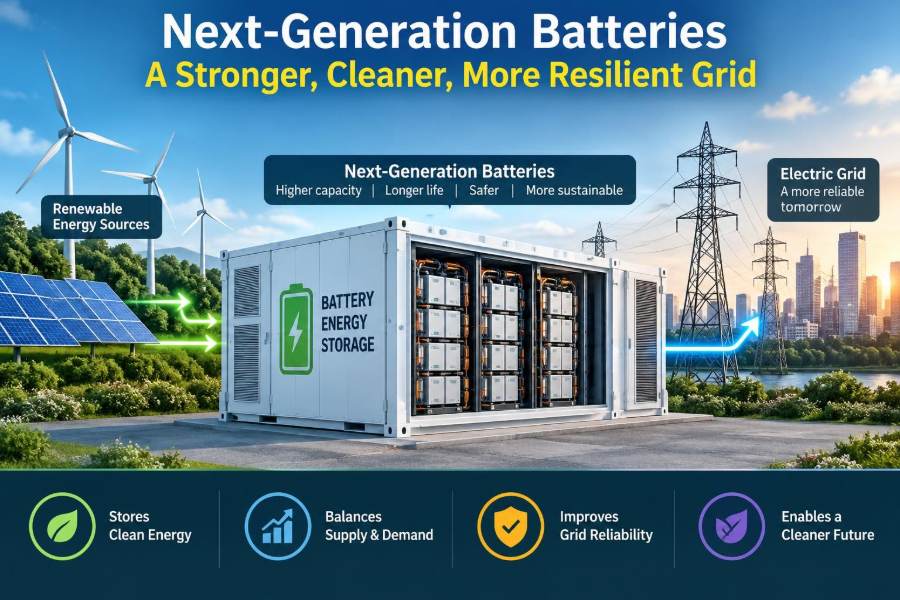
Batteries offer another option. They can absorb electricity when it is plentiful, hold it briefly or for many hours, and return it when the system needs support. But “a battery” is not one technology, one duration, or one solution.
The next generation of energy storage may change not only where electricity comes from, but also how power networks are planned, protected, operated, and paid for.
⚡ The Grid’s Constant Balancing Act
An AC power grid operates near a target frequency: 50 Hz or 60 Hz depending on the region. When demand exceeds generation, frequency tends to fall; when generation exceeds demand, it tends to rise. Large deviations can damage equipment or trigger protective actions.
Grid operators therefore match generation and consumption continuously. Storage adds a controllable load while charging and a controllable generator while discharging. That dual role is unusually valuable because it can respond in seconds or less.
🔌 Power and Energy Are Different Battery Jobs
Two specifications are essential. Power, measured in kilowatts or megawatts, describes how fast a system can deliver electricity. Energy, measured in kilowatt-hours or megawatt-hours, describes how much electricity it can deliver over time.
A 100 MW battery with 400 MWh of usable stored energy can, in principle, discharge at full rated power for about four hours. Actual operation is constrained by reserve margins, temperature, efficiency, and operating rules, but the distinction remains fundamental.
- High power helps with rapid frequency response and short peaks.
- High energy capacity helps bridge longer shortages.
- Long-duration storage aims to shift energy across many hours, days, or potentially longer periods.
🌞 Why Renewable Generation Changes the Problem
Solar generation commonly rises through the morning, peaks around midday, and falls toward evening. Demand often remains high after solar output declines. Wind can be abundant at night, scarce during a calm period, or strong when demand is low.
These patterns do not make renewable energy unusable; they make flexibility more valuable. Storage can shift some energy from a lower-value period to a higher-value period and reduce curtailment, which is the deliberate reduction of available generation because the system cannot use or export it at that moment.
🕒 The Duration Question
Not every reliability event lasts the same length of time. A frequency disturbance may need a response lasting minutes. An evening peak may last several hours. A prolonged cloudy, calm period can challenge a region for much longer.
That is why discussions about “battery capacity” can mislead. A fleet with a large megawatt rating may still have limited capability during a multi-day shortage if its stored energy is exhausted quickly. Planning must ask which problem needs solving, for how long, and how often?
🧪 Lithium-Ion: The Current Benchmark
Lithium-ion batteries are widely deployed because they combine high efficiency, rapid response, compact size, and a mature manufacturing base. Their electrochemical cells move lithium ions between electrodes during charging and discharging.
Grid systems usually package many cells into modules, racks, enclosures, power-conversion equipment, controls, cooling equipment, and protection systems. The cell matters, but the complete battery energy storage system determines field performance and safety.
📈 What Makes a Battery “Next Generation”
Next-generation storage is not defined by a single chemistry. It describes technologies seeking meaningful improvements in one or more areas: lower cost, longer duration, reduced reliance on constrained materials, better safety, higher cycle life, or simpler recycling.
Some candidates are intended to outperform lithium-ion in familiar short-duration applications. Others accept lower energy density because stationary grid installations have more space than vehicles and need inexpensive energy storage more than compactness.
🧱 Solid-State Batteries and Safer Cell Design
Conventional lithium-ion cells typically use a liquid electrolyte, the material through which ions move. Solid-state batteries replace that liquid with a solid electrolyte. In principle, this can offer safety and energy-density advantages, depending on the materials and design.
However, making a promising laboratory cell into a durable large-scale product is difficult. Interfaces between solid materials can develop resistance or mechanical damage as electrodes expand and contract. Manufacturing consistency, cost, and long-term cycling remain practical hurdles.
🔩 Sodium-Ion and Material Availability
Sodium-ion batteries use sodium rather than lithium as the mobile ion. Sodium is widely available, and sodium-ion designs can reduce dependence on some materials used in particular lithium-ion supply chains.
The trade-off is generally lower energy density than leading lithium-ion cells. That matters greatly in a car or aircraft, but it can be less decisive for a stationary container beside a solar farm, substation, or industrial facility. The best chemistry depends on the site’s constraints.
💧 Flow Batteries Store Energy in Tanks
In a flow battery, energy is stored in liquid electrolytes held in external tanks. Pumps circulate the liquids through an electrochemical stack, where charging or discharging occurs. The separation of tanks and stack creates a useful design feature.
Tank size largely determines energy capacity, while stack size largely determines power capacity. This can make flow batteries attractive where long duration and frequent cycling matter. Their footprint, pumps, balance-of-plant complexity, and chemistry-specific costs must also be considered.
🔥 Thermal Batteries Store Heat, Not Electrons
Some energy-storage systems convert electricity into heat, store that heat in materials such as solids or molten media, and later use it directly in an industrial process or convert it back to electricity. The direct-use case can be especially compelling where heat is the desired output.
Converting electricity to heat is usually straightforward; converting stored heat back into electricity adds losses and equipment complexity. Thermal storage therefore should be evaluated against the actual need: process heat, district heating, or electrical output.
🌬️ Mechanical Storage Has a Role Too
Next-generation grid storage is broader than batteries. Pumped-storage hydropower moves water uphill, compressed-air systems store pressurized air, and gravity concepts lift heavy masses. These approaches can offer long service lives and large-scale energy storage under suitable conditions.
They are highly site-dependent. Geography, geology, water use, permitting, transmission access, and construction time can matter more than the basic physics. A diverse portfolio may be more resilient than reliance on any one technology.
🔄 Round-Trip Efficiency and Why Losses Matter
Round-trip efficiency is the fraction of input electricity recovered after charging and later discharging. It includes losses in cells, inverters, transformers, thermal management, and auxiliary equipment.
A lower-efficiency technology is not automatically a poor choice. It may still be valuable if it can store energy much longer, use low-cost materials, or provide a service that efficient short-duration batteries cannot. Efficiency must be judged alongside duration, utilization, and system value.
🧠 The Battery Management System Is the Brain
A battery management system, or BMS, monitors cell voltages, currents, temperatures, insulation conditions, and state of charge. It limits operation when conditions become unsafe and helps keep cells within acceptable ranges.
State of charge is not measured as directly as fuel in a transparent tank. The BMS estimates it from electrical measurements and models. Estimation errors, sensor faults, and cell imbalance can affect usable capacity, making quality controls and validation essential.
🌡️ Temperature Controls Performance and Aging
Battery reactions are sensitive to temperature. Cold conditions can reduce available power and charging capability, while sustained high temperatures can accelerate degradation. Uneven temperatures across an enclosure can cause cells to age at different rates.
Grid systems may use air cooling, liquid cooling, or carefully designed ventilation. Thermal design is not a minor accessory: it influences capacity, lifetime, reliability, auxiliary energy use, and the ability to operate safely in local climate conditions.
🛡️ Fire Safety Requires System-Level Design
Some battery failures can produce heat, flammable gases, or a self-heating chain reaction known as thermal runaway. Risk depends on chemistry, cell condition, enclosure design, siting, detection, suppression strategy, and emergency response planning.
Responsible deployment uses layered protections rather than assuming any single device eliminates danger.
- Cell screening and fault detection reduce the chance of initiating failures.
- Spacing, barriers, and ventilation limit propagation and gas accumulation.
- Clear site access and responder coordination improve emergency preparedness.
Requirements differ by jurisdiction and application, so projects need qualified engineering review rather than a generic checklist.
🏭 From Pilot Cell to Grid Asset
A new chemistry can show impressive performance in a small test cell yet face a long path to commercial operation. Grid assets must withstand thousands of cycles or years of calendar aging, changing temperatures, shipping, installation, maintenance, and occasional abnormal events.
Scale-up also introduces manufacturing questions: Can materials be produced consistently? Can defects be detected? Can modules be serviced? A breakthrough is useful only when it becomes repeatable, financeable, and operable in real conditions.
📉 Degradation Is a Planning Input
Battery capacity and power capability change with time. Cycling, high temperatures, deep charge-discharge swings, high current, and time spent at extreme states of charge can all contribute to degradation, though the balance varies by chemistry.
Project models should use a realistic end-of-life definition, not only nameplate capacity on commissioning day. Operators may limit usable state-of-charge range or augment a system with additional modules later to preserve contracted performance.
🏘️ Storage Can Support Local Distribution Networks
Not all grid problems occur on the transmission system. A neighborhood with rapid EV adoption, rooftop solar, and electrified heating can strain distribution transformers and feeders that were not designed for those simultaneous loads.
A strategically placed battery may reduce local peaks, absorb midday solar, and defer some upgrades. It cannot replace every wire upgrade: if a feeder has a persistent capacity or voltage problem, storage must be correctly sized, controlled, and available at the needed times.
🏗️ Storage at Substations and Transmission Nodes
At larger scales, storage near substations can relieve congestion, provide voltage support through inverter controls, and shift power across constrained periods. Location matters as much as size because a battery installed on the wrong side of a bottleneck may not solve it.
Interconnection studies assess fault levels, protection coordination, voltage behavior, and thermal limits. Treating storage as a simple “plug-in generator” overlooks the electrical engineering needed to integrate inverter-based resources responsibly.
🎛️ Inverters Are Becoming Grid-Forming Tools
Batteries connect to AC networks through power electronic inverters. Many inverters are grid-following: they measure an existing grid voltage waveform and inject current synchronized to it. This works well when strong synchronous generation is present.
Grid-forming inverters can instead establish a voltage and frequency reference under defined conditions. Their controls may help support weak networks and enable islanded microgrids, but their behavior must be carefully coordinated with protection systems and other resources.
🌀 Inertia, Fast Response, and Stability
Traditional synchronous generators have spinning mass that naturally resists rapid frequency change. Inverter-connected resources do not provide physical rotational inertia in the same way, but controls can deliver very rapid active-power response.
This response is valuable, not magical. It depends on stored energy, inverter headroom, measurements, control settings, and network conditions. Engineers must distinguish between a short, high-power stabilizing response and sustained energy delivery after the event.
🌩️ Black Starts and Microgrids
A black start is the process of energizing parts of a grid after a major outage without relying on the wider network. Batteries can be useful because they can start quickly and power controls, communications, and auxiliary equipment.
In a microgrid, storage can help maintain continuity for a campus, hospital, industrial site, or remote community when separated from the main grid. Critical-load planning remains necessary: even a large battery has finite energy, and priority loads must be defined before an emergency.
💸 Value Stacking Can Improve Economics
A battery may earn or provide value through several services: energy shifting, peak demand reduction, frequency support, reserve capacity, congestion relief, and resilience. Combining compatible services is often called value stacking.
The caution is that one stored megawatt-hour cannot serve two conflicting commitments at the same time. If a battery is held in reserve for an outage, it may not be available for energy arbitrage. Dispatch strategies must honor physical limits and contractual priorities.
📊 A Practical Technology Comparison
| Approach | Typical strength | Key constraint | Often suited to |
|---|---|---|---|
| Lithium-ion | Fast response and compact deployment | Thermal management and aging | Short-to-medium duration grid services |
| Sodium-ion | Potential material-supply advantages | Lower energy density | Stationary systems where space is available |
| Flow battery | Independently scalable energy capacity | Footprint and system complexity | Frequent, longer-duration cycling |
| Thermal storage | Direct delivery of stored heat | Electricity reconversion losses | Industrial and thermal-demand applications |
| Mechanical storage | Potential large-scale, long-life storage | Strong site dependence | Locations with suitable geography or geology |
These are broad tendencies, not universal rankings. Specific designs can differ substantially.
⛏️ Supply Chains and Responsible Materials
Storage deployment depends on mining, refining, component production, transport, and manufacturing capacity. Material availability is not merely a purchasing issue; it can affect project schedules, cost volatility, regional resilience, and technology choice.
Responsible procurement also considers worker safety, environmental effects, traceability, and community impacts. A lower-carbon grid should not treat upstream impacts as invisible simply because they occur outside the power plant fence.
♻️ Recycling and Second-Life Questions
Recycling can recover valuable materials and reduce waste, but processes vary by chemistry and local infrastructure. Packs must be transported and dismantled safely, and economic viability depends on material values, volumes, design, and regulations.
Using retired vehicle batteries in stationary applications can sometimes be plausible, but “second life” is not automatically sustainable or cheap. Remaining health, cell consistency, warranty responsibility, testing cost, and safety architecture all need careful assessment.
📜 Market Rules Can Limit Useful Storage
A technically capable battery may remain underused if interconnection rules, tariffs, market products, or planning methods do not recognize the service it provides. For example, a rule designed around conventional generators may not fit an asset that switches between load and generation within seconds.
Clear performance requirements, transparent access to markets, and planning that values location and duration can help systems capture real benefits. Policy choices shape deployment, but they do not remove the underlying engineering constraints.
🧮 How Engineers Size a Storage Project
Sizing starts with a load and generation profile, not a preferred battery chemistry. Engineers identify the event to be managed: a 15-minute feeder overload, a four-hour evening peak, backup for critical loads, or a longer renewable-energy gap.
- Define the required service and reliability target.
- Estimate power, energy, response time, and expected cycling.
- Include losses, temperature, degradation, outages, and reserve margin.
- Evaluate site constraints, interconnection, controls, safety, and lifecycle cost.
A model that uses perfect forecasts and full nameplate capacity will usually overstate real-world performance.
🚫 Common Mistakes in Battery Discussions
One common mistake is equating a battery’s energy capacity with guaranteed backup duration. Loads vary, usable capacity is limited, and inverters have power ratings. Another is assuming every battery can recharge from a renewable source during an outage; that depends on microgrid controls and available generation.
It is also misleading to compare chemistries only by energy density. For grid storage, lifetime throughput, safety, land use, maintenance, response characteristics, supply chain, and site-specific value may be more decisive.
🔭 What Progress Will Actually Look Like
Grid transformation is unlikely to arrive through one dramatic chemistry replacing everything overnight. More often, progress appears as better cell manufacturing, safer enclosures, improved controls, new long-duration options, lower-cost materials, and smarter operation of diverse assets.
Different regions will make different choices. A dense city may prioritize compact systems and constrained-grid support; an industrial region may value thermal storage; a location with suitable terrain may expand pumped storage. The grid is a network of local engineering problems.
🎓 Skills Electrical Engineers Will Need
Energy storage sits at the intersection of electrochemistry, power electronics, protection, control theory, thermal engineering, communications, and economics. Students and professionals do not need to master every specialty, but they should understand the interfaces between them.
- Read one-line diagrams and understand protection boundaries.
- Interpret power, energy, efficiency, and degradation data.
- Recognize inverter-control and grid-strength issues.
- Include safety, commissioning, and maintenance in early design work.
The strongest projects connect detailed component knowledge to system-level behavior.
🧭 The Core Principle: Match Storage to the Grid Need
Next-generation batteries could reshape the grid because they turn electricity into a resource that can be scheduled, moved in time, and used for stability as well as energy. Their greatest contribution is not simply storing more electrons; it is giving operators more options when conditions change.
The right question is not “Which battery wins?” It is “What flexibility problem exists here, what duration and response are required, and which technology delivers it safely over its full life?” That framing leads to better engineering than chemistry headlines alone.
The future electric grid will be more reliable and adaptable when storage is selected as a system solution—matched to location, duration, controls, safety, and the real needs of the network. 🔋⚡🌍