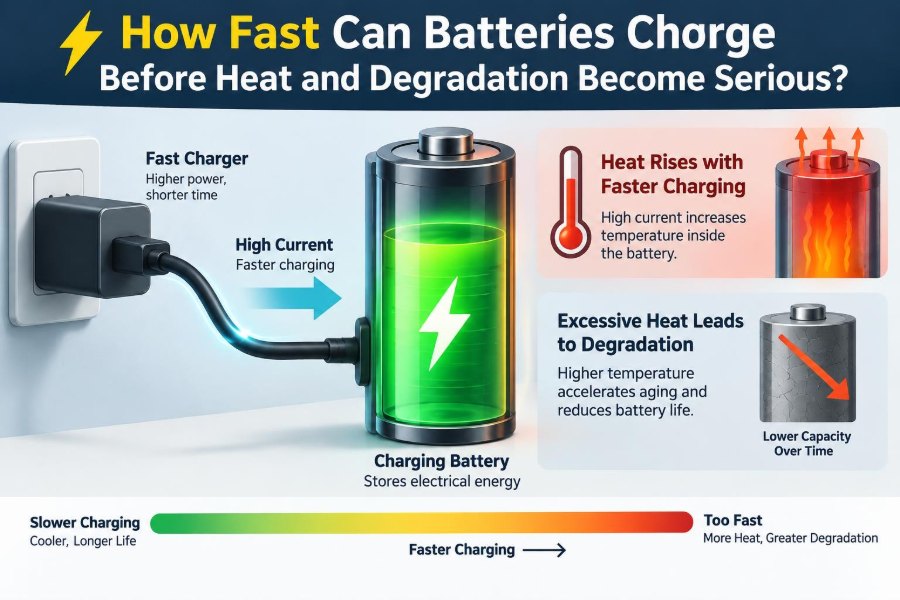

Your phone is at 8% just before you leave home. Plugging it into a high-power charger can turn that anxious wait into a usable charge in minutes, and it is easy to wonder why every battery cannot always charge that quickly.
The same question matters at a larger scale. An electric vehicle owner may plan a road trip around fast-charging stops, while a facility engineer may need to recharge backup batteries without shortening their service life. Faster charging saves time, but the battery is not simply an empty container accepting energy.
Inside a rechargeable cell, ions, electrons, heat, and chemical side reactions must all stay within workable limits. Push the process too hard, and some of the supplied power becomes heat while unwanted reactions begin to compete with the intended one.
The practical question is therefore not “what is the fastest charger available?” It is how much charging current a particular battery can accept at its current temperature, state of charge, age, and cooling condition.
🔋 Charging Speed Is More Than Charger Wattage
A charger’s wattage rating describes what it can offer, not necessarily what the battery will accept. The battery management system, or BMS, negotiates and limits charging power based on measurements such as cell voltage and temperature.
A 100 W USB-C adapter may charge one phone rapidly, another moderately, and a nearly full device slowly. The limiting component could be the cell, charging electronics, cable, connector, or thermal design.
For battery packs, the relevant quantity is usually power delivered to the cells after conversion losses. A high-rated charger does not override electrochemical limits; a well-designed system reduces power when those limits approach.
📏 The Meaning of C-Rate
Engineers often describe charging intensity using C-rate. A 1C charge current would, in an idealized sense, add the battery’s rated capacity in one hour. A 0.5C rate corresponds to two hours, while 2C corresponds to roughly half an hour.
For example, a 5 Ah cell charged at 5 A is at 1C. At 10 A it is at 2C. Actual time differs because charging current normally tapers near full charge and because usable capacity depends on conditions.
C-rate makes comparisons more meaningful than amperes alone. Ten amperes is extreme for a small phone cell but modest for a large electric-vehicle cell.
🧪 A Battery Charges by Moving Ions
In a lithium-ion cell, lithium ions move through the electrolyte from one electrode to the other while electrons travel through the external circuit. During charging, ions must enter suitable locations within the active electrode material, a process called intercalation in many common cell designs.
This movement is not instantaneous. Ions must cross interfaces, diffuse through materials, and distribute reasonably evenly across the electrode. Higher current asks all of those steps to occur faster.
When transport cannot keep up, voltage rises more sharply and the cell experiences concentration gradients: some regions become more charged than others. Those gradients contribute to heat, lower efficiency, and stress.
🔥 Where Charging Heat Comes From
The familiar starting point is resistive heating, often approximated as I²R: current squared times resistance. Doubling current can therefore produce roughly four times the resistive heating in the same resistance.
Cells also generate heat from electrochemical polarization. Polarization is the extra voltage needed to force reactions and ion transport at a chosen current. It reflects kinetic and transport limitations rather than just simple wire resistance.
Contacts, busbars, cables, power electronics, and connectors add their own losses. A fast-charging system must manage the whole thermal path, not merely the temperature inside a cell.
🌡️ Temperature Changes the Rules
Moderately warm cells generally move ions and conduct charge more readily than cold cells. That may reduce some internal resistance, but warmth also accelerates many unwanted chemical reactions. The best charging temperature is therefore a controlled range, not “as hot as possible.”
Cold charging deserves special caution for lithium-ion batteries. At low temperature, ion movement and insertion into the negative electrode become slower. A current that is acceptable at room temperature can become damaging in the cold.
Battery systems use temperature sensors and current limits because a cell’s safe charging capability changes with climate, parking conditions, and recent use.
⚡ Why Voltage Rises During a Charge
Cell voltage is partly a measure of state of charge, but it also rises temporarily when current flows. This temporary rise includes voltage drop across internal resistance and polarization effects.
At high current, the charger may reach the cell’s voltage ceiling before the cell is truly near full. Reducing current allows the voltage to relax and lets charging continue more effectively.
That behavior explains why a battery may seem to charge briskly at first, then slow even before it reaches the last few percent. It is a controlled response to voltage and chemistry, not necessarily a faulty charger.
📈 The Constant-Current Stage
Most lithium-ion chargers begin with a constant-current stage when the battery is within an acceptable voltage range. The charger holds a chosen current while cell voltage climbs.
This is where a pack can receive energy fastest, particularly from a low or moderate state of charge. Even then, current is constrained by the manufacturer’s cell specification, the cooling system, and the pack’s weakest monitored cell.
A deeply depleted lithium-ion pack may first receive a small recovery current. This protects cells that are below their normal operating voltage and allows the charging system to assess their response.
📉 The Constant-Voltage Taper
Once the maximum allowed cell voltage is reached, the charger enters a constant-voltage stage. It holds voltage near that limit and lets current fall naturally as the cell becomes harder to fill.
This taper is fundamental to lithium-ion charging. Forcing the original high current at the voltage limit would risk overvoltage and accelerate unwanted reactions.
Fast charging claims often refer to reaching a partial state of charge, not filling a battery from empty to 100%. The final portion can consume disproportionate time because the system is deliberately reducing current.
🧱 The Solid-Electrolyte Interphase Matters
Many lithium-ion cells rely on a thin protective layer on the negative electrode called the solid-electrolyte interphase, or SEI. It forms during early life and helps prevent the electrolyte from continuously reacting with the electrode.
The SEI is useful but imperfect. It can grow, crack, and reform as the electrode expands, contracts, warms, and ages. Each repair consumes some cyclable lithium and can raise impedance.
High temperature, high voltage, and aggressive charging can increase the conditions that promote side reactions. The result is commonly less available capacity and more resistance over time.
❄️ Lithium Plating Is a Key Fast-Charge Risk
If lithium ions cannot enter the negative electrode quickly enough, metallic lithium can deposit on its surface instead. This is called lithium plating, and it is more likely under combinations of high charge current, low temperature, high state of charge, and aged-cell resistance.
Some plated lithium may be chemically isolated from normal battery operation, reducing capacity. In unfavorable cases, deposits can contribute to internal defects and safety hazards.
Plating is not something a user can reliably detect by watching a charge indicator. This is why conservative cold-weather charging limits and battery preconditioning are engineering safeguards rather than unnecessary inconvenience.
🧓 Aging Raises the Difficulty of Fast Charging
An older battery generally has less capacity and higher internal resistance than it did when new. For a given charging current, greater resistance means greater heat generation and a larger voltage rise.
That does not mean every aged battery is unsafe to charge quickly. It means its BMS may reduce allowable power sooner, and the margin between normal operation and damaging conditions can shrink.
Calendar aging also matters. A battery stored for long periods at high temperature or high state of charge can degrade even with few charge cycles.
🔌 Cell Format Influences Thermal Behavior
Cylindrical, pouch, and prismatic cells package the same broad electrochemical ideas in different mechanical forms. Their heat paths, electrode dimensions, and ability to be cooled can differ substantially.
A large-format cell has fewer interconnections, but heat generated deep inside must still travel outward. A pack built from many smaller cells has more electrical connections yet may offer more surface area for thermal management.
Format alone does not determine fast-charge capability. Electrode design, chemistry, sensor placement, cooling hardware, and control software matter just as much.
🧬 Chemistry Sets Different Limits
Not all rechargeable batteries use the same chemistry. Lithium iron phosphate, nickel-rich lithium-ion variants, lithium titanate, lead-acid, nickel-metal hydride, and sodium-ion batteries each have different voltage behavior, thermal characteristics, and charge acceptance.
Lithium titanate designs are known for strong power capability and can tolerate rapid charging in appropriate systems, though they trade away some energy density. Lead-acid batteries often need careful current and voltage control to limit heating, gassing, and water loss.
Never transfer a charging rule from one chemistry to another merely because both are described as rechargeable. The manufacturer’s charging profile is part of the battery’s safe operating design.
🚗 Why EV Fast Charging Slows Near Full
An electric vehicle pack combines many series and parallel cells. It cannot safely charge faster than its most constrained cell group, and it must keep cell voltages balanced.
At low to medium state of charge, a compatible DC fast charger can deliver high power if the pack is warm enough and the cells can accept it. As cell voltage rises, the BMS reduces current to respect voltage and temperature limits.
This is why charging stops are often planned around a middle range rather than waiting for 100% at every stop. It is a time-efficiency choice, not proof that the vehicle has stopped charging correctly.
📱 Phones Also Use Charging Curves
Phone fast charging is a smaller-scale version of the same problem. The device may use a higher negotiated input voltage, charge-pump circuitry, multiple cells, or a split battery arrangement to reduce stress in parts of the system.
Thin enclosures make heat especially noticeable. A phone may dim its screen, slow charging, or display a temperature message when internal temperature rises.
Using the device heavily while charging adds heat from the processor, display, radio, and battery at the same time. It may not cause immediate damage, but it can make the thermal control system throttle more often.
🏠 Stationary Storage Has Different Priorities
A home battery or backup power system may have more room for cooling and less pressure to recharge in ten minutes. Its design can prioritize cycle life, predictable behavior, and energy throughput over maximum charging speed.
Solar charging adds variability. The battery may receive a gentle partial charge on cloudy days and a higher current around midday, while the inverter coordinates household loads and export limits.
For stationary systems, following the approved inverter and battery configuration is essential. Improvised settings can defeat communication-based current limits or apply an unsuitable voltage profile.
🧊 Cooling Is a System, Not a Fan
Cooling removes heat only after it has traveled from the cell interior through electrode layers, casing, interface materials, and a cooling plate or surrounding air. A powerful fan cannot instantly cool a hot cell core.
Liquid cooling can move heat effectively in high-power packs, while air cooling may be adequate for lower-power products. Both depend on good contact, sensible flow paths, and controls that respond early rather than after temperature has already climbed.
Thermal management also includes heating. Prewarming an EV battery before fast charging in cold weather can improve charge acceptance and reduce plating risk.
🧠 The BMS Makes Dynamic Decisions
A BMS monitors cell voltages, pack current, temperatures, insulation conditions in many high-voltage systems, and often estimated state of charge and health. It uses these measurements to calculate an allowable charging current.
Its limits may change from second to second. A pack arriving hot from a steep climb, for example, may initially accept less fast-charge power than the same pack arriving after a gentle drive.
State estimates are not perfect. Manufacturers include operating margins because sensors have tolerances, cells vary, and electrochemical conditions cannot be measured directly at every microscopic location.
🪫 Cell Balancing Adds Time at the Top
Cells in a series string do not remain identical forever. Small differences in capacity, self-discharge, temperature, and resistance can cause their state of charge to drift apart.
Near full charge, the BMS may use balancing circuits to reduce the mismatch, commonly by bleeding a small amount of energy from higher-voltage cells. This is not a substitute for a healthy pack; it is a maintenance function within a limited correction range.
Stopping at a partial charge does not inherently harm a lithium-ion battery. But occasional full charging may be useful in some products for calibration or balancing when the manufacturer recommends it.
🧯 Heat Is Not the Same as Thermal Runaway
A warm battery during rapid charging is not automatically in a dangerous state. Heat is expected whenever power flows, and well-designed systems measure it and reduce power when necessary.
Thermal runaway is a much more serious self-heating failure process in which heat-producing reactions can accelerate beyond the system’s ability to remove heat. It is associated with severe abuse, defects, damage, or failure conditions, not routine warmth alone.
The correct response to unusual swelling, hissing, smoke, a strong chemical odor, or extreme heat is to stop using the device and follow local safety guidance. Do not puncture, crush, or attempt to repair a damaged lithium-ion battery.
🧾 Read Specifications in Context
A datasheet may list a “standard” charge rate, a maximum charge rate, and a temperature range. These are not interchangeable. Standard conditions often support rated cycle life, while maximum conditions may be allowed only under controlled circumstances.
Look for limits on charge current, charge voltage, and temperature. For battery packs, also verify whether a specified rate assumes active cooling, a particular mounting arrangement, or communication with an approved charger.
The safest number is not a universal C-rate. It is the limit for the exact cell or pack under its actual conditions.
🛠️ Designing for Faster Charging
Engineers seeking faster charging work on several constraints at once: lower-resistance current paths, thinner or more porous electrodes, improved electrolyte formulations, better heat transfer, accurate sensing, and smarter charging algorithms.
There are trade-offs. Electrode changes that improve power may reduce energy density. More cooling adds mass, complexity, and cost. Conservative limits can improve longevity but may disappoint users expecting the highest advertised charging speed.
The strongest designs treat charging as a coordinated electrochemical and thermal control problem, rather than trying to solve it by simply increasing charger output.
🔍 Measuring the Right Temperatures
A temperature sensor placed on a cell surface does not directly measure the hottest point inside the cell. The difference can matter during high-power operation because internal heat takes time to reach the sensor.
Engineers use multiple sensors, thermal models, and conservative current limits to account for this delay. Pack layouts also try to avoid regions where some cells consistently run warmer than others.
For users, this explains why a device may limit charging before it feels very hot externally. The control system may be responding to internal estimates or a nearby component rather than the case temperature alone.
🔄 Charge Cycles Are Not the Whole Story
A “cycle” is often treated as one full equivalent discharge and recharge, but battery wear is not counted perfectly by a single cycle number. Depth of discharge, temperature, charge rate, voltage exposure, and time all influence degradation.
Repeated shallow charging is not automatically worse than occasional full cycles. In many lithium-ion applications, avoiding prolonged high state of charge and excessive heat can be helpful for long-term health.
There is no need to turn ordinary charging into a daily optimization ritual. The practical goal is to avoid the conditions known to stack stress together: high current, high heat, cold charging, and long periods at maximum voltage.
🚫 Common Fast-Charging Mistakes
- Charging a cold battery at full power: Let the device or pack warm into its permitted range, or allow its thermal system to precondition it.
- Using damaged cables or connectors: High resistance at a connection creates localized heat and can interrupt proper power negotiation.
- Covering a device while it charges: Blankets, pillows, and enclosed spaces restrict heat rejection.
- Assuming every USB charger is equivalent: Standards, cable ratings, and device protocols determine what power can be delivered safely.
- Bypassing pack protections: External “boost” methods can defeat the very limits that protect cells and wiring.
✅ Practical Habits for Users
Use a charger and cable intended for the product, particularly for high-power USB-C devices and e-bikes. Keep charging areas clear of insulating materials, direct summer sun, and moisture.
If a phone becomes uncomfortably hot, removing a thick case, stopping demanding apps, or allowing it to cool may help it resume normal charging. Do not place it in a refrigerator or freezer; rapid or uneven cooling can create other problems.
For electric vehicles, use route planning and battery preconditioning features when available. Let the vehicle manage its charging curve rather than repeatedly attempting to force higher power from an incompatible charger.
🧰 Practical Guidance for Engineers
Validate a fast-charge design across the real operating envelope: cold starts, hot ambient conditions, aged cells, cell-to-cell variation, repeated charge sessions, and restricted cooling. A single room-temperature test is not enough.
Instrument more than pack voltage. Cell temperatures, connector temperatures, current distribution, coolant behavior, and voltage dispersion can reveal limitations that an average pack measurement hides.
Design fault handling deliberately. Sensor failures, blocked cooling, communication loss, and abnormal cell imbalance should lead to controlled derating or shutdown rather than continued high-power charging.
⚖️ Fast Charging Is an Optimization Problem
The best charge rate depends on the priority. A delivery vehicle may value short downtime and accept a carefully managed life trade-off. A backup battery may prioritize decades of dependable standby service. A consumer phone must balance convenience, size, price, and acceptable battery aging.
That is why different products can make different reasonable choices. “Faster” is not universally better, and “slower” is not always safer if a charger uses the wrong voltage or lacks basic protection.
A good charging strategy delivers the most energy that the battery can accept under present conditions, while preserving enough margin for uncertainty and normal aging.
🧭 The Core Principle: Respect the Battery’s Limits
Serious heat and degradation do not begin at one magical charging speed. They emerge when current, temperature, voltage, cell condition, and cooling combine to push the battery beyond what its chemistry and design can handle.
C-rate gives a useful language for charging intensity, but it does not replace a cell-specific specification. The current that is routine for one pack can be excessive for another, especially when cold, hot, nearly full, or aged.
The most effective protection is built into the system: suitable cell chemistry, low-resistance hardware, thermal management, accurate monitoring, and a BMS that tapers power when conditions demand it.
Fast charging works best when it is treated as controlled energy transfer, not a race to force electrons into a battery. Choose approved equipment, allow thermal controls to do their job, and recognize that a slower charge at the wrong moment can be the smarter engineering outcome. ⚡🔋🌡️