Skip to content
  • facebook.com
  • twitter.com
  • t.me
  • instagram.com
  • youtube.com
Electrical Engineering

Powering Knowledge. Engineering the Future.

Subscribe
  • Home
  • Online Tools
  • Electrical Engineering App
  • Home
  • magnetic saturation
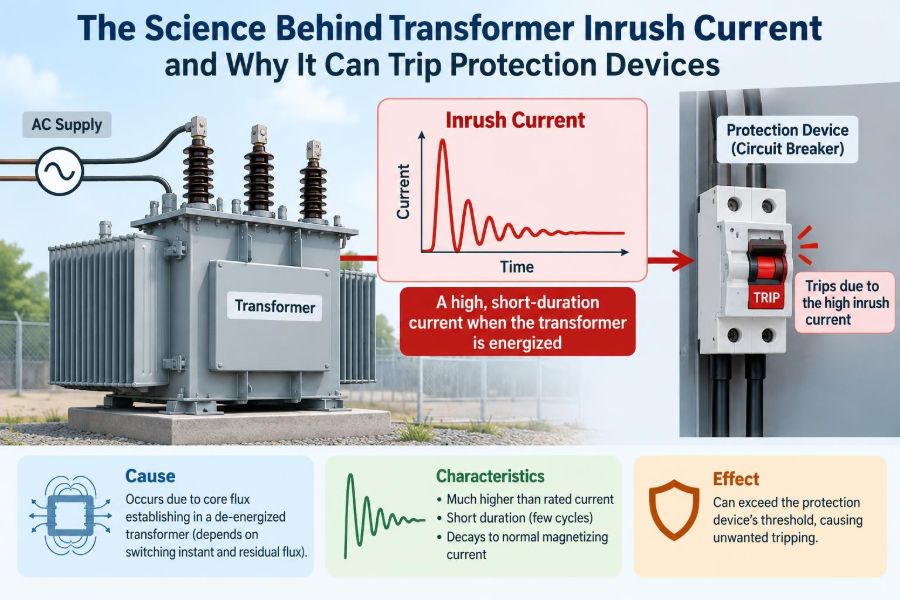
⚡ The Science Behind Transformer Inrush Current and Why It Can Trip Protection Devices
Posted inFeatured

⚡ The Science Behind Transformer Inrush Current and Why It Can Trip Protection Devices

Posted by admin November 23, 2026
A transformer can draw fault-like current the moment it is energized. Learn how flux, saturation, harmonics, and relay settings separate normal inrush from danger. 🧲🛡️⚡
Read More

Recent Posts

  • ⚡ The Science Behind Transformer Inrush Current and Why It Can Trip Protection Devices
  • ⚡ Ground Faults Explained: How Unwanted Current Paths Create Electrical Safety Risks
  • ⚡ Differential Protection Explained: How Electrical Systems Detect Internal Equipment Faults
  • ⚡ Exploring Microgrids: How Local Energy Systems Can Operate Independently from the Main Grid
  • ⚡ What Lies Behind Transformer Protection and How Faults Are Detected Before Serious Damage Occurs

Recent Comments

No comments to show.

Archives

  • November 2026
  • October 2026
  • September 2026
  • August 2026
  • November 2025
  • July 2025
  • May 2025
  • March 2025
  • February 2025
  • January 2025
  • October 2024
  • February 2022
  • December 2021
  • November 2021
  • October 2021
  • August 2021
  • July 2021

Categories

  • Basics
  • Circuit Design
  • Design of electrical machines
  • Digital logic system
  • Display Technology
  • Electric Vehicle
  • Electrical Engg2
  • Electrical machines
  • Electricity
  • Featured
  • High voltage
  • Linear integrated circuits and applications
  • measurement and instrumentation
  • Medical Technology
  • power system
  • Power System Operation and Control
  • Protection Switchgear
  • Renewable Energy Systems
  • Telecommunication systems
  • Transmission and distribution
  • Uncategorized
Copyright 2026 — Electrical Engineering. All rights reserved. Bloghash WordPress Theme
Scroll to Top