
A train glides into a station as office lights brighten, phones begin charging, and a hospital’s monitoring equipment continues its quiet work. None of these moments feels remarkable until the power disappears.
Electricity is often treated as a commodity: something that arrives at a socket, switch, motor, or screen on demand. Behind that apparent simplicity is a carefully designed chain of generation, conversion, transmission, control, protection, and maintenance.
Electrical engineers work across that chain. They do not merely “make power”; they shape how energy is measured, moved, transformed, controlled, and used safely enough to support modern life.
That work is becoming more demanding as grids absorb renewable generation, transport becomes more electric, and digital systems require dependable power. Understanding the engineering principles behind these changes makes the profession—and the infrastructure it creates—far easier to appreciate.
⚡ Electrical Engineering Is the Art of Controlled Energy
Electrical engineering applies mathematics, physics, and design practice to systems involving electricity, electronics, electromagnetism, and information. Its central challenge is control: delivering the right electrical behavior at the right place and time.
That may mean sending megawatts across a transmission network, regulating a tiny voltage inside a medical sensor, or making a motor turn with precise speed and torque. The scale changes, but the engineering logic remains connected.
🔌 From Source to Service
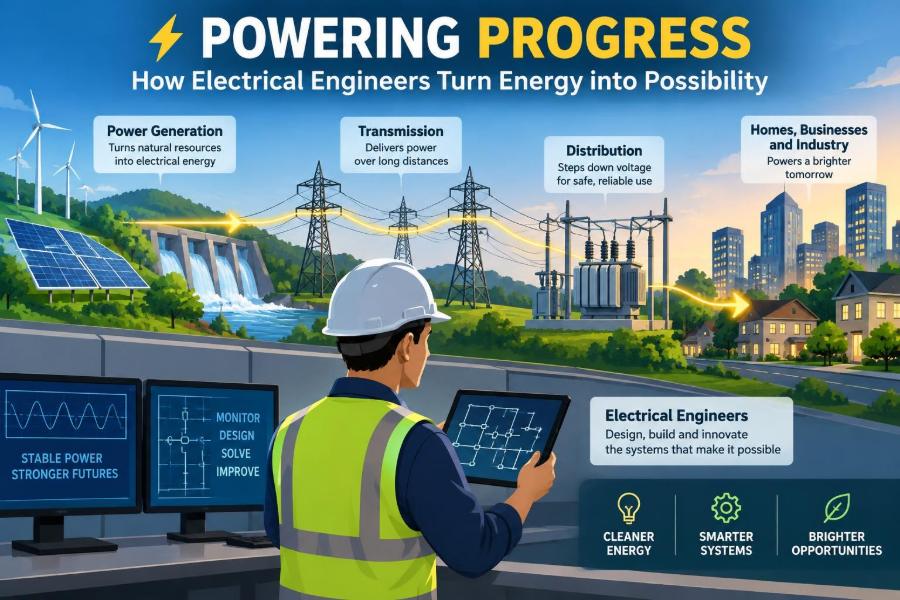
Electricity becomes useful through a chain rather than a single device. A generator or solar inverter supplies energy; transformers adjust voltage; lines and cables carry it; switches and protection devices manage faults; and equipment converts it into light, heat, motion, computation, or communication.
Each link has limits. A design that produces abundant energy but cannot transmit it reliably, or one that supplies a building but cannot isolate a fault, does not meet the full requirement.
🧭 The Core Engineering Question
Engineers repeatedly ask four practical questions: How much power is needed? At what voltage and current? How reliably must it be delivered? What happens when something fails?
These questions turn a broad goal—such as electrifying a factory—into specifications for conductors, transformers, drives, protection settings, backup supplies, and control systems.
📐 Voltage, Current, and Power
Voltage is electrical potential difference, similar to the pressure that drives water through a pipe. Current is the flow of electric charge. Power is the rate at which electrical energy is transferred or used.
For a simple direct-current circuit, power is expressed as P = VI, where P is power, V is voltage, and I is current. Alternating-current systems add factors such as phase angle and power factor, but the basic relationship remains useful.
🔥 Why Higher Voltage Helps Move Power
Conductors have resistance, and resistance produces heat when current flows. That loss is commonly represented by P_loss = I²R. The squared current term is crucial: reducing current can greatly reduce heating losses.
For a given power transfer, raising voltage allows lower current. This is why transmission systems use very high voltages, then transformers step voltage down progressively for local distribution and end use.
🔄 Alternating Current and Direct Current
Alternating current (AC) reverses direction periodically and is widely used in public power systems because transformers can change its voltage efficiently. Direct current (DC) flows in one direction and is fundamental to batteries, electronics, solar photovoltaic output, and many data-center loads.
Neither is universally superior. AC networks are deeply established for distribution, while DC can be advantageous in particular long-distance links, interconnections, battery systems, and electronic equipment. Engineers choose based on distance, conversion needs, cost, controllability, and existing infrastructure.
🏭 Generating Electrical Energy
Many power stations use a turbine connected to a generator. Water, steam, wind, or combustion turns the turbine; electromagnetic induction converts mechanical rotation into electrical energy.
Other technologies convert energy more directly. Solar photovoltaic modules create DC electricity from light, while electrochemical batteries store and release energy through chemical reactions. Their output still needs power electronics and controls before it can serve many real-world loads or interact with a grid.
🌬️ Renewable Energy Changes Grid Behavior
Wind and solar output depends on weather and daylight, not solely on demand. That does not make them unusable; it means the grid must be planned around variability, geographic diversity, forecasting, flexible demand, storage, transmission capacity, and other dispatchable resources.
Traditional synchronous generators naturally contribute rotating inertia to a grid. Inverter-based resources behave differently, so their controls may need to provide functions such as voltage support, frequency response, and fault behavior compatible with system protection.
🔋 Storage Is More Than a Large Battery
Energy storage can shift electricity from one period to another, provide rapid response, or support critical loads during an outage. Batteries are highly visible, but pumped storage, thermal storage, flywheels, and other approaches also serve particular applications.
A storage project is judged by more than energy capacity. Engineers consider power rating, duration, efficiency, cycling behavior, thermal management, fire protection, control strategy, and how the asset will actually be operated.
🏗️ Transmission Builds an Electrical Backbone
Transmission networks connect large generators, substations, and regions. Their purpose is not simply distance; interconnected networks can share resources and offer alternative paths when equipment is unavailable.
Line routing and expansion are difficult engineering tasks because they involve land constraints, environmental conditions, public acceptance, construction logistics, stability studies, and long-term demand forecasts. A conductor alone does not create a reliable corridor.
🏘️ Distribution Delivers the Last Mile
Distribution networks bring power from substations to neighborhoods, commercial premises, farms, and industrial customers. They include feeders, local transformers, switches, underground cables or overhead lines, and service connections.
Distribution design must account for voltage drop, loading, fault levels, future growth, and restoration options. A rapidly growing neighborhood with rooftop solar, heat pumps, and electric vehicles can create load patterns unlike those assumed when its original equipment was installed.
🧲 Transformers Make Voltage Practical
A transformer uses magnetic coupling between windings to change AC voltage. It allows high-voltage transmission and lower-voltage use without requiring moving mechanical parts.
Transformers are major assets, not passive afterthoughts. Their insulation, cooling, loading, protection, and condition monitoring influence reliability. In large installations, a transformer failure can take significant time and planning to remedy.
🧠 Power Electronics Direct the Flow
Power electronics use semiconductor switches to convert and control electrical power. Inverters turn DC into controlled AC; rectifiers turn AC into DC; converters adjust voltage, frequency, or both.
They make variable-speed motor drives, solar inverters, battery chargers, rail traction systems, and many high-efficiency power supplies possible. Their speed and flexibility are valuable, but they also introduce switching effects, heat, harmonics, and control complexity that must be engineered carefully.
⚙️ Motors Turn Electricity into Motion
Motors power pumps, fans, compressors, conveyors, elevators, machine tools, and electric vehicles. Because motor-driven systems consume a substantial share of electricity in many facilities, small control improvements can matter over long operating periods.
Variable-frequency drives let an AC motor operate at a speed suited to the task. For a pump or fan whose demand varies, slowing the motor can be more efficient than running at full speed and restricting flow with a valve or damper.
🏢 Buildings Are Active Electrical Systems
A building’s electrical design includes more than outlets and lighting. Engineers coordinate service capacity, distribution boards, emergency power, fire interfaces, grounding, lighting controls, communications, heating and cooling loads, and increasingly, vehicle charging and local generation.
Good design anticipates change. Leaving physical space, electrical capacity, and pathways for future equipment is often less disruptive than rebuilding a crowded electrical room years later.
💡 Efficiency Means Delivering the Same Service with Less Waste
Energy efficiency is not synonymous with using less electricity in every circumstance. It means reducing unnecessary losses while preserving the useful outcome: adequate illumination, comfortable temperature, required production, or reliable computing.
Examples include efficient motors, appropriately sized transformers, insulation, lighting controls, optimized compressed-air systems, and demand-responsive operation. The best option depends on operating hours, maintenance capability, process requirements, and upfront constraints.
📊 Measuring Comes Before Managing
Engineers use meters, sensors, data acquisition systems, and power-quality analyzers to understand how a system behaves. Measurements reveal peak demand, voltage variations, energy use by process, harmonics, unbalanced phases, and unusual operating patterns.
Without a meaningful baseline, claims of improvement are difficult to evaluate. A meter alone is not insight; data must be interpreted in the context of weather, production volume, occupancy, equipment schedules, and known changes to the system.
🎛️ Control Systems Keep Processes Stable
A control system compares a measured condition with a desired condition and adjusts an input to reduce the difference. A thermostat is a familiar example, but industrial control may regulate pressure, speed, temperature, position, or chemical processes.
Feedback control can improve consistency and efficiency, yet poor tuning may cause oscillation or slow response. Electrical engineers work alongside mechanical, process, and software specialists to make control behavior stable under real operating conditions.
🛡️ Protection Limits the Damage of Faults
A short circuit or insulation failure can produce extremely high current and intense heat. Protective devices such as fuses, circuit breakers, relays, and reclosers detect abnormal conditions and disconnect the affected portion of the system.
Protection coordination aims to isolate the smallest practical section first. If a fault occurs on one branch circuit, the branch device should operate before an upstream main breaker disconnects an entire facility.
🌍 Grounding Supports Safety and Performance
Grounding and bonding create intended paths for fault current and help keep exposed conductive parts near the same electrical potential. Their exact design depends on the system, local rules, soil conditions, equipment, and fault calculations.
Grounding is not simply attaching a wire to earth. An inadequate or misunderstood grounding scheme can leave protective devices unable to operate as intended, create touch-voltage hazards, or introduce noise into sensitive equipment.
⚠️ Arc Flash Requires Deliberate Risk Control
An arc flash is an electrical arc fault that releases intense heat, light, pressure, and molten material. It can occur during equipment failure or certain work activities, especially when energized equipment is exposed or disturbed.
Risk reduction combines engineering and work practice: equipment design, fault-current and protective-device studies, labeling where required, maintenance, isolation, verification of absence of voltage, appropriate procedures, and qualified personnel. Exact requirements vary by jurisdiction and workplace rules.
🌊 Power Quality Affects Sensitive Equipment
Power quality describes how well voltage, frequency, waveform, and supply continuity meet a load’s needs. Dips, swells, outages, transients, harmonics, and phase imbalance can disrupt controls, overheat equipment, or shorten component life.
The solution is not always “install a bigger UPS.” Engineers first identify the disturbance, its source, its path, and the affected load. Remedies may include surge protection, filtering, improved grounding, separate feeders, ride-through equipment, or changes to the source system.
🧩 Reliability Is Designed in Layers
Critical services may need redundancy: alternative sources, standby generators, battery backup, duplicate feeders, or equipment that can continue operating after one component fails. The appropriate level depends on consequences, budget, maintenance, and realistic failure scenarios.
More redundancy is not automatically better. Unnecessary complexity can create maintenance burdens and hidden failure modes. Reliable systems are understandable, testable, and supported by operating procedures.
🔧 Maintenance Preserves the Design Intent
Electrical equipment ages through heat, moisture, vibration, contamination, switching duty, corrosion, and normal wear. Inspection, cleaning, torque checks, insulation testing, thermal scanning, and functional testing can reveal conditions before they become outages.
Maintenance should be risk-based rather than purely calendar-based where practical. A rarely used emergency generator, for example, still needs testing because its value is concentrated in the moment the normal supply fails.
🖥️ Automation Connects Electrical and Digital Worlds
Modern electrical systems increasingly communicate through sensors, programmable controllers, supervisory software, and remote monitoring. Automation can improve restoration, reveal developing faults, and coordinate distributed energy resources.
Connectivity also creates cybersecurity responsibilities. Engineers must consider access control, network segmentation, software updates, vendor support, and the consequences of losing communications. A control system should fail in a predictable, safe way rather than assuming every network connection will always be available.
🚗 Electrification Shifts Demand Rather Than Erasing It
Electric vehicles, electric heating, and industrial electrification can reduce reliance on direct fuel combustion in many uses. They also transfer demand onto electrical infrastructure, often at times when local networks are already heavily loaded.
Smart charging, managed heating, time-sensitive tariffs, local storage, and upgraded feeders can help. The engineering question is not whether one device is “good” or “bad,” but whether the system can serve its load safely, affordably, and reliably.
🧪 Simulation Helps Before Steel Is Installed
Power-flow studies estimate voltage and loading across a network. Short-circuit studies estimate fault currents. Stability and transient studies examine how systems react to disturbances. Thermal models, electromagnetic models, and control simulations address other design questions.
Models are only as useful as their assumptions and input data. Engineers validate them against measurements where possible and update them as equipment, settings, and operating conditions change.
🧰 A Practical Design Workflow
Sound electrical engineering usually follows a disciplined sequence rather than beginning with a favorite product or diagram.
- Define the service, process, safety, reliability, and future-growth requirements.
- Estimate loads and operating scenarios, including normal, peak, and contingency conditions.
- Select an architecture for sources, distribution, conversion, control, and protection.
- Analyze voltage drop, fault levels, coordination, thermal limits, power quality, and resilience.
- Document the design clearly, then test and commission it before handover.
- Plan how the system will be operated, maintained, modified, and eventually replaced.
Real projects iterate. A late discovery about available utility capacity, equipment lead time, physical space, or safety clearance may require the architecture to change.
🚫 Common Mistakes That Create Expensive Problems
- Designing only for today’s load: this can leave no capacity for process growth, charging, or electrified heating.
- Ignoring installation conditions: ambient temperature, cable grouping, enclosure ventilation, and corrosive environments affect equipment ratings.
- Treating protection as a final checklist: protection settings must match the actual equipment and network configuration.
- Collecting data without ownership: alarms and dashboards help only when someone understands what actions they should trigger.
- Assuming identical equipment behaves identically: control settings, wiring, maintenance history, and operating context matter.
🤝 Electrical Engineering Is a Team Discipline
Electrical decisions affect architects, civil engineers, mechanical designers, operators, technicians, IT teams, safety professionals, regulators, and end users. A technically correct schematic can still fail as a project if cable routes are inaccessible, control interfaces are confusing, or maintenance windows are unrealistic.
Clear drawings, calculations, specifications, commissioning records, and honest communication are therefore engineering deliverables—not paperwork added after the technical work is complete.
🎓 Skills That Matter for Emerging Engineers
Fundamentals remain the foundation: circuit analysis, electromagnetics, machines, signals, controls, and safety. Software tools are valuable, but a result from a simulation or spreadsheet should be questioned when it conflicts with physical intuition.
Professionals also benefit from learning to read drawings, write requirements, analyze data, explain risk plainly, and work across disciplines. The ability to translate between a technical calculation and an operational decision is especially valuable.
🌱 Progress Depends on Whole-System Thinking
A solar array, battery, motor drive, or electric vehicle is not an isolated symbol of progress. Each becomes useful when it fits within a system that has suitable conductors, controls, protection, operating practices, and people able to maintain it.
Electrical engineers turn energy into possibility by seeing those connections. They balance efficiency with resilience, innovation with proven practice, and ambitious goals with the physical realities of voltage, heat, materials, and human safety.
✨ The Core Takeaway: Make Energy Useful, Safe, and Dependable
Electrical engineering is ultimately about converting available energy into dependable service. That service may be a safe operating room, a productive factory, a connected community, or a cleaner way to move people and goods.
The strongest solutions do not chase a single metric. They combine sound fundamentals, measured evidence, careful protection, maintainable design, and enough flexibility to serve needs that will change over time.
When electrical engineers design the whole system—not just the device—energy becomes a practical foundation for human capability and progress. ⚡🔧🌍