
A production line is meeting its target, but the electrical room is running hot. A commercial building has enough lighting and cooling, yet the utility bill keeps rising. A pump station delivers the required flow, but motors hum continuously at full speed even when demand changes.
These situations are common because energy efficiency is often mistaken for doing less: dimming lights, slowing machines, reducing comfort, or accepting lower throughput. That is only one approach, and often not the best one.
A better goal is to deliver the same useful output with fewer electrical losses. In engineering terms, this means improving how power is converted, distributed, controlled, and used—without compromising capacity, quality, safety, or reliability.
The opportunity is rarely a single “magic” upgrade. It is usually a disciplined process of measuring waste, correcting the largest causes, and verifying that the system still performs its intended job.
⚙️ Define Output Before Trying to Save Energy
Energy efficiency only has meaning when output is clear. For a factory, output may be parts produced within specification. For an HVAC system, it may be indoor temperature, humidity, and ventilation. For a pumping system, it may be delivered flow and pressure.
Start with a measurable service result, then compare it with energy used. A machine that consumes less electricity but produces more rejects has not become meaningfully efficient.
The target is not minimum power consumption; it is minimum energy per unit of useful work. Useful indicators include kilowatt-hours per product, energy per cubic metre pumped, or energy per occupied floor area while maintaining agreed comfort conditions.
📏 Establish a Reliable Energy Baseline
Before changing equipment, establish how the system behaves now. Collect enough data to capture normal operating variation: production schedules, weather, occupancy, product mix, and seasonal loads can all change electrical demand.
A useful baseline combines energy data with output data. Monthly utility bills show broad trends, but submetering major loads often reveals where the energy is actually going.
- Record real power in kilowatts and energy in kilowatt-hours.
- Track demand peaks where demand charges or capacity limits matter.
- Log operating hours, load level, and production or service output.
- Note abnormal events such as maintenance shutdowns or process changes.
Without this reference point, a claimed saving can be confused with reduced activity rather than an actual improvement.
🔍 Build an End-Use Energy Map
An electrical single-line diagram shows how power flows physically. An energy map adds a different question: where is it being consumed, and what useful task does each load perform?
List large motors, compressors, heaters, chillers, lighting circuits, IT equipment, and process loads. Then identify control equipment, transformers, feeders, and backup systems that influence their losses.
Prioritize loads by both size and run time. A modest motor operating continuously may use more annual energy than a large machine used only occasionally. This prevents teams from focusing only on the most visually impressive equipment.
📊 Measure Real Load Instead of Relying on Nameplates
Nameplate ratings describe allowable or rated conditions, not necessarily actual operation. A 30 kW motor may draw far less during much of its duty cycle, while a heavily loaded motor may run close to its rated input.
Use appropriate instruments—such as power analyzers, clamp meters, data loggers, and building-management trends—to measure voltage, current, real power, power factor, and operating time. Measurements must be taken safely by qualified personnel, especially inside energized panels.
Real measurements can expose oversized equipment, persistent idle operation, phase imbalance, harmonic distortion, and unnecessary peak demand. They also reveal whether a proposed upgrade addresses an actual loss.
🔥 Understand Where Electrical Energy Becomes Loss
Not all consumed electricity reaches the intended process. Some is converted into unwanted heat in conductors, transformers, motors, electronic drives, and poor connections. Other losses arise because equipment runs when no useful work is needed.
Resistive losses follow the familiar relationship P = I²R. Because current is squared, a relatively small reduction in current can noticeably reduce conductor and connection heating.
There are also process-level losses. Throttling a pump to restrict excessive flow, for example, wastes energy even if the motor and cable are in good condition. Efficient systems address both electrical losses and mismatched operating methods.
🧭 Match Equipment Capacity to the Actual Duty
Oversizing is frequently chosen to provide a safety margin, accommodate future expansion, or avoid uncertainty during design. Some margin is sensible. Excessive margin can leave motors, transformers, pumps, fans, and power supplies operating far from their efficient range.
Equipment behavior varies by technology, so there is no universal “ideal loading” number. The practical question is whether the selected capacity fits the normal and peak duty without chronic underloading, overheating, unstable control, or frequent overload trips.
Reviewing measured demand against installed capacity can identify candidates for right-sizing. Future requirements must be considered carefully; replacing equipment too aggressively can create a new reliability problem.
🔄 Improve Motor System Efficiency
Motor systems deserve special attention because motors drive pumps, fans, conveyors, compressors, mixers, and machine tools. The system includes more than the motor itself: it also includes transmission, driven equipment, controls, and the process being served.
A high-efficiency replacement motor can reduce losses, particularly when an older motor fails or operates for long hours. But changing only the motor may deliver limited savings if the driven machine is oversized, misaligned, or controlled poorly.
Inspect bearings, belt tension, coupling alignment, lubrication practices, and mechanical drag. These details affect the torque the motor must produce, which directly affects electrical input.
🎚️ Use Variable-Speed Drives Where Flow Must Vary
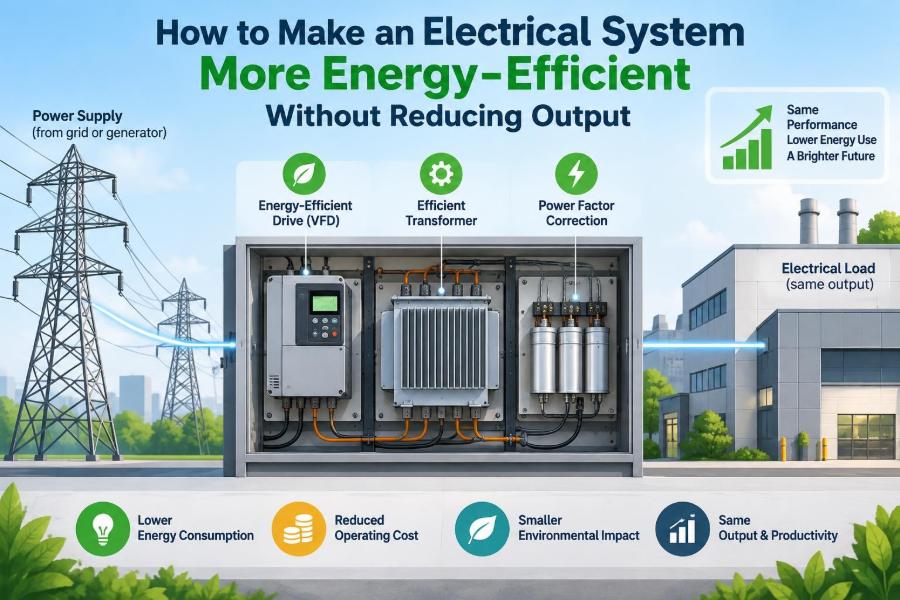
Many pumps and fans are controlled by dampers, throttling valves, bypass lines, or repeated start-stop cycles. A variable-frequency drive, commonly called a VFD, adjusts motor speed to better match changing demand.
For suitable centrifugal pumps and fans, reducing speed can reduce required power substantially because of the system’s affinity relationships. The exact benefit depends on the system curve, static head, duty cycle, and control strategy.
VFDs are not automatic efficiency devices. They add electronic losses and may introduce harmonics, electromagnetic compatibility concerns, bearing-current issues, or cooling challenges at low speed. Select and commission them as part of the full motor system.
💨 Eliminate Throttling and Bypass Waste
When a pump produces more flow than needed and a valve restricts it, the system still expends energy creating that excess pressure and flow. Similarly, a bypass line may recirculate fluid simply to keep a machine within an operating limit.
The same pattern appears in fans controlled by dampers and compressed-air systems controlled by artificial demand. Better control may involve speed adjustment, smaller parallel equipment, revised setpoints, or redesigned piping.
Before modifying a process, verify required pressure, minimum-flow protection, pump stability, and safety interlocks. A reduction in throttling should never compromise equipment protection.
🌬️ Treat Compressed Air as a Managed Utility
Compressed air is convenient, but producing it usually requires far more electrical energy than users expect. Leaks, excessive pressure, inappropriate end uses, and poor sequencing between compressors can turn it into a major avoidable load.
Walk the system during quiet periods and listen for leaks, then confirm and prioritize repairs with suitable detection methods. Also examine whether air is being used for cooling, cleaning, agitation, or vacuum tasks that could be served more efficiently by another method.
Reducing pressure setpoints can help only when every end-use device still performs correctly. Pressure should be treated as a process requirement, not a rough substitute for insufficient pipe capacity or poor maintenance.
💡 Design Lighting Around the Task
Efficient lighting is not merely lower wattage. It is sufficient light on the task, appropriate distribution, controlled glare, good colour rendering where inspection matters, and reliable operation.
Modern efficient luminaires can reduce input power while maintaining or improving illumination, but layout matters. Replacing fixtures one-for-one without checking mounting height, beam distribution, surface reflectance, and work-plane light levels can create dark zones or excessive glare.
Occupancy sensors, daylight controls, and scheduled zoning are useful where spaces are intermittently used. In constantly occupied areas, controls should be chosen for stability and user acceptance rather than complexity alone.
🌡️ Reduce Heating and Cooling Loads First
Electrical HVAC equipment must overcome heat entering through walls, roofs, windows, doors, ventilation air, equipment, and people. Improving the building or process envelope reduces the load before the electrical system has to supply it.
Repairing air leaks, improving insulation, managing solar gain, maintaining filters, and sealing duct leakage can lower required heating or cooling while preserving comfort. These measures may also allow equipment to operate at lower fan speeds or with fewer compressor cycles.
For process cooling, insulating cold surfaces and reducing unwanted heat sources can be just as valuable. The best electrical saving is often heat that never enters the conditioned space.
🧊 Optimize Setpoints and Deadbands Carefully
Setpoints define desired operating conditions; deadbands define the range in which no corrective action is required. Poorly coordinated controls can make heating and cooling systems fight each other, or cause frequent cycling near a narrow threshold.
Adjustments should be based on the real process need. A laboratory, server room, food process, and general office have different tolerances. Wider control bands may save energy in some applications but are unsuitable where precision or product quality is essential.
Trend data before and after changes. A stable, well-tuned control sequence is usually more valuable than a collection of aggressive setpoint changes.
🔌 Lower Distribution Losses Without Sacrificing Reliability
Distribution losses increase with current, conductor resistance, poor terminations, and unnecessary distance. High-current circuits deserve particular attention because heating at joints and cables can waste energy and shorten component life.
Possible improvements include shortening unnecessarily long runs during redesign, selecting adequately sized conductors, balancing loads across phases, and maintaining clean, correctly torqued connections. Connections must be serviced according to approved procedures; loose energized hardware is a serious hazard.
Do not reduce conductor size merely to cut project cost. Electrical design must continue to meet ampacity, voltage-drop, fault-duty, installation, and code requirements.
⚖️ Balance Three-Phase Loads
In a three-phase system, uneven loading causes unequal phase currents. This can increase neutral current, create additional losses, reduce available capacity, and contribute to voltage imbalance.
Voltage imbalance can be especially harmful to three-phase motors because it produces disproportionately uneven currents and heating. The source may be uneven single-phase loads, poor connections, supply issues, or improperly distributed circuits.
Measure rather than assume. Rebalancing circuits may be straightforward, but the work should be planned so that phase loading, protection coordination, and operational continuity are preserved.
🔋 Correct Power Factor for the Right Reason
Power factor describes how effectively current is converted into useful real power. Inductive loads such as motors can require reactive power, which supports magnetic fields but does not perform useful work at the load.
Low power factor can raise current for a given real-power demand, increasing distribution losses and using capacity in cables, transformers, and switchgear. Capacitor banks or active correction systems can reduce this burden in appropriate systems.
Power-factor correction does not directly reduce the kilowatt demand of a motor’s mechanical work. It must also be evaluated for harmonics, switching transients, resonance, and changing load conditions. Incorrect capacitor application can create operational problems.
〰️ Manage Harmonics from Nonlinear Loads
Nonlinear loads, including many electronic power supplies, rectifiers, LED drivers, and VFDs, draw current in pulses rather than as a smooth sinusoid. This can create harmonic currents that add heating and affect voltage quality.
The impact depends on the installation. Some systems operate well with ordinary mitigation practices; others need harmonic studies, line reactors, filters, multipulse arrangements, or active harmonic conditioning.
Symptoms can include overheated transformers or neutrals, nuisance trips, abnormal capacitor-bank behavior, and unreliable sensitive equipment. The solution should follow measurement and analysis, not a generic hardware purchase.
🧠 Automate Shutdowns, Not Essential Service
Idle energy is often overlooked because a load appears small at any moment. Across nights, weekends, and changeovers, unattended equipment can accumulate significant energy use.
Use schedules, occupancy signals, production status, and permissive logic to shut down or place equipment in a low-energy state when it has no purpose. Examples include local exhaust fans, conveyors, display lighting, and auxiliary pumps.
Every automatic shutdown needs a restart strategy. Consider freeze protection, ventilation requirements, maintenance access, startup sequencing, data retention, and whether a sudden restart could be unsafe or disruptive.
⏱️ Reduce Peak Demand Through Sequencing
Energy use is measured in kilowatt-hours, while peak demand concerns the highest rate of electrical use over a defined interval. A system can use the same total energy but create a larger demand peak if major loads start or operate together.
Staggering motor starts, sequencing compressors, preconditioning thermal loads, and avoiding simultaneous electric heating can reduce unnecessary peaks. The operational result remains the same, but the electrical infrastructure experiences a smoother load profile.
Demand management is not simply delaying work. It requires understanding deadlines, process constraints, utility billing arrangements, and the risk that shifted loads will create a new peak later.
🛠️ Make Preventive Maintenance an Efficiency Tool
Wear, dirt, leakage, friction, loose connections, and degraded controls steadily increase energy use. Maintenance teams often notice the reliability consequence first, but the energy consequence begins earlier.
Useful routines include cleaning heat-transfer surfaces, replacing blocked filters, repairing compressed-air leaks, inspecting belts and bearings, checking electrical terminations, and calibrating sensors. Condition monitoring can help direct work toward equipment showing abnormal temperature, vibration, current, or runtime patterns.
Maintenance does not replace design improvement, but it protects the performance expected from efficient equipment.
📈 Use Submetering and Trends to Find Drift
One-time audits identify obvious opportunities. Continuous or periodic submetering identifies gradual drift: a compressor running longer, a chiller cycling differently, a production line consuming more energy per unit, or a ventilation system left in manual override.
Useful dashboards connect energy to context. A raw power graph can be misleading; power plotted against production rate, outdoor temperature, or occupancy makes abnormal behavior easier to recognize.
Set practical alerts for unusual baseload, excessive overnight operation, or deviations from expected energy intensity. Review alarms so frequently that they become useful, but not so frequently that staff ignore them.
🧪 Verify Savings After Each Change
Verification answers a simple question: did the improvement actually reduce energy while maintaining output? Compare post-change performance with the baseline under reasonably similar conditions, adjusting for variables such as production volume or weather where necessary.
Also check quality, comfort, equipment temperatures, pressure, flow, and operator feedback. An intervention that saves power but increases downtime or rejects is not a complete success.
For complex projects, a formal measurement-and-verification plan should define meters, data intervals, baseline assumptions, adjustment methods, and acceptance criteria before work begins.
🧰 Choose Projects by Total System Value
Projects should not be ranked only by estimated kilowatt-hours saved. Consider reliability, safety, maintenance burden, process resilience, implementation downtime, and interaction with future upgrades.
| Project type | Typical strength | Key caution |
|---|---|---|
| Control optimization | Often low disruption and fast feedback | Must preserve process limits |
| Maintenance repair | Restores lost performance | May not solve poor original design |
| Equipment replacement | Can improve efficiency and reliability | Requires sound duty sizing |
| System redesign | Can address root causes | Needs careful engineering and commissioning |
A modest control change can sometimes outperform an expensive replacement because it eliminates wasted operating hours or excess process demand.
🚫 Avoid Common Efficiency Mistakes
Efficiency work fails when changes are treated as isolated component swaps. Replacing a motor, installing capacitors, or adding a VFD without studying the system can shift problems rather than solve them.
- Using runtime assumptions instead of logged operating data.
- Optimizing for low energy while ignoring output quality.
- Oversizing new equipment “just in case.”
- Disabling safeguards to stop nuisance cycling.
- Making control changes without documenting original settings.
- Ignoring harmonics, protection coordination, or power quality.
Electrical safety, applicable codes, manufacturer instructions, and qualified design review remain non-negotiable.
👷 Involve Operators and Maintenance Staff
Operators know which loads are essential during different production states. Maintenance staff know which valves stick, which motors run hot, and which overrides are routinely used to keep the process moving.
Involving both groups early makes energy projects more realistic. It also reduces the risk of controls being bypassed because they interfere with actual work.
Document operating modes in plain language: normal production, idle, cleaning, startup, emergency, and maintenance. Each mode can have different energy needs and different acceptable control actions.
🧩 Design for Commissioning and Future Adjustment
An efficient system must remain understandable. Provide metering points, accessible isolation, clear labels, trend logs, adjustable but protected setpoints, and documentation of control sequences.
Commissioning should test more than whether equipment turns on. It should confirm response at part load, transitions between modes, protective functions, sensor accuracy, and behavior after a power interruption.
Future changes in occupancy, production, or equipment can alter the original optimum. Systems that are measurable and adjustable can be retuned rather than replaced prematurely.
🛡️ Keep Safety and Resilience in the Design
Energy optimization must never weaken electrical protection, emergency ventilation, life-safety systems, thermal limits, or safe maintenance practices. A lower-energy operating mode is only acceptable if it remains safe under normal and foreseeable fault conditions.
Resilience also matters. Some redundancy consumes additional standby energy but protects a critical process or service. The right choice depends on the consequence of failure, not on a simplistic rule that every duplicate component is wasteful.
When working on electrical distribution, use qualified personnel and established lockout, isolation, testing, and arc-flash safety procedures.
🏁 The Core Principle: Remove Waste, Preserve the Service
Making an electrical system more energy-efficient without reducing output is a system-engineering task. Measure the useful result, locate losses and unnecessary runtime, then improve equipment selection, controls, maintenance, and distribution together.
The most durable gains usually come from matching supply to demand: the right capacity, at the right speed, pressure, temperature, voltage quality, and operating time. That approach reduces wasted energy while protecting the performance people actually depend on.
Efficiency is achieved not by asking the system to do less, but by preventing it from working harder than the required output demands.
Start with sound measurements, make changes that respect the whole system, and verify performance afterward. Energy savings then become a repeatable engineering result rather than a temporary reduction in service. ⚡🔧📉