
Picture a neighborhood at 6 p.m. People arrive home, plug in their electric vehicles, switch on lights, start cooking, and perhaps run air conditioning or heating. That same hour is often demanding for the electricity network.
Now picture a different response: instead of sitting idle, thousands of plugged-in vehicle batteries briefly supply some power back to homes or the local grid. The vehicles still have enough energy for their owners’ next trips, but together they help smooth a difficult peak.
This is the promise of vehicle-to-grid, usually shortened to V2G. It turns an electric vehicle from a one-way electricity customer into a controllable energy resource—at least when its owner agrees and the technical conditions are right.
The idea is compelling, but reliability in a power network is a much higher bar than simply proving that a car can discharge through a charger. Whether V2G becomes routine depends on power electronics, battery management, market rules, communications, customer trust, and careful grid planning.
🔌 What Vehicle-to-Grid Actually Means
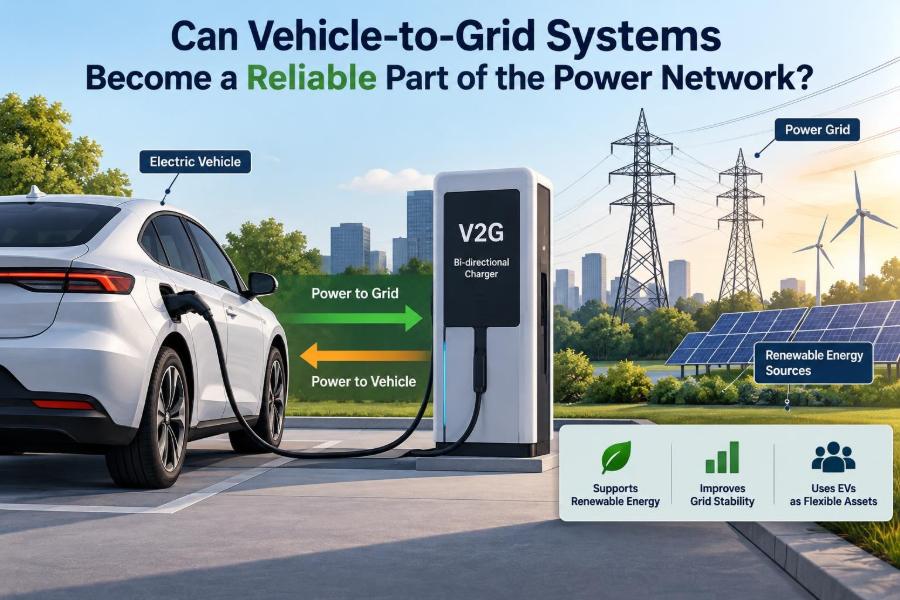
V2G is a form of bidirectional charging. Electricity can flow from the grid into an EV battery while charging, and from the battery back through approved equipment when the vehicle is asked to export power.
That exported power may serve several destinations. It can support the wider utility grid, reduce demand at a commercial site, or supply a building during an outage. These uses are related but should not be treated as identical.
- V2G: energy or grid services delivered to the utility network.
- Vehicle-to-home (V2H): a vehicle supports a home, commonly as backup or to reduce purchased power at selected times.
- Vehicle-to-building (V2B): a vehicle supports a workplace, depot, campus, or other facility.
A car powering a few appliances during an outage demonstrates useful capability. It does not, by itself, prove that thousands of vehicles can provide a dependable, grid-operated service.
⚙️ Why the Grid Needs Flexible Resources
Electricity systems must continually balance generation and demand. Frequency is one visible indicator of that balance: if demand suddenly exceeds supply, frequency tends to fall; if supply is excessive, it tends to rise.
Conventional power plants have long provided much of the flexibility needed to keep that balance. As electricity demand changes and variable wind and solar generation grows, grids also need fast, distributed resources that can adjust consumption or output.
EV batteries are attractive because they can respond rapidly through power electronics. Their value is often less about supplying energy for many hours and more about providing the right amount of power at the right time.
🔋 The Battery Is Energy Storage, Not an Unlimited Fuel Tank
An EV battery has two constraints that are easy to confuse: energy capacity, measured in kilowatt-hours, and power capability, measured in kilowatts. Capacity tells us how long a battery can supply a load; power tells us how quickly it can supply it.
A fleet might have ample stored energy in total but limited export power because chargers, cables, or local transformers impose limits. Conversely, vehicles may provide a short burst of high power without being suitable for a long evening peak.
Battery state of charge also matters. A vehicle at a low state of charge should normally prioritize its driver’s mobility needs, while one parked for many hours with spare energy is a better V2G candidate.
🔄 Charging and Discharging Need Different Hardware
Most EV charging is one-way: alternating-current power from the grid is converted and controlled to charge the battery. V2G requires an inverter system that can safely reverse the direction of useful power flow while meeting grid-quality requirements.
Bidirectional operation may be delivered through an off-board DC charger or, in some vehicle designs, through onboard electronics. Compatibility depends on the vehicle, the connector system, the charger, software support, and local interconnection requirements.
Not every EV advertised as electrically capable of external power can automatically participate in a utility V2G program. The equipment must be certified and configured for that specific operating mode.
🧭 A Simple Evening-Peak Example
Consider a hypothetical fleet of delivery vans that returns to a depot in mid-afternoon. The vehicles will not leave again until morning, and the operator knows the minimum charge each van needs for its routes.
During a local evening peak, a control system could pause some charging and ask selected vans to export a limited amount of power. Later, when demand falls, the vans recharge to their scheduled departure targets.
This is a stronger V2G use case than asking commuters to participate unpredictably. Fleet managers know where vehicles are, when they are parked, and what energy must be reserved for work.
📈 Power Services Can Matter More Than Bulk Energy
Grid operators procure different services. Some address second-to-second frequency changes; others reduce demand over a peak period or help manage voltage on a distribution feeder.
For brief balancing services, a battery can move from charging to discharging very quickly. The actual energy exchanged may be modest even though the response is valuable because speed is difficult for some conventional resources.
For multi-hour supply, the trade-off becomes tougher. A vehicle battery must retain enough energy for transport, and a large number of parked, available vehicles is needed to make a material contribution.
🎛️ Aggregators Turn Individual Cars into a Resource
A single car is usually too small and too uncertain for direct participation in many grid programs. An aggregator coordinates many vehicles and presents their combined capability as one managed resource.
The aggregator receives a grid request, estimates which connected vehicles can respond, dispatches them within agreed limits, and verifies the delivered service. It also needs to manage customer preferences, payment calculations, and failures in communications.
Aggregation reduces the impact of any one driver unplugging early. It does not eliminate uncertainty, so reliable programs require conservative forecasts and reserves.
📡 Communication Is Part of the Power System
V2G is not only an electrical connection. It is a connected control system. Chargers, vehicles, site energy-management systems, aggregators, and utilities may all exchange information.
Useful data can include connection status, state of charge, requested departure time, charger power limit, pricing signal, and permission to export. Controls must also recognize when communication is lost and move to a safe default state.
A reliable V2G system should not depend on perfect internet availability. It needs defined behavior for delays, partial outages, conflicting commands, and local safety events.
🛡️ Cybersecurity Cannot Be an Afterthought
Remote control of thousands of chargers creates a cybersecurity concern. An attacker that manipulates charging schedules could create local overloads, disrupt a service commitment, or affect customer mobility.
Practical defenses include authenticated devices, encrypted communications, software-update management, access controls, monitoring, and segmentation between operational technology and ordinary business networks. Security also includes the ability to revoke compromised credentials quickly.
The most useful design principle is restraint: no system should grant more control or collect more personal data than its function requires.
🏠 The Local Transformer Is Often the Real Bottleneck
It is tempting to evaluate V2G using national generation capacity. Yet many constraints occur much closer to customers: in service cables, neighborhood transformers, feeder conductors, and voltage-control equipment.
Simultaneous charging can raise local demand, while simultaneous export can reverse expected power flow. Either direction may exceed equipment ratings or push voltage outside acceptable operating ranges if the network was not designed for it.
V2G can help a constrained feeder when it is targeted carefully. Uncoordinated V2G could worsen the same feeder’s problems, which is why local grid visibility is so valuable.
⚡ Voltage Support Has Limits and Opportunities
Distribution voltage changes with power flows along lines and cables. Modern inverters can often control not only real power, measured in kilowatts, but also reactive power, which helps manage voltage without consuming battery energy in the same way.
This makes EV chargers potentially useful for local voltage support. However, the charger’s apparent-power rating limits the combined real and reactive power it can provide.
Utilities must coordinate inverter settings with existing voltage regulators and capacitor banks. Otherwise, well-intended devices can react against one another and cause unnecessary switching or unstable behavior.
🧯 Protection Must Still Isolate Faults Correctly
Electricity networks use protective devices to detect faults and disconnect damaged sections quickly. These schemes are designed around assumptions about where fault current comes from and how it behaves.
Inverter-based resources, including V2G chargers, do not respond like large rotating generators. Their fault-current contribution is limited and controlled, which may affect detection and coordination methods.
Before widespread deployment, engineers need studies for anti-islanding, fault detection, grounding, reconnection, and abnormal grid conditions. Keeping people and line workers safe takes priority over extracting flexibility from batteries.
🌐 Islanding Is Useful Only When Designed Deliberately
An electrical island occurs when a local area remains energized after it has been disconnected from the main grid. Accidental islanding is hazardous because it can expose workers to unexpected voltage and complicate restoration.
Planned islanding is different. A properly designed home or microgrid can disconnect from the utility, establish its own voltage and frequency reference, and supply selected loads from a vehicle battery.
That requires transfer equipment, controls, and load management. Plugging a vehicle into an ordinary circuit without approved isolation is not a safe substitute for an engineered backup system.
🚗 Driver Mobility Is the First Constraint
Drivers buy vehicles primarily for transportation. A V2G program that makes people worry about an insufficient morning charge will struggle regardless of its grid benefits.
Good programs let users set a departure time and a minimum state of charge. The control system can then use only energy above that mobility reserve, and it should prioritize restoring the reserve if conditions change.
Preferences need to be simple. Asking every driver to make daily energy-market decisions is unlikely to scale; automated defaults with clear override options are more practical.
🧪 Battery Aging Is a Real, Manageable Uncertainty
Battery degradation depends on temperature, state-of-charge range, charge and discharge rate, battery chemistry, and time. Extra cycling for V2G can contribute to wear, but the effect is not captured by one universal number.
Some grid services use shallow, tightly controlled cycles that may have a different impact from repeatedly draining a battery. The vehicle’s own battery-management system also enforces limits that can protect cells from damaging conditions.
Any V2G offer should explain how cycling is managed and how warranty terms apply. Claims that V2G has no battery impact, or that it always causes major damage, are both too simplistic.
💰 The Economics Depend on More Than Energy Prices
Buying low-priced electricity and selling it later at a higher price is the most familiar V2G story. In practice, revenue must cover conversion losses, equipment costs, installation, communications, program administration, and any compensation for battery use.
Payments for availability or fast response may be more relevant than simple energy arbitrage in some markets. But these opportunities are location- and rule-dependent, and they can change as more resources compete.
For a customer, the central question is straightforward: does the expected value justify the added equipment, complexity, and commitment? A technically elegant system can still fail commercially if that answer is unclear.
🧾 Markets Must Reward What the Grid Needs
A V2G resource is most valuable when it is paid for a service it can actually provide reliably. Markets and utility programs therefore need rules for qualification, metering, baseline calculation, performance measurement, and penalties for non-delivery.
Those rules must be achievable for distributed batteries. Requirements designed only for large power stations can create unnecessary barriers, while overly loose rules can undermine confidence in delivered service.
Clear settlement also matters. Participants need to understand whether they are paid for exported energy, reserved capacity, rapid response, avoided demand, or a combination of these.
📏 Metering and Measurement Settle the Difference
When electricity moves in both directions, accurate measurement becomes essential. A system may need to distinguish energy used by a building, energy imported to charge a vehicle, energy exported from the vehicle, and losses in conversion equipment.
Measurement intervals must match the service being offered. A program paying for rapid response may need more detailed telemetry than one that only rewards a monthly reduction in peak demand.
Transparent metering protects everyone: utilities can verify performance, aggregators can settle contracts, and customers can check that their account reflects actual behavior.
🏢 Fleets Are a Natural Early Starting Point
School buses, municipal vehicles, delivery vans, service fleets, and workplace vehicles often have predictable idle periods. Their charging infrastructure is concentrated in one location, which can simplify installation and control.
Electric school buses, for example, may be parked during some daytime periods and overnight, though schedules, route energy needs, climate control, and emergency use all affect availability. Their promise is not automatic; it comes from operational predictability.
Fleet operators can also evaluate V2G as part of a broader energy plan involving depot demand, solar generation, backup power, and demand charges.
🏘️ Homes Offer Resilience but Add Diversity
Residential V2G has a powerful appeal because an EV can potentially support essential household loads during an outage. Refrigeration, lighting, communications, and some medical or work equipment may be more valuable to a family than participation in a grid market.
But homes are diverse. Vehicles arrive at different times, drivers have different travel needs, electrical panels vary, and local feeder conditions differ from street to street.
Residential participation is therefore likely to work best with strong automation, simple customer protections, and utility programs that consider local constraints rather than broadcasting the same command everywhere.
☀️ Solar and V2G Can Complement Each Other
Rooftop solar can produce substantial energy when household demand is modest, while EVs are often parked at home or workplaces during part of the day. Smart charging can absorb some local solar output that might otherwise be exported.
Later, a vehicle may support evening demand, subject to the driver’s minimum-charge setting. This can reduce a household’s dependence on the grid at certain times, but it does not guarantee independence across cloudy periods or long outages.
Coordinated controls are crucial. A system should account for solar forecasts, household loads, battery limits, and grid signals instead of simply charging and discharging whenever instantaneous power changes.
🌬️ V2G Is Not a Replacement for Long-Duration Storage
Vehicle batteries can support short-duration balancing and peak management, but their availability is constrained by travel. During a prolonged regional shortage, drivers may need their vehicles more than the grid needs their stored energy.
Long-duration storage, flexible generation, transmission, building efficiency, demand response, and stationary batteries each address different parts of the reliability problem. V2G should be viewed as one tool in a portfolio.
This distinction prevents a common mistake: adding up all EV battery capacity and assuming it is fully available, connected, and dispatchable at the same time.
🧠 Forecasting Availability Is a Core Engineering Task
Reliable V2G depends on knowing not only how much energy is theoretically stored, but how much can be delivered at a specific place and time. Connection patterns, weather, holidays, commute behavior, and fleet schedules all influence that estimate.
Aggregators can use historical patterns and real-time connection data to forecast participation. They should then commit less capacity than their most optimistic estimate, leaving a margin for vehicles that depart early or cannot respond.
Overcommitment may win a contract in the short term, but repeated non-delivery damages trust in the resource class and can trigger financial penalties.
📋 Interoperability Determines Whether Scale Is Affordable
A scalable system needs vehicles, chargers, backend platforms, and grid operators to exchange information using compatible technical approaches. Otherwise, every new model or program requires a costly custom integration.
Interoperability includes communication formats, authorization, charging controls, smart-meter data, and the ability to update software safely. It also includes practical questions such as whether a driver can change charging providers without losing core functionality.
Open, well-governed interfaces do not remove competition. They reduce friction and make it easier for customers and grid operators to adopt useful services.
🔧 Installation Quality Affects Reliability
Bidirectional chargers are substantial electrical equipment. Their installation may involve service upgrades, protective devices, grounding arrangements, network configuration, permits, and utility approval.
Site surveys should assess available electrical capacity, panel condition, cable routes, transformer loading, and the intended operating mode. A charger that works in a demonstration may still require changes before it can safely support a home or a fleet depot.
Commissioning should test normal operation, loss of communications, export limits, emergency shutdown, and—where applicable—backup transition. Reliability begins with installation details that are rarely visible after the project is complete.
⚖️ Regulation Balances Innovation and System Safety
V2G sits at the boundary between transportation and electricity regulation. Rules may govern interconnection, consumer billing, data privacy, electrical safety, market participation, and who is allowed to operate distributed resources.
Regulatory pathways need to protect the network without forcing every small installation through processes intended for a large power plant. At the same time, simplified approval should not hide feeder-level constraints or safety requirements.
Progress is often incremental: pilots reveal where rules, equipment standards, and operational practices need refinement before deployment grows.
🚧 Common Claims That Deserve Careful Scrutiny
Several attractive claims can obscure practical limits. “Every parked EV is available” ignores driver needs and connection status. “Battery capacity solves grid reliability” ignores power limits, location, and duration.
Another mistake is assuming export is always better than managed charging. Sometimes the most valuable action is simply delaying or reducing charging during a local peak. Smart charging is less complex and may deliver much of the benefit in certain locations.
- Ask what grid service is needed and for how long.
- Check whether the resource is connected at that time and location.
- Account for equipment limits, losses, and mobility reserves.
- Verify safety, metering, communications, and contractual responsibility.
🗺️ A Sensible Path from Pilot to Routine Operation
Early projects should target clear use cases, such as a predictable fleet, a constrained feeder, or a facility seeking backup capability. Success criteria should include customer experience and operational reliability, not only peak power achieved in a demonstration.
The next step is repeatability: standard installation procedures, interoperable equipment, understandable contracts, and proven response under real operating conditions. Scale should follow evidence that the service can be delivered consistently.
Utilities also need planning tools that treat V2G as a probabilistic resource. It can reduce required infrastructure investment in some cases, but only if planners understand when and where it will actually be available.
✅ Whether V2G Can Become a Reliable Network Resource
V2G can become a reliable part of the power network, but not by treating every EV as a permanently available power plant. Reliability comes from controlled participation, adequate margins, qualified equipment, local grid awareness, and respect for the vehicle owner’s primary purpose.
The strongest early applications are likely to be predictable fleets and carefully designed sites where parking schedules, electrical infrastructure, and economic incentives align. Residential systems can add resilience and flexibility, but they require especially simple controls and clear consumer safeguards.
The central engineering principle is that flexibility is valuable only when it is observable, controllable, safe, and dependable at the moment the grid needs it. V2G meets that test in some circumstances today; broader adoption will depend on making those circumstances easier to reproduce.
Vehicle-to-grid systems are best understood not as a magic battery reserve, but as a carefully managed partnership between mobility, power electronics, and grid operations. When that partnership is designed around real constraints, parked EVs can become a useful and increasingly dependable source of flexibility. ⚡🔋🏙️