
A facility manager notices that a motor-driven pump delivers the required flow, yet the electrical panel runs warm and the monthly energy bill keeps climbing. At home, lights dim briefly when a large appliance starts. In a data room, a small amount of heat from every cable, power supply, and transformer adds up to a serious cooling problem.
These situations look different, but they share a common engineering question: how much of the electrical energy purchased actually becomes useful work? The rest is not always “lost” in a dramatic failure. Much of it quietly becomes heat, vibration, magnetic loss, unwanted current, or equipment that runs when no useful output is needed.
Electrical efficiency is therefore more than an energy-cost metric. It affects conductor temperature, equipment life, voltage quality, reliability, cooling load, and the capacity available for future expansion.
Improving it starts with measurement and sound design, not with a single universal upgrade. The most effective solution depends on where energy is being converted, transmitted, controlled, and consumed.
⚙️ What Electrical Efficiency Actually Means
Efficiency compares useful output power with input power. In its basic form, efficiency = useful output ÷ input, usually expressed as a percentage. A motor that receives electrical power and produces shaft rotation is not perfectly efficient because some input becomes heat, noise, and internal magnetic loss.
For a whole system, “useful output” must be defined carefully. For a pumping system, it may be hydraulic flow at the required pressure; for lighting, useful illumination in the occupied area; for a server installation, reliable computing work.
🔥 Where Power Losses Go
Electrical power is conserved: it does not disappear. Losses are energy diverted from the desired function, most often into heat. That heat may appear in conductors, transformer windings, semiconductor switches, motor windings, contacts, or poorly ventilated enclosures.
Other losses include core losses in magnetic materials, dielectric losses in insulation, friction in rotating equipment, and harmonic-related heating. Locating the physical destination of wasted energy helps identify the right corrective action.
📏 Start With an Energy Baseline
Do not optimize from assumptions. Establish a baseline using utility interval data, submetering, portable power analyzers, equipment run-hour records, and temperature observations. Measure at a representative operating condition and, where loads vary, across a full operating cycle.
A useful baseline records real power in kilowatts, energy in kilowatt-hours, voltage, current, power factor, demand peaks, and load duration. It should also identify the process output: units produced, air delivered, water pumped, or occupied hours served.
🗺️ Draw the Power Path
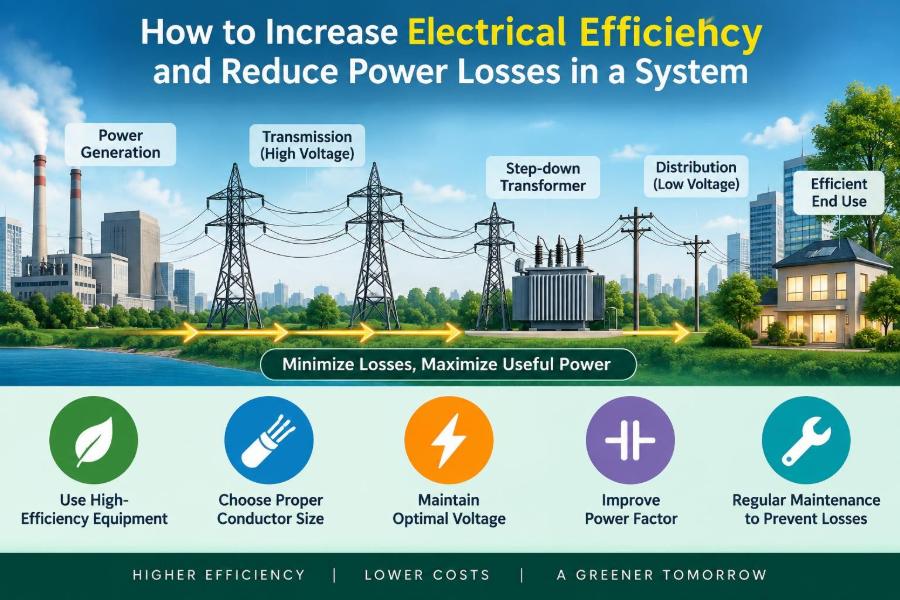
Map energy from the service entrance to the final useful load: incoming supply, transformer, switchboard, feeders, branch circuits, controls, drives, motors, and process equipment. This simple one-line view prevents attention from being focused only on the utility meter.
Losses often occur in combinations. An oversized transformer may have unnecessary no-load loss; a long undersized feeder may add voltage drop; then a motor at the end may draw extra current because it is overloaded or poorly controlled.
🧮 Understand Resistive I²R Loss
In a conductor, resistive heating follows P = I²R. Current squared matters: doubling current creates four times the heating for the same resistance. This is why high-current circuits deserve particular attention even when their measured resistance seems small.
Resistance rises with conductor length and generally rises with temperature. Loose or corroded connections can create a small, high-resistance point that becomes disproportionately hot, so efficiency and safety inspections often overlap.
🧵 Select Conductors for the Actual Duty
Conductor size should be chosen for ampacity, voltage drop, installation conditions, fault-duty requirements, and anticipated load growth. Selecting wire only by minimum allowable ampacity can leave a system with avoidable running losses over its lifetime.
Very large conductors are not automatically economical. They cost more and can be harder to install. A lifecycle comparison weighs installed cost against expected energy savings, operating hours, load current, and local energy prices.
📉 Keep Voltage Drop Under Control
Voltage drop is the reduction in voltage along a conductor caused by current flowing through impedance. Excessive drop wastes energy in the wiring and can impair equipment performance, especially motors and electronic power supplies.
Long runs, high current, poor terminations, and low supply voltage all make the issue more visible. Practical remedies include shorter routes, larger conductors, distribution closer to loads, appropriate supply voltage, and balanced circuit loading.
🔩 Treat Connections as Electrical Components
Terminations, lugs, breakers, contactors, and bus joints are often treated as passive details. In reality, every connection has resistance, and poor assembly can turn it into a heat source.
Use the specified connector type, conductor preparation, torque procedure, and inspection interval. Thermal imaging can help find abnormal temperature differences, but it must be interpreted with load level, emissivity, access conditions, and comparison points in mind.
⚖️ Balance Three-Phase Loads
In a three-phase system, uneven single-phase loading can cause one phase to carry more current than the others. The heavily loaded phase has higher I²R loss, greater voltage drop, and more heating, while the imbalance can also affect motors and transformers.
Review phase currents under normal peak operation, not merely at an idle moment. Redistributing single-phase circuits is often a low-cost improvement, although critical loads must still be arranged to preserve continuity and code compliance.
🔌 Improve Power Factor With Purpose
Power factor describes how effectively current is converted into real power. Inductive loads such as induction motors and transformers can draw reactive power, which supports magnetic fields but does not itself perform net useful work.
Low power factor increases current for a given real-power demand. That can increase feeder losses and use up capacity. Capacitor banks, properly applied, can supply reactive power nearer to the load and reduce upstream current.
⚠️ Avoid Blind Capacitor Installation
Power-factor correction is not simply a matter of adding capacitors until a target value appears. Excess correction can lead to leading power factor at light load, and capacitors can interact with harmonic frequencies in installations containing drives, rectifiers, and other nonlinear equipment.
Measure the load profile and harmonic environment first. In complex systems, detuned capacitor banks, filters, or an engineering harmonic study may be appropriate. Switching stages with changing load is usually more sensible than permanent correction sized for a peak condition.
🌊 Manage Harmonics and Nonlinear Loads
Nonlinear loads draw current in pulses rather than as a smooth sinusoid. Variable-speed drives, LED drivers, UPS systems, and switched-mode power supplies are common examples. Their harmonic currents can increase heating in transformers, neutral conductors, and distribution equipment.
Solutions may include line reactors, harmonic filters, appropriately rated transformers, larger or separate neutral arrangements where required, and separating sensitive circuits. The right choice depends on measured distortion, source impedance, and the equipment connected.
🔄 Use the Right Motor for the Job
Motors are central to industrial electricity use, so a poor match has lasting consequences. A motor operating far below its intended load may have weaker efficiency and power factor, while a consistently overloaded motor runs hot and has reduced life.
Choose a motor based on torque-speed needs, starts per hour, ambient conditions, enclosure type, duty cycle, and control method. High-efficiency motors can reduce loss, but their value is greatest when the driven machine and operating schedule are also suitable.
🌀 Match Speed to Process Demand
Many fans and centrifugal pumps are controlled by throttling a valve or damper while the motor runs at full speed. This deliberately creates resistance and wastes part of the energy as pressure loss.
A variable-frequency drive can reduce motor speed when demand falls. For centrifugal loads, the affinity laws mean that flow changes roughly with speed, pressure with speed squared, and power with speed cubed. That makes speed reduction potentially powerful, but only when the process genuinely permits it.
🛠️ Do Not Assume Every Drive Saves Energy
A variable-frequency drive has its own switching and filtering losses. It may provide little energy benefit for a load that must run at one fixed speed, and it can introduce harmonics, bearing-current concerns, or cooling constraints at low motor speed.
Evaluate the load curve, operating hours at partial demand, bypass strategy, motor compatibility, and control requirements. A drive is a control tool first; its energy benefit comes from changing an inefficient operating point.
💧 Reduce Mechanical and Process Losses
Electrical efficiency cannot be separated from the machine being powered. A clean, correctly tensioned belt drive, aligned coupling, lubricated bearing, or unobstructed air filter reduces the torque that the motor must supply.
In compressed-air systems, leaks and excessive pressure settings convert purchased electricity into noise and heat. In pumping systems, worn impellers, blocked strainers, and unnecessarily restrictive pipework raise energy demand even when the electrical equipment is healthy.
🏭 Operate Transformers Near Sensible Loading
Transformers have two major loss categories: core loss, which exists whenever energized, and winding loss, which rises approximately with the square of load current. An energized transformer serving almost no load still consumes core-loss power continuously.
Right-sizing requires judgment. Oversizing can add no-load loss, while undersizing increases heating and may limit future capacity. Where a site has multiple transformers, switching arrangements can sometimes let lightly loaded periods be served by fewer energized units, subject to reliability and protection requirements.
🧊 Consider Cooling as Part of the Loss Budget
Every watt lost as heat inside a conditioned electrical room or data environment can create additional cooling demand. The total penalty is therefore larger than the electrical loss alone.
Maintain clear ventilation paths, clean filters, correct enclosure ratings, and suitable ambient conditions. Cooling cannot fix an overloaded conductor or failing connection, but it can prevent normal losses from escalating through higher operating temperatures.
💡 Upgrade Lighting as a Complete System
Efficient lighting is not just a lamp replacement exercise. Useful lighting depends on luminaire optics, mounting height, surface reflectance, task requirements, glare control, occupancy pattern, and daylight availability.
LED luminaires often reduce electrical demand and maintenance, but poor placement can create dark work areas or glare that encourages users to add extra fixtures. Controls such as occupancy sensors and daylight dimming should be commissioned so that they save energy without disrupting normal use.
⏱️ Eliminate Idle and Standby Consumption
Some loads consume energy simply because they remain energized: heaters, control transformers, vending equipment, chargers, displays, servers, and machines in ready mode. Individually small loads become significant when they run continuously.
Use schedules, automatic shutdown, occupancy logic, and clear operating procedures. Avoid indiscriminate switching, however; equipment that needs controlled cooldown, cybersecurity updates, safety monitoring, or humidity protection may need to remain powered.
📊 Control Demand Peaks
Peak demand is the highest average power drawn during a utility-defined interval. Even if annual energy use stays unchanged, simultaneous starts and coincident heating, charging, or process loads can raise demand-related costs and stress distribution equipment.
Sequence large motor starts, stagger charging, precondition spaces when appropriate, and use load-shedding logic for noncritical loads. Demand management should never interfere with essential life-safety systems or process safeguards.
🧠 Use Automation, but Verify Its Logic
Controls can prevent waste by matching output to occupancy, temperature, pressure, production rate, or measured flow. Sensors and programmable logic make it possible to avoid running equipment at a fixed maximum setting.
Yet a control sequence can drift from its original intent after schedule changes, sensor failures, overrides, or maintenance modifications. Trend data and periodic functional testing are necessary; automation without review can automate inefficiency.
📡 Meter the Loads That Matter
A whole-building meter tells you that energy was used, not which decision caused it. Submetering major end uses—such as chillers, air compressors, production lines, or tenant areas—turns energy management into a diagnosable engineering task.
Use meters with suitable accuracy, sampling, communications, and safety ratings. Pair electrical data with process data. A rise in kilowatt-hours per unit of production can reveal deterioration even when total monthly energy appears normal.
🧪 Commission Changes and Compare Results
After an improvement, compare performance against the baseline under similar weather, production, occupancy, and operating conditions. A lower current reading alone is not proof of better system efficiency if useful output also fell.
Document settings, drawings, meter locations, and assumptions. Commissioning should confirm safe operation, correct protection coordination, acceptable voltage, control response, and process output—not merely an attractive energy result.
🧰 Prioritize by Loss, Runtime, and Feasibility
The best project is rarely the most visible one. Prioritize opportunities according to wasted power, annual operating hours, cost of correction, reliability effect, maintenance timing, and interaction with other upgrades.
| Opportunity | Likely value | Key check before acting |
|---|---|---|
| Repair hot connection | Reduces loss and reliability risk | Verify load, torque method, and component condition |
| Resize or control a pump | Can reduce large variable-load energy use | Confirm the process curve and required flow range |
| Power-factor correction | Reduces upstream current in suitable systems | Assess harmonics and load variation |
| Shutdown scheduling | Removes unnecessary runtime | Protect safety, product quality, and required standby functions |
🧯 Keep Safety and Compliance in the Design
Energy work occurs around hazardous voltages, stored energy, rotating machinery, and sometimes arc-flash hazards. A change that saves power but compromises overcurrent protection, grounding, ventilation, emergency operation, or access is not a successful improvement.
Use qualified personnel for electrical testing and modification. Follow applicable local codes, equipment instructions, lockout procedures, and site safety rules. Measurements should be planned so that diagnostic work does not create unnecessary exposure.
🚫 Watch for Common Efficiency Mistakes
Several habits repeatedly produce disappointing results:
- Replacing equipment before measuring the actual load and duty cycle.
- Correcting power factor without checking harmonic interaction.
- Using current alone as a measure of energy performance.
- Ignoring mechanical restrictions, leaks, and process settings.
- Optimizing one component while shifting heat or loss elsewhere.
- Leaving overrides, bypasses, and temporary schedules in place indefinitely.
These mistakes are avoidable when efficiency is treated as a system property rather than a product feature.
📈 Build an Ongoing Improvement Cycle
Efficiency changes over time as production, weather, occupancy, equipment condition, and operating practices change. A one-time audit is useful, but a repeating cycle is more durable: measure, identify, test, implement, verify, and maintain.
Assign ownership for reviewing trends and alarms. Include energy indicators in maintenance discussions, especially where rising current, temperature, or run time may signal an emerging equipment problem.
🎯 The Core Principle: Reduce Waste Without Reducing Value
The goal is not simply to make every current reading smaller. It is to deliver the required service—light, flow, motion, heat, computation, or production—with less avoidable electrical input and without sacrificing safety, reliability, or quality.
Start at the biggest and longest-running losses, verify them with data, and choose measures that fit the real load. Good conductor design, sound power quality, efficient motors, process control, maintenance, and measurement reinforce one another.
Electrical efficiency improves most reliably when engineers view the installation as one connected system: source, distribution, controls, equipment, process, and people. Small corrections can remove persistent waste, while well-targeted system changes can improve performance for years. ⚡🔧📉