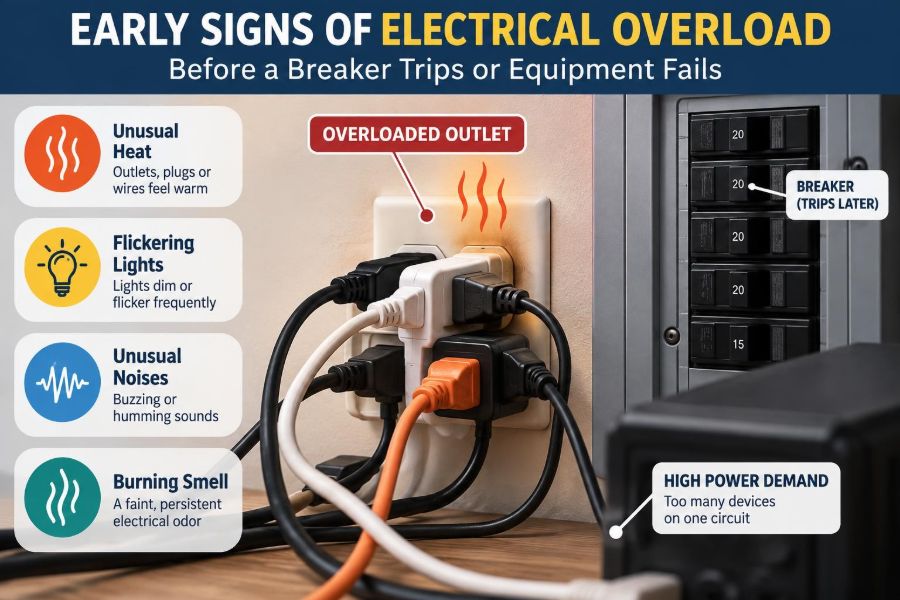

A breaker that trips during dinner, a power strip that feels warmer than expected, or lights that dim when a motor starts can seem like minor household annoyances. In an office, workshop, or plant, the equivalent signs may be a warm panel cover, an intermittent fault alarm, or a drive that begins derating on busy days.
These events are often treated as isolated inconveniences until a breaker opens or a piece of equipment fails. But protective devices are usually the last line of defense, not the first indication that a circuit is being asked to do too much.
Electrical overload develops as current demand exceeds what a conductor, connection, device, or circuit can carry continuously without excessive heating. Recognizing its early signs helps prevent damaged insulation, shortened equipment life, avoidable downtime, and—in severe cases—fire hazards.
The goal is not to diagnose a live electrical system by touch or guesswork. It is to understand what the warning signs mean, what can safely be observed, and when measurements and corrective work belong to a qualified electrician or electrical professional.
⚡ What an Electrical Overload Actually Means
An overload occurs when a circuit carries more current than its components are intended to carry for the operating condition. The components include branch-circuit conductors, terminals, receptacles, plugs, switches, power strips, breakers, and the equipment connected to them.
Current creates heat in resistance. The relationship is commonly expressed as P = I²R: heat loss rises with the square of current. A modest increase in current can therefore produce a disproportionately larger increase in heating at a conductor or, more critically, at a resistive connection.
An overload is not necessarily a fault. A space heater, microwave, hair dryer, and toaster can all be functioning normally while their combined demand exceeds the capacity of one branch circuit.
🛡️ Why the Breaker May Not Trip Right Away
Most common breakers use a thermal element for sustained overcurrent and a magnetic element for very high fault current. The thermal part is intentionally time-delayed, allowing harmless short-duration loads such as motor starting current without nuisance trips.
That delay means a circuit can be stressed for a period before the breaker operates. A load slightly above the breaker’s rating may heat conductors and terminals gradually, while a much larger overload may trip sooner.
Breaker behavior also depends on ambient temperature, panel conditions, breaker type, and its time-current characteristic. A breaker is essential protection, but it is not a precision indicator that every part of a circuit is operating at a comfortable temperature.
🔌 Overload, Short Circuit, and Ground Fault Are Different
These terms are often used interchangeably, but they describe different electrical conditions. Their distinction matters because the clues, urgency, and likely causes are not the same.
| Condition | Typical cause | Usual behavior |
|---|---|---|
| Overload | Too many or too-large normal loads | Heating and delayed trip |
| Short circuit | Unintended low-resistance path between conductors | Very high current and rapid trip |
| Ground fault | Current leaking to grounded metal or earth path | May trip GFCI/RCD or breaker |
A breaker that trips immediately when an appliance is plugged in may point to a fault rather than ordinary overload. Repeated resetting without finding the cause is unsafe in either case.
💡 Dimming or Flickering Lights Under Load
Lights that momentarily dim when a vacuum, refrigerator compressor, well pump, or large tool starts may reflect voltage drop. Starting motors draw a higher inrush current than they use while running, and circuit impedance causes a temporary reduction in voltage at other loads.
An occasional small dip on an older or heavily loaded circuit is not automatic proof of danger. Frequent, pronounced, or worsening dimming deserves attention, especially if it occurs with modest loads or affects several circuits.
Flickering can also arise from a loose connection, failing lamp driver, or utility-side issue. Because a loose neutral can create unusually high or low voltage on circuits, persistent flickering should not be dismissed as simple overload.
🌡️ Warm Plugs, Receptacles, and Switches
A plug, receptacle faceplate, switch, extension cord, or power strip that becomes noticeably warm during ordinary use is an early warning worth investigating. Heating can result from high current, but it can also result from a loose or worn contact that adds resistance at one small point.
That second case is particularly significant: a breaker senses circuit current, not the temperature of every contact. A poor connection may overheat at a current below the breaker rating.
Do not test electrical parts by repeatedly touching them. If a device feels hot, smells abnormal, discolors, crackles, or shows deformation, stop using it if this can be done safely and arrange inspection.
👃 The Smell of Hot Insulation or Plastic
Electrical overheating can produce a sharp, acrid, or “hot plastic” odor. It may come from softened insulation, an overloaded cord, a deteriorating power strip, a failing appliance component, or a terminal connection that is heating under load.
The smell may be intermittent because temperature rises only when a particular load operates. Note what equipment was running, which room the odor appeared in, and whether a breaker, receptacle, or panel area seems involved—without opening energized equipment.
An electrical burning smell is not a symptom to monitor casually. Disconnect the suspected appliance when safe, avoid further use, and seek qualified help if the source is uncertain, fixed wiring is involved, or any smoke is present.
🎨 Discoloration, Scorching, and Melted Plastic
Brown marks around receptacle slots, yellowed plug blades, softened cord jackets, warped power strips, and darkened breaker-panel components indicate that excessive heat has already occurred. Cosmetic cleaning does not correct the underlying electrical cause.
Arcing at a loose contact can leave localized damage even when the average circuit load appears reasonable. Replacing only the visible receptacle without checking the conductors, terminals, connected load, and device rating may leave the hazard in place.
Any evidence of melting, charring, or scorch marks calls for the affected equipment or circuit to be removed from service until evaluated.
🔊 Buzzing, Crackling, and Unusual Electrical Sounds
A steady low hum from some transformers, fluorescent ballasts, and dimmers can be normal. New buzzing, crackling, sizzling, or a sound that changes when a load operates is not a normal overload indicator to ignore.
These sounds may come from vibration, loose terminals, arcing contacts, a failing relay, or stressed electronic components. The sound alone does not identify the fault, but it narrows attention to equipment that needs inspection.
Never open a panel or device cover to chase a sound unless you are trained, authorized, and equipped for that work. Energized electrical enclosures contain shock and arc-flash hazards.
🔁 Breakers That Trip Only During Busy Periods
A breaker that trips only when several appliances run together often provides a clear load-related pattern. For example, a kitchen circuit may remain stable until a countertop appliance operates while the dishwasher heating element or microwave is also active.
Start by observing the sequence: what turns on before the trip, whether the loads are portable or fixed, and whether the problem occurs at the same time of day. This is more useful than simply resetting the breaker and hoping the event does not recur.
Load coincidence matters. Equipment with heating elements can draw near its rated input for long periods, while motors may briefly add high starting current to an already busy circuit.
📈 A Rising Baseline Load
Overload is often introduced gradually. A home office gains monitors, chargers, a printer, and a portable heater. A workshop adds a dust extractor. A commercial space adds refrigeration, displays, or workstations without revisiting the original circuit allocation.
The circuit may have been adequate when installed, then become marginal as usage changed. This is why a new trip or warm receptacle can appear even though no single appliance seems defective.
Listing connected loads is a practical first step. Equipment nameplates state voltage and current or power; these values support an initial estimate, though actual demand can vary with operating mode and duty cycle.
🧮 Estimating Load Without False Precision
For many simple single-phase loads, current can be approximated from I = P/V, where P is power in watts and V is voltage. A 1500 W resistive heater on a nominal 120 V supply draws roughly 12.5 A under typical conditions.
This calculation is useful for identifying obvious conflicts, not for certifying a circuit. Motor loads, electronic power supplies, power factor, supply-voltage variation, simultaneous operation, and local electrical rules all affect real design decisions.
Do not assume the printed wattage on every device tells the whole story. A qualified professional can measure actual current with a properly rated clamp meter and evaluate the circuit as a system.
🧯 Extension Cords and Power Strips as Warning Signs
An extension cord is meant to extend a connection, not permanently increase circuit capacity. A power strip provides more outlets, but every outlet still shares the capacity of its plug, cord, internal contacts, and upstream branch circuit.
Daisy-chaining strips, running cords under rugs, or using lightweight cords for high-wattage appliances increases heat retention and can hide damage. Coiled cords can also shed heat poorly when carrying substantial current.
- Use only cords and strips rated for the intended load and environment.
- Plug high-wattage appliances directly into suitable wall receptacles where practical.
- Replace damaged, loose, cracked, or warm cords and strips.
- Treat recurring reliance on temporary distribution as a wiring-planning problem.
🏠 High-Wattage Appliances That Commonly Collide
Heating appliances are frequent contributors because electrical resistance heaters convert a large, sustained share of their input power into heat. Examples include portable heaters, kettles, toasters, hair dryers, irons, coffee makers, and some cooking appliances.
In a hypothetical bedroom, a portable heater and hair dryer on the same 120 V, 15 A circuit can exceed the circuit’s usable capacity if operated together. The breaker may trip, but the more useful lesson is that the circuit assignment was unsuitable for simultaneous use.
Portable heaters deserve special caution. Their load is often continuous for long intervals, and placing one on an extension cord or power strip can create a weak point even before the branch breaker trips.
⚙️ Motor Starts and Mechanical Stress
Motors draw elevated current while starting because the rotor is not yet producing the opposing electromagnetic effect that limits running current. Refrigerators, pumps, compressors, fans, and machine tools may therefore cause brief light dimming or breaker stress.
A motor that starts slowly, hums before turning, cycles repeatedly, or trips protection more often than before may have a mechanical problem, capacitor issue, supply-voltage issue, or winding-related fault. It should not automatically be treated as a normal overload.
Mechanical drag matters. A blocked fan, failing bearing, overloaded conveyor, or restricted pump can raise motor current because the motor must work harder to produce the required torque.
🏭 Three-Phase Imbalance in Commercial Systems
In commercial and industrial systems, overload may affect one phase more than the others. Unevenly distributed single-phase loads, loose connections, a degraded contactor pole, or motor problems can create phase-current imbalance.
For a three-phase motor, current imbalance can produce additional heating and reduced service life. The phase with the highest current deserves investigation, but the root cause may be supply voltage imbalance, wiring resistance, or the motor itself.
This work requires competent measurement and interpretation. Measuring inside energized equipment introduces hazards that are not appropriate for untrained personnel.
🔩 Loose Connections Can Mimic an Overload
Not every overheating symptom means total circuit current is excessive. A loose terminal, corroded connector, worn receptacle contact, or poorly made splice raises local resistance. Current passing through that resistance generates concentrated heat.
Think of a partially closed valve in a water system: the overall flow may not be extreme, but the restriction experiences a large pressure drop. Electrically, a poor connection can become the hot restriction.
This is why replacing a breaker with a larger one is never a valid response to a warm receptacle or damaged connection. It can permit more current while leaving the localized weak point untouched.
📉 Voltage Drop Is a Clue, Not a Complete Diagnosis
Voltage drop is the reduction in voltage along conductors and connections when current flows. Long runs, undersized conductors, high load current, and poor connections all contribute to it.
Symptoms can include dimming lights, slow motor starting, reduced heater output, or electronics that reset under load. However, a voltage measurement at one moment does not prove the exact cause; measurements must be made under relevant load conditions and interpreted correctly.
Excessive voltage drop can become self-reinforcing for certain equipment. A motor operating at lower voltage may draw more current to maintain torque, increasing heating and stressing the circuit further.
🧠 Electronic Equipment Has Different Warning Signs
Computers, network equipment, LED drivers, variable-speed drives, and chargers often contain switch-mode power supplies. Their symptoms may include unexplained restarts, intermittent alarms, power-supply whine, or failure when another large load starts.
These signs can result from voltage sag, poor connections, a failing internal supply, or electromagnetic interference. They should not be diagnosed solely as overload, but their timing relative to other loads is valuable evidence.
For sensitive systems, proper circuit separation, equipment-rated surge protection, and power-quality evaluation may be more useful than repeatedly replacing individual power supplies.
🧭 Patterns That Help Locate the Problem
Good troubleshooting begins with pattern recognition rather than random replacement. Record which circuit is involved, what loads were running, whether the condition is immediate or delayed, and whether weather, time of day, or equipment cycle changes it.
- Only one appliance causes the issue: suspect the appliance, its cord, or its starting behavior.
- Several normal loads together cause it: suspect a load-allocation or circuit-capacity problem.
- One outlet is hot while others are not: suspect that receptacle or its connection.
- Multiple circuits flicker: consider service, feeder, or neutral issues and seek prompt evaluation.
A pattern does not replace testing, but it makes professional diagnosis faster and reduces the temptation to make unsafe changes.
🧰 Safe Observations a Non-Electrician Can Make
Users can often improve the quality of a service call without opening equipment. Read appliance labels, identify what is plugged into each accessible outlet, and note whether cords are pinched, damaged, or warm.
After a breaker trip, leave the breaker off if there is odor, heat, damage, water exposure, or uncertainty about the source. If there is no sign of damage and local practice permits reset, disconnect portable loads first and restore them one at a time; a recurring trip needs investigation.
Photographs of visible damage, breaker labels, and equipment nameplates can be useful documentation. Do not remove panel covers, tighten terminals, or probe receptacles unless qualified to do so.
🚫 Dangerous “Fixes” That Make Overload Worse
Some responses hide the symptom while increasing risk. The most serious is installing a larger breaker without verifying that every conductor and device on the circuit is rated and protected appropriately.
Other unsafe practices include bypassing protective devices, replacing a fuse with the wrong rating, using adapters to defeat grounding, and repeatedly resetting a breaker that immediately trips. These actions can turn a manageable diagnosis into equipment damage or a fire hazard.
Protection must match the weakest properly installed part of the circuit, not the user’s desire for more available power.
🧑🔧 When to Call a Qualified Electrician Promptly
Call promptly when there is smoke, scorching, melted insulation, sparking, persistent burning odor, a hot panel, repeated breaker trips, shocks or tingling from equipment, or widespread flickering. If there is an immediate fire concern, follow local emergency procedures.
Professional evaluation is also appropriate when adding a major appliance, EV charging equipment, workshop machinery, HVAC equipment, or a sustained office load. The question is not only whether the breaker holds, but whether the panel, feeder, branch circuit, receptacles, and load calculation support the intended use.
In workplaces, report abnormalities through the site’s electrical safety process. Maintenance staff need operating history, not just the statement that “the power went out.”
📋 What a Professional Assessment May Include
A qualified electrician or electrical technician may inspect visible condition, verify conductor and protective-device ratings, measure load current, check voltage under load, evaluate terminals, and review circuit sharing. In larger systems, infrared thermography can help identify abnormal heating, but it must be interpreted with load level and connection condition in mind.
For motors and industrial equipment, assessment may include phase-voltage and current comparison, overload-relay settings, motor condition, mechanical load, and control-circuit behavior. The right test depends on the symptom and system type.
The result may be as simple as moving loads, replacing a worn device, or repairing a connection. It may also justify a dedicated circuit, conductor upgrade, panel modification, or equipment repair.
🏗️ Designing Capacity Instead of Chasing Trips
The durable solution to repeated overload is usually better load planning. Dedicated circuits separate high-demand equipment from general receptacle loads, while balanced distribution prevents one branch or phase from carrying an unfair share.
Design also considers expected simultaneous use. A circuit serving a single appliance may be adequate in isolation but inadequate when its location encourages users to connect several portable loads.
For facilities, maintain panel schedules that reflect actual usage rather than old assumptions. For homes, consider future loads during renovations: kitchens, workshops, laundry areas, HVAC upgrades, and vehicle charging can change demand substantially.
🧾 Continuous Loads Need Special Attention
A continuous load is one expected to operate for an extended period, often defined by applicable electrical rules using a multi-hour threshold. Such loads can heat conductors and terminals steadily, so their circuit sizing and protection require deliberate treatment.
Examples may include certain lighting systems, fixed heating, EV charging, and equipment that runs for long production periods. Exact requirements depend on the jurisdiction, installation method, equipment listing, and applicable code.
The practical message is simple: do not judge a circuit only by whether it survives a few minutes. Sustained operation reveals thermal limits that a short test may miss.
🔍 Preventive Inspection Makes Small Clues Useful
Routine visual checks catch many early issues: damaged cords, overloaded strips, loose plugs, blocked equipment ventilation, faded labels, and appliances that are routinely used together. In professional environments, scheduled electrical maintenance can add documented load readings and targeted thermal inspections.
Keep panels accessible and circuit directories legible. An accurate label helps users avoid adding a large load to a circuit already serving critical or high-demand equipment.
Prevention is not about treating every warm charger as an emergency. It is about noticing changes, separating normal operating warmth from abnormal heat, and responding before insulation and connections deteriorate.
✅ The Core Principle: Treat Heat and Repetition as Data
Early overload signs are rarely mysterious: warmth, odor, discoloration, dimming, noise, recurring trips, and equipment instability are all observations about current, resistance, voltage, or protection. Their value lies in the pattern they create together.
A breaker trip should be treated as information, not merely an interruption. Determine what was operating, reduce unnecessary simultaneous load, and correct the circuit or equipment problem rather than defeating protection.
The safest response scales with the symptom. Rearranging ordinary plug-in loads may solve a clear usage conflict; heat, damage, repeated trips, or uncertainty calls for qualified assessment.
The most reliable way to prevent overload damage is to respect circuit limits, investigate abnormal heat early, and let correctly matched protection do its job. A small warning noticed today can prevent a much larger repair tomorrow. ⚡🔧🛡️