
Flip a wall switch in an apartment, board a brightly lit train, or pass a shop window after dark, and electricity feels less like infrastructure than a background condition of city life. It arrives quietly, on demand, and usually without asking us to think about where it came from.
That ordinary experience was once a radical engineering promise. Before urban electrical systems, light came from flames, power came from steam engines close to the machinery they drove, and communication networks had their own limited sources of energy.
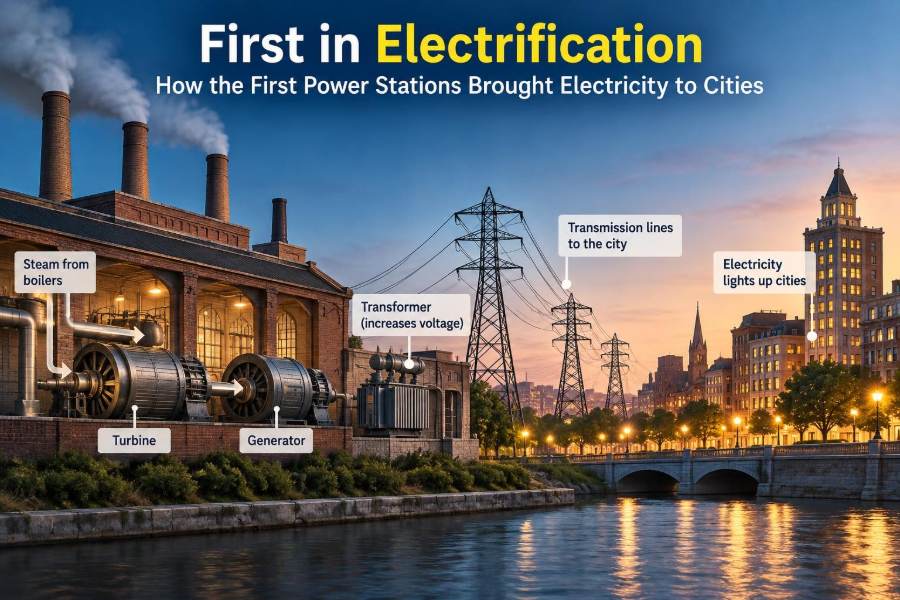
The first central power stations changed this arrangement. They did not merely generate electricity; they created a system for producing it in one place, distributing it through streets, measuring its use, and maintaining it reliably enough that customers could depend on it.
Understanding how those early stations worked explains many features of modern power engineering: grids, substations, voltage transformation, load forecasting, protection, and the persistent challenge of matching supply with demand.
🏙️ Before Central Stations, Power Was Local
For most of the nineteenth century, useful energy was produced where it was needed. A factory might use a steam engine and belts to turn machine tools. A wealthy building might have its own small generator. Street lighting commonly relied on gas, while homes used candles and oil lamps.
This arrangement limited flexibility. A factory’s mechanical power could not easily serve neighboring buildings, and a standalone generator required fuel, operators, repair skills, and enough demand to justify its cost. Central stations offered a different model: shared equipment serving many customers.
💡 Arc Lamps Created the First Urban Demand
Some of the earliest practical electrical lighting used arc lamps. An electric arc forms when current crosses a small gap between electrodes, producing an intense light. It was bright enough for streets, large halls, railway yards, and industrial spaces.
Arc lighting was not ideal for ordinary rooms. It was harsh, required careful regulation, and suited high-output applications better than numerous small fixtures. Still, it demonstrated a powerful idea: electricity could improve nighttime activity across an entire district.
🕯️ Incandescent Lamps Changed the Customer Base
The incandescent lamp made central supply more attractive to homes, shops, and offices. Passing current through a resistant filament heats it until it glows, producing a smaller and more manageable source of light than an arc lamp.
No early lamp was perfect. Filament life, manufacturing consistency, socket design, wiring quality, and cost all mattered. But the lamp created a load that could be installed room by room, allowing utilities to sell a standardized service rather than a custom industrial installation.
🏭 A Power Station Was More Than a Generator
An early power station combined several engineered systems under one roof: fuel delivery, boilers, steam engines, dynamos, switchboards, cables, meters, and staff procedures. A failure in any one of these could interrupt customers.
A dynamo is an electrical generator that converts mechanical rotation into electrical energy through electromagnetic induction. Steam machinery rotated the dynamo, and the dynamo supplied the conductors leaving the station. This energy chain remains recognizable today, even though turbines and generators have changed dramatically.
📍 Why Stations Had to Sit Near Their Loads
Early low-voltage distribution could not economically carry power far. Every cable has resistance, so current flowing through it produces a voltage drop and heat loss. If too much voltage is lost on the way, lamps dim and equipment performs poorly.
As a result, early stations were placed close to dense clusters of customers. Busy commercial areas were particularly attractive because many users could be reached with relatively short runs of underground cable. Location was therefore an electrical decision, not simply a real-estate decision.
🔌 The Pearl Street Milestone
Thomas Edison’s Pearl Street Station in lower Manhattan began operation in 1882 and is widely recognized as a landmark early central station. It supplied direct current, or DC, to customers in a compact service area and paired generation with underground distribution, metering, and customer installations.
Calling it the single “first” power station can oversimplify history. Earlier generating installations and public lighting systems existed in several places, and definitions differ. Pearl Street’s lasting significance was its integrated commercial model: a coordinated urban electricity service rather than an isolated demonstration.
⚙️ Direct Current Fit Early Lamp Networks
In a DC system, electric charge flows with one constant polarity. Early incandescent lamps could operate effectively on DC, and the associated equipment was understandable using the technology of the period.
The central limitation was distribution distance. A low-voltage DC network serving more customers needs either longer conductors, thicker conductors, higher current, or additional generating sites. Each choice increased cost, losses, or operating complexity. The practical service radius of a station was therefore limited.
🌊 Alternating Current Offered a Different Path
Alternating current, or AC, reverses direction periodically. Its major system-level advantage emerged from the transformer, a device that can change AC voltage efficiently by electromagnetic induction. Electricity could be sent at higher voltage and lower current, then reduced near the customer.
Lower current for a given power reduces resistive losses because cable heating depends strongly on current. This made longer-distance transmission more feasible and enabled fewer, larger generating stations to serve wider territories.
🔄 The Transformer Solved a Network Problem
A transformer has windings around a magnetic core. Alternating current in one winding creates a changing magnetic field, inducing voltage in another winding. The turns ratio determines whether the voltage is stepped up or stepped down.
It did not make electricity free of losses or risks. High voltage required insulation, safe clearances, trained workers, and sound equipment design. But it made voltage a practical engineering tool: high for efficient transfer, lower for end use.
⚔️ The “War of Currents” Was Not a Simple Contest
The historical competition between DC and AC is often reduced to a dramatic rivalry between inventors and companies. The deeper issue was that each system suited particular technical and commercial conditions. Early DC could work well in dense, short-range networks, while AC offered important advantages as service areas expanded.
Safety arguments were also entangled with business competition. Both systems could be dangerous when poorly designed or handled. The enduring engineering lesson is not that one technology is always superior, but that voltage level, distance, load type, protection, and operating practice determine whether a system is appropriate.
🧭 Distribution Networks Needed a Physical Map
Electricity had to travel through a city already crowded with water pipes, sewers, gas mains, telegraph lines, railways, and building foundations. Installing conductors required rights-of-way, excavation planning, duct systems, joints, access points, and coordination with local authorities.
Underground cable helped protect equipment and reduce visual clutter, but it was difficult to install and repair. Overhead lines were generally easier to inspect and extend, yet they raised concerns about clearance, weather exposure, and public safety. Cities adopted different mixes according to local conditions.
🧱 Insulation Was a Hidden Enabler
A conductor is useful only when current stays on its intended path. Insulation and physical separation prevent unwanted contact between conductors, earth, buildings, and people. Early systems had to contend with moisture, heat, mechanical wear, and imperfect manufacturing.
Cable joints were especially critical. A weak joint could heat, admit water, or fail intermittently, creating faults that were hard to locate. The history of electrification is therefore partly a history of materials engineering: insulation compounds, ceramics, metal enclosures, and better cable construction.
📏 Voltage Drop Shaped the Customer Experience
Voltage drop was not just an equation in a design notebook. Customers could see it. If lamps near the station were bright while lamps at the end of a feeder were dim, the service appeared unreliable even when the generator was running normally.
Engineers managed this through conductor sizing, shorter feeder routes, controlled supply voltage, and network arrangements that reduced uneven loading. The core relationship remains familiar: a conductor’s resistance rises with length and falls with cross-sectional area.
🧮 Load Diversity Made Central Supply Economical
Not every customer switches on every lamp or machine at the same instant. This load diversity meant a station could serve a group whose combined connected equipment was larger than the station’s continuously required output.
That did not eliminate peak demand. Evening lighting could create a sharp rise in load, while industrial districts might have daytime peaks. Operators learned to size plant for plausible peaks, keep reserves for equipment trouble, and avoid building far more capacity than the customer pattern justified.
🕰️ Electricity Introduced the Daily Load Curve
A load curve shows how demand changes over time. In an early lighting district, demand might climb around sunset, remain high during active evening hours, and fall late at night. A mixed district produced a more complicated shape.
This was a new operational reality. Boilers needed to be ready, generators had to be brought online at the right time, and fuel use had to follow demand. Modern system operators still manage this same basic problem, although they now coordinate much larger and more diverse grids.
🔥 Coal, Boilers, and the Thermal Chain
Many early central stations burned coal to heat water in boilers. Steam then drove reciprocating engines, which turned dynamos. Every conversion stage lost some energy through exhaust heat, friction, incomplete combustion, and electrical resistance.
Coal also brought practical burdens: delivery logistics, ash removal, smoke, boiler maintenance, and fire risk. Centralization could improve fuel handling compared with thousands of individual fires and engines, but it concentrated pollution and industrial activity near urban neighborhoods.
👷 Operators Were Essential Infrastructure
Early stations could not run unattended. Operators watched boiler pressure, lubrication, belt or shaft behavior, generator output, switchboard readings, and customer complaints. They adjusted equipment as load changed and responded quickly when abnormal conditions appeared.
This work required judgment as well as routine. A meter reading could indicate overload, a hot smell could signal insulation trouble, and flickering lamps might point to a mechanical or electrical issue. Reliable supply depended on skilled people interpreting imperfect information.
🛡️ Switching and Protection Had to Evolve
A fault is an unintended electrical path, such as a short circuit or insulation breakdown. Faults can produce very high currents, dangerous arcing, equipment damage, and fire. Early systems needed fuses, switches, isolators, and operating rules to limit these consequences.
A fuse contains an element designed to melt when current exceeds a safe value. It is simple but must be replaced after operation. Protection systems later became far more selective and sophisticated, yet the objective remains the same: disconnect the faulty part while keeping as much healthy service operating as possible.
⚠️ Early Safety Was Learned Through Experience
Electrification brought genuine hazards: exposed conductors, inadequate insulation, overloaded circuits, arc flashes, and unsafe work practices. Electrical safety did not arrive automatically with electric lighting; it developed through equipment improvements, codes, inspection, training, and hard-earned operational experience.
One persistent mistake is to imagine old systems as primitive but harmless because their power levels were smaller. Low-voltage systems can still deliver dangerous current, and early urban systems combined electrical risks with steam, rotating machinery, fire, and confined workspaces.
🏠 Service Connections Brought the Grid Indoors
Getting power to a street was only part of the job. Each customer needed a service connection, wiring, switches, lamp holders, protective devices, and often guidance on how to use the new equipment safely.
Building wiring became a major interface between utility engineering and daily life. Poor workmanship inside a building could cause faults that affected both occupants and the supply network. This is why standardized installation practices became as important as central generating equipment.
💰 Metering Turned Electricity Into a Utility Service
A central station needed a way to charge fairly for energy delivered. Meters made electricity measurable at the customer premises, enabling utilities to bill according to use rather than relying solely on fixed fees or estimates.
Metering also changed behavior. Customers could compare the cost of electric light with gas or other alternatives, while utilities could observe demand patterns and plan expansion. In technical terms, utilities sell energy over time, not simply instantaneous power; meters record that accumulated consumption.
🏪 Commercial Districts Were Early Strongholds
Shops, theaters, hotels, offices, and transport-related facilities often gained quickly from electric lighting. Better illumination could extend useful business hours, improve indoor visibility, and avoid some of the heat, soot, and open-flame concerns of older lighting methods.
These benefits were conditional. Early electric service could be expensive and geographically limited, and buildings often required new internal wiring. Adoption spread unevenly, beginning where customers had dense loads, clear commercial value, and access to a nearby network.
🚋 Electric Traction Expanded the Meaning of Urban Power
Electric street railways and other traction systems demonstrated that electricity could move people as well as light buildings. Their loads were much larger and more variable than individual lamps, requiring robust generation, distribution, and specialized control equipment.
Traction also showed why electricity systems could not be designed around an average load alone. Starting and accelerating motors draw substantial current, and a cluster of vehicles can create localized demand. Network design had to account for peaks, voltage regulation, and return-current paths.
🌐 From Isolated Plants to Interconnected Systems
At first, many stations operated as isolated islands. If a generator failed, customers in that district had few alternatives. Interconnection allowed one area to support another, improved utilization of generating equipment, and made larger-scale coordination possible.
Interconnection also introduced complexity. Operators had to manage frequency in AC systems, voltage control, power flows, and the possibility that a disturbance could spread. A grid improves resilience when well designed, but shared infrastructure creates shared responsibilities.
📊 AC and DC in the Early Urban Context
| Engineering question | Early DC approach | Early AC approach |
|---|---|---|
| Best initial service area | Dense loads near a station | Potentially wider service territory |
| Changing voltage | Historically difficult with period technology | Practical with transformers |
| Distribution challenge | High current over distance increased losses | Higher voltage reduced current for transfer |
| Network development | Often required nearby stations or heavy conductors | Supported substations and longer feeders |
| Safety requirement | Insulation and protection still essential | Additional high-voltage controls and clearances needed |
This comparison describes broad historical tendencies, not absolute rules. Modern power electronics have made DC valuable again in applications such as long-distance transmission links, data centers, battery systems, and some local distribution concepts.
🏗️ Scale Brought Both Efficiency and Vulnerability
Larger generating plants could benefit from improved equipment utilization, centralized maintenance, and more efficient operating practices. Larger systems also made it easier to combine different customer loads and hold reserve capacity.
But concentration created consequences. A station outage, fuel interruption, damaged feeder, or operator error could affect many customers at once. Good utility design therefore balances scale with redundancy, sectionalizing, maintenance access, and credible restoration plans.
🌫️ Electrification Did Not Automatically Mean Clean Energy
Electricity at the point of use could be cleaner and quieter than a local coal stove, gas flame, or steam engine. Yet early station electricity was commonly produced by burning coal, shifting much of the smoke and ash to the generating site.
This distinction still matters when evaluating energy technologies. Electricity is an energy carrier, not a primary fuel. Its environmental and social effects depend heavily on how it is generated, how equipment is made, and how the network is operated.
🧠 What Early Stations Teach Modern Engineers
The first power stations faced a systems problem, not a single-machine problem. Success required matching generation to load, building safe conductors, choosing voltage levels, installing customer equipment, collecting revenue, maintaining assets, and earning public confidence.
That systems perspective applies to present-day challenges such as integrating renewable generation, charging electric vehicles, strengthening distribution feeders, and deploying storage. New technologies may change the equipment, but they do not remove the need to understand constraints at every interface.
🔧 Practical Questions for Electrical Learners
When studying an electrical network, start with a few disciplined questions rather than treating it as a diagram of wires:
- Where is power generated, and what limits its available output?
- How far must it travel, and what voltage drop or losses are acceptable?
- When do customers use power, and what creates the peak demand?
- What happens when a cable, transformer, generator, or switch fails?
- How are people protected during normal operation and maintenance?
- How is energy measured, controlled, and paid for?
These questions would have been useful at an 1880s station and remain useful in a modern distribution planning meeting.
🚫 Common Misreadings of Electrification History
One common error is treating electrification as an overnight invention. In reality, progress involved many incremental improvements in lamps, generators, cables, meters, switches, motors, materials, and operating methods. Deployment also depended on finance, municipal permissions, customer trust, and skilled labor.
Another is assuming a city became “electrified” the moment a station opened. Service expanded neighborhood by neighborhood and building by building. Different groups gained access at different times, and older energy systems continued alongside electrical ones for decades.
🧩 The Core Principle: Electricity Became Useful as a System
The decisive achievement of the first central stations was not simply producing electrical current. It was making electricity dependable enough to become a service: available through a connection, suited to ordinary equipment, measured for billing, and supported by people who could repair it.
That is why the early power station belongs at the foundation of electrical engineering. It joined physics with civil works, mechanical equipment, economics, safety practice, and human routines. The city-scale network, rather than any single invention, made electrification transformative.
The first power stations changed cities because they turned electricity from a laboratory phenomenon and isolated machine supply into a coordinated, maintainable public utility. Every modern grid still builds on that same promise: useful energy delivered where people need it, when they need it. ⚡🏙️🔧