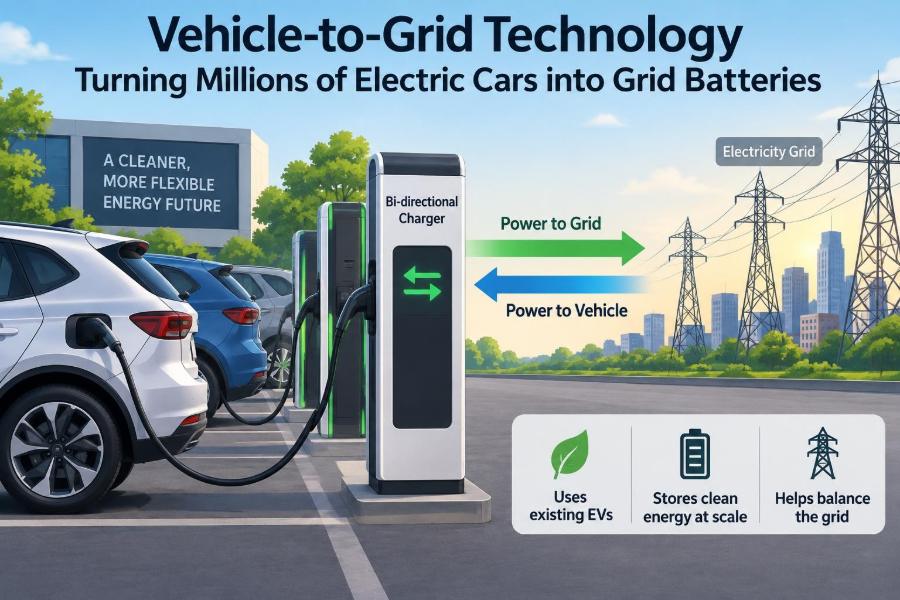

Picture a summer evening when air conditioners are running, people arrive home from work, and electricity demand climbs just as solar generation begins to fade. The grid must meet that surge immediately, even if it means starting costly, high-emission backup generators.
Now picture the same neighborhood with thousands of electric cars parked in driveways, garages, and office lots. Most will not be driven again until morning. Their batteries are sitting still—but they could briefly support the local grid before charging back up later.
That is the basic promise of vehicle-to-grid technology, usually shortened to V2G. It treats an electric vehicle not only as a load that consumes electricity, but also as a flexible energy resource that can return power when conditions justify it.
The idea is compelling, but it is not as simple as connecting every car and pressing “share.” Useful V2G depends on compatible hardware, careful control, fair compensation, battery safeguards, and an electricity system able to use the resource well.
🚗 What Vehicle-to-Grid Means
Vehicle-to-grid is a controlled, bidirectional exchange of electricity between an electric vehicle battery and the power system. During charging, energy flows from the grid to the car. During V2G discharge, it flows from the car back through charging equipment to a building or grid connection.
The vehicle owner sets constraints, such as a required state of charge by a departure time. A charging-management system then decides whether the plugged-in battery can charge, pause, or export a limited amount of power.
🔄 Charging Is Not Automatically V2G
Many electric vehicles can charge intelligently without sending energy back. Smart charging, also called managed charging, shifts or slows charging to avoid peak demand or use lower-cost, lower-carbon electricity.
V2G adds reverse power flow. That difference requires bidirectional power electronics, approved interconnection arrangements, and additional coordination with the utility or an authorized market participant.
| Approach | Direction of energy flow | Main purpose |
|---|---|---|
| Uncontrolled charging | Grid to vehicle | Charge whenever plugged in |
| Smart charging | Grid to vehicle | Move charging to better times |
| V2G | Both directions | Charge and provide grid services |
| Vehicle-to-home | Vehicle to home | Support household loads or backup |
⚡ The Battery Is Only One Part of the System
An EV battery stores direct current, while most homes and grids use alternating current. An inverter must convert DC to AC during discharge and AC to DC during charging, while controlling voltage, current, frequency response, and safety functions.
In some designs, the inverter is inside the vehicle. In others, a bidirectional charger performs more of the conversion externally. The location affects equipment cost, certification, efficiency, and which vehicles can participate.
🔌 Bidirectional Chargers Enable Reverse Flow
A normal charger is designed primarily to deliver power into a vehicle. A bidirectional charger is designed and certified to transfer power both ways while complying with protection requirements.
Not every connector, vehicle, charger, or installation supports this capability. “Has a large battery” and “can export power to the grid” are separate claims; buyers and fleet managers should verify the complete approved combination.
🧠 An Aggregator Coordinates Many Cars
One parked car is small from the perspective of a regional grid. Thousands of connected cars, however, can be coordinated as an aggregated resource—a group operated as though it were one flexible power plant.
An aggregator receives signals about market prices, grid needs, and service requests. It sends schedules or real-time commands while respecting each driver’s availability, charge target, and opted-in limits.
📡 Fast Signals Make Some Services Valuable
Electric grids must keep supply and demand closely balanced. Small imbalances can cause frequency to drift away from its nominal value. Batteries can change output very quickly, which makes them technically suited to certain balancing services.
A V2G fleet may therefore earn value not only by delivering many kilowatt-hours, but by being ready to adjust power for short periods. Actual eligibility and payment structures vary substantially by grid operator and market rules.
🌆 Peak Demand Is a Natural Use Case
Electricity systems are built to serve their highest expected demand, not merely their average demand. Short evening peaks can require extra generation, network capacity, and operating reserves.
If vehicles discharge during a constrained period and recharge later when demand is lower, they can reduce the sharpness of that peak. The benefit is greatest where cars are connected during the hours the system is under stress.
☀️ Matching Solar Generation Better
Solar output often peaks around midday, while household demand may rise later. Workplace charging can absorb some midday solar energy, and V2G can potentially return a portion after workers leave—if cars remain connected and their owners permit it.
This is not energy creation. It is time shifting, with conversion and battery losses along the way. Its value comes from moving usable electricity from a less constrained period to a more valuable one.
🌬️ Supporting Variable Renewable Energy
Wind and solar output change with weather and time. A diverse portfolio of flexible demand, storage, transmission, and dispatchable generation helps the grid accommodate those changes.
V2G is one flexible option, not a replacement for all others. Its strength is that much of the battery capacity may already exist for transportation, although availability cannot be assumed at every moment.
🏠 V2G, Vehicle-to-Home, and Backup Power Differ
Vehicle-to-home (V2H) sends energy to household circuits. Vehicle-to-building (V2B) serves a commercial site. These can reduce a site’s peak demand or maintain selected loads during an outage.
Grid export is a further step. Backup operation may need isolation from utility lines, often called islanding protection, so a home does not energize wires that utility crews believe are de-energized.
🛡️ Safety Depends on Proper Interconnection
Reverse power flow must be detected, controlled, and disconnected safely during abnormal conditions. Equipment needs anti-islanding functions, fault protection, grounding arrangements, and settings appropriate to the local electrical code and utility rules.
A vehicle should never be improvised into a home or grid supply with unapproved adapters or wiring. Qualified installers and listed equipment are essential because the risk involves fire, equipment damage, and danger to line workers.
🔋 Battery Degradation Is a Real Trade-Off
Lithium-ion batteries gradually lose capacity through calendar aging and cycle aging. Heat, high state of charge, high power, and repeated energy throughput can all influence the rate, though effects depend strongly on cell chemistry and battery management.
V2G adds cycling, so it cannot honestly be described as free for the battery. But a program can limit depth of discharge, avoid stressful temperature conditions, and reserve a minimum charge level to reduce impact.
📏 Depth of Discharge Matters More Than a Simple Cycle Count
Calling every discharge event “one cycle” can be misleading. Battery wear depends on how far the battery is discharged, how quickly energy moves, temperature, and time spent at high or low charge levels.
A system that makes shallow, carefully managed adjustments may have a different aging profile from one that repeatedly drains a large share of the pack. Program design should reflect this engineering reality rather than using a single generic assumption.
🧾 Driver Mobility Must Come First
The central user question is simple: will the car be ready when needed? A practical V2G service must let drivers specify departure times, required range, minimum state of charge, and temporary opt-outs.
For example, a commuter might normally permit grid support from 6 p.m. to 9 p.m., while requiring 80% charge by 7 a.m. Before a long trip, that person should be able to override the routine without friction.
💰 The Economics Depend on More Than Energy Prices
Buying electricity cheaply and selling it later at a higher price sounds straightforward, but the margin must cover conversion losses, equipment, installation, communications, program fees, and possible battery wear.
Some projects focus instead on capacity, demand response, or fast grid services. Whether an owner benefits depends on local tariffs, available programs, vehicle warranty terms, and how reliably the car is connected when called upon.
🏢 Fleets Often Fit V2G Better Than Individual Cars
School buses, delivery vans, municipal fleets, and workplace vehicles can have predictable parking schedules and centralized charging. That predictability makes it easier to estimate available power and honor operating commitments.
Electric school buses are frequently discussed because they may be parked during parts of the day and for long periods outside school hours. The practical result still depends on route needs, charger availability, and local program design.
🅿️ Availability Is the Hidden Constraint
A large national EV battery total does not equal an equally large V2G resource. Cars must be parked, plugged in, compatible, enrolled, connected to a suitable charger, and available under the owner’s chosen rules.
Travel patterns also matter. A resource that is plentiful overnight may be scarce during an evening peak if drivers unplug after arriving home or need their batteries for the next trip.
📶 Communications and Control Must Be Reliable
V2G relies on data: vehicle status, charger status, charge limits, schedules, grid requests, and metering. Delayed or failed communication can reduce value or cause a resource to miss a requested response.
Good control systems fail safely. If communication is lost, the charger should follow a defined local policy rather than continuing unpredictable export or ignoring the driver’s minimum-charge requirement.
🔐 Connected Chargers Create Cybersecurity Duties
Any device that can alter electrical power remotely deserves security attention. Weak authentication, insecure software updates, or poorly protected user data could affect individual customers and, at scale, system operations.
Useful safeguards include encrypted communications, unique credentials, access controls, signed updates, monitoring, and clear procedures for vulnerability response. Cybersecurity is not an optional add-on after deployment; it is part of grid reliability.
🧮 Accurate Metering Makes Payment Possible
Programs need to measure energy imported and exported, and sometimes the timing and power level of those flows. Depending on the arrangement, separate metering may distinguish vehicle transactions from total household consumption.
Transparent records help settle payments and resolve disputes. They also allow participants to see whether earnings justify the added cycling and any changes in their electricity bill.
🏛️ Rules Can Be Harder Than Hardware
Technical capability alone does not guarantee permission to export. Utilities, regulators, market operators, electrical inspectors, and standards bodies may each influence how a V2G installation is connected and compensated.
Rules must address interconnection review, export limits, tariff treatment, aggregation, telemetry, and responsibility during faults. These details often determine whether a pilot can grow into a routine customer offering.
🌐 Standards Improve Interoperability
Interoperability means a compatible vehicle, charger, backend platform, and utility system can exchange information without being locked into a single proprietary arrangement. Shared communication and charging standards are crucial for this goal.
Standards evolve, and support can vary by region and product generation. Engineers should check the exact capabilities that are implemented—not merely whether a product mentions a standard family.
⚙️ Distribution Networks Need Local Awareness
V2G can help a network, but poorly coordinated export can also create local problems. If many vehicles discharge or charge at the same time on one feeder, transformers, cables, and voltage-regulation equipment may experience new stress.
Location-aware control can avoid concentrating power at already constrained points. In some cases, a utility may value flexible charging more than export because preventing an overload is the immediate need.
📉 Efficiency Limits the Energy Returned
Every conversion and battery transfer loses some energy as heat. The electricity returned to a grid or building will therefore be less than the electricity previously stored for that purpose.
This does not make V2G useless. It means the service should be targeted where timing, resilience, capacity, or fast response is worth more than the energy lost in the round trip.
🌍 Carbon Benefits Depend on Timing and Location
Charging from a cleaner generation period and discharging when a more carbon-intensive marginal generator would otherwise run can reduce operational emissions. The opposite pattern may offer less benefit, or even worsen emissions in some systems.
Carbon claims should therefore consider local generation, charging time, losses, and the resource displaced by discharge. “Electric” does not automatically mean the same environmental outcome everywhere.
🧑🔧 A Practical Path for Engineers and Site Owners
Start with the operational question, not the technology label. Is the goal backup power, lower demand charges, fleet resilience, renewable integration, or a grid-service program? Each goal needs a different design.
- Confirm vehicle and charger bidirectional compatibility.
- Review utility interconnection and electrical permitting requirements early.
- Model parking patterns, departure needs, and minimum charge reserves.
- Evaluate battery warranty language and program compensation together.
- Plan metering, communications, cybersecurity, maintenance, and emergency operation.
A small monitored deployment can reveal whether real availability, user behavior, and site constraints match the original assumptions.
🚫 Common Mistakes in V2G Discussions
One mistake is treating every EV battery as dispatchable at all times. Another is comparing battery capacity with grid demand without accounting for connection rates, parked time, owner consent, and network limits.
It is also misleading to frame V2G as either a universal solution or a failed concept because one pilot faced difficulties. Its suitability is highly situational: a predictable fleet and a well-designed tariff may be a strong fit, while an unmanaged residential rollout may not be.
🔮 What Wider Adoption Could Look Like
Near-term growth is likely to be uneven. Applications with predictable schedules, dedicated charging infrastructure, and clear value streams are easier to organize than millions of independently behaving private vehicles.
As bidirectional capability becomes more common, software improves, and market rules mature, V2G could become one component of a broader flexible grid. Smart charging may remain more widespread because it captures some benefits with less hardware and less battery cycling.
🧩 The Core Principle: Flexibility Has Value
V2G works because electricity is more valuable at some times and places than others. A parked EV can offer flexible power when the driver does not need it, provided the system protects mobility, safety, equipment, and informed consent.
The most realistic vision is not millions of cars endlessly powering the grid. It is a carefully coordinated network of voluntary, constrained battery resources that complements generation, stationary storage, efficient buildings, and stronger electricity networks.
Vehicle-to-grid technology turns EVs into useful grid batteries only when the right vehicle, charger, controls, rules, and human needs all align. That alignment—not the battery size alone—will determine where V2G delivers lasting value. 🔌🚗🌍