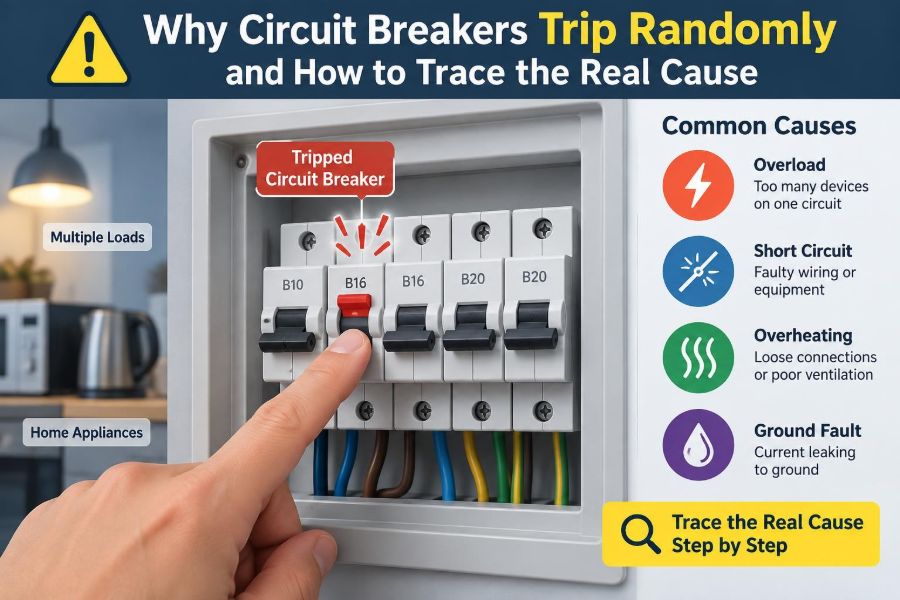

The kitchen lights go out halfway through dinner. A breaker in the panel has moved to the middle position, yet nothing obvious was switched on at that exact moment. After it is reset, the circuit may run for hours—or trip again as soon as the kettle starts.
That experience feels random, but a circuit breaker does not usually operate without a reason. It responds to heat, current, imbalance, leakage current, or an internal mechanical condition. The difficult part is that the condition that causes a trip may be intermittent.
For students, troubleshooting trips turns circuit theory into a practical diagnostic exercise. For electricians, facility staff, and homeowners, the same skill prevents repeated resets from becoming damage, downtime, or a shock and fire hazard.
The goal is not to force a breaker to stay on. It is to identify what protective function is operating, what condition triggers it, and whether the fault is in the load, wiring, panel, or breaker itself.
🔌 A Breaker Trip Is a Protective Decision
A circuit breaker is an automatically operated switch designed to interrupt a circuit when electrical conditions exceed its safe operating limits. In common low-voltage installations, it protects conductors from overheating and, depending on its type, may also protect people from ground-fault shock hazards.
Calling a trip “nuisance” before finding the cause is risky. A trip may indeed be caused by normal inrush current or a sensitive protective device, but it can also be the first visible symptom of a loose connection, damaged cable, failing appliance, or water intrusion.
🎲 Why the Problem Looks Random
Electrical faults often depend on conditions that change: a compressor cycles, a heating element warms, rain reaches an exterior fitting, vibration moves a damaged cord, or several appliances happen to operate together.
A breaker therefore may trip at an unpredictable time while still responding consistently to the same underlying trigger. The useful question is not “Why did it trip for no reason?” but “What changed just before it tripped?”
🧭 Identify the Device Before Diagnosing It
Look at the breaker label and any test button before drawing conclusions. A standard thermal-magnetic breaker reacts primarily to overcurrent. A GFCI, RCD, or RCBO monitors unintended current flowing to ground. An AFCI detects electrical arcing patterns.
Combined devices can provide more than one kind of protection. Their indicator lights, trip flags, and reset procedures vary by manufacturer, so the panel documentation and device markings matter.
| Protective device | What it chiefly detects | Common clue |
|---|---|---|
| Thermal-magnetic breaker | Overload or short circuit | Trips when demand is high or fault is energized |
| GFCI/RCD/RCBO | Current leaking to earth/ground | Trips with damp, damaged, or filtered equipment |
| AFCI/AFDD | Potentially hazardous arcing | Trips with damaged cords, connections, or some electronic loads |
🌡️ Thermal Trips Follow Heating Over Time
In a thermal-magnetic breaker, a bimetal element bends as current heats it. This gives the breaker an inverse-time characteristic: a modest overload may take minutes to trip, while a heavier overload trips sooner.
That explains a familiar pattern: a circuit works when a toaster runs alone, then trips after the toaster, kettle, and space heater have operated together. The breaker is not measuring appliance names; it is responding to conductor heating caused by total current.
🧲 Magnetic Trips Respond to Severe Fault Current
The magnetic portion of a conventional breaker reacts much faster to high current, such as a line-to-neutral or line-to-ground short circuit. A hard short often trips immediately when a switch is turned on or a plug is inserted.
Immediate tripping does not prove the fixed wiring is faulty. A shorted appliance cord, crushed extension lead, failed motor, or defective power strip can create the same behavior.
📊 Add Loads Instead of Guessing
Every load on a branch circuit contributes to the current. Resistive heating appliances are particularly easy to overlook because their power is substantial and their behavior is steady: kettles, portable heaters, hair dryers, irons, toasters, and countertop cooking equipment.
For a rough single-phase estimate, current is power divided by voltage: I ≈ P/V. Real appliances may have power-factor effects, motor starting current, or variable control electronics, but the estimate is still useful for recognizing when simultaneous loads are implausible on one circuit.
🍳 The Kitchen Countertop Example
Consider a hypothetical circuit supplying countertop receptacles. A kettle is heating water while a toaster is operating and a coffee maker begins its warming cycle. None of these appliances needs to be defective for the total demand to exceed the branch-circuit rating.
The remedy is not a larger breaker. It may be using appliances at different times, moving one appliance to a different correctly supplied circuit, or having a qualified electrician assess whether additional circuits are appropriate.
🚀 Motor Starting Current Can Be Legitimate
Motors can draw a brief inrush current as they start. Refrigerators, freezers, pumps, air conditioners, compressors, and workshop tools may therefore cause a momentary current peak beyond their running current.
Normally, a correctly selected breaker tolerates expected starting current. Repeated trips during starts can indicate a circuit already close to capacity, a motor that is mechanically overloaded, a failing start component, low supply voltage, or an incorrectly selected protective device.
🔥 A Loose Connection Can Create Heat Without an Obvious Overload
A loose terminal, worn receptacle contact, corroded splice, or poorly seated breaker can add resistance at one point. Current through that resistance produces heat according to P = I²R, often concentrated in a very small area.
This may not trip a breaker promptly, because the branch current can remain below the breaker rating while the connection itself overheats. Discoloration, a hot cover plate, crackling, burning odor, or a receptacle that grips plugs poorly calls for prompt professional attention.
💧 Ground Faults Often Arrive With Moisture
A ground fault occurs when current takes an unintended path to equipment grounding conductors, grounded metal, earth, or another conductive route. GFCI- and RCD-type devices trip when the current leaving on one conductor does not match the current returning on the other.
Bathrooms, kitchens, laundry areas, garages, exterior receptacles, crawl spaces, and outdoor lighting deserve special suspicion after condensation, cleaning, rain, or flooding. Moisture does not always create a permanent fault; it can lower insulation resistance only when surfaces are wet.
🧼 Appliances Can Leak Current Even When They Seem Fine
Heating elements, pumps, motors, and aging insulation can develop leakage to grounded metal frames. The appliance may still run, but a ground-fault protective device can correctly identify a hazardous condition before anyone receives a serious shock.
Unplugging all loads and reconnecting them one at a time is a useful first isolation step for an accessible plug-in circuit. If one appliance consistently causes the trip, remove it from service until it is tested or repaired.
🖥️ Electronic Equipment Changes the Picture
Many modern devices use filters between line, neutral, and ground to control electrical noise. Each device may leak a small normal current; a collection of computers, chargers, LED drivers, variable-speed drives, and UPS units can produce enough aggregate leakage to trip a sensitive ground-fault device.
This does not mean protection should be bypassed. It means the circuit design, device type, load distribution, and manufacturer guidance may need review by a qualified professional.
⚡ Arc-Fault Protection Looks for a Different Hazard
An arc fault is electricity jumping across a gap or poor contact. Series arcs can occur at loose connections in a conductor path, while parallel arcs can occur between conductors. Arcing can generate intense localized heat even when current is not high enough to trip an ordinary breaker quickly.
AFCI or AFDD devices analyze electrical signatures associated with arcing. Because loads with brushes, switching power electronics, and certain controls can create complex waveforms, diagnosis should include the device’s diagnostic indication rather than assumptions based only on the trip.
🪢 Damaged Cords Create Intermittent Faults
A cable damaged by a door, chair wheel, staple, pet, repeated bending, or sharp edge may behave normally until it is moved. Internal conductor strands can separate, insulation can crack, or conductors can contact each other only in one position.
Inspect flexible cords without flexing, cutting, or dismantling them. Replace visibly damaged cords and power strips; taping over damaged insulation is not an equivalent repair.
🏠 Fixed Wiring Can Also Be the Source
Faults in fixed wiring may involve a nail or screw penetrating a cable, rodent damage, failed junction-box connections, degraded insulation, or water entering an exterior box. These faults can be concealed behind walls and may be affected by temperature, vibration, or moisture.
If the breaker trips with all downstream loads unplugged, or trips immediately after a circuit is energized, fixed wiring becomes more likely. Further testing commonly requires isolation procedures and instruments that should be used by competent electrical personnel.
🧪 Start With a Safe Load-Isolation Test
A practical first-level method is simple: turn off or unplug accessible loads on the affected circuit, reset the breaker once, and observe. If it holds, reconnect loads individually and allow enough time for the suspected operating cycle to occur.
- Record what was running and what had recently changed.
- Unplug portable equipment and switch off fixed loads where their local controls are accessible.
- Reset the breaker fully by moving it to OFF first, then to ON.
- Reconnect one load at a time, noting the time and result.
- Stop if there is heat, odor, noise, sparking, or repeated immediate tripping.
This process identifies patterns; it is not a substitute for electrical testing when warning signs are present.
📝 Keep a Trip Log Long Enough to Reveal a Pattern
A brief log is surprisingly effective for faults linked to time or weather. Note the date, trip time, breaker identity, weather or moisture, loads running, and what happened immediately before the trip.
For example, a trip that appears only after a sump pump runs, or only when outdoor lights are wet, directs attention much more efficiently than repeatedly resetting the panel without observations.
🔍 Read the Clues in Trip Timing
Timing narrows the diagnosis. An immediate trip on energizing a load suggests a short circuit, ground fault, or strong inrush-related issue. A trip after several minutes of high demand suggests overload or heat. A trip after rain points toward moisture-related leakage.
These are diagnostic clues, not certainty. A loose connection can heat with delay, and an appliance fault can occur only once its internal parts warm up.
🧰 What a Qualified Electrician Tests
Professional diagnosis goes beyond swapping parts. Depending on the installation and symptom, it may include load-current measurement with a clamp meter, voltage-drop checks, continuity and insulation-resistance testing on safely isolated circuits, torque verification to manufacturer specifications, and inspection of panel and termination condition.
Technicians also separate sections of a circuit to locate a fault. That disciplined isolation prevents an expensive but ineffective response, such as replacing a breaker when the actual problem is a wet exterior luminaire.
🧯 When Not to Reset the Breaker
Do not continue resetting if the breaker trips immediately and repeatedly, a panel or receptacle is hot, there is smoke or burning smell, there are buzzing or crackling sounds, water is present, or damage is visible. Turn the circuit off if it is safe to do so and seek qualified help.
A breaker that will not remain reset may be preventing ongoing heating or shock exposure. Repeatedly forcing it on can worsen damage at the fault location.
🚫 Never Solve Trips by Upsizing the Breaker
Replacing a breaker with one of a higher rating without an engineered assessment is dangerous. Circuit conductors, terminals, receptacles, and installation conditions are selected around a permitted current. A larger breaker can allow wiring to overheat before it disconnects.
The same caution applies to installing a different trip curve or disabling GFCI, RCD, AFCI, or AFDD protection merely because it trips. Protective devices may need coordinated selection, but that is a design decision—not a workaround.
🔄 A Bad Breaker Is Possible, but Not the Default
Breakers are mechanical and thermal devices and can eventually fail, become damaged, or perform incorrectly. A loose bus connection or incompatible panel component can also create problems that appear to be breaker failures.
Still, replacing the breaker first can hide the real fault and wastes evidence. Suspect the breaker after load, wiring, moisture, termination, and device-specific trip information have been evaluated—not simply because it is the component that moved.
🏭 Panel Conditions Matter in Commercial Work
In commercial and industrial settings, trips can result from phase loading, large motor starts, harmonics from nonlinear loads, protective coordination issues, or changed equipment use. A panel schedule that no longer matches actual connected loads complicates every troubleshooting effort.
These systems may involve stored energy, higher fault levels, and interdependent protective settings. Investigation should follow site safety procedures and be handled by authorized personnel with the relevant equipment knowledge.
📐 Selective Coordination Has Limits
In systems with multiple protective devices, ideally the device closest to the fault opens first. This is called selective coordination. If an upstream device trips instead, more of the facility loses power than necessary.
Achieving coordination requires comparing time-current characteristics, available fault current, and equipment ratings. It cannot be assumed from breaker ampere ratings alone, particularly when electronic-trip breakers and motor circuits are involved.
🧠 Avoid Common Troubleshooting Traps
- Resetting without observing: loses the operating clues around the trip.
- Assuming the last-used appliance is guilty: a different cycling load may be the trigger.
- Ignoring shared loads: another room or outdoor receptacle may be on the same circuit.
- Changing several things at once: makes the result impossible to interpret.
- Using extension cords as a permanent fix: can introduce additional loading and connection hazards.
Good troubleshooting changes one controlled variable at a time and records the outcome.
🛠️ Prevention Begins With Circuit Awareness
Clearly labeling circuits, avoiding daisy-chained power strips, keeping outdoor covers weather-resistant, and replacing worn cords reduce many avoidable trips. Regular visual checks are especially valuable where appliances are moved often or moisture is common.
For facilities, maintain updated panel schedules and review circuit loading whenever equipment is added. A new appliance can change not only total demand but also leakage current, inrush behavior, and power quality.
📚 A Practical Decision Path
Use the symptoms to choose the next safe action. If a standard breaker trips only under heavy simultaneous use, investigate load distribution. If a ground-fault device trips with one appliance, isolate that appliance. If trips follow rain, inspect the outdoor portion of the circuit through a qualified person.
If the circuit trips empty, trips immediately, shows heat or damage, or supplies critical equipment, move beyond informal testing. The correct next step is professional fault location rather than another reset.
✅ The Core Principle: Trace Conditions, Not Coincidences
Breakers rarely trip randomly; faults and loads are often intermittent. The reliable method is to identify the protection type, distinguish overload from fault behavior, isolate loads safely, observe timing and environmental conditions, and escalate when the evidence points to fixed wiring or hazardous symptoms.
That method respects the breaker’s purpose. It turns an annoying interruption into useful diagnostic information while keeping conductor protection and shock protection intact.
Do not treat a tripping breaker as a switch that needs persuasion; treat it as a signal that the circuit needs evidence-based investigation. ⚡🧰🔍