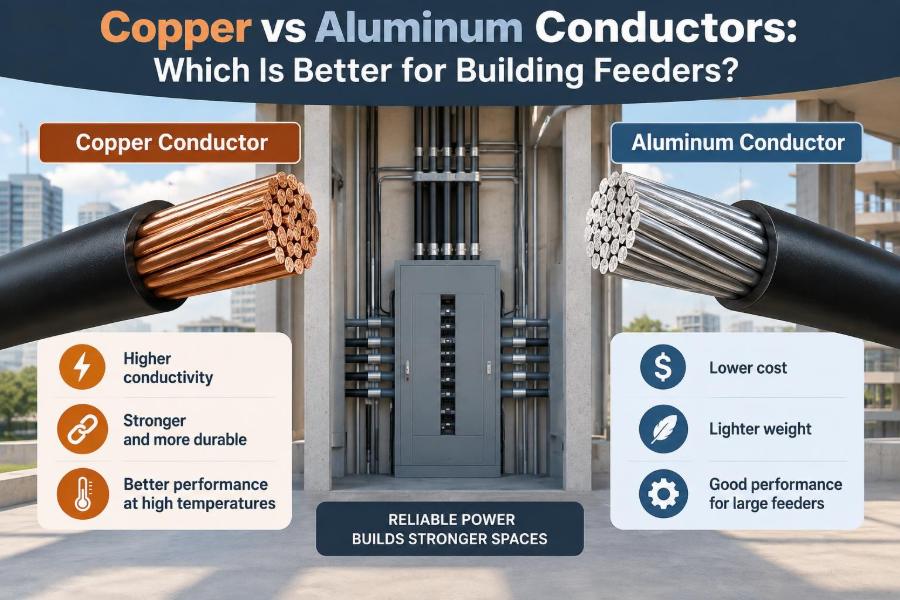

A design team is laying out a feeder from a building service to a large distribution panel. The electrical room is tight, the route includes several bends, the load may expand, and the owner is watching both schedule and material cost.
At first glance, the conductor decision seems simple: copper is smaller, aluminum is lighter. But a feeder is not selected by metal preference alone. Its ampacity, terminations, installation conditions, mechanical protection, and maintenance expectations all matter.
A poor comparison can create avoidable problems. Selecting aluminum without verifying listed terminals can lead to bad connections; specifying copper by habit can add weight and cost without improving the installed system.
The better question is not which metal is universally superior. It is which complete conductor-and-termination system is appropriate for this feeder, this building, and this code jurisdiction. ⚡
🔎 1. Start With the Actual Feeder Duty
A feeder carries power from service equipment, a separately derived source, or other distribution equipment to downstream panelboards, switchboards, motor-control equipment, and similar loads. It is different from a branch circuit, even though many conductor-selection principles overlap.
Before choosing copper or aluminum, establish the calculated load, system voltage, phase arrangement, continuous-load treatment, expected future loads, available fault current, route length, and installation method. The material choice comes after those electrical duties are understood.
⚖️ 2. Copper and Aluminum Are Not Equal by Size
Copper has lower electrical resistivity than aluminum. Therefore, an aluminum conductor generally needs a larger cross-sectional area than a copper conductor to provide comparable ampacity and resistance performance.
That does not make aluminum a lesser product. It means the comparison must be made using properly sized conductors under the applicable ampacity rules, not by comparing the same trade size in both metals.
| Characteristic | Copper | Aluminum |
|---|---|---|
| Electrical conductivity | Higher for a given conductor size | Lower for a given conductor size |
| Typical conductor size for equal duty | Usually smaller | Usually larger |
| Weight | Heavier | Much lighter for a comparable application |
| Termination requirement | Must match terminal listing | Must match terminal listing |
| Common feeder use | Widely used, especially where space is limited | Widely used for larger building feeders |
🧮 3. Ampacity Is the First Sizing Check
A conductor must have sufficient allowable ampacity for the calculated load after all applicable adjustment and correction factors are applied. The governing electrical code provides ampacity tables and rules for the installation conditions.
Use the correct column based on insulation temperature rating and the limitations imposed by terminals, equipment, and code rules. A conductor with high-temperature insulation is not automatically allowed to use its highest table ampacity at the equipment connection.
🌡️ 4. Terminal Temperature Ratings Can Control
Feeder conductors terminate at equipment lugs, breakers, disconnects, panelboards, and splices. Those connections have temperature ratings and listing conditions that can limit the usable ampacity.
For many building feeders, particularly with larger conductors and equipment rated for higher-temperature terminations, the applicable rules may permit use of a higher temperature column for ampacity. For smaller equipment or different conditions, a lower terminal limitation may govern.
Never select an ampacity table column in isolation. Read the equipment marking, follow the installation instructions, and apply the adopted code.
🏷️ 5. A Lug Must Be Listed for the Conductor Material
Conductors and terminals form one system. A terminal must be identified as suitable for the conductor material being installed; do not assume a copper-only lug accepts aluminum simply because the conductor fits physically.
Modern equipment commonly uses terminals marked for aluminum and copper conductors, but markings, conductor ranges, strand classes, and installation instructions still need to be checked. The correct answer is found on the product and in its documentation, not guessed from appearance.
🔩 6. Torque Is an Electrical Requirement
Terminations need the manufacturer-specified tightening torque. Too little torque can produce inadequate contact pressure and elevated resistance; too much can damage strands, threads, or the terminal itself.
Use a calibrated torque tool and the specified method. For critical feeder work, documenting torque practices is a practical quality-control step, especially where multiple installers and large quantities of lugs are involved. 🔧
🧪 7. Oxide Layers Need Proper Connection Practice
Aluminum forms a stable oxide layer when exposed to air. That oxide has much higher electrical resistance than the base metal, which is one reason aluminum connections must be made using listed, properly prepared components and the manufacturer’s instructions.
Copper also oxidizes and still requires sound workmanship. The lesson is not that one metal needs care and the other does not; it is that every termination needs the preparation, hardware, contact pressure, and torque intended by its listing.
📏 8. Voltage Drop Deserves a Separate Calculation
A feeder can satisfy ampacity requirements and still deliver unsatisfactory voltage performance at a distant load. Voltage drop depends on conductor resistance and reactance, circuit length, current, power factor, and conductor arrangement.
Because aluminum has higher resistance for a given size, it may need additional upsizing on a long route. Copper may also need upsizing when the run is long or loads are sensitive to voltage variation.
Good feeder design evaluates thermal capacity and voltage performance separately.
📐 9. Physical Size Changes Raceway Design
When aluminum is selected for equivalent feeder duty, the larger conductor sizes can affect raceway fill, bend radius, box space, gutter space, and the ability to make up terminations cleanly. These are design issues, not field inconveniences to discover after materials arrive.
A raceway that appears adequate based on a rough sketch may become difficult to pull through once the actual conductor insulation diameter, number of parallel sets, and bends are considered.
🧲 10. Raceway Fill Is More Than a Percentage
Code-required fill limits are essential, but a technically compliant fill calculation does not guarantee an easy installation. Pulling tension, sidewall pressure at bends, lubricant selection, and the stiffness of large conductors all influence field results.
Aluminum’s lighter weight can help on long pulls, while its larger overall dimensions can complicate congested pathways. Copper’s smaller size can help where raceway space is constrained, while its weight can increase handling effort.
🏗️ 11. Weight Affects Installation Logistics
Large copper conductors can be heavy to transport, stage, pull, and support. On a long vertical riser or a roof route with limited access, that weight affects labor planning and safe material handling.
Aluminum’s lower weight is a major practical advantage for many large feeders. It can reduce reel-handling demands and make large parallel sets more manageable, provided the raceway and termination design accommodates the larger conductor sizes.
🪢 12. Flexibility Depends on Construction, Not Just Metal
Installers often describe aluminum as easier to handle because it is lighter, but flexibility depends on conductor size, stranding, insulation, and cable construction. Very large conductors of either metal require careful pulling and bending practices.
Specify the conductor type deliberately. The differences between compact-stranded, conventional stranded, individual conductors in raceway, and multiconductor cable can materially affect pulling and termination details.
🧱 13. Termination Space Can Decide the Project
Equipment lugs have a limited conductor range. A larger aluminum conductor selected for ampacity or voltage drop may not fit the standard lug, may require a different lug kit, or may change the required enclosure dimensions.
Verify both ends of every feeder: source equipment, overcurrent device, distribution equipment, splice points, and any transition equipment. A design that checks only the downstream panel is incomplete.
🛡️ 14. Overcurrent Protection Must Match the Design
The feeder conductor, overcurrent protective device, equipment ratings, and calculated load must be coordinated under the applicable code rules. Conductor material does not change the need for correct overcurrent protection.
Do not treat a larger aluminum conductor as permission to increase the breaker rating, or a smaller copper conductor as justification to ignore load calculations. The protective device must be selected through the full set of applicable rules.
⚡ 15. Short-Circuit Duty Is Not an Afterthought
During a fault, conductors and their terminations experience severe thermal and mechanical stress. Available fault current, clearing time, equipment withstand ratings, conductor protection, and fault-path integrity all contribute to a sound design.
For ordinary building work, code compliance and listed equipment are fundamental. For high available fault current, critical facilities, or unusual systems, engineering review should explicitly address short-circuit and coordination considerations.
🧯 16. Neutral and Grounding Conductors Have Their Own Rules
Do not assume every conductor in a feeder can be selected using the same sizing logic. A neutral may carry nonlinear loads or be permitted to be reduced only under specific load-calculation conditions; an equipment grounding conductor follows separate sizing requirements.
Where unbalanced, harmonic-rich, or electronic loads are significant, neutral loading deserves particular attention. Copper versus aluminum is only one part of this analysis.
🌊 17. Environment Can Shift the Better Choice
Wet locations, corrosive atmospheres, high ambient temperatures, outdoor exposure, and locations subject to physical damage all influence conductor and wiring-method selection. The insulation marking, cable listing, raceway system, and fittings must suit the environment.
Neither copper nor aluminum is a universal answer for harsh conditions. Material compatibility and the manufacturer’s environmental suitability guidance are essential when moisture, chemicals, or dissimilar metals may be present.
🔗 18. Dissimilar Metals Require Thoughtful Interfaces
When copper and aluminum meet in the same electrical system, use connectors and lugs listed for that purpose. Avoid improvised transitions, especially in locations where moisture or contaminants could support corrosion.
The objective is not to avoid mixed-metal systems; they are common. The objective is to provide an engineered, listed interface with correct preparation and installation.
🏢 19. Aluminum Is Established in Large Feeders
Modern aluminum building wire is widely used for feeders and service conductors when it is correctly specified and installed. Its use should not be confused with historical concerns associated with certain older small-conductor branch-circuit applications.
Feeder decisions should be based on current conductor products, terminal listings, applicable code requirements, and installation quality. Broad statements that aluminum is always unsafe or copper never has connection problems are both inaccurate.
🛠️ 20. Workmanship Often Matters More Than the Metal
Many connection failures trace back to installation errors: an incompatible lug, incorrect strip length, damaged strands, contamination, failure to follow preparation instructions, or improper torque. These risks can affect either conductor material.
Useful field controls
- Confirm conductor material, size, insulation, and strand type before pulling.
- Verify terminal markings and conductor ranges at every endpoint.
- Use manufacturer-required preparation materials and methods.
- Apply and document specified torque values.
- Inspect for strand damage, insulation damage, and adequate bend space.
📚 21. Code Compliance Means Using the Adopted Code
Electrical rules vary by jurisdiction and adoption cycle. In the United States, designers commonly work under an adopted edition of the National Electrical Code, together with local amendments and requirements of the authority having jurisdiction.
Always consult the version adopted for the project, manufacturer instructions, and equipment listings. This article explains design principles; it does not replace project-specific code analysis or stamped engineering documents where those are required.
💰 22. Compare Installed Cost, Not Just Metal Cost
Material pricing changes over time and across markets, so a simple claim that one conductor is always cheaper is unreliable. Aluminum often offers a material-cost advantage in large feeder applications, but the total installed result can differ.
Include conductor quantity, raceway size, fittings, lug kits, equipment changes, pulling labor, handling, schedule effects, voltage-drop upsizing, and space constraints. A smaller copper solution may be economically attractive in a congested renovation, while aluminum may be compelling on a long, high-ampacity run.
📈 23. Future Capacity May Favor a Different Choice
A feeder sized only for today’s calculated load may limit a future tenant improvement, equipment upgrade, or electrification project. Designing spare capacity can be valuable, but it should be intentional rather than an unsupported guess.
Consider spare raceways, larger equipment bus ratings, reserved lug positions, and realistic load-growth scenarios. The selected conductor material should fit the project’s long-term distribution strategy.
🏥 24. Critical Loads Need a Broader Reliability Review
For healthcare, data processing, life-safety, industrial continuity, and other critical loads, conductor selection belongs within a wider reliability plan. Redundancy, selective coordination, physical routing separation, inspection, testing, and maintainability may outweigh a narrow material comparison.
Copper may be selected where compact routing and termination space are especially valuable. Aluminum may be selected where large-capacity distribution and manageable installation weight support the overall design. Neither choice alone creates reliability.
📝 25. Build a Practical Selection Workflow
A disciplined workflow prevents the conductor decision from becoming a late-stage substitution debate.
- Calculate the feeder load and determine applicable continuous-load treatment.
- Select a compliant wiring method for the environment and route.
- Size copper and aluminum alternatives for ampacity, corrections, and adjustments.
- Check voltage drop for the actual route length and load characteristics.
- Verify raceway fill, pulling feasibility, bending space, and support needs.
- Confirm every lug, splice, breaker, and enclosure accepts the selected option.
- Compare installed cost, schedule, maintenance access, and future capacity.
✅ 26. The Core Principle: Select the System, Not the Metal
Copper is often advantageous where compact dimensions, smaller raceways, and constrained termination space are decisive. Aluminum is often advantageous for large feeders where lower weight and a favorable installed-cost evaluation offset its larger required size.
The correct selection is the one that is properly sized, code-compliant, compatible with listed terminations, practical to install, and appropriate for the project’s operating conditions. It must be evaluated as a complete electrical system from source lug to load lug.
For building feeders, copper and aluminum are both sound choices when design discipline and installation quality—not assumptions about the metal—drive the decision. ⚖️⚡🏗️