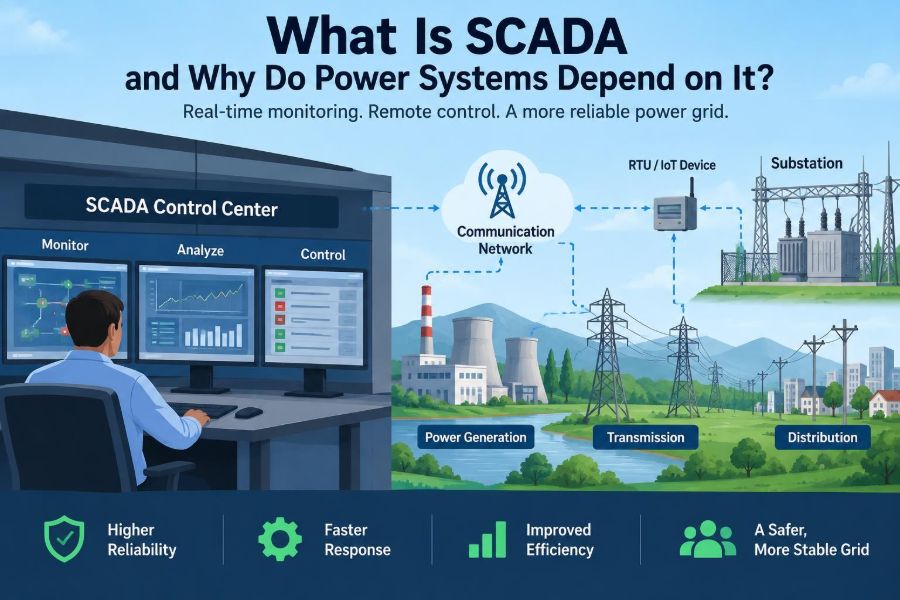

It is a hot afternoon, electricity demand is climbing, and a transmission line trips hundreds of kilometres from the control room. Operators need to know what changed, which equipment opened, whether voltages are recovering, and what action is safe.
They cannot drive to every substation or wait for field reports. The grid must be observed and controlled across vast distances in seconds, even when conditions are changing quickly.
This is where SCADA becomes essential. It gives power-system operators a structured view of remote assets and a controlled way to send commands back to them.
SCADA is not the grid itself, and it does not replace engineering judgement. It is the information-and-control layer that helps people operate an increasingly complex physical system reliably. ⚡
🛰️ 1. What Does SCADA Mean?
SCADA stands for Supervisory Control and Data Acquisition. The name describes its two central jobs: collecting operational data from distributed equipment and allowing supervisory-level control from a central location.
In power systems, SCADA connects control centres to substations, generating plants, renewable-energy sites, and sometimes major customer facilities. It turns many separate physical locations into a coordinated operational picture.
The word “supervisory” matters. SCADA generally oversees and commands lower-level automated devices rather than directly performing every fast protective action itself.
⚡ 2. Why Electricity Networks Need Remote Visibility
A power network may span cities, regions, or entire countries. Important equipment is often located in unattended substations, on remote transmission corridors, or at plants with limited local staffing.
Operators need timely knowledge of states and measurements such as:
- Whether circuit breakers and disconnectors are open or closed
- Voltage, current, power flow, frequency, and transformer loading
- Equipment alarms, communication failures, and abnormal temperatures
- Generator output, battery status, and renewable plant availability
Without remote visibility, operators would work from delayed and incomplete information. That makes routine switching slower and disturbance response much harder.
🏗️ 3. The Physical Assets Behind the Screen
A SCADA display may show coloured lines, symbols, and numbers, but each item represents real electrical equipment. A one-line diagram is a simplified operating map of a much larger physical network.
At a substation, SCADA may represent busbars, transformers, circuit breakers, instrument transformers, capacitor banks, reactors, and protection relays. At a generating station, it may show turbines, generators, fuel or water systems, and grid interconnection equipment.
The display is useful only if it accurately reflects field conditions. Good SCADA design therefore depends on disciplined engineering of both physical assets and information models.
🧩 4. The Main Layers of a SCADA System
SCADA is a system of connected layers rather than a single product. Each layer has a specific role, from sensing a physical quantity to presenting useful information to an operator.
| Layer | Typical role in a power system |
|---|---|
| Field layer | Sensors, transducers, breakers, switches, and protection devices |
| Station layer | IEDs, RTUs, PLCs, and local automation controllers |
| Communication layer | Networks that carry measurements, statuses, alarms, and commands |
| Control-centre layer | SCADA servers, databases, historian, and engineering tools |
| Operator layer | Human-machine interfaces used for monitoring and supervision |
Failures or design weaknesses in any layer can affect the usefulness of the whole system. SCADA engineering is therefore as much about interfaces as individual devices.
📡 5. Data Acquisition: Turning Physics into Information
Data acquisition begins with field signals. A current transformer, voltage transformer, temperature sensor, position contact, or meter provides information that can be measured by an intelligent electronic device or remote terminal unit.
Some signals are analogue values, such as MW, MVAr, kV, amperes, or temperature. Others are digital indications, such as a breaker auxiliary contact showing open or closed.
Devices convert these inputs into data points with defined meanings, quality attributes, and timestamps. This translation is fundamental: a number without engineering context is not yet operational information.
🔌 6. RTUs, PLCs, and IEDs
Remote terminal units (RTUs) are designed to gather field data and communicate it to a control centre. They are widely used where a robust interface is needed between remote equipment and SCADA communications.
Programmable logic controllers (PLCs) are flexible industrial controllers often used for plant processes, auxiliary systems, and local automation. Their role can overlap with an RTU depending on the application.
Intelligent electronic devices (IEDs), including modern protection relays and meters, can measure, communicate, alarm, and sometimes automate directly. In digital substations, IEDs often provide a large share of the available operational data.
🖥️ 7. The Operator’s Human-Machine Interface
The human-machine interface, or HMI, is the screen environment used by operators. It presents network topology, alarms, trends, equipment status, measurements, and command controls.
Effective HMI design prioritises clarity over decoration. Operators must distinguish normal from abnormal conditions, identify what changed, and avoid confusing adjacent equipment or similar labels.
A well-designed display supports attention during routine work and resilience during a disturbance. Poor visual design can hide important conditions or contribute to operator error.
🗺️ 8. One-Line Diagrams Make Networks Operable
Power-system SCADA commonly uses one-line diagrams. They represent three-phase equipment with a single line, making complex network arrangements easier to view at a practical scale.
Symbols show the state of breakers, switches, transformers, generators, and feeders. Colours may provide additional operating context, but the exact conventions vary by organisation and should never be assumed without training.
One-line diagrams also support navigation: an operator can move from a regional overview to a substation, then to a specific bay or piece of equipment.
🚨 9. Alarms Are More Than Notifications
An alarm signals that a condition needs awareness, assessment, or action. It may indicate a protection operation, low battery voltage, a communication loss, a limit violation, or an abnormal equipment state.
Not every event deserves the same urgency. Alarm systems assign priorities so that the most time-critical and consequential conditions stand out.
Alarm management is a major operational discipline. During a fault, thousands of related indications can arrive quickly; the system should help operators recognise the initiating problem rather than drown them in symptoms.
⏱️ 10. Event Time and Sequence of Events
After a disturbance, the order of events matters. Did a protection relay operate before a breaker opened? Did a communication alarm begin before or after the equipment alarm?
Sequence-of-events recording uses accurately time-stamped changes to reconstruct what happened. High-resolution timing is particularly valuable when engineers investigate protection performance and cascading events.
SCADA event records are often combined with relay records, fault data, and operator logs. Together, these sources build a more defensible understanding than any single screen capture.
📈 11. Real-Time Data and Historical Data Serve Different Jobs
Real-time SCADA data helps operators understand current conditions and make near-term decisions. It answers questions such as whether a breaker has operated or whether a line is approaching a limit.
A historian stores time-series information for later review. Engineers use historical trends to investigate recurring alarms, compare loading patterns, assess voltage behaviour, and support maintenance planning.
Historical data must be interpreted carefully. Sampling intervals, data quality flags, missing periods, scaling, and configuration changes can all affect conclusions.
🎛️ 12. Supervisory Control Means Deliberate Commands
SCADA allows authorised operators to issue commands such as opening or closing a breaker, raising a transformer tap, starting a standby generator, or changing a setpoint.
These commands do not bypass electrical safety principles. A command normally passes through configured checks, communication paths, field-device logic, and equipment interlocks before an action occurs.
Because a wrong command can have serious consequences, command functions are intentionally controlled. The goal is not merely remote operation; it is remote operation with verification.
✅ 13. Select-Before-Operate Reduces Command Risk
Many SCADA systems use select-before-operate for significant control actions. The operator first selects the intended point, reviews its identity and current state, and then issues the operate command.
This two-step process reduces the chance of acting on an incorrect device, especially on crowded diagrams. It also provides a clearer audit trail of what the operator intended to do.
Control-room procedures commonly add further safeguards, including verbal confirmation, switching orders, and independent checks for higher-risk work.
🛡️ 14. SCADA Does Not Replace Protection Systems
Protection systems must act much faster than a human operator or a wide-area SCADA command path. Protective relays detect faults and trip circuit breakers locally to isolate damaged equipment.
SCADA reports that protective action and gives operators situational awareness afterward. It may also support restoration, but it is not normally the primary mechanism for clearing a high-speed short circuit.
This distinction is crucial: protection preserves equipment and system stability; SCADA supervises, informs, and coordinates operations.
⚙️ 15. Local Automation and Central Supervision
Many decisions must happen close to the equipment. Examples include transformer cooling control, automatic capacitor switching, generator controls, and protection-based automatic reclosing.
SCADA may monitor these automatic functions, report their status, and permit approved supervisory adjustments. However, local automation remains valuable when communications are delayed or unavailable.
Power systems are therefore designed with layers of autonomy. Central visibility improves coordination, while local intelligence supports speed and resilience.
🌐 16. Communication Networks Carry the Operational Picture
SCADA data travels over communication media such as fibre-optic networks, radio links, cellular services, microwave systems, and leased telecommunications circuits. The best choice depends on geography, criticality, bandwidth, and resilience requirements.
Communication design considers more than speed. Availability, latency, path diversity, cybersecurity controls, maintainability, and recovery after storms or other disruptions are equally important.
When a link fails, the control room may lose updates from a site. The physical equipment can still operate locally, but operator awareness and remote control capability may be reduced.
🔗 17. Protocols Help Devices Understand One Another
Different devices need agreed rules for exchanging data. A communication protocol defines how messages are structured, identified, transmitted, and interpreted.
Power-system environments commonly use protocols such as IEC 60870-5-101, IEC 60870-5-104, DNP3, Modbus, and IEC 61850-related services. Their suitability depends on the system architecture and required functions.
Interoperability is not automatic just because two products mention the same protocol. Point definitions, addressing, timing, control behaviour, and engineering conventions must also align.
🏭 18. SCADA in Generation Facilities
At conventional generating stations, SCADA may report unit output, breaker status, auxiliary-system alarms, transformer conditions, and plant-grid interface measurements. Plant control systems often handle detailed process control locally.
For wind and solar plants, SCADA can aggregate the status of many distributed units. It may show available capacity, inverter or turbine alarms, weather-related conditions, and site-level electrical measurements.
Grid operators use this information to understand what generation is connected and what operational constraints may affect dispatch or network security.
🔋 19. SCADA and Energy Storage
Battery energy storage systems add controllable charging and discharging capability to modern grids. Their operational state includes power output, state of charge, availability, thermal conditions, and converter status.
SCADA provides a pathway for observing these conditions and issuing approved power or mode commands. It also helps operators see whether a storage facility is supporting a local voltage, responding to a schedule, or unavailable.
Because storage can change power flow quickly, accurate status and clearly defined control authority are especially important.
🌬️ 20. SCADA Helps Integrate Variable Renewable Energy
Wind and solar output change with weather and operating conditions. Their connection points can be far from traditional control centres and may include large numbers of individual devices.
SCADA consolidates key information so operators can see plant-level production, connection status, curtailment state, and alarms. This supports broader awareness of changing generation patterns.
It does not make renewable output predictable by itself. Instead, it provides timely operational evidence that can be used alongside forecasts, market systems, and engineering studies. 🌤️
🏙️ 21. Distribution SCADA Brings Visibility Closer to Customers
Transmission SCADA is often associated with large substations and bulk power flows, but distribution networks also benefit greatly from remote monitoring and control. Distribution feeders have many more branches and often serve directly connected customers.
Remote-controlled switches, reclosers, and feeder devices can help operators isolate a faulted section and restore unaffected areas more efficiently. This is sometimes coordinated with automated feeder-management applications.
Distribution SCADA must handle a broad, geographically dispersed device population while keeping device identity and network connectivity accurate.
🔍 22. Data Quality Is an Engineering Requirement
A value can be present on a screen yet still be untrustworthy. SCADA points may be marked invalid, substituted, stale, out of range, or affected by a communication problem.
Operators and engineers need to understand data quality flags, not just numerical values. A stale MW reading should not be treated as proof of present loading.
Quality depends on correct scaling, reliable communications, maintained sensors, sound point mapping, and rigorous testing. Trust in SCADA is earned through continual verification.
🧪 23. Testing and Commissioning Prevent Hidden Errors
Before a new SCADA point enters service, engineers typically test its meaning, scaling, alarm logic, timestamping, display location, and control response. A point that is electrically connected but wrongly labelled can still create an operational hazard.
Testing may include simulated signals, end-to-end checks from field device to HMI, and witnessed control operations under approved conditions. Configuration management is essential when equipment or logic changes later.
Commissioning is not simply an IT task. It requires cooperation among protection, control, telecommunications, operations, and field teams.
🔐 24. Cybersecurity Is Part of Reliable Operation
SCADA connects operational technology to communications infrastructure, making cybersecurity a reliability concern as well as an information-security concern. Unauthorised access or altered data could affect real equipment and real people.
Common protective approaches include network segmentation, strong authentication, role-based access, secure remote access, patch management, logging, backups, and incident-response planning. No single control is sufficient on its own.
Cybersecurity must be balanced with operational needs. A control centre cannot simply become inaccessible during an emergency, so resilience and secure recovery matter as much as prevention.
👥 25. People, Procedures, and Authority Matter
SCADA provides information and control capability, but people decide what actions are appropriate. Operators work under defined responsibilities, switching procedures, safety rules, and coordination arrangements.
A display cannot fully capture site hazards, work permits, grounding arrangements, or changing field conditions. Operators communicate with dispatchers, protection engineers, plant personnel, and field crews before critical actions.
The strongest SCADA systems support human judgement rather than encouraging blind acceptance of automation.
📚 26. Skills for Students and Working Engineers
Anyone entering this field benefits from a foundation in power-system components, three-phase quantities, protection principles, instrumentation, networking, and control logic. Understanding the physical process is as important as understanding the software.
Useful practical habits include reading one-line diagrams, tracing a signal from sensor to screen, checking units and scaling, interpreting alarms, and asking what happens when a communication path fails.
For working professionals, SCADA literacy improves collaboration across operations, protection, automation, telecommunications, and cybersecurity teams. It helps turn isolated technical decisions into dependable system behaviour.
🎯 27. The Core Principle: Observe, Understand, Act Safely
Power systems depend on SCADA because reliable operation requires a shared, timely view of distributed assets. SCADA gathers field information, presents it in operational context, records what happened, and enables carefully governed remote control.
Its value is greatest when the entire chain is dependable: accurate sensors, well-engineered devices, resilient communications, intelligible alarms, secure systems, trained operators, and disciplined procedures.
SCADA does not eliminate complexity in a power system; it gives operators the visibility and controlled reach needed to manage that complexity safely. ⚡🛰️🔐