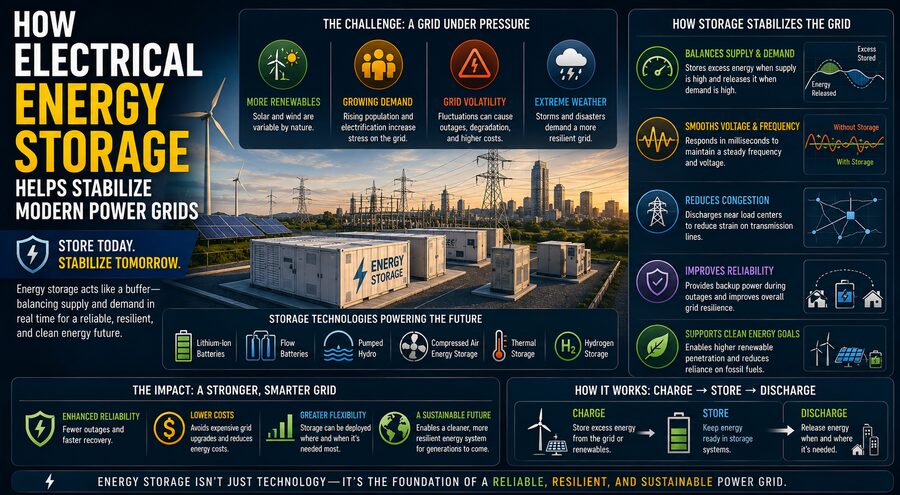

Electric power grids must perform a difficult balancing act every second of the day. Electricity generation and electricity consumption must remain closely matched, even though demand constantly changes and many modern energy sources—such as wind and solar—can vary with weather conditions. 🌬️☀️
If too much electricity is produced, grid frequency and voltage can move outside acceptable limits. If too little is produced, the system may struggle to meet demand, potentially causing equipment problems, emergency load shedding, or blackouts.
Electrical energy storage helps solve this challenge by absorbing electricity when it is abundant and releasing it when the grid needs additional power.
In simple terms:
Excess electricity ➡️ Energy storage ➡️ Electricity released later
Storage can respond much faster than many conventional power plants, making it valuable not only for shifting energy from one time of day to another but also for maintaining the stability, reliability, and resilience of modern power systems. 🔋⚙️
🌐 Why Must an Electricity Grid Stay Balanced?
Unlike water stored in a reservoir, electricity on a traditional grid is generally produced and consumed almost simultaneously.
When millions of homes and businesses switch appliances on and off, electricity demand changes continuously.
A grid operator must therefore maintain:
Power generated ≈ Power consumed
Suppose consumers suddenly require an additional 500 megawatts of electricity.
If generation does not increase quickly enough, the grid’s operating frequency can begin to decline.
If generation exceeds demand, frequency may rise.
Large or prolonged deviations can threaten equipment and system reliability.
Energy storage acts as a flexible buffer between supply and demand.
🔋 What Is Electrical Energy Storage?
Electrical energy storage systems convert electricity into another form of energy that can be stored temporarily.
Later, that stored energy is converted back into electricity.
Different technologies store energy in different forms.
Examples include:
- 🔋 Electrochemical energy in batteries
- 💧 Gravitational potential energy in pumped hydro
- 🌀 Rotational energy in flywheels
- 💨 Compressed air
- 🔥 Thermal energy
- ⚡ Electric fields in capacitors
The ideal technology depends on how much power is needed, how long the energy must be stored, how quickly the system must respond, and how frequently it will operate.
🔋 Battery Energy Storage Systems
One of the most visible modern storage technologies is the Battery Energy Storage System, often abbreviated BESS.
Large battery installations may contain thousands of battery modules connected to sophisticated power-electronic converters.
A grid-scale battery can:
Charge when electricity is plentiful
and:
Discharge when electricity is scarce
The power-electronic equipment controls how electrical energy moves between the battery and the alternating-current power grid.
Lithium-ion batteries are widely used because they offer:
- Fast response
- High efficiency
- Modular construction
- Falling costs over time
- Good power density
Other battery chemistries are also being developed and deployed for different applications.
⚖️ How Storage Balances Supply and Demand
Imagine electricity demand is low at 2:00 a.m., but several power plants and wind farms continue generating electricity.
A battery can absorb some of this excess production.
Later, at 6:00 p.m., millions of people return home and electricity demand increases.
Instead of immediately starting additional power plants, the grid operator can discharge the battery.
The cycle becomes:
Low demand ➡️ Charge storage 🔋
High demand ➡️ Discharge storage ⚡
This is known as energy shifting or load shifting.
It moves electricity from periods of lower value or excess production to periods when it is more useful.
📈 Peak Shaving
Electricity networks must be designed for their highest demand periods, even if those peaks occur only a few hours each year.
For example, air-conditioning demand may surge during a hot afternoon. 🌡️
Without storage, the utility might need additional generators, transformers, transmission lines, and distribution equipment to serve that temporary peak.
A battery can discharge during the highest-demand period and reduce the maximum power drawn from the grid.
This is called peak shaving.
Conceptually:
Normal demand + sudden peak ➡️ Battery supplies part of peak ➡️ Grid sees lower maximum demand
Reducing peak demand can delay or avoid expensive infrastructure upgrades.
☀️ Energy Storage and Solar Power
Solar generation follows a predictable daily pattern.
Production rises in the morning, becomes strongest around midday, and falls toward evening.
But electricity demand may remain high after sunset.
This creates a mismatch.
During sunny midday hours:
Solar generation ☀️ > Immediate demand
A battery can charge.
During the evening:
Solar generation falls 🌇 + Demand remains high ➡️ Battery discharges
Storage therefore helps move solar energy from the middle of the day into the evening.
This can reduce dependence on conventional generators during peak periods.
🌬️ Energy Storage and Wind Power
Wind generation can vary over minutes, hours, and days.
A strong weather system may produce large amounts of electricity when demand is low.
Later, wind speeds may decline.
Storage can absorb some energy during high-wind periods and release it later.
For shorter fluctuations, batteries can also smooth rapid changes in wind-farm output.
This makes the combined power supplied to the grid more predictable and manageable.
📉 Preventing Renewable Energy Curtailment
Sometimes renewable generators can produce more electricity than the grid can use or transport.
Grid operators may then instruct wind or solar plants to reduce output.
This is known as curtailment.
The energy that could have been produced is effectively lost.
Storage can reduce curtailment by absorbing excess renewable electricity.
Instead of:
Excess solar ➡️ Curtail production ❌
the system can use:
Excess solar ➡️ Charge battery 🔋 ➡️ Use energy later ✅
This improves utilization of renewable-energy infrastructure.
⏱️ Frequency Regulation
One of the most important grid-stability services is frequency regulation.
Alternating-current power systems operate at a target frequency, commonly 50 Hz or 60 Hz depending on the region.
The frequency changes slightly when supply and demand become unbalanced.
If demand suddenly increases:
Demand > Generation ➡️ Frequency tends to fall
If generation becomes excessive:
Generation > Demand ➡️ Frequency tends to rise
Battery systems can detect these changes and respond extremely quickly.
They may discharge when frequency falls and charge when frequency rises.
This response can occur far faster than ramping many conventional generators.
⚡ Why Fast Response Matters
Traditional thermal power plants contain massive rotating machinery.
Changing their power output can take seconds, minutes, or longer depending on the plant.
Modern batteries connected through power electronics can adjust output in fractions of a second.
That speed is extremely useful when a major generator suddenly disconnects.
Suppose a 1,000-megawatt power plant trips offline.
The grid instantly loses a large source of generation.
Storage systems can begin delivering power while slower backup resources increase their output.
The storage does not necessarily need to replace the lost plant for hours. Sometimes its greatest value is helping stabilize the system during the critical first moments after the failure. ⚡
🌀 What Is Grid Inertia?
Traditional power systems contain large spinning generators.
Because these machines have substantial rotating mass, they store kinetic energy.
If generation and demand suddenly become unbalanced, this rotating energy naturally resists rapid changes in grid frequency.
This property is known as inertia.
Solar panels and many wind turbines connect to the grid through power electronics rather than directly synchronized rotating generators.
As conventional generators are replaced, traditional mechanical inertia may decrease.
Advanced battery inverters can help compensate by providing very fast frequency-support functions.
🧠 Grid-Forming Inverters
Some modern storage systems use grid-forming inverter technology.
Traditional grid-following inverters synchronize themselves with an existing grid waveform.
Grid-forming inverters can actively establish or support voltage and frequency references.
This capability can be valuable in power systems containing large amounts of inverter-based renewable generation.
Grid-forming storage may help with:
- Frequency stability
- Voltage control
- Weak-grid operation
- Restoration after outages
- Renewable integration
These capabilities make power electronics increasingly important to grid engineering.
🔌 Voltage Support and Reactive Power
Power grids must maintain not only frequency but also appropriate voltage.
Voltage can change because of:
- Heavy electricity demand
- Long transmission distances
- Network disturbances
- Reactive power flows
Battery inverters can often provide or absorb reactive power.
Reactive power does not directly deliver net energy to consumers in the same way as active power, but it plays an essential role in maintaining voltage.
A battery installation may therefore support grid voltage even when it is not providing substantial real energy.
🚧 Congestion Relief
Sometimes the problem is not insufficient generation but limited transmission capacity.
Suppose a region contains abundant wind power, but the transmission line connecting it to a city is already operating near its limit.
During windy periods, additional electricity cannot easily be transported.
A battery located near the wind generation can charge during congested periods.
Later, when the transmission line has spare capacity, the battery can discharge.
This reduces stress on the transmission network.
Storage can therefore act as a temporary alternative to constructing new transmission capacity in some situations.
🏙️ Supporting Distribution Networks
Energy storage can also be installed closer to consumers.
A local battery might support a neighborhood with rapidly growing electricity demand.
For example, widespread adoption of:
- Electric vehicles 🚗⚡
- Heat pumps
- Air conditioning
- Electric industrial equipment
can increase demand on local transformers and cables.
A battery can discharge during peak periods, reducing the maximum load on those assets.
This may allow utilities to postpone expensive distribution upgrades.
🚗 Electric Vehicles and the Grid
Electric vehicles are both a new source of electricity demand and potentially a future storage resource.
Smart charging systems can schedule vehicle charging when:
- Demand is low
- Renewable generation is high
- Electricity prices are lower
Some systems also explore vehicle-to-grid, or V2G, operation.
With V2G, compatible electric vehicles could potentially return electricity from their batteries to the grid when needed.
A large number of connected vehicles could collectively behave like a distributed energy-storage network.
However, practical deployment requires appropriate chargers, communication systems, market rules, and battery-management strategies.
💧 Pumped Hydroelectric Storage
Not all grid storage uses batteries.
One of the oldest and largest-scale methods is pumped hydroelectric storage.
A pumped-storage facility uses two water reservoirs at different elevations.
When electricity is abundant:
Electricity ➡️ Pump water uphill 💧⬆️
When electricity is needed:
Water flows downhill 💧⬇️ ➡️ Turbine ➡️ Electricity ⚡
The stored energy is gravitational potential energy.
Pumped hydro can store very large quantities of energy and discharge for many hours.
Its main limitation is geography: suitable sites require significant elevation differences and appropriate environmental conditions.
💨 Compressed-Air Energy Storage
Another approach is Compressed-Air Energy Storage, or CAES.
During charging, electricity powers compressors that store high-pressure air.
Later, the compressed air is released and used to help generate electricity.
Large underground caverns can potentially store substantial amounts of compressed air.
CAES can provide longer-duration storage, although system design, geology, efficiency, and thermal management are important considerations.
🌀 Flywheel Energy Storage
A flywheel stores electricity as rotational kinetic energy.
Electricity accelerates a rotor to very high speed.
When power is needed, the rotating system drives a generator.
Flywheels can:
- Respond extremely quickly
- Complete many charge-discharge cycles
- Provide high power for short durations
They are particularly suitable for applications such as frequency regulation and short-duration power support.
Their energy capacity is generally smaller than technologies intended for many hours of storage.
🔥 Thermal Energy Storage
Electricity can also be converted into heat and stored.
Thermal storage technologies may use:
- Molten salts
- Hot water
- Rocks or solid materials
- Phase-change materials
The stored thermal energy can later be used directly for heating or, in some systems, converted back into electricity.
Thermal storage can be especially useful when electricity and heat systems are integrated.
⌛ Short-Duration vs. Long-Duration Storage
Different grid problems require different storage durations.
⚡ Seconds to Minutes
Useful for:
- Frequency regulation
- Voltage support
- Fast reserve
🕒 One to Several Hours
Useful for:
- Peak shaving
- Solar energy shifting
- Daily demand balancing
🌙 Many Hours to Days
Useful for:
- Extended renewable shortages
- Major weather events
- Long-duration balancing
No single storage technology is ideal for every time scale.
Future grids may therefore use a combination of technologies.
🏭 Replacing Peaker Plants
Utilities have traditionally used peaker plants to meet short periods of very high demand.
These generators may operate only occasionally.
Battery systems can sometimes provide an alternative, particularly for shorter peaks.
Instead of starting a combustion-based generator:
Peak begins ➡️ Battery discharges ➡️ Peak ends ➡️ Battery recharges
Whether storage is preferable depends on duration, cost, local grid conditions, and reliability requirements.
🚨 Backup Power and Grid Resilience
Energy storage can help critical facilities survive interruptions.
Examples include:
- Hospitals 🏥
- Data centers 💻
- Emergency services 🚑
- Telecommunications
- Water-treatment systems
- Military facilities
A battery can provide immediate backup while generators start or while renewable sources continue operating.
At community scale, storage can help create microgrids.
🏝️ What Is a Microgrid?
A microgrid is a local electrical network that can sometimes disconnect from the larger grid and operate independently.
A microgrid may combine:
- Solar panels
- Batteries
- Generators
- Local loads
- Control systems
During a widespread outage:
Main grid fails ❌ ➡️ Microgrid disconnects ➡️ Local generation + storage continue operating ✅
Energy storage is especially useful because it rapidly balances local generation and demand.
🖥️ How Software Controls Grid Batteries
A large battery installation is not simply a collection of cells.
It relies on sophisticated control systems.
These may include:
- Battery Management Systems
- Energy Management Systems
- Power Conversion Systems
- Grid control software
- Thermal management
- Safety monitoring
The software continuously evaluates:
- State of charge
- Battery temperature
- Grid frequency
- Electricity prices
- Power demand
- Operating limits
It then determines when and how quickly the battery should charge or discharge.
🔋 State of Charge
The State of Charge, or SOC, indicates approximately how much usable energy remains in a battery.
It is similar to the fuel gauge in a car.
For example:
SOC = 80% ➡️ Battery mostly charged
SOC = 20% ➡️ Battery has much less stored energy
Grid operators must manage SOC carefully.
A battery that is completely full cannot absorb additional electricity.
A battery that is nearly empty cannot provide much additional power.
Keeping some reserve in both directions allows the battery to respond flexibly.
♻️ Battery Degradation
Batteries gradually lose performance as they age.
Degradation depends on factors such as:
- Number of cycles
- Depth of discharge
- Temperature
- Charging rates
- Chemistry
- Time
A grid battery may therefore be operated differently depending on whether the goal is maximizing short-term revenue or extending battery life.
Operators often optimize dispatch so the value of grid services is balanced against degradation costs.
🔥 Safety Is a Major Engineering Consideration
Large battery installations contain substantial amounts of stored energy.
Engineers must carefully manage risks including:
- Overheating
- Electrical faults
- Fire
- Thermal runaway
- Cell damage
Modern systems may include:
- Temperature monitoring
- Fire detection
- Isolation systems
- Battery enclosures
- Ventilation
- Suppression systems
Site design and emergency-response planning are important parts of grid-scale battery deployment.
💰 How Storage Makes Money
Energy-storage projects can potentially earn revenue from several services.
For example:
📉 Energy Arbitrage
Charge when electricity prices are low and discharge when they are high.
⚡ Frequency Services
Get paid for rapidly helping stabilize grid frequency.
🛡️ Capacity
Receive compensation for being available during periods of high demand.
🔌 Grid Support
Provide voltage or other ancillary services.
A single battery can sometimes provide several services over different periods, a concept known as revenue stacking.
📊 Example: A Battery During One Day
Imagine a grid-scale battery with substantial energy capacity.
At midday:
☀️ Solar generation is extremely high.
Electricity prices fall.
The battery charges.
At 5:00 p.m.:
Solar production begins declining.
Demand rises as people return home.
The battery starts discharging.
At 7:00 p.m.:
The grid experiences a sudden generator failure.
The battery rapidly increases output to help stabilize frequency.
Later at night:
Demand falls.
The battery begins charging again.
In one day, the same storage system has performed:
- Renewable-energy shifting
- Peak support
- Frequency response
- Energy-price optimization
This versatility is one of the major advantages of electrical energy storage.
⚠️ Energy Storage Does Not Generate Energy
An important distinction is that storage does not create electricity.
It moves energy through time.
Because every storage system has losses:
Energy discharged < Energy originally charged
The ratio between energy recovered and energy used for charging is commonly called round-trip efficiency.
Even with losses, storage can still be valuable because electricity at one moment can be far more useful than electricity at another.
🧠 Why Storage Becomes More Important in Modern Grids
Traditional power grids were dominated by controllable generators.
Operators could increase or decrease fuel input to adjust generation.
Modern grids increasingly contain weather-dependent resources.
Solar generation depends on sunlight.
Wind generation depends on wind conditions.
At the same time, electricity consumption is changing because of electric vehicles, electrified heating, data centers, and new industrial loads.
Storage adds flexibility between these variable sources and variable demands.
🌟 The Bigger Picture
Electrical energy storage helps stabilize modern power grids by creating a controllable buffer between electricity production and consumption.
When electricity is abundant:
Grid ➡️ Storage 🔋
When electricity is needed:
Storage ➡️ Grid ⚡
But storage performs much more than simple energy shifting.
It can support:
- ⚖️ Supply-demand balancing
- ⚡ Frequency regulation
- 🔌 Voltage control
- 📈 Peak shaving
- ☀️ Solar integration
- 🌬️ Wind integration
- 🚧 Transmission congestion relief
- 🚨 Emergency backup
- 🏝️ Microgrid operation
- ♻️ Reduced renewable curtailment
Different technologies serve different time scales. Batteries can respond within fractions of a second, pumped hydro can store huge quantities of energy, flywheels can deliver intense short-duration power, and long-duration technologies can help bridge extended gaps between generation and demand.
As power systems become more decentralized, renewable, electrified, and dependent on power electronics, flexibility becomes increasingly valuable.
Energy storage provides that flexibility.
Rather than forcing every power plant to produce exactly what consumers need at every instant, storage gives the grid somewhere to place excess electricity—and a reserve of energy to draw from when conditions suddenly change.
That ability to absorb, hold, and release electrical energy exactly when it is most valuable makes storage one of the key technologies supporting reliable and resilient modern power grids. ⚡🔋🌍