
Electricity often has to travel astonishingly long distances before it reaches the people who use it.
A hydroelectric dam may be located hundreds of kilometers from a city. A large solar farm may be built in a desert far from major population centers. Offshore wind farms may generate electricity far from shore. Entire regions may need to exchange large amounts of power across national borders.
Moving that much electricity efficiently over long distances is a major engineering challenge. 🔌🌍
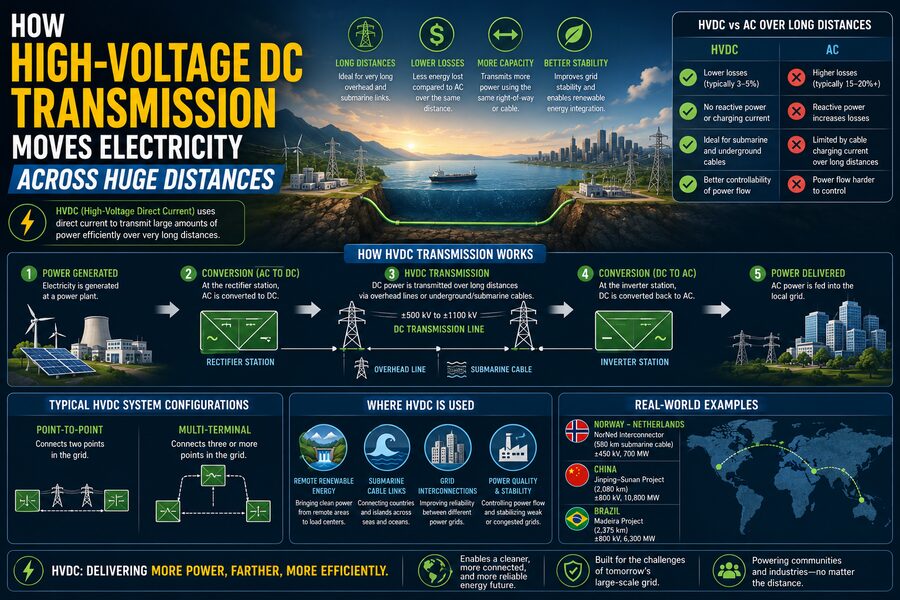
One of the most important technologies for solving it is High-Voltage Direct Current transmission, commonly called HVDC.
HVDC systems transmit electrical energy using direct current at extremely high voltages. In many situations—especially very long overhead routes, long submarine cables, and links between asynchronous power grids—HVDC can offer major advantages over conventional high-voltage alternating current transmission.
The principle is simple:
Raise the voltage, reduce the current, move the power efficiently, and convert it back where needed.
Behind that simple idea is some of the most sophisticated power-electronics infrastructure in the electrical grid.
🔋 What Is HVDC?
HVDC stands for High-Voltage Direct Current.
In a direct-current system, electric charge flows predominantly in one direction.
This differs from alternating current, or AC, where current repeatedly reverses direction many times per second.
Most electricity delivered to homes and businesses is AC because AC voltage can be transformed conveniently and works extremely well for conventional distribution networks.
HVDC, however, is particularly useful when transporting large blocks of electrical power over very long distances.
An HVDC transmission system typically includes:
- A converter station at the sending end
- High-voltage transmission conductors or cables
- A converter station at the receiving end
- Control and protection equipment
The converter stations are what make HVDC possible.
🔄 Why Electricity Usually Starts as AC
Most large electric generators naturally produce alternating current.
A turbine in a hydroelectric, nuclear, gas, or steam power plant turns a generator.
Inside the generator, rotating magnetic fields induce alternating voltages.
Wind turbines also generate electrical power that is ultimately integrated into AC power systems, often after passing through power-electronic converters.
Traditional national power grids therefore developed primarily around AC.
So why convert that AC electricity into DC?
Because for certain long-distance transmission problems, DC can be more efficient and easier to control. ⚙️
📉 Why High Voltage Reduces Transmission Losses
The amount of electrical power transferred can be described approximately by:
Power = Voltage × Current
or:
P = V × I
Suppose you want to transmit a fixed amount of power.
If you increase the voltage, you can reduce the current.
That matters because resistive heating losses in a conductor are proportional to the square of the current:
Power loss = I²R
where:
I= currentR= electrical resistance
If current is cut in half, resistive losses fall to roughly one-quarter, assuming the same resistance.
That is why both AC and DC long-distance transmission systems use very high voltages.
Higher voltage allows enormous amounts of power to move with lower current and lower conductor losses. ⚡
🏗️ Why Use DC Instead of AC?
High-voltage AC works extremely well and forms the backbone of most power grids.
But AC transmission has additional electrical effects that become increasingly important over long distances.
AC lines interact with:
- Inductance
- Capacitance
- Reactive power
- Phase relationships
- Frequency synchronization
These effects can limit how much useful real power can be transferred efficiently.
HVDC largely avoids some of these issues.
With DC, the transmission line does not carry alternating reactive power in the same way.
This can make HVDC especially attractive when power must travel hundreds or thousands of kilometers.
🛣️ Think of HVDC as an Electricity Superhighway
A useful analogy is to imagine a road network.
Local AC transmission lines are like ordinary highways connecting many towns and cities.
HVDC is more like a high-capacity express route built to move a huge amount of traffic between two major locations with relatively few exits.
The HVDC link may carry gigawatts of power from one region to another.
Once the electricity arrives, it is converted back into AC and distributed through the local grid.
This point-to-point character is one reason HVDC is so useful for connecting distant generation resources to large demand centers.
🏭 The Converter Station at the Sending End
Suppose a remote hydroelectric region produces large amounts of AC electricity.
Before that power enters an HVDC line, it reaches a converter station.
The converter station changes the electricity from AC to DC.
This process is called rectification.
Modern converter stations use very large arrays of semiconductor switches and sophisticated control systems.
Depending on the HVDC technology, these power-electronic valves may use devices such as thyristors or insulated-gate bipolar transistors.
The equipment operates at enormous voltage and power levels.
A single station may handle power comparable to the output of several large generating units. 🏭⚡
🔌 The DC Transmission Line
Once converted into high-voltage DC, electricity travels along the transmission route.
The route may use:
- Overhead transmission lines
- Underground cables
- Submarine cables
Overhead HVDC lines often resemble large conventional transmission corridors with towers and conductors.
However, their electrical configuration differs from AC lines.
A common arrangement uses two conductors:
Positive pole
and:
Negative pole
This is called a bipolar HVDC system.
Electric current flows through one pole in one direction and returns through the other.
➕➖ Bipolar HVDC Systems
In a bipolar system, one conductor operates at a high positive voltage relative to ground and the other at a high negative voltage.
For example, a link might conceptually operate around:
+500 kV
and:
−500 kV
The voltage difference between the two poles would therefore be approximately 1,000 kV.
Actual system voltages vary widely.
Using two poles provides operational flexibility.
Under some designs and operating conditions, if one pole becomes unavailable, the remaining pole may continue transmitting a reduced amount of power.
This improves system resilience.
🔄 Converting DC Back to AC
At the receiving end, another converter station performs the reverse process.
The HVDC power arrives as direct current.
The converter changes it back into alternating current.
This process is called inversion.
The resulting AC electricity is synchronized appropriately with the receiving grid and delivered into substations and transmission networks.
So the full journey looks like:
AC generation → AC-to-DC conversion → HVDC transmission → DC-to-AC conversion → AC grid
The conversion equipment adds cost and some energy loss, but over sufficiently long routes, the transmission benefits can outweigh those penalties. 📈
📏 Why Distance Matters
HVDC is not automatically better for every transmission project.
Converter stations are expensive.
If power needs to travel only a short distance, conventional AC transmission may be cheaper and simpler.
As distance increases, however, the lower line losses and other operational advantages of HVDC can become more valuable.
Engineers sometimes speak of a break-even distance where the total lifetime economics of HVDC begin to compare favorably with AC.
There is no single universal distance.
It depends on:
- Power level
- Voltage
- Overhead line versus cable
- Converter technology
- Land costs
- Grid conditions
- Reliability requirements
For long submarine cables, HVDC can become advantageous at much shorter distances than for overhead transmission.
🌊 Why HVDC Is Excellent for Submarine Cables
Submarine cables are one of the strongest applications for HVDC.
Long AC cables have substantial capacitance.
Because AC voltage continually changes direction, this capacitance repeatedly charges and discharges.
That creates charging current.
As cable length increases, more of the cable’s capacity may be consumed by this reactive current rather than useful real-power transmission.
DC does not create the same continuous charging-current problem.
Once the DC cable is charged to its operating voltage, current can primarily be used to transport real power.
This makes HVDC extremely useful for long underwater connections. 🌊⚡
🌬️ Connecting Offshore Wind Farms
Modern offshore wind farms are being built farther from coastlines and at increasingly large scales.
For shorter distances, AC export cables may work well.
For very large offshore projects far from land, HVDC can become attractive.
An offshore platform may collect AC electricity from many wind turbines.
A converter transforms the electricity to DC.
High-voltage submarine cables carry it toward shore.
At an onshore converter station, the power is turned back into AC and delivered to the national grid.
This allows massive amounts of renewable electricity to travel efficiently from remote marine locations. 🌬️🌊
🌞 Connecting Remote Solar Resources
Some of the best solar-energy locations are far from large cities.
Desert regions may have abundant sunlight but relatively little local electricity demand.
HVDC can transport solar power from these remote regions to distant population centers.
The same principle applies to:
- Hydroelectric power
- Wind power
- Remote geothermal generation
- Large renewable-energy zones
HVDC therefore helps separate the question:
“Where is the energy resource?”
from:
“Where are the electricity users?”
🌍 Connecting Different Power Grids
One of HVDC’s most valuable features is that it can connect AC grids that are not synchronized.
AC grids normally operate at a defined frequency, such as 50 Hz or 60 Hz.
When large AC systems are directly interconnected, their frequencies and phases must be coordinated.
HVDC links break that direct electrical synchronization requirement.
One AC system can feed a converter.
Power crosses the DC link.
Another converter supplies a different AC system.
This makes it possible to exchange power between grids that operate independently. 🔄
🕒 Connecting 50 Hz and 60 Hz Systems
Some countries or regions use 50-hertz electricity.
Others use 60-hertz.
Directly joining those AC networks would be problematic.
An HVDC connection can transfer power between them because the intermediate DC link has no AC frequency.
At one end:
50 Hz AC → DC
At the other:
DC → 60 Hz AC
The two grids can therefore exchange energy while retaining their own frequency systems.
🎛️ HVDC Gives Operators Precise Power-Flow Control
One major advantage of HVDC is controllability.
In an AC network, power flows according to the electrical characteristics and phase relationships across the network.
Operators can influence those flows, but they are constrained by the interconnected system.
An HVDC converter can directly control how much power is being transferred within its operating limits.
For example, the operator may command the link to transmit:
2,000 MW
from Grid A to Grid B.
The control system adjusts converter operation accordingly.
This precise control can help stabilize large transmission networks. 🎛️
🧭 HVDC Can Help Prevent Unwanted Power Flows
AC grids can experience loop flows, where electricity travels through unexpected or undesirable paths because of the physics of interconnected networks.
An HVDC link behaves differently.
Operators can command a specific transfer level and direction.
That means HVDC can be used strategically to move power without creating the same uncontrolled flows through neighboring AC lines.
This is particularly useful in complex regional grids.
🔁 Power Can Flow in Either Direction
HVDC links are not necessarily one-way systems.
Many can reverse the direction of power transfer.
At one time, Region A may export energy to Region B.
Later, if conditions change, Region B may export to Region A.
For example:
During a windy afternoon, one country may have excess renewable electricity.
At night or during low wind, it may import power from a neighboring system.
HVDC interconnectors make this kind of cross-border energy trading possible. 🌍
🛡️ HVDC Can Improve Grid Stability
Power grids must remain balanced continuously.
Generation and demand have to stay closely matched.
Disturbances such as generator failures or transmission faults can threaten stability.
HVDC systems can respond rapidly by adjusting transferred power.
Modern control systems may help support:
- Frequency control
- Power-flow balancing
- Oscillation damping
- Emergency power support
The exact capabilities depend on converter design and grid configuration.
HVDC therefore acts not only as a transmission line but also as a controllable power-electronic interface between grid regions.
🔧 Two Major HVDC Converter Technologies
Two broad converter families are especially important.
⚡ Line-Commutated Converter HVDC
Line-Commutated Converter, or LCC-HVDC, is a mature technology commonly based on thyristor valves.
It is particularly well suited to transmitting extremely large amounts of power over long distances.
LCC systems rely significantly on the connected AC network for their commutation process.
They may also require substantial equipment for reactive-power management and harmonic filtering.
🔋 Voltage-Source Converter HVDC
Voltage-Source Converter, or VSC-HVDC, commonly uses controllable semiconductor switches.
VSC systems provide greater flexibility in controlling active and reactive power.
They can be particularly useful for:
- Offshore wind connections
- Weaker AC grids
- Underground cable systems
- Complex network applications
Modern VSC systems often use modular multilevel converter technology.
🧱 What Is a Modular Multilevel Converter?
A Modular Multilevel Converter, commonly abbreviated MMC, is built from large numbers of smaller power-electronic submodules.
These modules work together to create a high-voltage waveform.
Instead of one semiconductor device handling the entire voltage, many modules share the task.
This architecture provides several advantages:
- High voltage capability
- High-quality waveforms
- Reduced filtering requirements
- Modular construction
- Fine control
MMC technology has become extremely important in modern VSC-HVDC systems. ⚙️
🏢 Why Converter Stations Are So Large
An HVDC converter station can occupy a substantial site.
It may contain:
- Converter halls
- Transformers
- Smoothing reactors
- Filters
- Switchgear
- Cooling systems
- Control rooms
- Protection equipment
The semiconductor valves must withstand enormous electrical stress.
Specialized insulation and cooling are required.
At ultra-high voltages, even the physical spacing between components becomes important because electricity can arc through air if clearances are insufficient.
Converter-station engineering is therefore a combination of power electronics, high-voltage insulation, thermal management, protection, and structural design.
🌡️ Converters Produce Heat
Power-electronic switches are highly efficient, but they are not lossless.
When handling gigawatts of power, even a small percentage of loss can produce a large amount of heat.
Converter stations therefore require substantial cooling systems.
Depending on design, these may use liquid cooling and heat exchangers.
Temperature monitoring is critical because semiconductor reliability depends heavily on operating conditions.
📉 Transmission Losses Still Exist
HVDC is efficient, but it does not eliminate transmission losses.
Energy is lost through:
- Resistance in conductors
- Converter losses
- Auxiliary systems
- Insulation leakage and corona effects
- Transformer losses
The objective is not zero loss.
The objective is to make total losses acceptably low while transporting enormous amounts of electricity across long distances.
For very long routes, even a small improvement in efficiency can save huge amounts of energy over the lifetime of the project.
✨ Corona Discharge at Very High Voltage
At extremely high voltages, the electric field around overhead conductors can become strong enough to ionize nearby air.
This phenomenon is called corona discharge.
Corona can create:
- Energy loss
- Audible noise
- Radio-frequency interference
Engineers reduce these effects through conductor design, spacing, bundle arrangements, and careful control of electric-field strength.
The same issue is important in ultra-high-voltage AC systems as well.
🏗️ Ultra-High-Voltage DC Transmission
Some modern HVDC projects operate at exceptionally high voltages.
These are often referred to as Ultra-High-Voltage Direct Current, or UHVDC, systems.
Higher operating voltages allow more power to be transmitted with lower current for the same power level.
That can reduce resistive losses and allow enormous power transfers across very long routes.
Such systems are especially useful in very large countries where major energy resources may be separated from cities by thousands of kilometers.
📐 Why HVDC Towers Can Differ From AC Towers
A typical three-phase AC transmission line needs conductors for three electrical phases.
An HVDC bipolar line commonly needs two main pole conductors.
This can sometimes allow a different tower geometry and potentially a narrower right-of-way for comparable power-transfer objectives, depending on the system design.
However, actual corridor requirements depend on many engineering and regulatory factors.
HVDC lines still require substantial clearances because of their extremely high voltages.
🗺️ Long-Distance Transmission Changes Where Power Plants Can Be Built
Without efficient transmission, electricity generation must remain relatively close to consumers.
HVDC changes that constraint.
A large renewable project can be built where natural resources are strongest rather than where electricity demand is concentrated.
For example:
Remote hydroelectric region → HVDC → distant megacity
or:
Desert solar region → HVDC → industrial corridor
This can reshape entire national energy systems.
🔄 HVDC and Renewable Energy Integration
Renewable electricity can be geographically uneven.
A wind-rich region may generate much more electricity than it can consume locally.
At the same time, another region may have high demand and low renewable output.
Long-distance HVDC links can help move renewable power across large geographic areas.
This geographic diversity can improve system flexibility.
If the wind is weak in one region but strong in another, interconnected grids can share generation.
HVDC does not eliminate renewable variability, but it gives grid operators more options for managing it. 🌱⚡
🔋 HVDC Works Well Alongside Energy Storage
Large batteries, pumped-storage plants, and other storage systems can complement long-distance transmission.
Consider a region with abundant daytime solar generation.
Some electricity can travel immediately over an HVDC line.
Excess electricity can be stored.
Later, stored energy can be transmitted when demand increases.
Transmission and storage solve different problems:
HVDC moves energy through space.
Storage moves energy through time.
Together, they can support increasingly flexible power systems. 🔋
🚇 Underground HVDC Cables
Not every major transmission corridor can use overhead lines.
Densely populated areas, environmental constraints, and public acceptance may favor underground cables.
Long-distance underground AC cables face many of the same capacitive issues as submarine cables.
HVDC can therefore be advantageous for long underground connections.
Cable projects are usually much more expensive than overhead lines, but they may be necessary in locations where transmission towers are impractical.
🔗 Back-to-Back HVDC Stations
Not all HVDC systems involve long DC transmission lines.
A back-to-back HVDC station places the rectifier and inverter at essentially the same site.
AC from one grid is converted to DC and almost immediately converted back to AC for another grid.
Why do this?
Because the DC stage electrically separates the two AC systems.
This allows power exchange between asynchronous networks without requiring a long DC line.
🧯 Protection Is a Major Engineering Challenge
Electrical faults can occur in any transmission network.
A damaged cable, insulation failure, or equipment malfunction can create very high fault currents.
HVDC protection must detect faults extremely quickly and isolate the affected equipment.
This can be especially challenging in multi-terminal DC grids because DC current does not naturally cross zero every half-cycle the way AC current does.
Modern engineers therefore develop specialized:
- DC circuit breakers
- Protection relays
- Fault-detection algorithms
- Converter controls
Fast protection is essential for reliable future HVDC networks.
🌐 From Point-to-Point Links to DC Grids
Most traditional HVDC systems are point-to-point:
Station A ↔ Station B
But engineers are increasingly interested in multi-terminal HVDC networks.
Imagine several offshore wind farms connected to multiple countries through one coordinated DC network.
Power could flow among several nodes rather than only between two fixed endpoints.
This could create offshore electricity “meshes” that combine:
- Wind generation
- Cross-border interconnection
- Regional balancing
Building large DC grids introduces more complex control and protection challenges, but it could become increasingly important.
📡 Control Systems Operate Continuously
HVDC links depend heavily on digital control systems.
Computers continuously monitor:
- Voltage
- Current
- Power flow
- Converter temperature
- Grid frequency
- Fault conditions
- Harmonic performance
Controllers may adjust power-electronic switching thousands of times per second.
This allows HVDC transmission to respond dynamically to changing grid conditions.
Modern HVDC is therefore as much a software-and-electronics technology as it is a transmission-line technology. 💻⚡
🛠️ Reliability Requires Redundancy
A major HVDC link can carry enough power to supply millions of homes.
Its reliability is therefore extremely important.
Engineers often include redundancy in:
- Cooling systems
- Control electronics
- Communication channels
- Auxiliary power
- Protection systems
Components can be monitored continuously for signs of deterioration.
Predictive maintenance may identify problems before they cause forced outages.
💰 Why HVDC Projects Are Expensive Up Front
The converter stations at both ends are major pieces of infrastructure.
They contain highly specialized equipment and require significant construction.
This gives HVDC relatively high initial terminal costs.
However, the transmission line itself may become economically attractive as distance and power level increase.
The basic economic tradeoff can be thought of as:
Higher converter cost + potentially lower long-distance transmission cost and losses
versus:
Lower AC terminal complexity + increasing long-distance AC limitations
Engineers and planners analyze the full lifetime cost rather than choosing based solely on initial construction price.
🧮 How Engineers Compare AC and DC Options
Before selecting HVDC, planners evaluate many variables:
- Required transfer capacity
- Route distance
- Expected energy flow
- Line or cable type
- Land availability
- Reliability needs
- Grid strength
- Environmental constraints
- Converter losses
- Maintenance costs
- Future expansion
Detailed computer models simulate how each design would perform.
No single technology wins every project.
HVDC is chosen when its specific advantages justify its additional complexity.
🌍 HVDC Enables International Electricity Trading
Countries increasingly connect their electricity networks through subsea and land-based HVDC links.
These interconnectors allow regions to share power.
If one country has excess renewable generation, it can export electricity.
If another experiences a shortage, it can import.
This can:
- Improve energy security
- Increase competition
- Reduce wasted renewable generation
- Share reserve capacity
- Balance regional supply and demand
Electricity can effectively become a cross-border commodity transported through controllable high-capacity links.
🌱 HVDC and the Future Grid
Future electricity systems are expected to contain much larger amounts of renewable energy.
Many renewable resources are located far from the largest cities.
At the same time, electricity demand may increase because of:
- Electric vehicles
- Data centers
- Heat pumps
- Industrial electrification
- Hydrogen production
These trends may require much stronger transmission networks.
HVDC is likely to remain an important tool for building those networks.
It allows grids to move large amounts of clean electricity across continents and seas with high efficiency and precise control.
🧠 A Simple Analogy: Voltage as Pressure
A rough analogy is to think of electricity like water in a pipeline.
Voltage is somewhat like pressure.
Current is somewhat like flow rate.
If you need to move a large amount of energy through a long route, raising the “pressure” allows you to deliver the required power with less current.
Lower current means lower resistive heating losses.
HVDC then adds another advantage: the flow travels steadily in one electrical direction rather than repeatedly reversing as it does in AC.
The analogy is not perfect, but it helps illustrate why high voltage is so important.
✅ The Bottom Line
High-Voltage Direct Current transmission moves enormous amounts of electricity across huge distances by converting AC electricity into high-voltage DC, transporting it efficiently, and converting it back into AC at the destination. ⚡🌍
High voltage keeps current lower for a given power transfer, which reduces resistive losses.
Using DC also avoids some of the reactive-power and cable-charging challenges associated with long AC transmission systems.
That makes HVDC especially valuable for:
- Very long overhead transmission routes
- Submarine power cables
- Offshore wind connections
- Cross-border electricity links
- Connections between asynchronous grids
- Remote renewable-energy projects
Converter stations make the system possible by using advanced semiconductor electronics to control power at enormous scales.
Although these stations are expensive and technically complex, the benefits can become substantial when electricity needs to travel far enough or through challenging cable routes.
HVDC fundamentally changes the geography of electricity.
A power plant no longer has to be close to the people who use its energy.
Wind from a distant coastline, sunlight from a desert, or hydroelectricity from remote mountains can be transported hundreds or thousands of kilometers to major cities and industrial centers. 🌬️☀️🏙️
In that sense, HVDC is more than a transmission technology.
It is an electrical superhighway system that helps connect distant energy resources with the places where electricity is needed most.