
Solar panels can turn ordinary sunlight into usable electrical energy without fuel, combustion, moving pistons, or spinning turbines. A rooftop solar system may look simple from the outside, but inside every panel are carefully engineered semiconductor materials that convert the energy carried by sunlight directly into electric current. ⚡🔋
This process is called the photovoltaic effect.
The word photovoltaic combines concepts related to light and electricity:
Photo → light
Voltaic → electricity
When sunlight strikes a solar cell, energy from the light can free or excite electrons inside a semiconductor. The internal electric structure of the cell then pushes those charge carriers in a preferred direction, creating an electrical current.
The complete process can be summarized as:
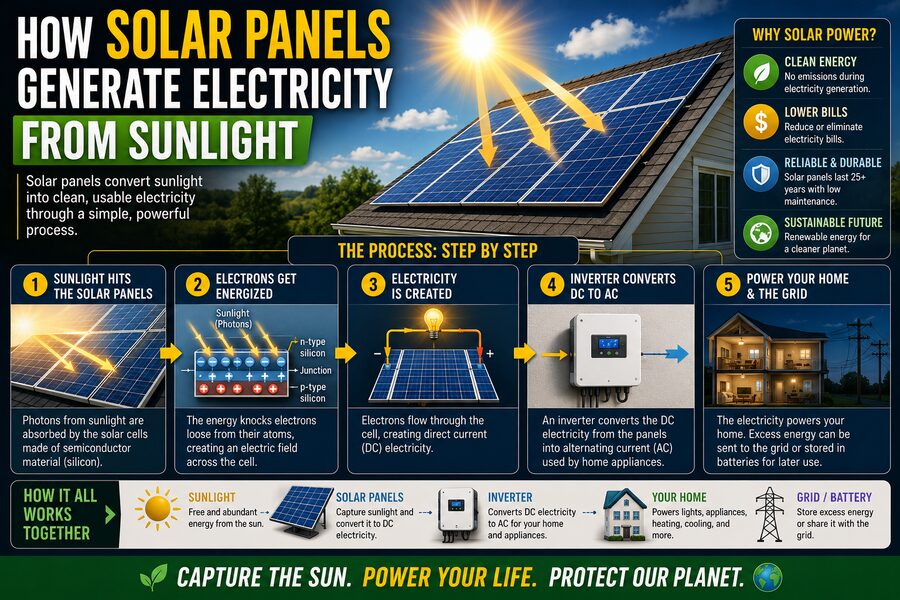
Sunlight → semiconductor interaction → charge separation → direct current electricity → inverter → usable alternating current
Understanding how this happens requires looking at photons, silicon atoms, semiconductor junctions, electrical circuits, and power electronics. ☀️🔬
🌞 Sunlight Carries Energy in Photons
Sunlight is electromagnetic radiation.
At the quantum level, light can be described as packets of energy called photons.
Different photons carry different amounts of energy depending on their wavelength.
Visible sunlight contains many wavelengths, along with infrared and ultraviolet radiation.
When sunlight reaches a solar panel, billions upon billions of photons strike its surface every second.
Some photons are reflected.
Some pass through materials without creating useful electrical energy.
Others are absorbed by the semiconductor inside the solar cell.
Those absorbed photons are the key to photovoltaic electricity generation.
🧪 Why Solar Cells Use Semiconductors
Most conventional solar cells are made primarily from silicon.
Silicon is a semiconductor, meaning its electrical behavior falls between that of a conductor and an insulator.
Metals such as copper conduct electricity easily because they contain mobile electrons.
Materials such as glass resist electrical current strongly.
Semiconductors are particularly useful because engineers can precisely modify their electrical properties.
This process allows them to create the internal electric field needed for a solar cell to separate electrical charges.
Silicon is especially suitable because it is abundant, well understood, and compatible with mature semiconductor manufacturing techniques.
⚛️ Electrons and Energy Bands
Inside a solid material, electrons occupy ranges of allowed energy known as energy bands.
Two particularly important bands are:
Valence band – where electrons are normally bound within the material.
Conduction band – where electrons can move more freely and contribute to electrical current.
Between them is an energy region known as the band gap.
For an electron to become electrically mobile, it needs enough energy to move from the valence band into the conduction band.
A photon with sufficient energy can provide that energy.
When the semiconductor absorbs such a photon, an electron may become excited into the conduction band.
This creates:
- A mobile electron
- A corresponding absence of an electron called a hole
The electron and hole together form an electron-hole pair. ⚡
🔋 The Solar Cell Must Separate Those Charges
Simply creating electron-hole pairs is not enough.
If the electron quickly falls back into the hole, the absorbed energy is lost as heat.
A useful solar cell therefore needs a mechanism for separating the charges before they recombine.
This is accomplished using a semiconductor structure called a p-n junction.
The p-n junction is one of the most important concepts in photovoltaic engineering.
➕ What Is P-Type Silicon?
Pure silicon does not naturally provide the exact electrical behavior needed for an efficient solar cell.
Engineers therefore deliberately add tiny quantities of other elements in a process called doping.
P-type silicon is created by adding atoms that leave the material with an increased concentration of mobile holes.
Boron is commonly used for this purpose.
Because boron has one fewer valence electron than silicon, its presence creates vacancies that behave electrically like positive charge carriers.
The material as a whole remains electrically neutral, but holes become important mobile carriers.
➖ What Is N-Type Silicon?
N-type silicon is created by adding atoms that contribute extra electrons.
Phosphorus is a common example.
Phosphorus has one more valence electron than silicon, so doping creates additional mobile electrons.
Again, the material is electrically neutral overall, but electrons become the dominant mobile charge carriers.
When p-type and n-type materials are brought together, something extremely useful happens.
⚡ The P-N Junction Creates an Internal Electric Field
At the boundary between p-type and n-type silicon, electrons and holes begin diffusing across the junction.
Some electrons from the n-type region combine with holes from the p-type region.
This leaves behind electrically charged atoms that cannot move freely.
As a result, a region called the depletion region forms.
This region develops an internal electric field.
That electric field acts somewhat like a built-in directional force for electrical charges.
When sunlight creates an electron-hole pair near the junction, the electric field tends to push the electron one way and the hole the opposite way.
This charge separation is what allows a useful voltage to appear across the solar cell. 🔌
🌤️ From Sunlight to Electrical Current
Now the full process starts to come together.
When sunlight strikes the cell:
- Photons enter the semiconductor.
- Some photons are absorbed.
- Their energy excites electrons.
- Electron-hole pairs form.
- The internal electric field separates the charges.
- Electrons accumulate toward one side of the cell.
- A voltage develops between the electrical contacts.
If an external circuit connects the two sides, electrons can flow through that circuit.
That movement of charge is electric current.
The current can power electrical loads before returning to the cell.
So the solar cell is continuously converting incoming light energy into electrical energy.
🔌 Solar Cells Produce Direct Current
A photovoltaic cell produces direct current, or DC.
In DC electricity, charge flows in one overall direction through the external circuit.
Batteries also provide DC power.
However, most homes and electrical grids use alternating current, or AC.
In AC systems, the electrical voltage and current repeatedly reverse direction.
This means a solar installation usually needs another important device:
the inverter. ⚙️
🔄 What Does a Solar Inverter Do?
A solar inverter converts DC electricity from the panels into AC electricity suitable for household appliances and the electrical grid.
The basic flow becomes:
Solar panels → DC electricity → inverter → AC electricity
Modern inverters do much more than simple conversion.
They may also:
- Monitor system performance
- Optimize power extraction
- Detect faults
- Synchronize with grid voltage and frequency
- Disconnect safely during dangerous grid conditions
The inverter is therefore one of the most important electronic components in a solar power system.
🎯 Maximum Power Point Tracking
A solar panel’s voltage and current change depending on conditions such as:
- Sunlight intensity
- Cell temperature
- Electrical load
- Shading
There is usually one operating point where the panel produces the maximum possible electrical power under those conditions.
This is called the maximum power point.
Modern solar inverters use algorithms known as Maximum Power Point Tracking, or MPPT.
The inverter continuously adjusts the electrical operating conditions to keep the panel or solar array close to its optimal power point.
This allows the system to extract more energy throughout the day. 📈
🧩 Why Solar Panels Contain Many Cells
A single silicon solar cell produces only a relatively small voltage.
Therefore, manufacturers connect many cells together electrically.
A typical solar panel may contain dozens of individual photovoltaic cells.
Cells connected in series increase voltage.
Parallel connections can increase current.
The cells are arranged inside a protective module containing materials such as:
- Tempered glass
- Encapsulant
- Electrical conductors
- Backsheet or rear glass
- Aluminum frame
The module protects fragile semiconductor cells from weather, moisture, mechanical impact, and electrical damage.
🏠 Panels Are Connected Into Arrays
One solar panel may produce hundreds of watts under favorable conditions.
A home, business, or solar farm may need much more power.
Panels are therefore connected together into strings and larger arrays.
For example:
Cell → module → string → array
A residential rooftop may use a few dozen modules.
A utility-scale solar farm may contain hundreds of thousands or even millions of panels. 🌍☀️
The same photovoltaic principle operates at every scale.
🌡️ Solar Panels Actually Become Less Efficient When Very Hot
It might seem logical that hotter weather would make solar panels produce more electricity.
But solar cells generally become less electrically efficient as their temperature rises.
Higher temperature changes semiconductor behavior and usually reduces cell voltage.
That means a cool, sunny day can sometimes be better for photovoltaic efficiency than an extremely hot day with similar sunlight.
This is why solar-panel datasheets often include a temperature coefficient.
The coefficient indicates how performance changes as cell temperature rises above standard test conditions.
☁️ Do Solar Panels Work on Cloudy Days?
Yes.
Clouds reduce the amount of sunlight reaching the panels, but they do not necessarily block all solar radiation.
Photovoltaic panels can still generate electricity under:
- Cloudy skies
- Hazy conditions
- Diffuse sunlight
However, output is generally lower than under strong direct sunlight.
The exact reduction depends on cloud thickness, location, panel orientation, and technology.
Solar power therefore varies naturally throughout the day and with weather conditions.
🌙 What Happens at Night?
At night, solar panels receive essentially no useful sunlight.
Therefore, they do not generate meaningful photovoltaic power.
A solar-powered building must then rely on another source.
Possible sources include:
- Electrical grid
- Battery storage 🔋
- Backup generator
- Other renewable generation
This is why energy storage has become increasingly important in solar systems.
Batteries can store excess electricity generated during sunny periods and release it later.
🔋 Solar Panels and Battery Storage
Suppose a home generates more solar power at midday than it is currently using.
Without a battery, the excess electricity might be exported to the grid, depending on the local system.
With battery storage, some of that excess electricity can charge the battery.
Later, in the evening:
Battery → inverter → household loads
This can increase the amount of solar energy used directly by the home.
However, batteries add cost, conversion losses, and additional equipment.
Solar panels and batteries therefore perform different functions:
Solar panels generate electricity.
Batteries store electricity.
🌅 Why Panel Direction and Tilt Matter
The amount of electricity generated depends strongly on how much solar radiation reaches the panel.
Engineers and installers therefore consider:
- Latitude
- Roof direction
- Panel tilt
- Seasonal sun angle
- Nearby obstacles
- Local climate
A panel receives the most direct solar energy when sunlight strikes its surface at a favorable angle.
Systems can be mounted at fixed angles or placed on solar trackers.
Trackers move panels during the day to follow the Sun.
They can increase energy capture but add mechanical complexity and cost.
🌳 Why Shading Can Reduce Output Significantly
Shade from trees, buildings, chimneys, or nearby structures can reduce solar generation.
The effect can be more complicated than simply losing the shaded area.
Because cells and panels are electrically interconnected, one shaded section can influence the output of a larger string.
Manufacturers use devices called bypass diodes to help reduce these losses and protect cells.
Some installations also use:
- Microinverters
- DC power optimizers
These technologies can allow individual panels to operate more independently when shading conditions vary.
⚡ Voltage, Current, and Power
Electrical power is calculated using:
P = V × I
where:
P = power
V = voltage
I = current
A solar panel might produce a particular voltage and current depending on sunlight and operating conditions.
If a panel produces:
40 volts × 10 amperes
then electrical power is approximately:
400 watts
This rated power helps describe how much electricity the panel can produce under standardized laboratory conditions.
Real-world power varies throughout the day.
📊 Efficiency: Where Does the Sun’s Energy Go?
Solar-panel efficiency describes how much incoming solar energy is converted into usable electrical energy.
If 1,000 watts of sunlight strikes a panel and it produces 220 watts of electrical power, the conversion efficiency is:
220 / 1,000 = 22%
The remaining energy is not simply “missing.”
Some is:
- Reflected
- Transmitted
- Converted into heat
- Lost through electrical resistance
- Lost because photons have unsuitable energies
Modern commercial silicon solar modules commonly achieve efficiencies well above those of early photovoltaic systems, but no ordinary solar panel converts all incoming sunlight into electricity.
🎨 Why Solar Panels Often Look Blue or Black
Crystalline silicon panels often appear blue-black or nearly black because of their semiconductor material and optical coatings.
Manufacturers apply anti-reflective coatings to reduce the amount of light bouncing off the surface.
More absorbed light means more opportunities to generate electron-hole pairs.
Modern all-black panels are often designed partly for appearance, especially on residential roofs.
Their electrical performance depends much more on cell design and construction than on visible color alone.
🏭 Monocrystalline vs. Polycrystalline Silicon
Two familiar silicon photovoltaic technologies are monocrystalline and polycrystalline cells.
◼️ Monocrystalline Silicon
These cells are manufactured from silicon with a highly ordered crystal structure.
They commonly offer high efficiency and are widely used in modern rooftop and utility projects.
🔷 Polycrystalline Silicon
These cells contain multiple crystal regions.
They historically offered lower manufacturing costs but generally somewhat lower efficiency.
Manufacturing technology has evolved rapidly, and monocrystalline technologies now dominate many markets.
🧪 Thin-Film Solar Cells
Not all photovoltaic panels use conventional crystalline silicon wafers.
Thin-film solar cells use extremely thin layers of photovoltaic material deposited onto another surface.
Technologies include materials such as:
- Cadmium telluride
- Copper indium gallium selenide
- Amorphous silicon
Thin-film modules may offer advantages in certain applications, including manufacturing, weight, temperature behavior, or low-light performance.
However, material availability, efficiency, durability, and manufacturing economics differ between technologies.
🧬 New Solar Technologies
Researchers continue developing new photovoltaic materials.
One important area is perovskite solar cells.
Perovskites have attracted attention because they can absorb light efficiently and may potentially be manufactured using comparatively low-temperature processes.
Researchers are also developing tandem solar cells, which stack different photovoltaic materials.
Each layer absorbs different portions of the solar spectrum.
This can potentially achieve higher efficiency than a single-junction silicon cell.
Commercialization requires solving challenges involving stability, manufacturing scale, cost, and long-term durability. 🔬
🧼 Dirt and Dust Reduce Solar Production
Solar panels need exposure to sunlight.
Dust, pollen, leaves, bird droppings, and other contaminants can block some incoming radiation.
This effect is called soiling loss.
The importance of cleaning depends heavily on the environment.
Rain may naturally clean panels in some climates.
Dry, dusty regions may require more active cleaning.
Utility-scale solar farms carefully evaluate whether the extra energy recovered through cleaning justifies the water, labor, and equipment required.
❄️ Snow Can Temporarily Block Panels
Snow can reduce solar output when it covers the panel surface.
However, several factors can help panels clear.
Solar modules are often mounted at an angle, allowing snow to slide downward.
Dark panel surfaces may also warm under sunlight.
In snowy climates, system designers consider snow loading as both an electrical and structural issue.
The mounting system and roof must safely carry accumulated snow and wind loads.
🔥 What Happens to Unused Solar Energy?
A solar cell cannot convert every photon into electricity.
Several loss mechanisms occur.
Some photons have too little energy to excite electrons across the semiconductor band gap.
Other photons carry more energy than necessary, but the excess energy may become heat.
Electrons and holes can also recombine before contributing to useful current.
Electrical resistance within cells and wiring creates additional losses.
Improving photovoltaic efficiency therefore involves reducing many different types of loss simultaneously.
🌐 Grid-Connected Solar Systems
Most rooftop solar installations are connected to the electrical grid.
During sunny periods:
Solar panels → home loads
If generation exceeds consumption:
Excess electricity → grid
When solar production is insufficient:
Grid → home
The exact rules governing exported electricity, metering, and compensation depend on local regulations and utility programs.
The inverter must carefully synchronize its output with the grid’s voltage and frequency.
🛑 Why Grid-Tied Solar Usually Shuts Down During an Outage
Many people are surprised to learn that ordinary grid-connected solar systems may shut down during a power outage even when the Sun is shining.
This is an important safety feature called anti-islanding protection.
If utility workers are repairing lines, uncontrolled electricity from rooftop systems could energize circuits that are expected to be disconnected.
Therefore, standard grid-tied inverters detect loss of the utility grid and stop exporting power.
Systems designed to operate during outages require special equipment, often including batteries and grid-isolation hardware.
📅 How Long Do Solar Panels Last?
Solar panels are designed for long operating lives.
They do not usually stop working suddenly after a certain number of years.
Instead, electrical output tends to decline gradually.
This process is called degradation.
Manufacturers commonly provide long-term performance warranties that specify an acceptable output level after decades of operation.
Actual lifetime depends on:
- Material quality
- Climate
- Installation
- Mechanical stress
- Moisture protection
- Manufacturing quality
Inverters may require replacement sooner than the solar modules because they contain more active power-electronic components.
♻️ What Happens at the End of a Panel’s Life?
Solar panels contain valuable materials such as:
- Glass
- Aluminum
- Silicon
- Copper
- Small quantities of other metals
Many of these materials can potentially be recovered.
Recycling infrastructure is developing as the number of older solar installations increases.
Designing panels for easier disassembly and material recovery could improve the long-term sustainability of photovoltaic technology.
🌍 Are Solar Panels Truly Emission-Free?
Solar panels produce electricity without burning fuel at the point of generation.
During normal operation, they do not emit combustion gases.
However, manufacturing, transportation, installation, maintenance, and eventual recycling all require energy and materials.
A proper environmental comparison therefore considers the entire life cycle.
Solar systems typically repay the energy used during manufacturing over part of their operating lifetime and then continue producing low-operational-emission electricity for many years.
The exact environmental impact depends on manufacturing methods, location, electricity mix, technology, and lifespan. 🌱
🏜️ Why Solar Farms Need Large Areas
Sunlight is abundant but relatively diffuse.
A single square meter receives only a limited amount of solar power.
Even with efficient panels, generating very large amounts of electricity therefore requires significant surface area.
Utility-scale solar farms may cover hundreds or thousands of hectares.
Engineers must consider:
- Land availability
- Grid connections
- Ecology
- Drainage
- Access roads
- Panel spacing
- Shading between rows
Solar development is therefore not only an electrical problem—it is also a land-use and infrastructure challenge.
☀️ Why Solar Power Is Variable
Solar generation changes continuously.
Output is influenced by:
- Time of day
- Season
- Cloud cover
- Dust
- Temperature
- Sun angle
At sunrise, power begins increasing.
Around midday, generation may peak.
Toward sunset, it declines again.
Electric grids with large amounts of solar generation therefore require flexibility.
Possible solutions include:
- Energy storage
- Demand response
- Flexible power plants
- Transmission between regions
- Forecasting
The challenge is not that solar electricity is unusable.
It is that grid operators must continuously balance variable generation with changing demand.
🧠 Solar Panels Are Quantum Devices at Massive Scale
One of the most remarkable aspects of solar power is that a rooftop panel is essentially a large-scale practical application of quantum physics.
The electricity starts with microscopic interactions:
Photon absorbed → electron excited → charge separated
Those individual events happen across millions of solar cells.
The resulting currents combine into enough electrical power to operate:
- Lights 💡
- Computers
- Refrigerators
- Air conditioners
- Factories
- Electric vehicles 🚗
An effect occurring at the atomic level can therefore contribute to powering entire cities.
📊 The Complete Solar Energy Chain
A typical grid-connected photovoltaic system can be summarized as:
Sun emits radiation
⬇️
Photons strike solar cells
⬇️
Semiconductor absorbs suitable photons
⬇️
Electron-hole pairs form
⬇️
P-n junction separates charges
⬇️
DC current flows
⬇️
Inverter converts DC to AC
⬇️
Electricity powers loads or enters the grid
Each stage has its own efficiency and engineering challenges.
🌟 Final Thoughts
Solar panels generate electricity through one of the most elegant energy-conversion processes in modern engineering.
There is no combustion chamber. 🔥❌
There are no pistons.
There is no turbine spinning inside each panel.
Instead, sunlight interacts directly with semiconductor material.
Photons transfer energy to electrons.
The internal electric field created by the solar cell’s semiconductor junction separates those electrical charges.
Metal contacts collect the resulting current.
An inverter then converts that DC electricity into the AC power used by homes, businesses, and electrical grids. ☀️⚡
The core process can be summarized simply:
Light energy → electronic excitation → electrical current
But behind that simple description lies a sophisticated combination of quantum physics, semiconductor engineering, materials science, electrical engineering, and power electronics.
The next time you see a solar panel sitting silently on a rooftop, remember that an enormous amount of activity is occurring inside it.
Billions of photons are striking its cells.
Electrons are being excited and separated.
Electrical current is flowing through microscopic conductive pathways.
And sunlight that left the Sun roughly eight minutes earlier is being converted directly into electricity that can power the modern world. ☀️🌍🔋