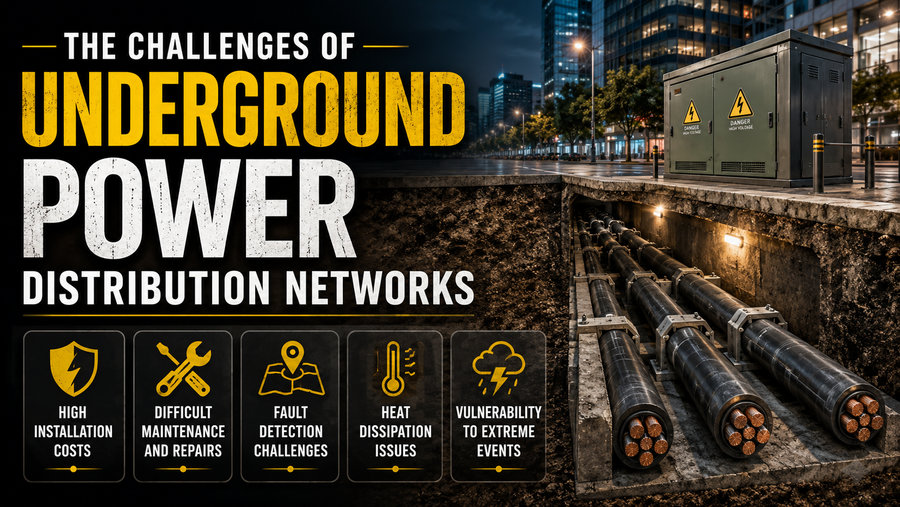

Underground power distribution networks are an important part of modern electrical infrastructure. Instead of placing conductors on poles above streets and buildings, underground systems carry electricity through insulated cables buried beneath roads, sidewalks, utility corridors, tunnels, or dedicated ducts. 🏙️🔌
At first glance, underground distribution seems like an obvious improvement over overhead power lines. There are no exposed wires hanging between poles, storms cannot easily knock trees into conductors, and urban landscapes look cleaner. Underground cables can also reduce certain types of weather-related outages and improve public safety in densely populated areas.
However, underground power networks introduce a completely different set of engineering challenges. They are expensive to install, difficult to inspect, harder to repair, sensitive to heat, vulnerable to moisture, and dependent on complex cable insulation systems.
For electrical utilities, the decision between overhead and underground distribution is therefore not simply a question of appearance. It involves reliability, economics, safety, maintenance, geography, load growth, and long-term infrastructure planning.
⚡ What Is an Underground Power Distribution Network?
A power distribution network carries electricity from substations to homes, offices, factories, shops, and other consumers.
In an underground distribution system, electrical conductors are installed below ground rather than suspended from utility poles.
The network may contain:
- High- or medium-voltage cables
- Distribution transformers
- Switchgear
- Cable joints
- Terminations
- Manholes and access chambers
- Protective relays
- Monitoring equipment
- Low-voltage service cables
Depending on the location, cables may be:
🕳️ Buried directly in soil
🧱 Installed inside ducts
🏗️ Routed through concrete utility tunnels
🚇 Placed in underground service corridors
Dense cities often rely heavily on underground networks because overhead lines would be impractical or visually intrusive.
💰 1. Underground Networks Are Expensive to Build
One of the biggest disadvantages of underground distribution is construction cost.
Installing an overhead line may involve poles, conductors, insulators, transformers, and relatively straightforward construction.
Underground installation requires much more work.
Engineers may need to:
- Excavate roads or sidewalks
- Create trenches
- Install ducts or conduits
- Construct manholes
- Protect cables mechanically
- Relocate existing utilities
- Restore pavement
- Manage traffic during construction
In busy cities, excavation can be extremely complicated because the ground may already contain:
🚰 Water pipes
🔥 Gas lines
📡 Telecommunications cables
🚇 Transit systems
🚽 Sewer networks
⚡ Existing electrical cables
The cable itself is also more expensive because underground conductors require sophisticated insulation and protective layers.
As a result, undergrounding an electrical network can cost several times more than constructing an equivalent overhead line.
🌡️ 2. Heat Dissipation Is a Major Engineering Problem
Electrical cables generate heat as current flows through them.
This occurs primarily because conductors have electrical resistance.
For overhead lines, surrounding air naturally removes much of this heat.
Underground cables do not have that advantage.
Heat must travel through:
Conductor → Insulation → Cable sheath → Surrounding soil or duct → Environment
If heat cannot escape effectively, the cable temperature increases.
Excessive temperature can damage insulation and reduce cable life. 🔥
Therefore, underground cables have strict current-carrying capacity, often called ampacity.
Engineers must consider:
- Soil thermal conductivity
- Soil moisture
- Cable spacing
- Burial depth
- Nearby cables
- Ambient ground temperature
- Cable loading
Dry soil can be especially problematic because it may conduct heat poorly.
This means an underground cable cannot simply be selected according to electrical voltage and current. Thermal conditions around the cable are equally important.
💧 3. Moisture Can Damage Cable Insulation
Underground infrastructure is constantly exposed to water.
Rainwater, groundwater, flooding, leaking pipes, and condensation can all create moisture around buried electrical cables.
Modern cables are designed to resist water intrusion, but damaged protective layers can eventually allow moisture to reach insulation.
One important degradation process is known as water treeing.
Water treeing can occur in certain polymer-insulated cables when moisture and electrical stress gradually create microscopic branching defects inside the insulation.
Over time, these defects can weaken the insulation and contribute to electrical failure.
Utilities therefore use:
- Waterproof cable jackets
- Moisture barriers
- Sealed joints
- Drainage systems
- Specialized insulation materials
Even so, long-term moisture management remains an important challenge. 💦⚡
🔍 4. Faults Are Difficult to Locate
When an overhead conductor breaks, technicians can often visually inspect the line.
A fallen tree, broken pole, damaged insulator, or snapped conductor may be clearly visible.
Underground cable faults are hidden.
A fault could occur hundreds of meters from the nearest access point without any obvious surface indication.
Utilities therefore need specialized equipment to determine the location.
Techniques may involve:
- Electrical resistance measurements
- Time-domain reflectometry
- High-voltage testing
- Acoustic fault detection
- Cable tracing systems
These techniques allow technicians to estimate where the fault occurred.
Accurate fault location is essential because excavation can be expensive and disruptive.
Digging in the wrong place wastes considerable time and money. 🚧
🛠️ 5. Repairs Can Take Longer
Underground systems may experience fewer weather-related failures than overhead lines, but when failures occur, repairs can be complicated.
A typical repair process may involve:
- Identifying the faulty cable section
- Isolating the electrical circuit
- Locating the exact underground fault
- Obtaining excavation permits
- Managing traffic
- Digging to reach the cable
- Removing the damaged section
- Installing a replacement or joint
- Performing electrical tests
- Restoring the road or sidewalk
This process can take significantly longer than replacing a damaged overhead conductor.
In heavily developed urban areas, access may be particularly difficult.
Utilities therefore often design underground networks with alternative supply paths so electricity can be rerouted while repairs are being performed.
🔌 6. Cable Joints Are Critical Weak Points
Underground cables cannot always be installed as one continuous conductor over long distances.
Sections must often be connected using cable joints.
These joints require extremely careful installation.
The electric field inside a high-voltage cable is carefully controlled by its insulation geometry.
At a cable joint, engineers must reconstruct that electrical insulation system while also providing:
- Mechanical protection
- Waterproof sealing
- Electrical continuity
- Shield continuity
- Proper stress control
A poorly installed joint can create localized electrical stress.
Eventually, insulation breakdown may occur.
Because joints are common locations for cable failures, technicians installing them often require specialized training and strict quality-control procedures. 🧑🔧
⚡ 7. Partial Discharge Can Damage Insulation
One phenomenon engineers monitor in underground cable systems is partial discharge.
Partial discharge is a small electrical breakdown that occurs within a limited region of insulation.
It does not immediately create a complete short circuit.
However, repeated partial discharge can gradually damage insulation.
Causes may include:
- Small air voids
- Manufacturing defects
- Damaged insulation
- Poor cable joints
- Contamination
- Excessive electrical stress
Over time, the damaged area may grow until a major insulation failure occurs.
Utilities can use specialized diagnostic equipment to detect partial-discharge activity before catastrophic failure.
🧱 8. Underground Cables Are Vulnerable to Excavation Damage
One of the most common external threats to underground utilities is construction activity.
Excavators, drills, trenching machines, and other equipment can accidentally strike buried cables.
Such incidents can:
⚡ Interrupt electricity
🔥 Start fires
💥 Damage equipment
🚑 Injure workers
🏙️ Cause major local outages
This is why underground utility maps and cable-location services are extremely important.
Before excavation, utility companies often mark the approximate positions of buried infrastructure.
However, older records may not always be perfectly accurate.
Future smart-grid systems may increasingly use digital mapping and geographic information systems to improve underground asset tracking.
🌊 9. Flooding Creates Additional Risks
Underground electrical chambers can flood.
Water may enter:
- Cable tunnels
- Transformer vaults
- Manholes
- Underground substations
- Utility basements
This is especially concerning in coastal cities or areas exposed to intense rainfall.
Although many cables can operate while submerged if properly sealed, electrical equipment such as switchgear and transformers may be much more vulnerable.
Flood protection can include:
- Drainage pumps
- Elevated equipment
- Waterproof doors
- Sealed enclosures
- Flood sensors
Climate change and increasing extreme-weather events are making flood resilience an increasingly important part of underground electrical design. 🌧️
🌳 10. Tree Roots Can Affect Underground Infrastructure
Underground cables are generally safer from falling trees than overhead conductors.
However, trees can still create problems below ground.
Roots may grow around ducts, access chambers, and utility corridors.
Over decades, root systems can:
- Shift ducts
- Obstruct access
- Damage surrounding structures
- Complicate excavation
Planners therefore need to coordinate underground electrical routes with landscaping and urban forestry.
🧲 11. Underground Cables Have Different Electrical Characteristics
Underground cables behave electrically differently from overhead lines.
One important difference is capacitance.
Because the conductor is surrounded by insulation and a grounded metallic shield, an underground cable behaves somewhat like a long capacitor.
Its capacitance is generally much higher than that of an overhead line.
This can produce charging current, especially on higher-voltage and longer cable circuits.
For ordinary local distribution systems, this may be manageable.
However, as voltage and cable length increase, reactive-power effects can become an important design consideration.
This is one reason extremely long underground AC transmission cables can be technically challenging.
🔥 12. Fire Can Be Dangerous in Cable Tunnels
Underground cables may be located in enclosed tunnels or utility spaces.
If a serious electrical fault produces fire, smoke and heat can accumulate.
Multiple cables located close together may allow fire to spread.
Engineers may therefore use:
- Fire-resistant cable materials
- Fire barriers
- Cable separation
- Smoke detection
- Fire-suppression systems
- Temperature monitoring
Fire safety becomes especially important in transportation tunnels, power stations, data centers, and dense urban utility corridors.
🗺️ 13. Network Expansion Can Be Difficult
Cities constantly change.
New apartment buildings, commercial districts, electric vehicle charging stations, data centers, and industrial facilities increase electrical demand.
Expanding an overhead distribution system may sometimes be relatively straightforward.
Adding underground cable capacity can require new excavation.
If existing conduits are full, engineers may need to construct entirely new duct systems.
Urban planners can reduce this difficulty by installing spare ducts during initial construction.
The additional upfront cost can make future network expansion much easier.
🚗 14. Electric Vehicles Are Increasing Distribution Loads
The rapid adoption of electric vehicles is creating new challenges for local electricity networks.
A neighborhood that historically consumed moderate power may suddenly contain dozens or hundreds of EV chargers. 🔋🚗
This can increase demand on:
- Underground feeders
- Distribution transformers
- Service cables
- Local substations
If infrastructure was designed decades earlier, it may not have enough capacity.
Utilities may therefore need to upgrade underground systems at considerable cost.
Smart charging can help by distributing EV charging demand across different times instead of allowing every vehicle to charge simultaneously.
🤖 15. Underground Networks Are Harder to Inspect
Overhead infrastructure can often be inspected visually using:
🚁 Helicopters
🚗 Utility vehicles
📷 Cameras
🚁 Drones
Buried cables cannot be inspected in the same way.
Utilities depend more heavily on diagnostic measurements and condition-monitoring systems.
Modern technologies may include:
- Temperature sensors
- Partial-discharge monitors
- Distributed fiber-optic sensing
- Smart switchgear
- Remote fault indicators
- Digital substations
These technologies allow engineers to identify abnormal conditions before a complete failure occurs.
Predictive maintenance is becoming particularly important as underground infrastructure ages.
🕰️ 16. Cable Aging Is a Long-Term Concern
Underground cables are designed for decades of service.
However, insulation gradually ages due to:
🌡️ Heat
💧 Moisture
⚡ Electrical stress
🔄 Load cycling
🧪 Chemical exposure
🛠️ Mechanical damage
An underground network installed decades ago may still appear normal from the surface while insulation is slowly degrading.
Utilities therefore face difficult decisions regarding when cables should be replaced.
Replacing them too early wastes money.
Waiting too long increases the risk of unexpected failures.
Condition-based maintenance attempts to solve this problem by using measurements rather than age alone.
🔄 17. Underground Networks Need Redundancy
Because repairs can take longer, resilient underground distribution systems often incorporate multiple supply paths.
One common arrangement is a ring network.
Instead of supplying customers from only one direction, cables form a loop.
If one section fails, switches can isolate the fault and electricity can sometimes reach consumers from the opposite direction.
Modern automated systems can perform switching rapidly.
This can significantly reduce outage duration.
However, redundancy adds:
- Additional cables
- More switchgear
- Greater complexity
- Higher construction cost
Reliability therefore comes with an economic trade-off.
⚖️ Underground vs. Overhead Distribution
Both systems have advantages and disadvantages.
| Feature | Underground Network | Overhead Network |
|---|---|---|
| Appearance | Excellent 🏙️ | More visually noticeable |
| Initial cost | High 💰 | Lower |
| Storm exposure | Lower | Higher |
| Fault location | Difficult | Often easier |
| Repair access | Difficult | Easier |
| Heat dissipation | More challenging | Excellent |
| Excavation damage | Possible | Not applicable |
| Tree impact | Reduced | Significant |
| Expansion | More difficult | Often easier |
| Urban suitability | Excellent | Sometimes limited |
Neither system is universally better.
The best choice depends on geography, population density, weather, reliability requirements, land use, and available funding.
🌆 Why Cities Still Choose Underground Power
Despite its challenges, underground distribution offers major advantages in dense urban environments.
It removes utility poles from crowded streets, reduces exposure to storms, protects lines from many accidental impacts, and improves the appearance of cities.
Underground networks are particularly attractive for:
🏙️ City centers
🏥 Hospital districts
🏢 Business districts
🏘️ New residential developments
🚇 Transportation hubs
🏛️ Historic areas
They may also be used where extremely high service reliability is required.
However, successful underground networks require careful design, maintenance, monitoring, and long-term asset management.
🧠 The Future of Underground Distribution Networks
Future underground power systems are likely to become much smarter.
Sensors embedded throughout the network can continuously measure:
- Cable temperature
- Current
- Voltage
- Insulation condition
- Fault location
- Equipment status
Artificial intelligence and predictive analytics may help utilities identify patterns indicating developing failures.
Digital maps can provide more accurate underground cable locations.
Automated switches can isolate faults and restore healthy sections of the network within seconds. 🤖⚡
New cable insulation materials may also improve longevity and thermal performance.
As cities become increasingly electrified through EVs, heat pumps, renewable energy, battery storage, and data centers, underground distribution networks will play an increasingly important role.
🏁 Final Thoughts
Underground power distribution can make electricity infrastructure safer, more resilient to certain weather events, and less visually intrusive. But moving electrical conductors below ground does not eliminate engineering problems—it changes them.
Instead of worrying primarily about falling trees and exposed conductors, engineers must manage heat, moisture, cable insulation, difficult fault location, flooding, excavation damage, complex repairs, electrical capacitance, and aging infrastructure. ⚡🛠️
Building reliable underground networks therefore requires much more than burying a cable.
Utilities must carefully design cable routes, select appropriate insulation, understand soil conditions, create redundancy, monitor equipment health, and plan for decades of future electrical demand.
As cities become smarter and electricity consumption rises, underground networks will increasingly depend on sensors, automation, predictive maintenance, and sophisticated grid-management systems.
The cables themselves may be hidden from view, but the engineering required to keep them operating reliably is anything but simple. 🌍⚡🏙️