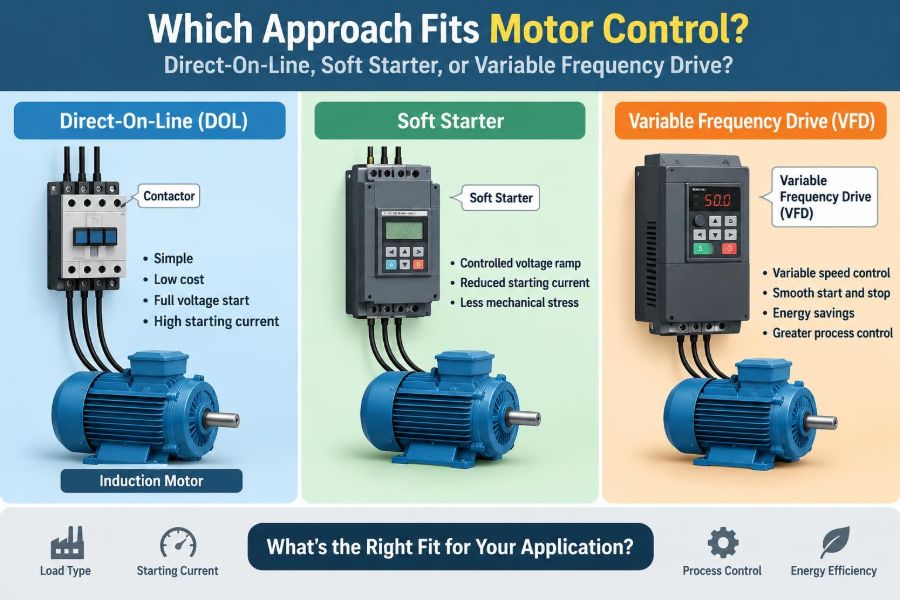

A maintenance technician is asked to replace a failed motor starter on a pump. The old panel contains a simple contactor, but the replacement quotation includes a soft starter and a variable frequency drive (VFD). All three options can start the motor. They do not, however, create the same electrical, mechanical, or operational result.
This choice appears in factories, commercial buildings, water systems, workshops, and HVAC plants. A small conveyor may run perfectly with a basic starter, while a large fan may waste energy and stress its ductwork if it is always started and operated at full speed.
Motor-control selection is not a contest to find the most advanced device. It is a question of matching the starting method and operating behavior to the load, the power system, the process, and the maintenance environment.
Understanding the differences between direct-on-line starting, soft starting, and variable-frequency control makes specifications clearer and troubleshooting more purposeful. It also helps prevent the expensive mistake of using a sophisticated controller where a contactor would be better—or a contactor where controlled speed is genuinely needed.
⚙️ Start with the motor and its load
Most industrial AC induction motors are designed to run near a speed set primarily by supply frequency and motor design. The driven equipment determines what happens when the motor starts and whether its speed needs to change afterward.
A centrifugal pump, fan, positive-displacement pump, loaded conveyor, crusher, and compressor can all use induction motors, but their torque demands are very different. A correct starter begins with the load torque-speed characteristic, not with a preferred brand or panel layout.
🔌 What Direct-On-Line starting means
Direct-on-line (DOL) starting connects the motor directly to the full line voltage through a contactor and overload protection. When the contactor closes, the motor sees the normal supply voltage and accelerates as quickly as its torque and load inertia allow.
A DOL starter is electrically simple: typically an isolator or breaker, contactor, overload relay, control circuit, and start/stop command. It is often the lowest-cost approach for motors that can tolerate an abrupt full-voltage start.
⚡ Why DOL produces high starting current
At standstill, an induction motor has no normal running back electromotive force to limit current. Applying full voltage therefore produces a high inrush current, commonly several times the motor’s full-load current. The exact value depends on the motor design, voltage, and supply conditions.
This current is brief during a successful start, but it can still cause voltage dip on a weak feeder. Nearby controls may reset, lighting may flicker, and other motors may lose torque if the supply impedance is significant.
💪 Full voltage also gives strong starting torque
The same full voltage that creates high current allows the motor to develop substantial starting torque. That can be an advantage for loads such as conveyors starting with material on them, some compressors, and machines that must overcome static friction promptly.
DOL is not automatically “harsh” in every application. A small motor on a stiff electrical supply, driving a load that accepts a quick start, may operate reliably for years with DOL control.
🧰 Where DOL is usually a sensible fit
DOL is often appropriate when the motor is modest relative to the available supply capacity, the machine needs only fixed-speed operation, and mechanical shock is acceptable. Examples can include small workshop pumps, simple exhaust fans, compact machine-tool auxiliaries, and some light-duty conveyors.
- The process needs only on/off control.
- The electrical system can accept starting current and voltage dip.
- The driven machine tolerates rapid acceleration.
- The motor receives a normal duty cycle with adequate cooling.
These conditions should be verified, not assumed from motor size alone.
🪛 Limits of the simplest starter
A DOL starter does not ramp voltage, limit acceleration smoothly, or alter running speed. It also cannot correct a poorly sized motor, a binding pump, or a high-inertia load that takes too long to reach speed.
Frequent abrupt starts can increase stress on belts, couplings, gearboxes, pipes, and the electrical supply. Where those effects matter, a different approach may be justified even if DOL starting is technically possible.
🌊 What a soft starter changes
A soft starter uses power semiconductors, usually thyristors, to control the voltage applied to the motor during starting and sometimes stopping. It raises effective motor voltage progressively rather than applying it instantly at full value.
It is called a soft starter because it manages the transition to normal speed. It is not normally a device for continuous speed regulation. Once the motor reaches operating speed, many soft starters use an internal bypass contactor to reduce heat losses.
📈 Voltage ramp versus current limit
A basic soft-start setting may ramp voltage over a chosen time. This can work for light, predictable loads, but voltage alone does not directly guarantee useful torque because induction-motor torque changes strongly with voltage.
Current-limit control is often more practical. The starter limits current to a configured level while allowing voltage to adjust as needed. The limit must still be high enough to produce the torque required to accelerate the actual load.
🏗️ Soft starters and accelerating torque
Reduced voltage means reduced available motor torque. Roughly speaking, induction-motor starting torque is highly sensitive to voltage, so an aggressive current restriction can leave too little torque for a loaded conveyor or a high-breakaway machine.
A soft starter should therefore be commissioned under realistic conditions. A pump that starts easily with an empty line may behave differently when its system is pressurized, and a conveyor may behave differently when carrying its normal product.
🚰 Soft stopping can protect fluid systems
One valuable soft-starter feature is controlled deceleration for certain pump systems. Instead of abruptly removing motor torque, the controller can reduce it over time, helping reduce rapid flow changes that contribute to pressure transients.
This is not a universal cure for water hammer. Pipe layout, check-valve behavior, pump characteristics, and system pressure all matter. Still, a carefully adjusted soft stop can be useful where an abrupt pump stop causes operational problems.
🔥 Thermal considerations inside a soft starter
During the start, the semiconductor devices dissipate heat. Long acceleration, frequent starts, high ambient temperature, and poor panel ventilation can exceed the starter’s duty capability even when its nominal current rating seems adequate.
Selection must account for start duration and starts per hour, as well as motor current. A device suitable for a lightly loaded fan may not survive repeated high-inertia starts without a larger rating or a different control strategy.
🔄 When soft starters outperform DOL
A soft starter fits fixed-speed equipment that benefits from gentler starting but does not need speed adjustment in normal operation. Common examples include pumps, fans, compressors, and conveyors where reduced mechanical shock or reduced supply disturbance is the goal.
It can offer a practical middle ground: more control than DOL, less complexity than a VFD. Its value comes from solving a defined starting or stopping problem—not simply from being newer technology.
🎛️ What a variable frequency drive does
A VFD first converts incoming AC power to DC and then uses switching electronics to create AC at a controlled frequency and voltage. By changing output frequency, it changes the motor’s synchronous speed and allows controlled acceleration, deceleration, and running speed.
This is a fundamentally different capability from soft starting. A VFD can start gently, but it can also run a fan at reduced speed for hours, maintain a process setpoint, reverse a motor, and often provide detailed operating data.
🧭 Frequency is the key to speed control
Motor speed is related to electrical supply frequency and the number of motor poles. An induction motor runs slightly below synchronous speed because of slip, but changing frequency remains the main way a VFD changes speed.
For example, reducing frequency generally reduces motor speed. The drive also adjusts voltage in a coordinated way to maintain suitable magnetic flux and available torque within its operating range. This is why a VFD can control speed without simply starving the motor of voltage.
🌀 Variable torque loads reward speed reduction
Centrifugal fans and pumps are especially strong VFD candidates because their required torque and power fall rapidly as speed falls. Where a process truly needs less air or water flow, slowing the machine can be more efficient than running at full speed and throttling flow with a damper or valve.
The result depends on the complete system. A VFD cannot create savings if the process still requires full flow continuously, or if poor control logic repeatedly drives the system between extremes.
🧱 Constant-torque loads need a closer look
Conveyors, mixers, extruders, hoists, and positive-displacement pumps often need broadly similar torque across a working speed range. A VFD can provide useful control, but its selection must address required low-speed torque, overload demand, acceleration time, and the driven machine’s safe speed limits.
For a hoist or other personnel-safety-related motion, the control system requires far more than a standard drive selection. Mechanical brakes, functional safety, load handling, and applicable machinery requirements demand specialist design.
📉 Controlled acceleration is not the only VFD benefit
A VFD can set acceleration and deceleration ramps, but its broader value is process control. It can receive a pressure, flow, temperature, level, or speed signal and adjust motor speed to hold a target.
Consider a hypothetical booster pump: instead of repeatedly starting and stopping at full speed as demand changes, a VFD may vary pump speed to maintain pressure. The final design still needs minimum-flow protection, suitable sensors, and a plan for faults.
🧠 Drive control modes affect performance
Many drives offer scalar volts-per-hertz control, vector control, or related sensorless and closed-loop modes. Scalar control is often adequate for uncomplicated fans and pumps. Vector-oriented control can improve torque response and speed regulation, particularly where load changes quickly or low-speed operation matters.
More advanced control is not automatically better. It needs correct motor data, sensible tuning, and a process that benefits from the added performance.
⚠️ VFD output is not the same as utility sine wave
A VFD creates a pulse-width-modulated output rather than a smooth utility waveform. Fast voltage transitions can place additional stress on motor insulation and can create reflected-wave effects, especially with long motor cables.
Motor suitability, cable length, grounding, output reactors, sine-wave filters, and dv/dt filters may need evaluation. The correct measures depend on drive voltage class, installation layout, motor insulation system, and manufacturer guidance.
🌐 Harmonics and power-quality planning
At its input, a VFD can introduce harmonic currents into the electrical system. In a small installation this may be manageable; in a facility with many drives, harmonics can affect transformers, capacitors, generators, and voltage distortion.
Line reactors, DC chokes, passive or active filters, and suitable drive front ends are possible mitigation tools. A power-quality review should consider the whole installation rather than treating each drive as an isolated device.
🛡️ Grounding, shielding, and electromagnetic compatibility
Fast switching edges can create electromagnetic interference (EMI). Good installation practice includes a low-impedance protective earth path, appropriate cable routing, correctly terminated shielded motor cable where required, and separation between power cables and sensitive signal wiring.
Problems blamed on “a noisy drive” are often installation problems: an encoder cable routed beside motor leads, an unshielded analog signal, or an incorrect shield termination. Follow the drive and motor manufacturer’s installation instructions rather than relying on one generic wiring rule.
🌡️ Low-speed cooling and motor capability
A standard self-cooled motor uses a shaft-mounted fan. At low speed, that fan moves less air while the motor may still be asked to produce considerable torque. The motor can overheat even though the VFD display shows current within a reasonable range.
Continuous low-speed, high-torque duty may require a motor rated for inverter duty, an independently powered cooling fan, a larger motor, or a reduced torque requirement. Thermal sensors and correct drive motor-protection settings add useful protection but do not replace sound sizing.
🧾 A direct comparison of the three approaches
| Feature | DOL starter | Soft starter | VFD |
|---|---|---|---|
| Starting method | Full line voltage | Reduced, controlled voltage | Controlled frequency and voltage |
| Running speed control | No | Generally no | Yes |
| Starting current | Highest of the three in typical use | Reduced or limited | Controlled; depends on settings and load |
| Mechanical starting shock | Potentially high | Reduced | Can be precisely managed |
| Installation complexity | Low | Moderate | Higher |
| Typical purpose | Simple fixed-speed duty | Gentle fixed-speed starting | Speed and process control |
The table is a starting point, not a selection rule. A high-torque starting load may favor DOL or a carefully sized VFD over a soft starter, despite the apparent simplicity of “reduced current.”
🧮 Size the controller for duty, not nameplate alone
Motor full-load current is essential, but it is not the whole specification. The controller must tolerate the actual overload, start time, acceleration frequency, ambient temperature, altitude where relevant, enclosure conditions, and available supply.
For a VFD, also confirm whether the application is normal-duty variable torque or heavy-duty constant torque. For a soft starter, examine start duty and bypass arrangement. For DOL, check contactor utilization category, protective-device coordination, and fault level.
🔍 Gather these facts before choosing
A short site survey can prevent a poor selection. Ask operators how the machine starts, stops, and behaves under worst-case production conditions—not just how it behaves when empty.
- Motor nameplate data, insulation condition, and service history.
- Load type, inertia, breakaway torque, and required speed range.
- Starts per hour, expected acceleration time, and stopping requirement.
- Supply capacity, generator operation, and sensitivity to voltage dip.
- Cable length, panel environment, and nearby sensitive equipment.
- Process measurements or control signals needed for automation.
🏭 Example: a fixed-speed process pump
Suppose a pump must always deliver essentially the same flow and starts only a few times per day. If the electrical system is robust and abrupt stopping does not cause hydraulic trouble, DOL may be entirely appropriate.
If starting causes an unacceptable pressure transient or voltage dip, a soft starter may solve the specific issue. A VFD becomes more compelling only if flow or pressure must vary during normal operation, or if controlled speed provides a clear process benefit.
🌬️ Example: a ventilation fan with changing demand
For a fan serving spaces with varying occupancy or thermal load, a VFD can match airflow to demand. A pressure sensor or building-control signal can command the drive, avoiding unnecessary full-speed operation when lower airflow is sufficient.
A soft starter would make the start gentler but would leave the fan running at fixed speed afterward. DOL would be reasonable only where the fan is truly an on/off, full-flow device and the supply and mechanics accept the start.
📦 Example: a loaded conveyor
A conveyor may need strong breakaway torque to start with product on the belt. DOL can provide this, but may create belt shock and current surge. A VFD can provide controlled acceleration while delivering appropriate torque if selected and configured for the duty.
A soft starter can work when torque demand is compatible with reduced-voltage starting, but it should not be chosen solely because it limits current. If it stalls or extends acceleration excessively, it transfers stress into heat rather than solving the problem.
🚫 Common selection mistakes
One frequent mistake is specifying a VFD merely to reduce starting current when the motor always runs at full speed and DOL or a soft starter would meet the real need. Another is applying a soft starter to a load that needs more starting torque than reduced voltage can provide.
Other costly errors include ignoring low-speed motor cooling, omitting EMC planning, using a standard motor on a demanding long-cable drive application, and treating protective settings as factory defaults rather than application settings.
🧪 Commissioning proves the design
Commissioning should include observing motor current, acceleration, direction, process response, protective trips, and temperature under representative load. For VFD systems, confirm minimum and maximum speeds, ramp times, control-signal scaling, fault response, and safe restart behavior.
Record the final settings and baseline readings. This makes future troubleshooting far easier than trying to reconstruct changes from a drive keypad after a failure.
🛠️ Maintenance and troubleshooting priorities
DOL systems need inspection of contactors, overload settings, terminals, and mechanical load condition. Soft starters need attention to heat dissipation, bypass operation, and event history. VFDs add cooling-fan, filter, capacitor-life, parameter-backup, and communication considerations.
Before replacing any controller, check the driven equipment. A jammed conveyor, blocked pump, failing bearing, or incorrect valve position can make a healthy starter or drive appear defective.
📚 Standards, manuals, and qualified design
Motor-control equipment must be designed and installed in accordance with the electrical and machinery requirements that apply at the site. Regional rules differ, and installation details such as short-circuit protection, disconnecting means, conductor sizing, enclosure rating, and emergency-stop functions require competent engineering judgment.
Manufacturer documentation is especially important for drive cable practices, motor compatibility, protective settings, and derating. When personnel safety, hazardous locations, lifting equipment, or critical processes are involved, seek appropriately qualified specialists.
✅ The core selection principle
Choose DOL when a fixed-speed motor can safely accept full-voltage starting and simplicity is valuable. Choose a soft starter when the equipment needs a gentler transition to fixed-speed operation. Choose a VFD when the process benefits from controlled running speed, not merely a controlled start.
Then test that choice against torque, inertia, duty cycle, electrical supply, motor cooling, cable installation, and protection. The best motor controller is the one that meets the actual operating requirement with manageable complexity and a well-understood maintenance plan.
Direct-on-line, soft starter, and VFD control are tools for different jobs; selecting by load behavior and process need is more reliable than selecting by perceived sophistication. ⚡🔧📈