
A household may notice a higher electricity bill after a hot month and assume the air conditioner is the whole story. A factory may receive a bill that seems high even when production has not changed much. Both observations can be partly true, but neither reveals the full pricing system.
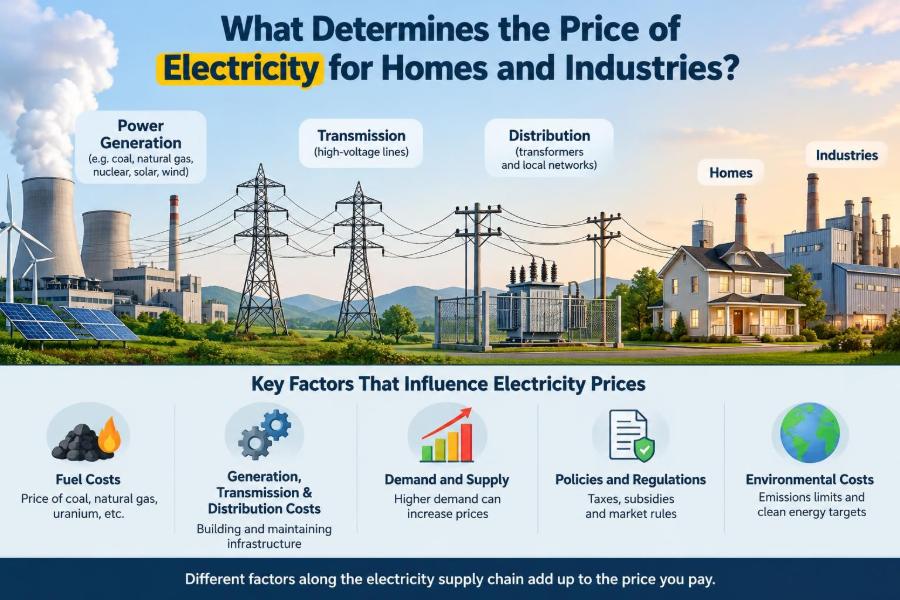
Electricity is unusual because large amounts must be produced and delivered at almost the exact moment they are used. The price therefore reflects more than the energy flowing through a meter: it also supports power plants, transmission lines, local wires, repair crews, market rules, and the capacity needed for the busiest hours of the year.
For homes, the bill is usually designed to be simple enough to read and predictable enough to budget for. For industries, the bill often exposes more of the underlying engineering challenge, especially the cost of drawing a large amount of power at one instant.
Understanding these layers makes a bill less mysterious. It also helps consumers choose tariffs, manage demand, evaluate solar or storage proposals, and recognize which actions will actually reduce costs.
⚡ Electricity Is Both Energy and a Service
A kilowatt-hour (kWh) is a unit of energy: one kilowatt used continuously for one hour. It is what most residential meters mainly record. Running a 2 kW heater for three hours consumes 6 kWh.
But supplying that energy requires a service that is available every second. The grid must maintain voltage, frequency, safety, and enough generating capability to meet changing demand. Electricity prices recover the cost of both the delivered kWh and the system that makes delivery reliable.
🧾 The Basic Parts of an Electricity Bill
Bill layouts differ by country, utility, and customer class, but the charges commonly fall into a few categories. A single line called “rate” may combine several of them.
- Energy charge: payment for kWh consumed.
- Demand or capacity charge: payment related to the highest rate of power use.
- Network charge: support for transmission and local distribution networks.
- Fixed customer charge: metering, billing, account, and connection costs.
- Taxes, levies, or policy charges: items set outside the utility’s operating cost.
Not every customer pays each component separately, but every electricity system must recover these costs somehow.
🏭 Generation Cost Starts with the Power Plant
Generating stations have very different cost structures. A gas-fired plant may be relatively quick to build but its operating cost changes with fuel prices. Wind and solar facilities have no fuel cost while generating, but require upfront investment and produce according to weather and daylight.
Nuclear, hydroelectric, coal, geothermal, biomass, and storage facilities each have their own combinations of construction cost, maintenance needs, fuel exposure, operating flexibility, and useful lifetime. A grid normally uses a portfolio rather than one technology because it must serve both steady and rapidly changing demand.
🔥 Fuel Prices Affect Marginal Electricity Prices
In many markets, generators are dispatched roughly in order of their marginal cost: the additional cost of producing one more unit of electricity. Plants with low immediate operating costs tend to run first, while more expensive flexible plants are called on as demand rises.
If the marginal plant burns imported fuel, fuel supply conditions can influence wholesale power prices quickly. This does not mean every customer bill changes immediately; retail tariffs may be fixed, regulated, or averaged over time. It does explain why fuel volatility can eventually reach electricity consumers.
📈 Demand Determines Which Plants Must Run
At low-demand hours, a system may be served by efficient baseload plants, renewable generation, or both. During a hot afternoon or a cold evening, extra generation must be brought online to serve air conditioning, heating, lighting, and commercial activity.
The last unit needed to meet demand can be much more expensive than the first. This is why the cost of electricity has a time dimension even though a conventional bill may show only a monthly total.
⏰ Peak Hours Cost More to Serve
Peak demand is the highest combined load the grid experiences over a defined period. Building and maintaining equipment for a few extreme hours can be costly, because generators, transformers, cables, and substations must be adequate when the system is most stressed.
A neighborhood’s evening peak may occur when cooking, cooling, charging vehicles, and entertainment loads overlap. In a commercial district, the peak may happen during business hours. Utilities design rates partly to recover the cost created by these patterns.
🌙 Time-of-Use Rates Send a Price Signal
Time-of-use tariffs apply different energy prices at different times, often separating peak, shoulder, and off-peak periods. They encourage customers to move flexible activities away from hours when the grid is costly to serve.
For example, a household with a timer-controlled water heater or electric vehicle may shift charging to lower-priced periods. The savings depend on the tariff and actual behavior; merely enrolling does not help if most consumption remains in the expensive window.
📊 Demand Charges Explain Many Industrial Bills
Large commercial and industrial customers are often billed for maximum power demand, measured in kilowatts (kW) or sometimes kilovolt-amperes (kVA). This is different from energy. Two factories can use the same monthly kWh but impose very different demands on the network.
Imagine both use 10,000 kWh in a month. Factory A spreads that use evenly. Factory B runs many machines together for short periods. Factory B may require a larger transformer, feeder, and generation reserve, so a demand charge can reflect that infrastructure requirement.
📏 How a Demand Charge Is Measured
A meter usually records average demand over intervals such as 15, 30, or 60 minutes, depending on the tariff. A short start-up event may have little effect if it is brief, while a sustained simultaneous load can set the billing peak.
Some tariffs use the highest interval in the month. Others use a seasonal peak, a ratchet based partly on past maximum demand, or demand only during specified hours. Reading the tariff definition matters before attempting load-management changes.
🔌 Transmission Moves Bulk Power Across Distance
High-voltage transmission networks carry bulk electricity from generators to regions where it is needed. Their costs include towers or underground cables, substations, protection systems, control centers, inspections, vegetation management, land access, and renewal of aging assets.
Transmission charges can be spread broadly because a strong interconnected network improves access to generation and resilience. However, congestion on important corridors can also affect local wholesale prices when cheaper power cannot easily reach a high-demand area.
🏘️ Distribution Delivers Power to Each Customer
Distribution is the lower-voltage network connecting substations to streets, buildings, and individual meters. It includes poles, underground cables, neighborhood transformers, switches, service drops, and protection equipment.
Costs vary with customer density and geography. A compact urban network may serve many customers per kilometer of cable, while rural service can require long lines for relatively few connections. Utilities and regulators decide how such costs are shared across customer groups.
🛠️ Reliability Has a Real Cost
Customers expect electricity to be available when they turn on a switch, but reliability requires redundancy, spare equipment, maintenance, skilled staff, and rapid fault isolation. Storm hardening, undergrounding, automation, and backup control systems can improve resilience, though each involves trade-offs in cost and construction disruption.
There is no universally “correct” reliability level independent of price. Essential services may justify stronger backup arrangements than a lightly used seasonal connection. Rate design attempts to balance affordability with the level of service customers and society require.
🧠 Grid Balancing and Ancillary Services
Frequency must remain close to its target value because supply and demand must stay balanced almost instantaneously. Grid operators procure ancillary services such as frequency response, reserves, voltage support, and black-start capability.
These services are less visible than kWh sales, but they are essential. A battery, a responsive generator, or a controllable industrial load may provide some of them. Their costs are generally embedded in wholesale settlements, network charges, or regulated tariffs.
🌬️ Renewable Generation Changes the Cost Pattern
Wind and solar can reduce fuel use and often have low marginal operating costs. When abundant, they may reduce wholesale energy prices. Yet their output varies by weather and time, so the system also needs transmission, flexibility, storage, demand response, or other generation for periods of low output.
It is misleading to call any technology simply “cheap” or “expensive” without asking which cost is being discussed: plant construction, fuel, hourly energy, firm capacity, network upgrades, or system balancing. Sound planning examines the whole system.
🔋 Storage Can Shift Energy, Not Create It
Batteries and pumped-storage facilities can charge when electricity is plentiful and discharge later. They can also respond quickly during grid disturbances, making them valuable beyond energy shifting.
Storage loses some energy during the charge-discharge cycle and has finite power and duration. A battery may reduce a facility’s short demand peak very effectively, but it cannot supply an unlimited multi-day shortage unless it is sized and charged for that purpose.
☀️ Rooftop Solar Changes a Customer’s Metered Use
Rooftop solar produces electricity behind a customer’s meter. When production coincides with building load, it reduces electricity bought from the grid. At other times, excess output may be exported, subject to local interconnection and compensation rules.
Its financial value depends on timing. A system that generates at midday may offset a high midday tariff well, while a home whose largest load occurs after sunset may still buy substantial evening energy. Export credits should not be assumed to equal the retail purchase price.
🔄 Net Metering and Export Compensation Differ
Some arrangements credit exported solar electricity close to the retail rate; others use a distinct export rate or calculate credits over specific periods. These choices influence how network costs are allocated between solar and non-solar customers.
There are reasonable arguments on both sides. Generous export credits can encourage distributed generation, while lower export compensation may reflect that some fixed network costs remain even when a customer imports less energy. The applicable local tariff, not a general rule of thumb, determines the outcome.
🏠 Why Residential Tariffs Are Often Simpler
Most households have modest loads and limited ability to monitor demand continuously. A mainly per-kWh tariff is easy to understand and gives a clear incentive to conserve energy.
The simplicity can hide cost differences between a customer who uses power steadily and one who creates a sharp evening peak. Smart meters make more detailed residential tariffs possible, but complexity must be weighed against clarity, fairness, and customers’ ability to respond.
🏢 Why Industrial Tariffs Are More Detailed
Industrial users can draw large loads, operate motors and furnaces, and sometimes shift processes by hours or minutes. Their bills may therefore include demand, time-of-use, power factor, voltage-level, and interruptibility provisions.
In return for this complexity, a facility may have meaningful ways to lower cost without reducing total production. Staggering motor starts, rescheduling a batch process, or controlling chilled-water equipment can reduce coincident peaks when operational constraints allow.
🧲 Power Factor Can Affect Large Customers
Alternating-current systems deliver both real power, measured in kW, and reactive power, measured in kilovolt-amperes reactive (kVAr). Motors, transformers, and some electronic equipment need reactive power to create magnetic fields, even though reactive power does not directly perform useful mechanical work.
Power factor describes how effectively apparent power is converted into real power. A low power factor means higher current for the same kW, increasing stress and losses in equipment. Some industrial tariffs charge for poor power factor or apparent demand; properly designed capacitor banks or other correction equipment can help.
⚠️ Electrical Losses Are Part of Delivery Cost
Conductors and transformers are not perfect. Current flowing through resistance produces heat, commonly described by the relationship I²R. Losses rise sharply when current rises, which makes high-demand periods particularly demanding for network equipment.
Utilities account for expected losses when purchasing and delivering energy. Customers do not normally see a separate household “losses” line, but losses influence network design and the total energy required to serve load.
🗺️ Location Can Change the Underlying Cost
Electricity is not equally expensive to supply everywhere at every moment. A growing industrial site may require a new feeder or substation. A remote area may need long lines. A region with constrained transmission may not be able to access lower-cost generation when it is needed.
Retail tariffs may average these differences across many customers for social and regulatory reasons. In other systems, large users can receive more location-specific signals. Neither approach is purely technical; it reflects policy choices about cost sharing.
🏛️ Regulation and Market Design Shape Final Prices
Some electricity systems rely largely on regulated utility rates. Others combine competitive generation markets with regulated networks and retail plans. Many use a mixture. Regulators commonly review investments, allowed revenue, service quality, and how costs are assigned among customer classes.
Market prices can reveal short-term scarcity, while regulation can support long-lived network investment and consumer protections. The final bill reflects institutional design as well as engineering and fuel costs.
🧾 Taxes, Levies, and Public Policy Charges
A bill may include taxes, environmental programs, energy-efficiency funds, support mechanisms, or other government-authorized charges. These are not necessarily costs of physically generating or delivering a kWh, but they can materially affect what a customer pays.
For clear analysis, separate the technical cost of service from taxes and policy components. This distinction is useful when comparing bills across regions, because two places can have similar power-system costs but different final retail prices.
📉 Fixed Charges Versus Per-kWh Charges
Fixed monthly charges make revenue less dependent on how much energy a customer buys and can more directly recover metering and account costs. Higher per-kWh charges give a stronger conservation signal and are easier for customers to reduce through efficiency.
Neither structure is automatically fairer. A customer with very low usage may prefer low fixed charges, while a utility must still maintain the connection. Good rate design balances cost recovery, affordability, conservation, and practical understanding.
🧮 A Simple Hypothetical Bill Example
Consider a hypothetical small manufacturer that uses 40,000 kWh in one month and reaches a measured peak demand of 180 kW. Its bill might include an energy component for 40,000 kWh, a demand component for 180 kW, fixed account charges, and applicable taxes.
If it uses the same 40,000 kWh next month but keeps the maximum at 150 kW by staggering equipment, the energy component could remain similar while the demand component falls. Actual results depend entirely on the tariff, but the example shows why kWh alone do not tell the complete cost story.
🔍 Read the Bill Before Changing Equipment
Efficiency upgrades are valuable, but the best project depends on the charges actually paid. Replacing inefficient lighting mainly reduces kWh. A controls project that limits simultaneous equipment operation may chiefly reduce kW. Solar, batteries, insulation, and power-factor correction each affect different bill components.
- Identify the tariff name and customer classification.
- Separate energy, demand, fixed, and tax charges.
- Compare usage and peak demand across comparable months.
- Check time periods, ratchets, and export-credit rules.
- Verify savings assumptions with interval meter data where available.
For complex sites, an energy manager or qualified electrical professional can help interpret data and ensure changes do not compromise safety or production.
🚫 Common Mistakes When Comparing Electricity Prices
A common error is comparing only the headline price per kWh. That can overlook fixed fees, demand charges, taxes, contract terms, and time-dependent prices. Another is assuming an appliance’s rated power equals its monthly energy use; operating hours are equally important.
Customers also sometimes buy equipment based on an advertised saving without checking their own load profile. A battery designed for energy arbitrage may not reduce a demand charge if it cannot discharge through the site’s actual peak. Measurement should come before a large investment.
🧑🔧 Practical Ways Homes Can Reduce Costs
Start with the loads that run often or at expensive times: space conditioning, water heating, cooking, laundry, pool pumps, and vehicle charging. Improve building insulation and sealing before expecting controls to solve an excessive heating or cooling load.
Where a suitable tariff exists, schedule flexible loads away from peak periods. Use smart controls carefully, preserve comfort and safety, and check the next bills to confirm that usage actually moved. A low tariff price is not helpful if it causes inconvenient or unsafe operating practices.
🏗️ Practical Ways Industry Can Manage Cost
Industrial savings often come from understanding process timing. Facilities can monitor interval demand, identify what coincides with the peak, and assess whether noncritical loads can be sequenced. Compressed-air leaks, poor motor control, and unnecessary idling can increase both energy use and operating burden.
Any change involving electrical distribution, motor starters, capacitor banks, generators, or storage should be engineered and installed by competent professionals. Lower bills are never a reason to bypass protection settings, overload conductors, or defeat safety interlocks.
🌡️ Weather and Seasons Shift the Load Profile
Heat waves can increase cooling demand, while cold spells can raise electric heating demand where it is common. Weather can also affect renewable output, line ratings, and equipment performance. These conditions may raise system costs even if an individual customer’s habits remain unchanged.
Seasonal tariffs recognize that the expensive period is not identical everywhere. A building’s own peak may also differ from the grid peak, so local interval data offers more insight than assumptions based only on season.
🔮 Electrification Will Make Load Timing More Visible
Electric vehicles, heat pumps, induction processes, and electric industrial equipment can reduce direct fuel use, but they add electrical demand. The challenge is not simply adding more kWh; it is integrating that demand where and when the grid can serve it efficiently.
Managed charging, thermal storage, smart building controls, and carefully planned network upgrades can reduce unnecessary peaks. Electrification can be highly beneficial, but its cost outcome depends on load shape, local capacity, and rate design.
🧩 The Core Principle: Cost Follows Energy, Capacity, and Timing
The price of electricity is determined by three connected questions: how much energy is used, how much power must be available at once, and when and where that use occurs. Generation, networks, reliability services, regulation, and public charges all sit around those physical requirements.
For a home, reducing unnecessary kWh and shifting flexible loads may be the most useful response. For an industrial facility, managing maximum demand and power quality can be equally important. The right strategy follows the actual tariff and measured load profile, not a one-size-fits-all tip.
Electricity costs are not just about the meter total; they reflect the continuous work of producing, balancing, and delivering dependable power at the moment customers need it. ⚡🏠🏭