
A phone charger, a wall outlet, an electric vehicle, and a rooftop solar panel all use electricity—but not in the same form. That difference can shape everything from shock risk to fire protection and the design of the equipment around it.
It is tempting to ask whether alternating current (AC) or direct current (DC) is simply “safer.” In practice, that question has no one-word answer. A low-voltage DC control circuit can be far less hazardous than a household AC outlet, while a high-voltage DC battery system can create serious hazards of its own.
Safety depends on voltage, current capability, the path through the body, exposure time, environment, circuit energy, and the protective devices installed. The waveform matters, but it is only one part of the engineering picture.
Understanding those differences helps students reason about electrical hazards and helps working professionals choose appropriate wiring methods, disconnects, enclosures, and test procedures.
⚡ AC and DC: The Essential Difference
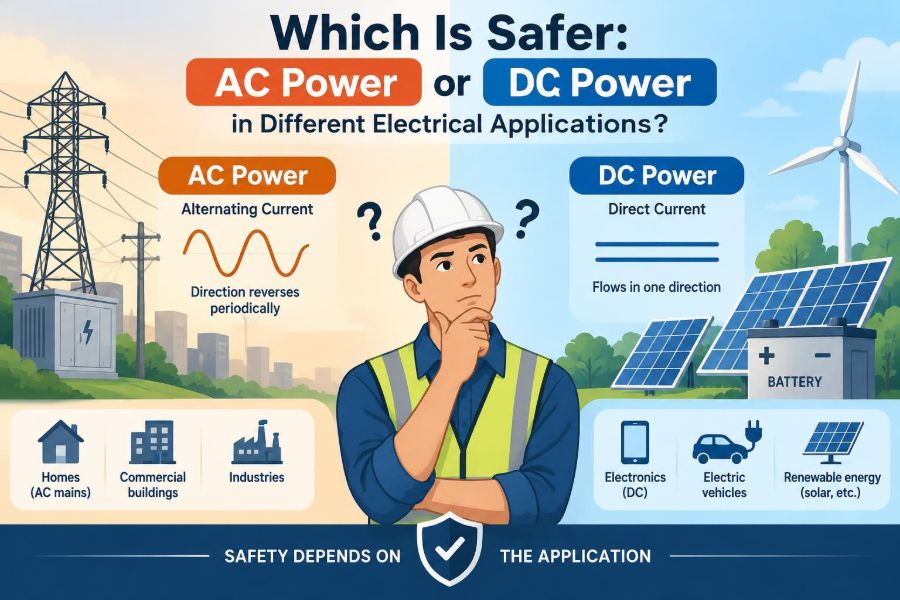
AC reverses direction periodically. Utility power supplied to buildings is normally AC, typically at 50 or 60 Hz depending on the region. Its voltage also rises and falls continuously through each cycle.
DC flows in one direction with a nominally constant polarity. Batteries, photovoltaic modules, many electronic circuits, and traction battery packs are DC sources. Some DC systems have ripple or switching noise, but their polarity does not reverse in the ordinary AC sense.
Neither description says anything by itself about how much energy is available or whether contact is safe.
🧭 Why “Safer” Needs a Specific Context
A 5 V USB supply and a 400 V DC battery pack are both DC, yet their hazards are radically different. Likewise, a small isolated AC signal source is not comparable to a building distribution panel.
A useful question is: safer for whom, from which failure mode, at what voltage and energy level? Engineers must separately consider electric shock, arc flash, burns, fire, stored energy, unintended motion, and damage caused by faults.
This context-based approach prevents a common error: treating AC/DC as a complete safety classification.
🫀 How Electric Shock Affects the Body
An electrical shock occurs when current enters the body and follows a path between points at different electrical potentials. The effects range from a mild sensation to burns, muscle contraction, respiratory disruption, or dangerous heart rhythm disturbances.
The outcome depends heavily on the contact path. Hand-to-hand or hand-to-foot contact can place the chest in the current path and is generally more concerning than a short path across one fingertip.
Skin condition matters too. Dry, intact skin can provide meaningful resistance; wet, damaged, or contaminated skin can reduce resistance substantially.
🌊 Why 50/60 Hz AC Deserves Special Attention
AC at utility frequency is particularly relevant to shock safety because repeated current reversals can interfere with normal nerve and muscle function. At sufficient current, a person may experience involuntary muscle contraction and be unable to release a conductor.
This does not mean that DC is harmless. It means that low-frequency AC has physiological characteristics that make it especially hazardous at commonly encountered mains voltages.
The precise effect on an individual cannot be predicted from voltage alone. Contact conditions, duration, and body path remain decisive.
🔋 DC Shock Hazards Are Different, Not Absent
DC contact may cause a strong initial muscle contraction when the circuit is made or broken. Sustained DC can also cause heating and serious injury if enough current flows through the body.
At higher voltages, DC can overcome skin resistance, especially where moisture, sweat, or damaged insulation is involved. High-voltage DC installations should therefore be treated as potentially lethal, not as a safer substitute for AC.
Battery systems can be especially deceptive because they remain energized silently and continuously until isolated.
📏 Voltage Is a Risk Indicator, Not the Whole Answer
Voltage creates the potential that can push current through a body or across insulation. Higher voltage generally increases the likelihood that dangerous current can flow, but voltage does not set the outcome alone.
A source with very limited available current may be unable to deliver harmful energy even at a relatively high open-circuit voltage. Conversely, a low-voltage battery can supply enormous current into a metal tool or undersized conductor.
Use voltage to identify possible exposure, then assess source capability, impedance, fault paths, and duration.
🔌 Available Current and Source Impedance
Source impedance is the effective internal resistance or opposition that limits fault current. A coin-cell battery has low voltage and limited fault energy; a large battery bank may have a similar chemistry but extremely low internal impedance and a vastly larger fault current.
Utility-fed AC circuits can also supply substantial fault current. This is why overcurrent protection, conductor ratings, and interruption ratings must be coordinated with the available fault level.
“It is only DC” is never an adequate assessment of a power source.
🔥 Arc Behavior: One of DC’s Major Challenges
An arc is a conductive plasma path through air. When a loaded circuit opens, the current may continue briefly as an arc between separating contacts. AC naturally passes through zero current twice per cycle, which can help an arc extinguish.
DC lacks those regular zero crossings. Once established, a DC arc can persist until the gap becomes large enough or the circuit is interrupted by equipment designed for the task.
This makes correctly rated DC switches, contactors, fuses, and circuit breakers essential in battery, solar, and DC distribution systems.
🧯 Fire Risk Is About Energy and Fault Clearing
Electrical fires commonly involve overheated conductors, loose connections, damaged insulation, overloaded equipment, or arcs. Both AC and DC can produce these conditions.
For a resistive fault, heating rises rapidly with current. A connection that has become loose can develop resistance, heat locally, oxidize, and worsen further. The waveform is less important than whether protective devices detect and clear the fault before materials ignite.
Good terminations, suitable conductor sizes, enclosure design, and periodic inspection reduce risk in either system.
🏠 Household AC: Familiar Does Not Mean Low Risk
Building outlets are convenient because AC can be transformed and distributed efficiently, but mains wiring presents meaningful shock and fire hazards. Damaged cords, missing protective earth connections, wet locations, and improvised extensions all increase exposure.
Residential circuits rely on layered protection: insulation, grounding or earthing, circuit breakers or fuses, and residual-current devices where required. No single layer should be assumed to handle every fault.
Never work on fixed building wiring unless qualified and authorized under applicable local rules.
🛁 Wet Locations Change the Risk Calculation
Bathrooms, kitchens, outdoors, and industrial washdown areas are higher-risk environments because moisture can lower surface resistance and create unintended conductive paths. Water itself is not always the main conductor; dissolved salts and contaminants often make the difference.
In these locations, protective measures such as residual-current protection, appropriate ingress-rated enclosures, and equipment intended for wet use become particularly important.
A dry floor today does not justify ignoring the conditions the installation may experience tomorrow.
🛡️ Grounding, Earthing, and Bonding
Grounding or earthing connects a system to earth for functional and fault-management purposes. Bonding connects exposed conductive parts together so they remain at similar potential during a fault.
In an AC appliance with a metal enclosure, the protective earth conductor can provide a low-impedance path that helps a protective device operate if a live conductor touches the enclosure.
DC systems may be grounded, ungrounded, or use a monitored insulation scheme depending on their application. The protection method must match the system architecture rather than being copied casually from AC practice.
🧪 Residual-Current Protection Has Limits
Residual-current devices compare the current leaving on active conductors with the current returning. A mismatch can indicate current leaking through a person or unintended path, allowing rapid disconnection.
They are highly valuable on many AC circuits, but they do not replace grounding, insulation, correct overcurrent protection, or safe work practices. They also may not operate as intended with every DC waveform or electronic converter arrangement.
Some installations require devices specifically selected for smooth DC components or variable-frequency equipment. Device selection should follow the equipment instructions and applicable installation requirements.
☀️ Solar PV: DC That Remains Live in Sunlight
Photovoltaic strings are a clear example of why DC safety deserves careful attention. Modules produce voltage whenever illuminated, and disconnecting an inverter does not necessarily remove voltage from conductors between the array and the isolating point.
Series-connected modules can create substantial DC voltage. Faults may occur in rooftop areas that are difficult to access, exposed to weather, and difficult to de-energize completely during an emergency.
PV installations need DC-rated isolators, connectors that are properly matched and terminated, protected cable routing, and clear labeling of energized sources.
🔋 Batteries: High Current at Apparently Modest Voltage
A 12 V battery is often below the voltage associated with ordinary dry-skin shock concerns, yet it can deliver enough current to vaporize small metal objects, heat tools, or start a fire. Rings, watches, and conductive jewelry are a particular concern around exposed battery terminals.
Large battery banks add stored energy, heavy conductors, corrosive electrolyte or thermal hazards depending on chemistry, and the possibility of unintended reconnection.
Insulated tools, terminal covers, correctly sized fuses close to the source, and disciplined lockout procedures matter greatly.
🚗 Electric Vehicles Combine Several Hazards
Electric vehicles usually contain a high-voltage DC traction battery, AC or multi-phase motor drive outputs, low-voltage auxiliary circuits, and large capacitors in power electronics. The service risk is not defined by one current type.
Contactors may isolate the battery under normal conditions, but capacitors can retain charge after shutdown. Manufacturers therefore specify waiting periods, verification steps, insulated PPE, and service procedures.
Unauthorized probing of orange high-voltage wiring or battery enclosures is unsafe. Follow the manufacturer’s documented isolation process.
💻 Electronics Often Use Both AC and DC
A laptop charger accepts mains AC, rectifies it to DC, switches it at high frequency, and provides a lower-voltage isolated output. The cable to the laptop may be relatively low risk, while the input side still contains hazardous mains-derived voltages.
Opening a power supply removes protective barriers and can expose capacitors with stored charge. Unplugging it is necessary, but it does not automatically prove that every internal node is safe to touch.
Designers use insulation spacing, protective enclosures, fuses, and isolation barriers to separate the user-accessible side from hazardous energy.
🏭 Industrial DC and Control Circuits
Many industrial control systems use 24 V DC because it works well with sensors, programmable controllers, relays, and field devices. In normal dry conditions, this voltage can reduce shock exposure compared with mains control wiring.
That benefit does not eliminate other failure modes. A 24 V DC supply feeding many loads can produce enough fault current to overheat wiring or damage components if branch circuits are not protected.
Segregating power and signal wiring, labeling terminal blocks, and using coordinated electronic or fuse protection support safer troubleshooting.
🚆 High-Voltage DC Traction Systems
Rail systems and other traction installations may use high-voltage DC because it suits particular distribution and vehicle designs. These systems are not “low risk” simply because they are DC; they can combine high voltage, substantial available current, exposed conductors, and complex return-current paths.
Public safety depends on physical separation, secure access control, signage, and operational procedures. Technical staff require specialized training because isolation and grounding practices differ by system.
Never assume a rail conductor is safe based on appearance, sound, or whether a vehicle is moving.
📡 Extra-Low-Voltage Systems Are Usually Safer
Many doorbells, USB supplies, Ethernet-powered devices, and control circuits operate at extra-low voltage. When supplied by suitable limited-energy or isolated sources, these systems can significantly reduce the likelihood of dangerous shock.
However, “low voltage” does not automatically mean safe under every condition. Long cable runs can introduce voltage drop and heating, and installations near flammable materials still need appropriate overcurrent protection.
The practical advantage is that well-designed extra-low-voltage systems make dangerous body current less likely during ordinary contact.
🔄 AC-to-DC Conversion Moves Rather Than Removes Risk
Converting AC to DC is common in modern equipment, but rectification does not make the energy inherently safer. A rectified mains supply can have a DC bus voltage comparable to the peak of the original AC waveform.
Large capacitors smooth that bus and store energy. A disconnected device may therefore retain hazardous voltage until the capacitors discharge through designed resistors or other circuits.
Technicians should verify absence of voltage with properly rated instruments; they should not rely only on indicator lights or expected discharge times.
🧰 Disconnects Must Be Rated for the Current Type
A switch that operates acceptably on AC may not safely interrupt the same DC voltage and current. Its contact spacing, arc chute, magnetic blowout arrangement, and tested ratings may be unsuitable for persistent DC arcs.
Check the manufacturer’s ratings for the actual voltage, current, polarity where relevant, load type, and number of poles used. Series poles may sometimes be specified for DC use, but only according to the manufacturer’s instructions.
Using an AC-only protective device in a DC circuit is an engineering error, not a harmless substitution.
📊 A Practical Comparison by Application
| Application | Typical dominant concern | Useful safety focus |
|---|---|---|
| Household AC outlet | Shock from mains contact; wiring faults | Grounding, insulation, residual-current protection |
| USB-powered device | Usually low shock risk; overheating from faults | Approved supply, undamaged cables, current limiting |
| Battery bank | Very high fault current and burns | Source fusing, covered terminals, insulated tools |
| Solar PV string | Persistent DC arcing and live conductors | DC-rated isolation, connector quality, labeling |
| EV traction system | High voltage and stored capacitor energy | Defined isolation procedure and verification |
The table is a starting point, not a design rulebook. Actual hazards depend on the equipment ratings and installation conditions.
⚠️ Common Misconception: DC Is Always Safer
This idea often comes from experience with batteries and low-voltage electronics. Those examples are useful but incomplete. High-voltage DC can cause dangerous shock, and its arcs can be harder to interrupt than comparable AC arcs.
A better statement is: low-voltage, energy-limited DC is often safer for user-accessible circuits than mains AC. That is a conclusion about the whole source and protective design, not merely about DC polarity.
⚠️ Common Misconception: AC Is Always More Dangerous
Low-frequency AC has notable physiological effects, but this does not make every AC circuit more hazardous than every DC circuit. A high-energy DC system may present a greater overall risk because of voltage, available fault current, stored energy, and persistent arcs.
Comparisons must use equivalent conditions. Comparing a 5 V DC phone charger with a 230 V AC outlet says more about voltage class and source design than about AC versus DC.
🧤 Safe Work Begins With De-Energization
The preferred method for electrical work is to remove energy, isolate all sources, secure the isolation against reconnection, and verify the absence of voltage using an appropriate test method. This principle applies to AC and DC alike.
Where work on energized equipment cannot be avoided, it requires a justified procedure, suitable training, boundaries, tools, protective equipment, and an assessment of shock and arc hazards. It is not a casual troubleshooting shortcut.
- Identify every supply source, including batteries, PV strings, generators, and backfeed paths.
- Allow time for stored energy to discharge where specified.
- Test the meter on a known source before and after proving absence of voltage.
- Restore covers, barriers, and labels before returning equipment to service.
🧑🔧 Design for the Person Who Will Service It
Good electrical safety is designed in before an incident occurs. Clear labeling, accessible disconnects, guarded terminals, touch-safe connectors, adequate creepage and clearance distances, and logical cable routing reduce the chance of human error.
For DC systems, designers should also consider polarity marking, reverse-polarity protection where appropriate, fault detection, and the DC interruption rating of every switching device.
A maintainable design makes the safe action the easy action.
📚 Standards and Instructions Matter
Electrical installation rules, product standards, and workplace procedures vary by country, industry, and equipment type. They translate broad principles into specific requirements for conductor sizes, protective devices, enclosure ratings, testing, and documentation.
When designing or modifying equipment, use the applicable local requirements and the manufacturer’s instructions. For unfamiliar high-energy systems, seek a qualified electrical professional rather than extrapolating from hobby electronics.
Standards do not eliminate judgment, but they provide a tested framework for applying it consistently.
🎯 The Core Principle: Match Protection to the Hazard
AC and DC are not competing safety labels. AC at mains frequency often raises particular shock concerns, while DC can create persistent arcs and formidable stored-energy or battery-fault hazards.
The safest choice depends on the application. Extra-low-voltage, isolated DC is well suited to accessible electronics and controls; AC remains practical for broad utility distribution; high-voltage DC demands equipment and procedures designed specifically for DC interruption and isolation.
Evaluate the complete electrical system: voltage, available current, energy storage, environment, fault paths, and protective layers.
AC or DC is safer only when the source, installation, equipment ratings, and work practices are appropriate for the hazards present. Thoughtful design and disciplined isolation matter more than choosing a waveform in isolation. ⚡🔋🛡️