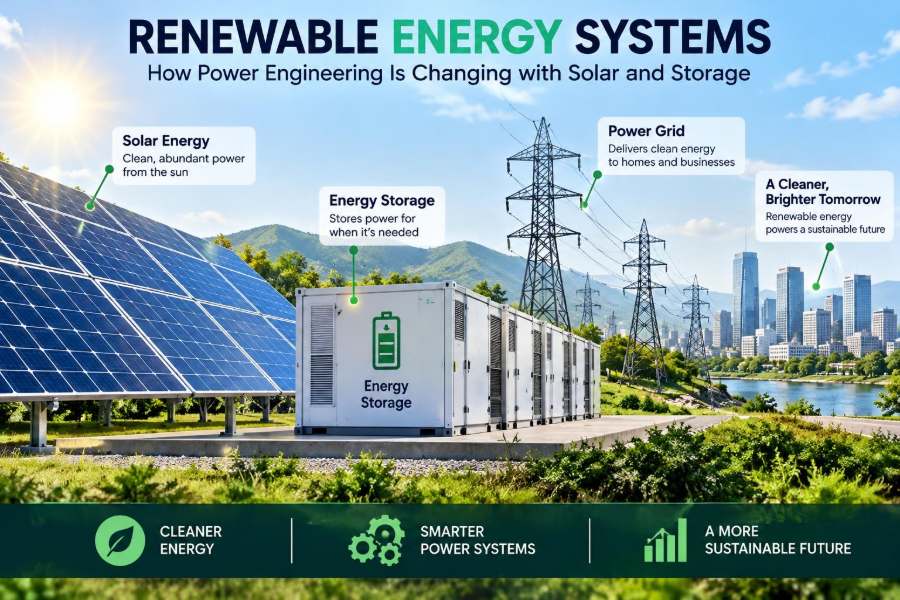

A neighborhood can look completely ordinary at noon: air conditioners running, electric vehicles charging, shops open, and rooftops quietly producing electricity. A few hours later, the sun drops, household demand rises, and those same solar panels produce almost nothing. The electrical system must handle both moments without customers noticing a flicker.
That is the practical challenge behind the growth of renewable energy. Adding solar panels and batteries is not simply a matter of connecting more equipment to the grid. It changes where power comes from, when it is available, how voltage is controlled, and how engineers respond when something goes wrong.
For students, this shift connects circuit theory, power electronics, protection, control systems, and energy economics. For working professionals, it affects planning studies, field procedures, operating practices, and the skills needed to design reliable systems.
Renewable energy is therefore reshaping power engineering from a discipline centered on large, predictable generators into one that coordinates many distributed, electronically controlled resources.
🌍 Renewable Growth Is a Power-System Change
Renewable generation includes solar photovoltaic (PV), wind, hydroelectric generation, geothermal plants, and other lower-carbon energy sources. Solar and wind are driving especially visible changes because they can be deployed from utility-scale sites down to individual buildings.
The engineering issue is not that these sources are inherently unreliable. It is that their output follows weather, daylight, and local conditions rather than a dispatcher’s direct fuel-control command. The grid must match production and consumption at every moment, so this variability needs deliberate management.
🔌 The Traditional Grid Was Built Around Central Stations
Historically, large synchronous generators at power plants supplied electricity through high-voltage transmission lines and then lower-voltage distribution networks. These rotating machines naturally contributed inertia, fault current, and voltage support.
Power generally moved in one direction: plant to transmission system to substation to customer. Protection settings, voltage regulators, and operational procedures were designed around that direction of flow. Distributed solar changes that assumption.
☀️ Solar PV Converts Light Through Semiconductor Physics
A PV cell uses semiconductor materials to convert incoming light into direct current (DC) electricity. Cells are connected into modules, modules into strings, and strings into arrays sized for a rooftop, carport, field, or utility-scale solar plant.
PV output depends on irradiance, temperature, orientation, shading, soiling, and equipment condition. Bright but very hot conditions can reduce module efficiency, while partial shade can affect a string more than a casual observer might expect.
🔄 Inverters Make Solar Useful to the AC Grid
Most power networks distribute alternating current (AC), while solar modules and batteries use DC internally. An inverter uses fast-switching power electronics and control algorithms to convert DC into grid-compatible AC.
Modern inverters do more than convert energy. They can regulate reactive power, limit current, follow voltage and frequency targets, disconnect under specified conditions, and communicate operating data. This makes their control settings as consequential as their nameplate capacity.
📉 Solar Output Has a Daily Shape
On a clear day, solar output usually ramps up after sunrise, peaks around the middle of the day, and falls toward evening. Demand, however, may peak later when people return home, cook, cool buildings, or turn on lights.
This timing mismatch does not mean solar lacks value. It means the system needs complementary resources: storage, flexible demand, dispatchable generation, transmission connections, or a mix of all of them. The difficult periods are often the ramps between high and low solar output.
🌦️ Variability Is Not the Same as Uncertainty
Variability is the expected change in output over time, such as the daily solar cycle. Uncertainty is the forecast error: a cloud bank may arrive earlier, later, or be denser than predicted.
Engineers manage these differently. Forecasting helps schedule resources ahead of time, while operating reserves provide capacity that can respond when actual conditions differ from the forecast. A system does not need perfectly constant generation; it needs enough flexibility to maintain balance.
🔋 Storage Turns Timing Into a Design Variable
Energy storage can absorb electricity at one time and return it later. Battery energy storage systems are increasingly paired with solar because both are modular and connect through power electronics.
Storage does not create energy. It shifts energy in time and loses some energy during charging, conversion, and discharging. Its value depends on when it charges, when it discharges, how long it can sustain output, and what grid services it can provide.
⏱️ Power Rating and Energy Rating Are Different
A battery system has a power rating, usually expressed in kilowatts or megawatts, and an energy rating, expressed in kilowatt-hours or megawatt-hours. Power describes how fast it can charge or discharge; energy describes how much it can deliver over a period.
A 10 MW battery with 20 MWh of usable energy could, in simplified terms, discharge at full power for about two hours. Real operation also considers reserve margins, state-of-charge limits, temperature, degradation, and inverter constraints.
| Question | Power-focused answer | Energy-focused answer |
|---|---|---|
| What is being measured? | Rate of electricity transfer | Quantity available over time |
| Common units | kW or MW | kWh or MWh |
| Typical concern | Can it meet a sudden load change? | How long can it support the load? |
🧠 State of Charge Guides Battery Operation
State of charge (SOC) is the stored energy level relative to the battery’s usable operating range. A battery that discharges fully during an afternoon price event may have little capability left for an evening reliability event.
Controls therefore preserve SOC targets, reserve bands, and operating limits. Good dispatch is not simply “charge when solar is available and discharge when it is not”; it considers forecasts, contractual obligations, degradation, and the risk of unexpected system conditions.
⚙️ Grid-Following and Grid-Forming Controls
Most inverters have traditionally been grid-following: they measure an existing voltage waveform and inject current synchronized to it. This works well when nearby synchronous generators establish a strong electrical reference.
Grid-forming inverters are designed to establish or regulate a voltage and frequency reference under defined conditions. They are an important developing tool for systems with high shares of inverter-based resources, but their behavior must be validated for the particular network and operating scenario.
🌀 Why Inertia Still Matters
Synchronous generators contain large rotating masses. When generation and load suddenly become unbalanced, their stored kinetic energy naturally slows the rate of frequency change for a short time.
Solar inverters do not provide this physical inertia in the same way. Controls can provide fast frequency response or emulate selected inertial behavior, but the response depends on sensing, software, available energy, and protection coordination. Engineers must evaluate dynamic performance rather than assume all sources behave alike.
📏 Frequency Reveals the Supply-Demand Balance
Grid frequency is an immediate indicator of balance. When demand exceeds generation, frequency tends to fall; when generation exceeds demand, it tends to rise. System operators use multiple layers of response, from very fast controls to slower dispatch changes.
Batteries can react rapidly, which makes them useful for frequency-related services. Yet rapid response alone cannot replace long-duration energy. A battery may arrest a frequency deviation, while another resource is needed to sustain the correction.
⚡ Voltage Depends on More Than Generation
Voltage is strongly affected by local reactive power, line impedance, transformer taps, and the location of loads and generators. Reactive power does not perform useful work in the same sense as real power, but it supports electric and magnetic fields needed by many AC devices.
PV inverters can often supply or absorb reactive power within their operating limits. This can improve local voltage behavior, especially on long distribution feeders, but it may reduce the inverter’s remaining capacity for real-power output at its limit.
🏘️ Distributed Energy Creates Bidirectional Feeders
On a sunny, mild day, a neighborhood with substantial rooftop PV may use less electricity from the substation or export power back toward it. Power flow can reverse on circuits originally designed for one-way delivery.
Reverse flow can raise voltage near PV systems, alter transformer loading patterns, and change how voltage regulators operate. Hosting-capacity studies estimate how much distributed generation a feeder can accommodate before upgrades or control changes may be required.
🛡️ Protection Must Recognize New Fault Behavior
Protective devices isolate faults quickly to reduce equipment damage and safety risks. Traditional overcurrent protection often relies on high fault currents from synchronous machines to distinguish a fault from normal operation.
Inverters commonly limit their fault current and may respond in control-dependent ways. This can make fault detection, coordination, reclosing, and anti-islanding design more complex. Protection engineers may use directional elements, communications, revised settings, or other methods suited to the network.
🏝️ Islanding Is a Safety and Reliability Issue
An unintended island occurs when a portion of the distribution system remains energized by local generation after it has been disconnected from the wider grid. This can endanger line crews, create unacceptable voltage and frequency conditions, and interfere with automatic restoration.
Anti-islanding functions are therefore essential for ordinary grid-connected systems. Intentional microgrids are different: they require carefully designed isolation switches, protection, controls, generation balance, and operating procedures before they can safely operate independently.
🏭 Utility-Scale Plants Need Plant-Level Coordination
A large solar or battery facility contains many inverter units, transformers, collection circuits, meters, communications equipment, and a point of interconnection. The grid sees the facility as one plant, even though it is built from many components.
A plant controller coordinates active power, reactive power, voltage targets, ramp rates, and curtailment instructions. Poor coordination between individual inverter controls and the plant-level controller can produce oscillations or failure to meet interconnection requirements.
📡 Forecasting Improves Planning and Dispatch
Solar forecasts combine weather information, satellite imagery, historical output, and local measurements in ways that vary by operator and system. Short-term forecasts are especially useful for scheduling flexible resources and anticipating ramps.
Forecasts are never perfect, particularly where clouds move quickly across a small area. Their practical value comes from reducing uncertainty, not eliminating it. Operators still maintain reserves because a forecast is an input to a decision, not a guarantee.
🧰 Demand Flexibility Can Support Renewable Integration
Flexible demand means adjusting consumption in response to system needs without unnecessarily reducing the service customers receive. Examples include shifting water heating, pre-cooling a building, scheduling some industrial processes, or managing EV charging windows.
For example, a workplace charger can prioritize vehicles that need immediate range while delaying others until solar output is high or local network loading is lower. Flexibility must respect customer needs, equipment limits, privacy, and clear program terms.
🚗 Electric Vehicles Add Both Load and Opportunity
Electric vehicles can increase local demand, particularly when many chargers operate on the same evening feeder. Unmanaged charging may worsen a local peak even if the overall grid has adequate energy.
Smart charging can spread load across available capacity or favor periods with plentiful generation. Vehicle-to-grid operation may eventually provide additional flexibility in suitable applications, but it depends on compatible vehicles, chargers, interconnection rules, battery-warranty considerations, and customer participation.
🌐 Transmission Connects Diverse Renewable Regions
Solar and wind resources are geographically uneven. Transmission allows power from one region to help serve another, while diverse weather patterns can reduce the impact of a local drop in generation.
New transmission is not a universal substitute for storage or local upgrades, and it can involve long planning, permitting, land-use, and community processes. Still, network capacity strongly influences whether renewable generation can reach demand centers when it is available.
🧱 Interconnection Studies Test Real Constraints
Before a new plant or large distributed resource connects, engineers evaluate thermal loading, voltage performance, fault duty, protection, power quality, and dynamic behavior. The exact process varies by jurisdiction and grid operator, but the engineering purpose is consistent: avoid creating unsafe or unreliable conditions.
Queue position and equipment size alone do not determine feasibility. A project may need network upgrades because of its location, shared constraints with other projects, or the combined effect of many proposed connections.
📊 Power Quality Requires Deliberate Attention
Power quality includes voltage magnitude, frequency, waveform distortion, flicker, unbalance, and continuity of supply. Power electronic devices can control their output precisely, but switching action and network interactions must be managed.
Harmonic studies examine whether currents or voltages at frequencies above the fundamental frequency could create equipment heating, resonance, or measurement problems. Filters, transformer choices, control tuning, and careful cable design can all matter.
🧯 Battery Safety Starts Before Installation
Battery systems require safety planning across chemistry selection, enclosure design, ventilation or thermal management, detection, suppression strategy, emergency response, maintenance, and end-of-life handling. Risks vary by technology and site, so a generic checklist is not enough.
Engineers should treat safety as a system design problem rather than an add-on. Clear spacing, access, labeling, isolation, monitoring, and coordination with local emergency responders are as important as electrical ratings.
🔐 Digital Control Expands the Cybersecurity Boundary
Inverters, battery management systems, meters, plant controllers, and supervisory control and data acquisition systems increasingly exchange data. Remote visibility can improve maintenance and dispatch, but every connection deserves security attention.
Practical measures include asset inventories, role-based access, secure configuration management, network segmentation, patch planning, event logging, and tested recovery procedures. Reliability planning must consider both electrical faults and loss or compromise of digital control paths.
🧑🔧 Operations and Maintenance Are Not Optional
Renewable assets have different maintenance needs from fuel-burning plants, not zero maintenance. PV systems need inspection for soiling, damaged modules, connector problems, vegetation, tracker faults, and inverter alarms. Battery systems need monitoring of temperatures, SOC behavior, cooling equipment, and alarms.
Performance data is useful only when teams can interpret it. A lower-than-expected solar yield might result from weather, curtailment, shading, sensor error, communications loss, inverter derating, or a genuine equipment failure.
🎓 Skills for the Changing Power Engineer
Core electrical engineering fundamentals remain essential: per-unit analysis, three-phase circuits, machines, protection, electromagnetic transients, and control theory. Renewable systems add strong demand for literacy in power electronics, communications, data analysis, and software-assisted studies.
Useful habits include reading one-line diagrams carefully, questioning control assumptions, tracing energy and signal paths separately, and documenting settings. Field experience also matters because grounding, labeling, access, weather exposure, and commissioning details can determine whether a sound design works in practice.
⚠️ Common Design Mistakes to Avoid
Several mistakes recur when projects focus too narrowly on energy production or equipment nameplates:
- Assuming a battery’s MW rating reveals its usable duration.
- Ignoring voltage rise and reverse power flow on distribution circuits.
- Treating inverter settings as factory defaults instead of engineered parameters.
- Planning only normal operation and overlooking faults, communication loss, and restoration.
- Confusing fast response with sufficient long-duration energy.
- Adding monitoring without assigning responsibility for alarms and corrective action.
Early studies cost less than late redesign. The best solution is often not a single technology, but a coordinated combination of controls, network upgrades, flexible demand, storage, and operational procedures.
🧭 A Practical Framework for Evaluating Projects
When evaluating a solar-and-storage proposal, begin with the electrical question it is meant to answer. Is the goal lower energy cost, peak reduction, resilience for critical loads, voltage support, capacity deferral, or wholesale market participation? One system may serve several goals, but tradeoffs must be explicit.
- Define the load, network, and reliability objective.
- Characterize generation and demand profiles at appropriate time resolution.
- Size power and energy separately.
- Study steady-state, fault, protection, harmonic, and dynamic behavior as needed.
- Specify controls, communications, operating limits, and maintenance ownership.
- Test commissioning and abnormal scenarios before relying on the system.
🤝 The Grid Is Becoming a Coordinated Ecosystem
The future grid is unlikely to be powered by one resource or controlled by one device type. Large generators, distributed PV, batteries, demand flexibility, transmission, conventional resources, and responsive loads will operate together.
That coordination is the real engineering challenge. A battery’s value changes with its location and controls; a solar plant’s value changes with transmission availability; flexible load becomes more useful when communications and customer protections are designed well.
✅ The Core Principle: Reliability Comes From System Design
Solar generation and storage are changing power engineering because they move intelligence and controllability closer to the edge of the grid. They also require engineers to look beyond annual energy production and consider second-by-second control, local network constraints, protection, safety, and human operations.
A resilient renewable system is not defined only by how many panels or battery containers it contains. It is defined by whether its equipment, controls, networks, procedures, and people can maintain safe, stable service across ordinary days and abnormal events.
The central lesson is simple: renewable energy succeeds at scale when power engineering treats solar and storage as integrated grid resources, not isolated devices. That mindset will shape better designs, stronger operations, and more reliable electricity for the systems built next. ⚡🔋🌞