
At 6 p.m., millions of people arrive home, switch on lights, cook dinner, charge phones, and sometimes plug in an electric vehicle. This familiar routine creates a steep rise in electricity demand just as solar generation begins to fade.
A traditional grid was designed around large power stations whose output could be increased or decreased by operators. The modern grid is becoming far less predictable: wind farms vary with weather, rooftop solar sends power backward through local networks, batteries can both consume and supply electricity, and demand is changing faster than many lines and transformers were built to handle.
Grid operators still need to maintain one non-negotiable condition: generation and consumption must remain closely balanced at every moment. If the mismatch becomes too large, grid frequency moves away from its nominal value, equipment protections may operate, and outages can cascade.
Artificial intelligence is not replacing the physical grid or the people responsible for it. It is becoming a powerful layer of forecasting, optimization, and decision support that helps operators coordinate a system with many more moving parts.
⚖️ The Instantaneous Balance a Grid Must Maintain
Electricity is unusual because, at grid scale, it must generally be produced when it is used. Although energy storage is expanding, the grid cannot simply put unlimited surplus electricity into a warehouse for later.
System operators therefore match supply and demand continuously. In alternating-current systems, frequency provides a useful signal: when demand exceeds generation, frequency tends to fall; when generation exceeds demand, it tends to rise. Controls respond on timescales ranging from fractions of a second to hours.
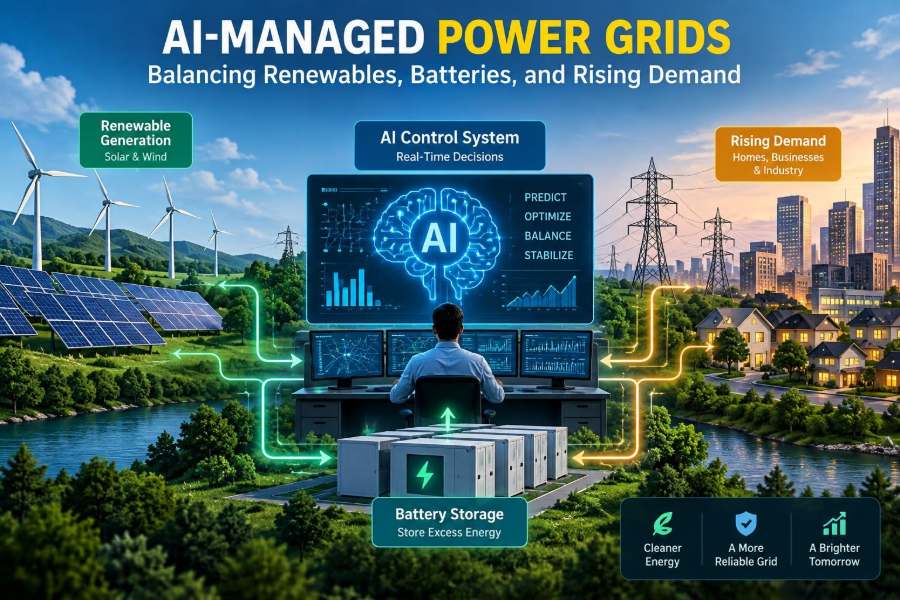
AI-managed power grids aim to improve these decisions. They combine measurements, forecasts, equipment limits, and market or operational rules to recommend—or in carefully bounded cases automatically execute—actions quickly.
🌬️ Why Renewable Variability Changes Grid Operations
Wind and solar resources are valuable, but their output follows weather and daylight rather than a dispatch instruction. A cloud passing over a solar plant may alter output within minutes; a regional weather pattern can affect wind generation for much longer.
This does not mean renewable generation is unknowable. Forecasting has improved substantially through weather models, satellite data, historical plant performance, and local measurements. The challenge is that a forecast contains uncertainty, and grid operations must prepare for plausible deviations, not just the most likely outcome.
As variable generation grows, operators need more flexibility: fast-ramping generation, storage, responsive demand, interconnections, and accurate forecasts.
🏘️ The Grid Is Becoming a Two-Way Network
For decades, electricity largely flowed from transmission-connected power plants through substations to customers. Distribution networks were often designed on the assumption that homes and small businesses would only consume power.
Now a neighborhood with many rooftop photovoltaic systems may export power at midday. Batteries, electric vehicles, heat pumps, and smart appliances can change local loading patterns quickly. Voltage, transformer loading, and feeder capacity can become constraints even when the wider system has enough generation.
Intelligence is therefore needed at more than the national control-room level. Distribution operators increasingly need visibility and control closer to where devices connect.
📈 Rising Demand Is More Complicated Than a Bigger Peak
Electrification can increase total electricity consumption, but its operational effect depends on when devices are used. An electric vehicle charged immediately after work affects the grid differently from one scheduled to charge overnight or during a renewable-energy surplus.
Data centers, industrial electrification, and building heating can also create concentrated new loads. A local feeder may need reinforcement before a region as a whole needs new generation.
AI can help identify emerging constraints by combining connection data, load measurements, weather, and expected adoption patterns. It cannot remove a physical bottleneck, but it can reveal where flexible operation can safely defer or reduce the need for upgrades.
🧠 What “AI-Managed” Actually Means
AI-managed does not describe one machine or one algorithm. It usually refers to a collection of analytical tools used alongside conventional control systems, optimization software, and operator procedures.
Common functions include:
- short-term forecasting of demand, wind, solar, and prices;
- detecting abnormal equipment behavior in sensor data;
- optimizing battery schedules and flexible demand;
- ranking possible responses to network constraints; and
- helping operators interpret large volumes of alarms and measurements.
The safest designs use AI within defined operating limits. Protection relays, interlocks, and established engineering rules remain essential safeguards.
🔮 Forecasting Is the First Major Advantage
Every dispatch decision begins with an expectation of what will happen next. A load forecast estimates demand; a renewable forecast estimates available wind and solar output; a net-load forecast combines the two.
Machine-learning models can find patterns involving temperature, humidity, calendar effects, cloud cover, customer behavior, and local geography. They are especially useful where the relationships are nonlinear or where many input streams must be considered together.
Forecast quality should be judged honestly. Operators need prediction intervals and scenario ranges, not only a single elegant-looking number. A model that reports its uncertainty can support more resilient reserve planning.
🗺️ Weather Data Connects the Atmosphere to Dispatch
Weather is a central input to renewable generation and demand. Temperature influences heating and cooling loads, wind speed affects turbine output, and irradiance—the sunlight arriving at a surface—drives solar production.
Useful systems blend broad meteorological forecasts with site measurements. A weather model may describe a storm over a region, while plant sensors reveal whether a particular turbine array or solar inverter is responding as expected.
Weather inputs need careful validation. A model trained on historical conditions may perform poorly during rare heat, smoke, ice, or storm events, precisely when operators need reliable guidance most.
🔋 Batteries Turn Time Into a Controllable Resource
A grid battery charges when electricity is plentiful or low-cost and discharges when the system needs support. Its value comes from timing, speed, and location—not merely from the number of megawatt-hours it can store.
Battery management must account for state of charge, power limits, round-trip losses, temperature, warranty constraints, and the possibility that a battery may be needed for a higher-priority service later. Discharging everything during a small afternoon peak may leave little support for a more serious evening shortage.
Optimization software can evaluate these trade-offs rapidly. The result is often a schedule that retains an operating reserve rather than chasing the apparent best short-term opportunity.
⏱️ Different Battery Services Need Different Timescales
A battery can contribute to several grid services, but the same stored energy cannot be committed indefinitely to all of them. Clear priorities and realistic availability assumptions are essential.
| Service | Typical operational purpose | Why intelligent control helps |
|---|---|---|
| Frequency response | Arrest rapid frequency deviations | Maintains headroom and reacts within defined limits |
| Energy shifting | Move energy from one period to another | Forecasts surplus, demand, and future constraints |
| Congestion relief | Reduce loading on a constrained line or feeder | Chooses the location and timing that actually helps |
| Backup support | Maintain supply during an outage or emergency | Protects reserved energy from routine dispatch |
This is a practical example of why “optimize the battery” is incomplete. The objective must state which service matters most under each condition.
🏠 Flexible Demand Is a Grid Resource Too
Demand response changes electricity use in response to grid conditions. It may involve reducing a load, shifting it to another time, or increasing it when renewable output would otherwise be curtailed.
Some flexibility is almost invisible to the user. A water heater can heat slightly earlier, an EV can delay charging until after the peak, or a building can pre-cool within comfort limits. Aggregated across many devices, these small changes can be meaningful.
Flexibility must be voluntary, transparent, and bounded. People need understandable settings, an easy override, and confidence that essential services will not be interrupted.
🚗 Electric Vehicles Can Be Coordinated, Not Merely Added
Unmanaged vehicle charging can coincide with household evening demand. Managed charging instead asks a simple operational question: by what time does the driver need a certain amount of energy?
Given permission and a departure target, a control system can distribute charging across lower-demand periods or times of abundant renewable generation. This often protects local transformers without requiring every driver to change habits manually.
Vehicle-to-grid operation, where a vehicle can export energy, is technically promising but more complex. It raises questions about battery wear, customer compensation, connection standards, communication reliability, and whether the vehicle will be available when expected.
🏭 Large Loads Need Active Coordination
Industrial facilities and large computing loads can be significant sources of flexibility, but only when operational requirements permit it. A process with strict quality, safety, or continuity requirements cannot be treated like a household appliance.
For a suitable load, an energy management system may shift noncritical tasks, adjust onsite storage, or use backup-capable equipment under agreed rules. The operator needs verified response, not just a promise that a load might reduce.
Contracts and control logic must distinguish between routine economic flexibility and emergency curtailment. Confusing the two can create unacceptable business risk.
🧩 Virtual Power Plants Coordinate Small Assets
A virtual power plant, or VPP, groups distributed energy resources such as batteries, solar systems, chargers, and flexible loads so they can act as a coordinated portfolio. It does not make the devices physically adjacent; it makes their behavior observable and dispatchable within agreements.
AI can help estimate which assets are available, how much flexibility they can provide, and whether activating them will create a local network problem. A portfolio that looks large in aggregate may offer little useful capacity at the constrained location.
Good VPP design includes opt-out rules, baseline methods for measuring delivered response, and clear cyber-security responsibilities.
🧮 Optimization Must Respect Engineering Constraints
Grid optimization is not simply choosing the lowest-cost resource. A feasible solution must respect thermal ratings, voltage limits, generator ramp rates, reserve requirements, battery constraints, and equipment switching limits.
On transmission systems, power-flow calculations model how injections and withdrawals affect lines and voltages. On distribution systems, phase imbalance and localized voltage rise can matter greatly, especially with high rooftop solar penetration.
An economically attractive action that violates a network limit is not an operational solution. AI models must either include these constraints directly or pass their proposals through reliable engineering validation.
⚡ Frequency Control Remains a Physical Problem
When a large generator trips or a major load changes suddenly, the grid must respond quickly. Conventional synchronous generators naturally contribute inertia through their rotating mass, slowing the initial rate of frequency change.
Many inverter-based resources behave differently. Modern inverters can provide fast frequency support when designed and configured for it, but their behavior depends on controls, measurements, available energy, and protection settings.
AI may help anticipate conditions where frequency risk is elevated and schedule appropriate resources. It does not replace the fast, deterministic control loops that must respond during the disturbance itself.
🔌 Voltage Control Is Increasingly Local
Voltage must stay within acceptable operating ranges for equipment to work safely and reliably. High local solar output can raise voltage on a distribution feeder, while heavy demand can lower it.
Traditional voltage-control equipment includes transformer tap changers, voltage regulators, capacitor banks, and reactive-power-capable inverters. Coordinating these devices is difficult because an action that improves one location may worsen another.
Data-driven tools can identify likely voltage issues and recommend settings, but they require accurate network models. Unknown conductor sizes, unrecorded equipment changes, or incomplete phase information can make a seemingly intelligent recommendation unsafe.
🛰️ Sensors Provide the Grid’s Situational Awareness
AI is only as useful as the information it receives. Grid data may come from smart meters, substations, phasor measurement units, inverter telemetry, weather stations, fault indicators, and equipment condition monitors.
These sources differ in speed, accuracy, ownership, and reliability. A high-speed substation measurement and a delayed smart-meter reading should not be treated as interchangeable evidence.
Data quality processes should flag missing values, impossible readings, timing errors, and sensor drift. Otherwise, a model may confidently optimize around a measurement error.
🧼 Data Cleaning Is an Engineering Task, Not Housekeeping
Historical grid data contains outages, maintenance periods, communication failures, meter replacements, and unusual events. Labels may also be ambiguous: was a demand reduction caused by a program signal, weather, an equipment fault, or a customer’s own decision?
Teams need data lineage: a record of where data came from, how it was transformed, and what assumptions were used. This makes model results auditable and helps engineers diagnose unexpected behavior.
For operational applications, the best dataset is not necessarily the largest one. It is the one whose timing, meaning, limitations, and quality are understood.
🛡️ Cybersecurity Is Part of Grid Reliability
Connecting more devices creates more potential entry points. A compromised controller, poorly secured installer account, or exposed application interface could affect privacy, billing, asset availability, or physical operations.
Security requires layered defenses: strong identity management, network segmentation, encryption where appropriate, software patching, logging, tested incident response, and the ability to operate safely if communications fail.
Automation should fail gracefully. If a cloud-based optimizer becomes unavailable, local controls must move to a defined safe mode rather than leaving devices in uncertain states.
👥 Human Operators Still Carry Responsibility
Control-room personnel manage competing priorities under uncertainty. They need tools that explain the basis of a recommendation, show relevant constraints, and allow rapid comparison of alternatives.
A black-box instruction such as “dispatch these batteries” is inadequate if it does not reveal the expected duration, state-of-charge consequences, affected constraints, and assumptions about renewable output.
Human-in-the-loop design is not a sign that automation failed. It is an acknowledgement that operational accountability, unusual events, and system-wide judgment remain vital.
🔍 Explainability Builds Operational Trust
Explainability means that engineers can understand enough about a model’s input, reasoning, and limits to use it responsibly. The required level varies: a maintenance alert can tolerate more uncertainty than an automated switching action.
Useful explanations may include feature importance, confidence ranges, comparable past conditions, and a list of binding constraints. A system should also make clear when it is outside the conditions on which it was trained.
Trust should be earned through testing and performance monitoring, not assumed because a model uses advanced terminology.
🧪 Digital Twins Allow Safer Experimentation
A digital twin is a computational representation of a physical system, such as a feeder, substation, battery fleet, or entire grid area. It can combine network models with live or historical data to test control strategies before they reach field equipment.
For example, engineers could simulate a hypothetical heatwave with weak wind, delayed battery response, and high EV charging. The goal is not to predict every detail perfectly; it is to expose weak assumptions and identify credible failure modes.
Digital twins must be maintained. A detailed model based on outdated switch positions or asset ratings can create misplaced confidence.
🚨 Rare Events Challenge Predictive Models
Most machine-learning systems learn from patterns represented in their training data. Extreme storms, compound heat-and-smoke events, cyber incidents, and unusual combinations of equipment outages may have few close historical examples.
During these conditions, conservative operating policies, scenario analysis, and operator judgment become especially important. Models should be monitored for distribution shift: evidence that current conditions differ materially from their training environment.
A sensible design includes fallbacks such as rule-based dispatch, larger reserves, and manual procedures. Resilience comes from preparing for uncertainty, not from assuming prediction will eliminate it.
💰 Markets and Operations Solve Different Problems
Electricity markets can help coordinate resource decisions through prices, but a market schedule is not automatically a physically feasible grid schedule. Local congestion, voltage limits, and contingency requirements may require changes after an economic dispatch is calculated.
Likewise, a purely reliability-focused schedule may ignore useful flexibility or impose unnecessary costs. AI can help reconcile these objectives, but the governing rules and priorities must be explicit.
Students and practitioners should distinguish economic optimization from secure operation. Good systems consider both without pretending they are identical.
⚠️ Common Mistakes in AI Grid Projects
Many promising projects stumble because the hard operational details are addressed too late. Typical mistakes include:
- training on data that does not represent rare but consequential conditions;
- optimizing aggregate power while ignoring local network constraints;
- assuming a connected device is always available for dispatch;
- measuring model accuracy without measuring operational value or safety;
- deploying automation without clear override and rollback procedures; and
- treating cybersecurity and customer consent as later implementation tasks.
These are not merely software issues. They are system-engineering issues involving hardware, people, rules, and physical power flows.
📏 Measuring Success Beyond Forecast Accuracy
A lower forecast error can be useful, but it is not the final objective. A grid application should be evaluated by the decisions it improves and the risks it reduces.
Relevant measures may include avoided constraint violations, quality of voltage or frequency support, delivered flexibility when called, battery availability during critical periods, restoration performance, and the rate at which operators accept or override recommendations.
Metrics should also detect harm. If an optimization lowers one cost while increasing transformer overheating risk or repeatedly inconveniencing the same customers, it needs redesign.
🛠️ A Practical Deployment Path
Utilities and technology teams often get better results by starting with a narrow, observable use case. Examples include a day-ahead solar forecast, battery state-of-charge advisory, feeder overload prediction, or anomaly detection for a defined asset class.
- Define the operational decision and its safety boundaries.
- Validate data quality and construct a trustworthy baseline method.
- Test the model offline against normal and stressed scenarios.
- Run in advisory mode with operators before enabling automation.
- Monitor performance, drift, overrides, and unintended outcomes.
- Expand scope only after controls, governance, and value are demonstrated.
This staged approach is slower than a broad demonstration, but it is better aligned with the consequences of real grid operations.
🎓 Skills Electrical Engineers Need for This Transition
Power-system fundamentals remain the foundation: three-phase analysis, protection, power flow, stability, machines, power electronics, and network planning. AI is most valuable when it is used by people who understand the physical system it influences.
Useful complementary skills include statistics, optimization, programming, time-series analysis, data governance, cybersecurity awareness, and clear communication with operators and customers.
For students, a strong project might combine a simple load forecast with a constrained battery dispatch model. The learning comes from explaining the assumptions, testing edge cases, and showing where the model should not be trusted.
🌍 Equity, Access, and Customer Choice Matter
Flexible-grid programs can create benefits, but those benefits should not depend only on who can afford a battery, EV, or smart home equipment. Program design affects who participates, who receives incentives, and who carries risk.
Customers should know what data is collected, how a device may be controlled, what compensation or savings are possible, and how to opt out. Privacy-preserving designs and accessible enrollment matter as much as technical sophistication.
A grid becomes more durable when its intelligence is paired with public trust and practical customer value.
🧭 The Core Principle: Coordinate Flexibility Within Limits
The future grid is not a contest between AI and conventional engineering. It is a coordinated system in which forecasting, optimization, automation, protection, physical infrastructure, and human judgment each have distinct roles.
Renewables add variability, batteries add fast controllable energy, and flexible demand adds another lever. AI helps make these resources work together by looking ahead, comparing options, and acting at the right location and time.
The governing principle is simple but demanding: use flexibility where it helps, preserve margins for uncertainty, and never optimize past the physical and safety limits of the network.
AI-managed grids will be most valuable when they make power systems more observable, more adaptable, and more reliable—not merely more automated. That outcome depends on sound engineering, secure systems, transparent governance, and people who understand both the algorithms and the electricity they control. ⚡🔋🌱