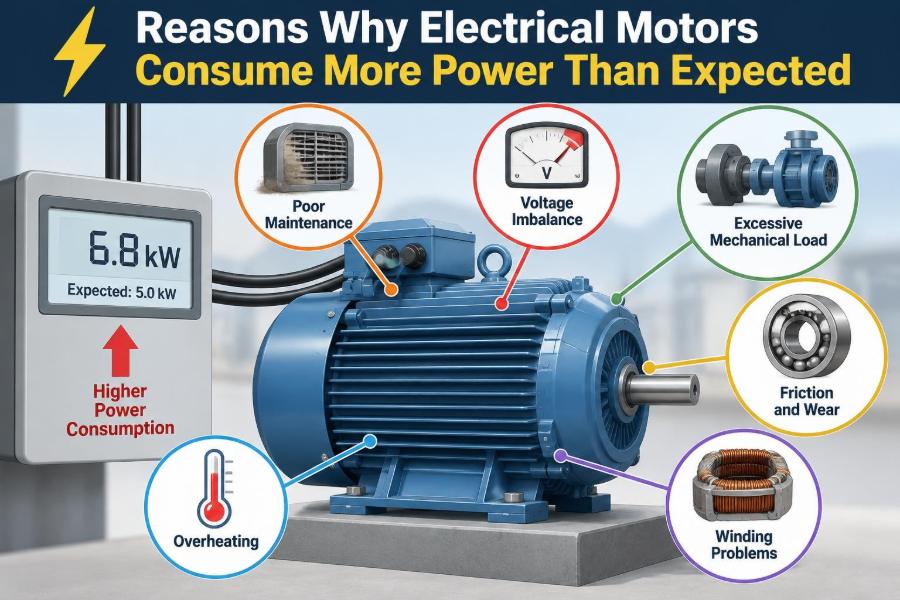

A motor that seems to be running normally can still be responsible for an uncomfortable electricity bill. A conveyor keeps moving, a pump delivers water, or an air-conditioning fan sounds no different than yesterday—yet the meter shows more energy use than the design estimate suggested.
This is a familiar problem in homes, workshops, commercial buildings, and industrial plants. Motors are dependable machines, but their electrical input depends on far more than the number printed on the nameplate.
The useful question is not simply, “Is the motor using too much power?” It is whether the motor is drawing the power required by its actual mechanical load, operating condition, supply quality, and control method.
Finding the answer matters because excess motor power often appears first as heat, noise, reduced output, nuisance trips, or shortened equipment life. It can also reveal a problem in the driven machine rather than in the motor itself.
🔌 Start with the difference between power and energy
Electrical power, measured in watts or kilowatts, is the rate at which a motor consumes electrical energy. Electrical energy, usually billed in kilowatt-hours, is power multiplied by operating time.
A 10 kW motor operating near 10 kW for ten hours uses roughly 100 kWh. A motor can therefore create a high bill because it draws excessive kW, because it runs for too long, or because both conditions occur together.
🏷️ A nameplate rating is not normal operating consumption
The kW or horsepower on a motor nameplate is primarily a rated mechanical output limit under specified conditions. It is not a promise that the motor will always draw that exact electrical input.
At rated load, input power must exceed shaft output because of losses. At light load, the motor still needs magnetizing current and must overcome internal losses. At overload, it may draw substantially more current and power until protection operates or damage develops.
⚙️ The basic power balance explains most cases
A motor converts electrical input into shaft output. In simplified form:
Electrical input power = shaft output power + electrical losses + mechanical losses
Higher required shaft power raises input power. So do higher losses in windings, magnetic steel, bearings, cooling fans, and the driven system. This balance prevents a common mistake: blaming the motor before checking what it is being asked to do.
📈 Mechanical load can quietly increase over time
A process may gradually demand more torque without an obvious change in day-to-day operation. A pump can accumulate deposits, a fan duct can be altered, a conveyor can carry heavier product, or a compressor can operate against higher pressure.
The motor responds by producing more torque, which generally means drawing more current. Comparing today’s current and process conditions with commissioning records is often more revealing than comparing current alone with the motor nameplate.
🌀 Fan and pump loads are especially sensitive to speed
Centrifugal fans and pumps follow approximate affinity laws: flow varies with speed, pressure varies roughly with the square of speed, and power varies roughly with the cube of speed.
That cubic relationship is why a modest speed increase can cause a surprisingly large rise in motor power. It also explains why reducing fan or pump speed with a variable-frequency drive can save much more energy than throttling flow with a damper or valve.
🚰 A pump may be operating away from its efficient point
Every pump has a preferred operating region where hydraulic efficiency is favorable. If the system resistance changes, the actual operating point can shift away from that region.
A partially closed valve, an incorrect impeller diameter, pipe restrictions, entrained air, worn internal clearances, or changed liquid properties can all alter the result. The motor may draw high power because the pump is moving more flow than intended, or it may waste power while delivering poor useful output.
🌬️ Dirty air paths make fans work harder
Filters, coils, ducts, louvers, and dampers create resistance to airflow. A dirty filter usually reduces flow, but the power effect depends on the fan type and control arrangement; it is not safe to assume that every restriction raises motor kW.
For example, a fan controlled to maintain a flow or pressure target may speed up as resistance rises, increasing power. The practical lesson is to measure airflow, static pressure, speed, and kW together rather than interpreting any one value alone.
🧱 Friction in the driven equipment becomes motor load
Misaligned couplings, overtightened belts, seized rollers, rubbing impellers, dry bearings, and poorly lubricated gearboxes all require extra torque. The motor cannot distinguish useful process work from friction; it supplies both.
Heat at bearings or couplings, unusual vibration, belt dust, and a rising trend in current are valuable clues. Correcting mechanical drag frequently reduces power while improving reliability at the same time.
🛢️ Lubrication problems are not just maintenance details
Too little lubricant increases metal-to-metal contact. Too much grease can churn and heat the bearing, while the wrong lubricant viscosity can create excessive drag or inadequate film thickness.
Because bearing losses are usually smaller than the process load, a lubrication issue may not always produce a dramatic kW increase. Yet it can rapidly raise temperature and accelerate failure, making it a high-priority condition even when the energy effect looks modest.
🔩 Belt, chain, and gearbox condition affects input power
Power transmission components introduce losses between the motor shaft and the load. A slipping belt wastes energy as heat and may tempt operators to overtension it, which then overloads bearings.
Gearboxes with damaged gears, poor oil condition, or incorrect alignment can consume noticeable power and create vibration. Inspecting the transmission is essential when a motor current increase is accompanied by noise or temperature at the drive train.
⚡ Low voltage can increase current for a constant-torque load
Many loads need roughly the same shaft torque to do their job. If supply voltage falls, an induction motor may draw more current to develop the required torque, increasing winding heating.
The relationship is not perfectly linear because motor slip and magnetic behavior also change. Severe undervoltage can prevent starting, cause unstable operation, or lead to overload trips. Measure voltage at the motor terminals while it is loaded—not only at the distribution board.
📐 Voltage imbalance creates disproportionate heating
In a three-phase system, a small voltage difference between phases can create a much larger current imbalance. Negative-sequence magnetic fields generated by imbalance oppose normal rotation and increase losses.
Possible causes include loose terminals, uneven single-phase loading, damaged fuses, poor contacts, or supply issues. Current should be measured on all three phases, because an average can hide one overheated winding path.
🔄 Phase loss and poor connections are urgent faults
A motor may continue running after losing one phase, especially if it is already in motion. This condition, often called single-phasing, forces the remaining phases to carry abnormal current and can damage windings quickly.
Loose lugs, burned contactor poles, corroded terminals, and failing fuses can produce similar localized heating. A thermal image can help identify hot connections, but safe inspection and corrective work require qualified personnel and proper isolation procedures.
🧲 Overexcitation raises magnetic losses
Induction motors need magnetizing current to establish air-gap flux. If voltage is too high for the applied frequency, the magnetic core can approach saturation, causing magnetizing current and iron losses to rise.
This is particularly relevant with incorrect variable-frequency drive settings or motors operated at an unsuitable volts-per-hertz ratio. More current does not always mean more useful shaft load; it can also signal inefficient magnetic operation.
🎛️ Variable-frequency drives change what should be measured
A variable-frequency drive, or VFD, can reduce energy use dramatically on variable-torque loads by matching speed to demand. It can also introduce harmonics, switching-related heating, and measurement challenges.
Ordinary clamp meters may misread non-sinusoidal VFD output current or voltage. Use instruments rated for VFD and harmonic-rich waveforms, and distinguish measurements at the drive input from measurements at the motor output.
🧮 Incorrect VFD programming can waste energy
A VFD set to run at an unnecessarily high minimum speed defeats much of its efficiency potential. Poor pressure or flow control tuning can make the drive hunt around its setpoint, repeatedly accelerating and decelerating the machine.
Motor nameplate data, current limits, acceleration ramps, carrier-frequency settings, and control targets should be configured deliberately. The goal is stable process control at the lowest speed that meets the actual requirement, not simply replacing a starter with a drive.
🌡️ Heat increases resistance and copper loss
Winding resistance rises as copper temperature rises. Copper loss is proportional to the square of current, so a hot motor can enter a harmful cycle: higher resistance produces more loss, which produces more heat.
High ambient temperature, blocked cooling air, a failed fan, dirt on cooling fins, or enclosure restrictions can start this cycle. Cooling problems may raise electrical input somewhat, but their larger danger is insulation aging and reduced motor life.
🧹 Blocked cooling does not always mean a dirty motor alone
Motor cooling depends on the whole installation. A clean motor inside a poorly ventilated cabinet can overheat, as can a motor located near a furnace, steam line, or other heat source.
Check air paths, clearance around the frame, enclosure heat load, and whether the motor’s own fan can move air effectively at low speed. A VFD-driven motor operating slowly may need independent cooling even when it is lightly loaded.
📦 An oversized motor can consume unnecessary no-load power
An induction motor draws magnetizing current even when the shaft load is small. If a motor is greatly oversized and runs lightly loaded for long periods, its efficiency and power factor can be poorer than those of a correctly sized motor.
Oversizing is sometimes justified for difficult starts, future capacity, high inertia, or harsh duty. The issue is not that a larger motor is always wrong; it is that selecting one without a load analysis can create persistent losses and weak operating performance.
📉 Poor power factor is not the same as high kWh
Power factor describes how effectively current contributes to real power. Low power factor can increase current, conductor losses, voltage drop, and—in some tariffs—utility charges, but it does not automatically mean the motor is consuming excessive real energy.
For a three-phase motor, real input power is approximately:
P = √3 × V × I × power factor
Measuring only amperes can therefore be misleading. A power analyzer that reports kW, kVA, power factor, and harmonics gives a much clearer picture.
🧪 Harmonics can add losses without producing useful torque
Non-sinusoidal supply waveforms can create additional losses in motors, transformers, and conductors. Harmonic currents may increase heating and complicate readings, especially where VFDs, rectifiers, or other electronic loads are concentrated.
The severity depends on the harmonic spectrum, motor design, cable arrangement, and system impedance. Harmonic assessment should be based on suitable measurements rather than assumptions, since remedies such as line reactors, filters, or drive changes must fit the actual installation.
🧭 Starting and frequent cycling can dominate short-duty energy use
Motors draw high current during starting because the rotor is initially stationary. A single start is usually brief, but frequent starts, plugging, rapid reversals, or repeated acceleration of high inertia can add substantial heating and energy use.
A pump that short-cycles because of poor level-control settings or a compressor that repeatedly loads and unloads deserves process-control attention. Reducing unnecessary starts also eases stress on contactors, couplings, belts, and windings.
🏭 The duty cycle may have changed without anyone noticing
Production schedules, occupancy patterns, control overrides, seasonal demands, and failed timers can extend runtime. A motor that draws the expected kW can still consume far more energy if it operates during idle periods.
Trend run hours alongside power. A simple time schedule or run-status log can reveal equipment that starts too early, stops too late, or runs continuously because an automatic control loop has been bypassed.
🔍 Instrument errors can create a false diagnosis
Not all current meters measure true RMS values accurately, and not all power meters handle distorted waveforms. Incorrect current-transformer ratios, wrong phase connections, and reversed power transducer wiring can produce believable but wrong data.
Before replacing equipment, verify the measurement chain. Confirm instrument type, wiring, scaling, sampling location, and the difference between instantaneous kW, average demand, and accumulated kWh.
📊 Compare like with like when evaluating motor performance
One reading taken on a hot afternoon says little by itself. Compare measurements at similar flow, pressure, speed, product load, ambient temperature, and supply voltage.
| What to record | Why it matters |
|---|---|
| kW and kWh | Separates instantaneous load from accumulated energy use. |
| Phase voltage and current | Reveals undervoltage, imbalance, and connection faults. |
| Speed, flow, pressure, or throughput | Connects electrical input to useful process output. |
| Temperature and vibration | Helps identify friction, cooling, bearing, and alignment issues. |
| Runtime and starts | Exposes control and scheduling problems. |
🛠️ A structured troubleshooting sequence saves time
Begin with safe, non-invasive checks and move toward detailed testing. Lockout, guarding, and electrical safety requirements must always take priority over data collection.
- Confirm that kW, kWh, runtime, and process output are being measured correctly.
- Compare voltage and current on every phase under normal load.
- Inspect for heat, vibration, noise, leaks, belt condition, and blocked cooling.
- Check the driven process: flow restrictions, pressure, mechanical drag, and control settings.
- Review motor loading, VFD parameters, starts, and historical trends.
- Escalate to qualified maintenance personnel for insulation tests, alignment work, vibration analysis, or electrical repairs.
🚫 Common “fixes” that can make the problem worse
Replacing a motor with a larger one may prevent overload trips while concealing a jammed pump, excessive system pressure, or incorrect process control. Increasing an overload setting can similarly remove a warning without removing the overload.
Adding capacitors solely because current is high is another frequent error. Power-factor correction may be useful when properly engineered, but it will not cure mechanical drag, low efficiency, phase imbalance, or a motor operating beyond its rated shaft load.
🧰 Maintenance prevents many hidden power losses
A practical motor reliability program includes clean cooling paths, terminal inspections, lubrication practices appropriate to the bearing type, alignment checks, belt-tension checks, and periodic review of vibration and temperature trends.
The best intervals depend on duty, environment, criticality, and manufacturer guidance. A lightly loaded indoor fan and a dusty, continuously running quarry conveyor should not receive identical maintenance treatment.
💡 Efficiency upgrades need a system-level business case
A premium-efficiency motor can reduce losses, particularly on long-running equipment near its intended load. However, replacing a healthy motor is not always the first or largest savings opportunity.
For pumps and fans, correcting controls, reducing speed, repairing system restrictions, or eliminating unnecessary runtime may have a greater effect. Evaluate motor efficiency, load profile, hours of operation, process needs, and installation compatibility together.
🧠 The central takeaway: power follows demand and losses
Unexpected motor consumption is rarely a mystery once electrical measurements are connected to mechanical and process conditions. The motor may be overloaded, inefficiently controlled, poorly supplied, inadequately cooled, mechanically restrained, or simply operating longer than intended.
Do not treat current as a complete diagnosis. Measure real power, examine the load, verify supply quality, and compare performance under equivalent operating conditions. That approach identifies whether the solution belongs in the motor, the drive, the transmission, the controls, or the process itself.
An electrical motor consumes more power than expected when useful demand, avoidable losses, or unnecessary runtime rise above the assumptions behind its original design and operation. Careful measurement turns that broad idea into practical corrective action. ⚡🔧📈