
A summer storm passes through town, and thousands of air conditioners restart as the clouds clear. In a conventional power system, grid operators may respond by asking large generators to increase output. The electricity arriving at a home still feels instant, but a complex balancing act is happening behind the wall outlet.
Now imagine the same neighborhood with rooftop solar, home batteries, electric vehicles charging overnight, and a nearby wind farm whose output changes with the weather. Electricity is no longer moving in only one direction from a distant power plant to passive customers.
That shift matters to anyone who designs, operates, uses, or depends on electrical infrastructure. Reliable power remains essential, but the equipment, data, control strategies, and market arrangements used to provide it are changing quickly.
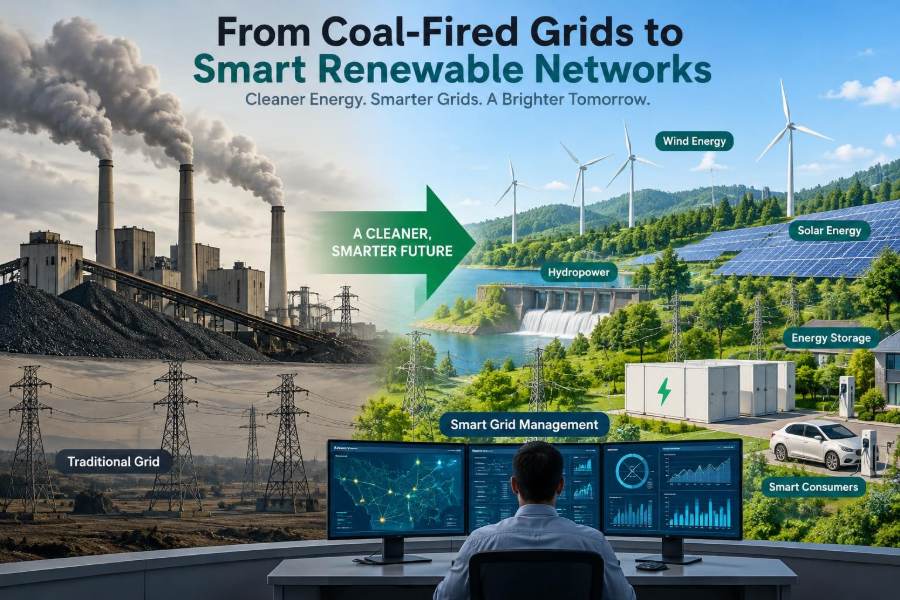
The transition is not a simple replacement of coal plants with solar panels. It is a redesign of how a power system produces energy, maintains stability, handles uncertainty, and serves communities fairly.
🏭 The Traditional Grid Was Built Around Large Central Stations
For much of the twentieth century, electricity systems were organized around large, centrally dispatched power stations. Coal, gas, nuclear, and hydroelectric plants generated bulk power at high voltage, which then flowed through transmission lines, substations, and local distribution networks.
This architecture suited generators with large rotating turbines. Their output could be scheduled, their location was known, and operators could increase or decrease production within the limits of each unit.
The model was not entirely one-way—distribution systems always required protection and voltage control—but the basic assumption was clear: generation was concentrated, while customers mainly consumed electricity.
🔄 Electricity Must Be Balanced Every Moment
Unlike a warehouse of physical goods, an alternating-current grid has limited ability to store electricity directly. At every moment, total generation must closely match total consumption plus losses.
If demand suddenly exceeds supply, system frequency falls. If generation exceeds demand, frequency rises. In many systems, frequency is nominally 50 or 60 hertz, and meaningful departures can trigger equipment protections or, in severe cases, cascading outages.
Grid operation is therefore a continuous control problem. Operators forecast demand, schedule resources, hold reserves for unexpected events, and coordinate equipment that responds on timescales ranging from milliseconds to hours.
⚙️ Why Coal Plants Shaped Earlier Operating Practices
Coal-fired stations historically supplied large amounts of steady energy. Their boilers, steam turbines, fuel handling systems, and emissions controls were designed for substantial output over long operating periods rather than rapid, repeated changes.
Some units can vary output, but doing so may reduce efficiency, increase wear, or face minimum operating limits. Starting a cold thermal unit can also take significant time compared with starting a battery or adjusting many inverter-based resources.
This does not mean traditional grids lacked flexibility. Hydroelectric plants, gas turbines, interconnections, and demand management have long helped balance systems. But high shares of variable generation make flexibility a central design requirement rather than a supporting function.
🌬️ Renewable Energy Changes the Shape of Supply
Wind and solar generation depend on weather and time of day. Their output is variable, but it is not random in the same way as a coin toss: weather forecasts, satellite observations, and production data provide useful information.
The operational challenge is matching the changing output of renewable resources with changing electricity demand. A windy night may produce abundant power when demand is low, while a calm evening can coincide with high household demand after sunset.
Renewables also differ by location. A broad geographic portfolio can reduce the effect of a local cloud bank or wind lull, although widespread weather systems can still affect large regions.
☀️ Variability Is Not the Same as Unreliability
Variable generation is sometimes described as unreliable, but the terms describe different problems. Variability means output changes over time. Reliability concerns whether the power system can meet demand with adequate quality and resilience when needed.
A solar plant predictably produces little or no output at night. That pattern can be planned for. More difficult events include a forecasting error, a major transmission outage, an extended period of low renewable output, or extreme temperatures that raise demand.
Reliable systems use a portfolio approach: diverse generation, transmission, storage, responsive demand, reserves, and well-maintained equipment. No individual technology alone determines system reliability.
📈 Net Load Reveals the New Balancing Challenge
Grid operators often examine net load: customer demand minus output from variable renewable resources. It represents the demand that must be served by dispatchable generation, storage discharge, imports, or demand reductions.
On a sunny day, solar production can reduce net load around midday. As the sun sets while people cook, cool homes, and turn on lights, net load may rise quickly. This evening increase is commonly called a ramp.
Net-load analysis helps engineers identify when flexibility is most valuable. It also shows why adding capacity alone is not enough; the timing and controllability of that capacity matter.
🔋 Storage Moves Energy Across Time
Energy storage charges when electricity is abundant or inexpensive and discharges later when the system needs support. Batteries are especially useful because they can respond very quickly to control signals.
Storage can provide several services: energy shifting, frequency response, reserve capacity, voltage support, and backup power in certain configurations. Pumped-storage hydropower, thermal storage, compressed-air concepts, and flow batteries may also serve particular applications.
Storage has limits. A battery’s power rating determines how fast it can charge or discharge, while its energy rating determines how long it can sustain that output. Confusing these two ratings leads to poor planning decisions.
🧮 Duration Matters as Much as Battery Power
A 100-megawatt battery can be a valuable grid asset, but its contribution depends on duration. If it stores 200 megawatt-hours, it can provide its full rated power for roughly two hours under simplified assumptions.
That may be excellent for managing a sharp evening ramp or responding to a contingency. It is less suited to covering several days of low wind and limited solar production without additional charging opportunities.
Planning therefore considers a mix of short-duration and longer-duration resources. The appropriate mix depends on local weather, demand patterns, network constraints, fuel availability, and the existing generation fleet.
🔌 Inverters Are Becoming Core Grid Equipment
Solar arrays, many battery systems, electric vehicle chargers, and modern wind turbines connect through power electronic converters, often called inverters. These devices convert direct current to alternating current or control AC power flow electronically.
Unlike a large synchronous generator, an inverter does not inherently have a heavy spinning rotor directly coupled to the grid. Its behavior depends on hardware design, software controls, measurement quality, and protection settings.
As inverter-based resources become more common, engineers must design controls that support voltage, frequency, fault response, and stable operation under changing grid conditions.
🌀 Synchronous Machines Once Supplied Most Grid Inertia
Large rotating generators store kinetic energy in their rotating masses. When frequency begins to fall, this stored energy naturally resists the change for a short time. That effect is called inertia.
Retiring synchronous generators can reduce the amount of physical inertia connected to a system. Frequency may then change faster after a disturbance, leaving less time for controls and protections to respond.
Lower inertia is manageable, but it requires careful study. Batteries and inverters can provide very fast active-power response, sometimes described as synthetic or virtual inertia, yet their performance depends on control design and available energy.
🧠 Grid-Forming Controls Can Establish Voltage and Frequency
Many conventional inverters are grid-following: they measure an existing grid waveform and inject power in synchronism with it. They work well when a strong grid already provides a stable voltage and frequency reference.
Grid-forming inverters are designed to actively establish a voltage waveform and regulate frequency-related behavior. This capability can be useful in weak grids, isolated systems, and networks with large shares of inverter-based resources.
The term does not mean every grid-forming device can solve every stability problem. Protection coordination, current limits, communications, and interactions among controllers must be tested carefully before deployment.
📡 Smart Grids Add Visibility to the Distribution Network
A smart grid combines electrical equipment with sensing, communication, automation, and data analysis. Its purpose is not simply to make the grid more digital; it is to make decisions faster and better informed.
Advanced meters can report consumption at shorter intervals than older meters. Feeder sensors can help utilities locate faults, observe voltage conditions, and understand how distributed energy resources affect local circuits.
More data is useful only when it leads to sound action. Data quality, time synchronization, clear operating procedures, and trained staff are as important as the sensors themselves.
🏠 Homes Are Becoming Active Energy Participants
A household with solar panels, a battery, a smart thermostat, and an electric vehicle may both consume and supply electricity at different times. Such customers are often called prosumers because they can produce and consume energy.
For example, a home battery might charge from midday solar generation and reduce evening grid purchases. Whether this helps the wider system depends on local feeder limits, tariff design, battery settings, and system conditions.
Individual devices are small, but large numbers acting similarly can create significant changes in demand and power flow. Coordination becomes increasingly valuable as adoption grows.
🚗 Electric Vehicles Create Both Load and Flexibility
Electric vehicles add electricity demand, particularly where many drivers charge after returning home. If unmanaged, simultaneous charging can increase evening peaks and overload local transformers or service conductors.
Smart charging shifts charging to times when capacity is available or renewable output is high, while still meeting the driver’s required departure time. This is usually more practical than expecting every driver to monitor grid conditions manually.
Vehicle-to-grid systems could eventually allow suitable vehicles to export power under controlled conditions. However, battery warranties, user preferences, charging infrastructure, market rules, and distribution constraints all affect whether the approach is practical.
🌡️ Flexible Demand Can Act Like a Grid Resource
Demand response changes electricity use in response to a signal, price, or agreement. It may involve reducing consumption during a tight period, shifting a task to another hour, or automatically adjusting equipment within agreed comfort limits.
Useful examples include pre-cooling buildings before a peak, delaying industrial pumping, managing refrigerated loads, or briefly adjusting water heating. The objective is not indiscriminate curtailment; it is targeted flexibility with clear boundaries.
Demand response must respect customer needs. A hospital, a data center, and a residential customer facing extreme heat have very different tolerance for interruption or temperature changes.
🗺️ Transmission Connects Diverse Resources and Regions
High-voltage transmission allows regions to share generation and access resources located far from cities. It can connect windy areas, sunny areas, hydroelectric reservoirs, industrial demand centers, and neighboring systems with different demand peaks.
Transmission also improves resilience by providing alternate paths when equipment fails. But new lines require long planning processes involving land use, environmental review, community engagement, permitting, cost allocation, and engineering studies.
Building generation without sufficient network capacity can lead to congestion, where low-cost energy cannot reach customers even though the resource is producing power.
🏘️ Distribution Networks Need a Different Kind of Upgrade
Transmission carries bulk power over long distances; distribution networks deliver it through local substations, feeders, transformers, and service lines. Distributed solar, batteries, and vehicle chargers place new demands on this lower-voltage network.
A feeder designed for one-way flow may experience reverse power flow when rooftop solar production exceeds local consumption. Voltage can rise, protective devices may operate differently, and transformer loading patterns can change.
Solutions may include reconductoring, transformer upgrades, voltage regulators, smart inverters, feeder automation, and better hosting-capacity analysis. The best option depends on the specific circuit, not a generic technology checklist.
🛡️ Protection Must Detect Faults in a Changing Grid
Protection systems isolate faults quickly to prevent equipment damage and reduce the chance that disturbances spread. Traditional protection often relies on predictable fault-current behavior from large synchronous generators.
Inverter-based resources can limit their fault current to protect semiconductor devices. As a result, relays may see smaller or differently shaped fault signals than expected, especially on distribution feeders with significant local generation.
Engineers address this through updated relay settings, directional protection, communications-assisted schemes, inverter fault-response requirements, and detailed studies. Protection is a safety-critical discipline; changes require rigorous validation.
📊 Forecasting Turns Uncertainty Into Planning Information
Forecasts cannot eliminate weather uncertainty, but they help operators prepare. Load forecasts estimate future demand, while wind and solar forecasts estimate probable renewable production across minutes, hours, and days.
Operators use forecast ranges, not just single values, to decide how much reserve to carry. If uncertainty is higher, more flexible resources may need to be available.
Good forecasting also supports maintenance scheduling, energy-market decisions, hydropower management, and battery dispatch. Forecast errors are unavoidable, so robust systems plan for them rather than assuming perfect predictions.
💹 Electricity Markets Must Value More Than Energy
Energy is measured in megawatt-hours, but power systems also need capabilities that are not captured by energy volume alone. These include fast response, operating reserves, voltage support, black-start capability, and resource adequacy during stressed periods.
Market and regulatory structures vary by region, but the engineering principle is universal: compensation and operating rules should recognize the services needed for secure operation. Otherwise, valuable capabilities may be underprovided.
Designing those rules is difficult. A rule that works in a system dominated by thermal plants may need revision when storage, demand response, distributed resources, and inverter-based generation become major contributors.
🧱 Resource Adequacy Is Different From Daily Dispatch
Daily dispatch asks which available resources should operate now. Resource adequacy asks whether the system is likely to have enough dependable capability during periods of highest risk, such as extreme weather or simultaneous equipment outages.
Nameplate capacity alone can be misleading. A solar facility’s full output may not be available during an evening peak, and a battery cannot contribute indefinitely if it has not had an opportunity to recharge.
Planning models estimate contributions under relevant conditions, but results depend on assumptions about weather, outages, demand growth, fuel supply, and neighboring systems. Adequacy assessments should be updated as conditions change.
🌪️ Climate Resilience Requires Planning for Physical Hazards
Power infrastructure faces hazards such as heat waves, storms, wildfire, flooding, ice, drought, and coastal exposure. These events can damage lines, reduce cooling-water availability, constrain fuel transport, and raise demand at the same time.
Resilience measures may include vegetation management, stronger poles, undergrounding in selected locations, elevated substations, microgrids for critical facilities, spare-equipment strategies, and improved restoration plans.
There is no universal resilience upgrade. Underground cables can reduce some wind-related outages but are costly and can be slower to repair. Engineering choices must reflect local hazard profiles and service priorities.
🔐 Digital Control Also Creates Cybersecurity Responsibilities
Connected meters, substations, distributed-energy platforms, and remote controllers improve visibility but expand the number of systems that must be protected. Cybersecurity is therefore part of power-system reliability, not a separate afterthought.
Practical safeguards include network segmentation, authentication, patch management, access control, monitoring, incident response plans, and supplier-security review. Operators also need procedures for operating safely when communications are unavailable or suspect.
Cybersecurity is not achieved by a single product. It is an ongoing process involving technology, people, asset inventories, testing, and clear responsibility across utilities, vendors, and operators.
🏥 Energy Equity Belongs in Grid Planning
Grid modernization can lower emissions, improve resilience, and create new choices for customers, but benefits do not automatically reach everyone. Households that rent, lack suitable roofs, or cannot afford upfront equipment may have limited access to rooftop solar and batteries.
Reliability failures also affect communities differently. Critical services, medically vulnerable residents, rural customers, and neighborhoods with aging infrastructure may face greater consequences from outages or high energy burdens.
Equitable planning examines who pays, who benefits, and who participates in decisions. Community solar, targeted efficiency programs, resilient public facilities, and accessible tariff design are examples of approaches that can broaden benefits.
👷 The Transition Requires New Skills and Disciplines
Modern power systems need electrical engineers who understand machines, protection, power electronics, communications, controls, data, and cybersecurity. They also need lineworkers, technicians, planners, software specialists, operators, and policy professionals.
For students, foundational topics remain essential: circuit analysis, three-phase systems, electromagnetic machines, power flow, fault analysis, and control theory. These foundations make newer tools easier to evaluate rather than merely operate.
For working professionals, practical learning often comes from cross-disciplinary collaboration. A protection engineer, distribution planner, inverter manufacturer, and cyber team may all influence whether a distributed-energy project works safely.
🧪 Modeling Must Be Verified Against Real Behavior
Power-system planning depends heavily on models. Engineers model generators, inverters, lines, loads, protection devices, and communication delays to predict behavior before equipment is installed or operating rules are changed.
Models are useful simplifications, not reality itself. Incorrect controller settings, missing device data, or unrealistic assumptions about customer behavior can produce misleading conclusions.
Commissioning tests, disturbance records, field measurements, hardware-in-the-loop testing, and periodic model validation help close the gap. A smart grid should be observable enough to learn from its actual performance.
⚠️ Common Mistakes in Renewable Grid Discussions
Public debate often frames the choice as one technology versus another. That misses the systems perspective. Solar, wind, hydro, storage, transmission, flexible demand, firm generation, and efficiency can each provide different forms of value.
- Mistake: treating annual energy production as proof of peak-time reliability.
- Mistake: assuming batteries solve every seasonal or multi-day challenge.
- Mistake: overlooking local distribution constraints while discussing national generation totals.
- Mistake: assuming digital automation eliminates the need for operators and field crews.
- Mistake: ignoring permitting, workforce, affordability, and community acceptance.
Better questions ask what service is needed, when it is needed, where it is needed, and what combination of resources can provide it safely.
🧭 A Practical Framework for Evaluating Grid Solutions
When evaluating a proposed technology or project, begin with the actual system problem. Is the issue energy cost, peak capacity, local voltage, outage resilience, emissions, congestion, or frequency response? Different problems call for different tools.
- Define the electrical need and its location.
- Identify the relevant time scale: milliseconds, hours, days, or seasons.
- Check network limits, protection requirements, and operating constraints.
- Compare technical performance, lifecycle needs, and uncertainty.
- Consider customer impacts, safety, environmental effects, and implementation time.
This approach prevents attractive technologies from being applied where they do not solve the limiting problem.
🌐 The Emerging Grid Is a Coordinated Network, Not a Single Machine
The future grid will likely include large renewable plants, distributed solar, flexible loads, storage systems, upgraded wires, and selected firm resources that can operate when weather-dependent output is limited. The exact balance will differ by region.
What unites these resources is coordination. Measurements must be trustworthy, controls must be stable, markets and tariffs must align with physical limits, and operators must retain the ability to manage abnormal conditions.
The central challenge is not simply generating cleaner electricity; it is operating a more diverse, distributed, and digitally connected power system with the reliability people expect.
From the power plant to the rooftop inverter, every part of the network now has a more active role. Understanding those interactions is the key to designing grids that are cleaner, resilient, and practical for the people who depend on them. ⚡🌍🔋