
A breaker trips repeatedly when the microwave, kettle, and toaster are running. Or a workshop circuit opens every time a saw starts. The tempting fix is simple: replace the breaker with one that has a larger number on its handle.
That number looks like extra capacity. A 20-amp breaker seems as though it should be an improvement over a 15-amp breaker, much like fitting a larger fuel tank to a vehicle. But a circuit breaker is not installed primarily to make appliances happier.
Its first job is to protect the conductors, connections, and equipment supplied by the circuit when something draws more current than the circuit can safely carry. Changing its rating can therefore change what the wiring is allowed to endure before protection operates.
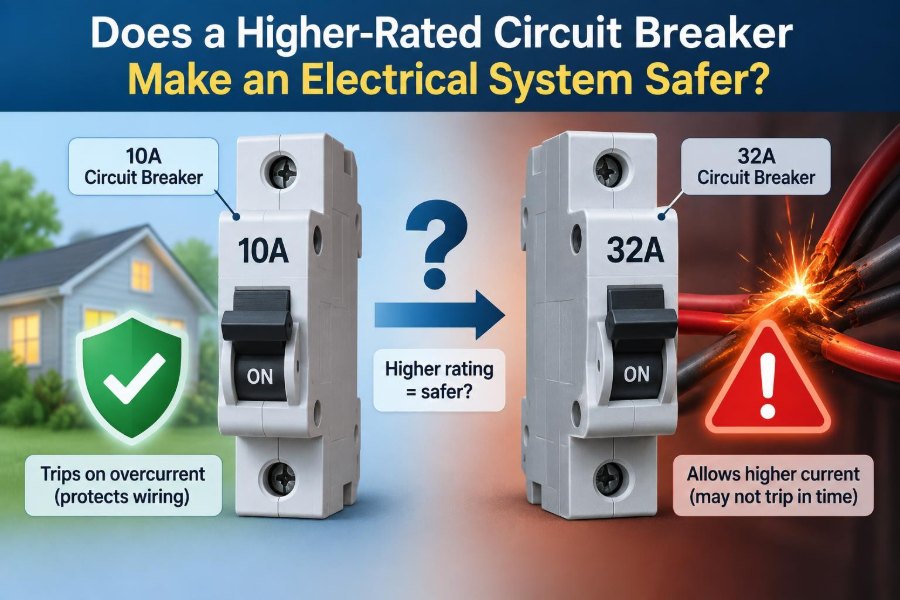
So, does a higher-rated circuit breaker make an electrical system safer? Usually, no. Safety comes from matching the protective device to the complete circuit—not from choosing the largest breaker that will fit in the panel.
🔌 The short answer: bigger is not automatically safer
A higher-rated breaker permits more current to flow before it trips for an overload. If the wire, terminals, receptacles, and connected equipment were designed for that higher current, the change may be appropriate. If they were not, it can remove the protection the circuit needs.
A breaker rating must be coordinated with conductor ampacity and the entire circuit design. A larger breaker on undersized wiring can allow damaging heating to continue without an overload trip.
🛡️ What a circuit breaker is actually protecting
People often describe a breaker as protection for whatever is plugged in. It can help protect equipment in certain faults, but its core overcurrent function is to protect the branch-circuit conductors and associated wiring from excessive current.
That includes cable in walls, insulation, splices, receptacle terminals, junction boxes, and sometimes portions of equipment wiring. Much of this wiring is hidden, so it cannot be watched for overheating during normal use.
⚡ Current is the quantity that drives conductor heating
Voltage pushes charge through a circuit; current is the flow of charge. When current passes through the resistance of wire, heat is produced. The heating effect rises roughly with the square of current, commonly expressed as P = I²R.
That squared relationship matters. Raising current from 15 A to 20 A is not a small thermal change: at the same resistance, the heating is about 1.78 times as great. Small-looking rating changes can have substantial consequences at weak connections or in bundled cable.
🧵 Wire size sets a practical current limit
Conductors have a cross-sectional area, material, insulation temperature rating, installation method, and permitted ampacity. Ampacity means the current a conductor can carry continuously under specified conditions without exceeding an allowed temperature.
Thicker conductors generally have lower resistance and can carry more current than thinner ones. But wire gauge alone is not the whole answer; insulation type, ambient temperature, cable grouping, and termination ratings can reduce what is permitted.
🏠 A simple branch-circuit example
Consider a hypothetical 15 A branch circuit installed with conductors and devices selected for that circuit rating. Replacing its 15 A breaker with a 20 A model does not upgrade the conductors inside the wall.
If a 19 A load develops, the new breaker may continue supplying it while the original design is being overloaded. The cable may gradually run hotter, particularly at connections. The correct remedy is normally to reduce the load, add a circuit, or redesign the circuit with appropriately sized conductors and devices.
🌡️ Why overheating can be difficult to notice
Overloaded wiring does not always produce sparks, smoke, or an immediate failure. Heat can build slowly in a wall cavity, ceiling, conduit, or crowded panel. Insulation can age faster, and terminals can loosen as materials expand and contract through repeated heating cycles.
A poor connection adds resistance at exactly the point where heat is least welcome. It may become much hotter than the cable itself even though the breaker sees only the circuit’s total current.
⏱️ Breakers do not trip at one instant, fixed current
Most common thermal-magnetic breakers respond differently to overloads and short circuits. Their time-current behavior is intentional: modest overloads may take time to trip, while severe faults cause a much faster response.
This allows ordinary equipment starting currents without needless trips, while still limiting sustained overload heating. The exact trip curve depends on the breaker type, manufacturer, and application, so its marking alone is not a complete performance description.
🧲 The thermal trip handles overloads
The thermal element responds to heating caused by current over time. It is suited to overloads such as too many appliances on one circuit, a motor working beyond its intended load, or a damaged appliance drawing excessive current.
Because thermal behavior depends partly on temperature, a warm breaker in a hot panel may operate differently from a cool breaker under otherwise similar load. This is one reason electrical design considers real installation conditions rather than only the number printed on a device.
💥 The magnetic trip responds to major faults
The magnetic element acts rapidly when current rises sharply, as can happen during a short circuit. A short circuit is an unintended low-resistance path between conductors, or between a live conductor and a grounded path.
Increasing a breaker’s ampere rating may also affect the current level at which its instantaneous magnetic action occurs. That means a larger breaker is not automatically a better response to faults either; fault protection requires proper coordination.
🔍 Overload, short circuit, and ground fault are different
| Condition | Typical cause | Protective concern |
|---|---|---|
| Overload | Too much intended load on a circuit | Gradual conductor overheating |
| Short circuit | Damaged insulation or conductor contact | Very high fault current and arcing |
| Ground fault | Current leaking to an unintended grounded path | Shock risk, fire risk, or equipment damage |
A standard breaker may address overloads and high-current faults, but it does not replace every specialized protective device. The type of fault and the circuit location determine what additional protection may be needed.
🧯 Ground-fault protection serves a separate purpose
Ground-fault circuit interrupters, often called GFCIs in North American practice, compare current leaving on an energized conductor with current returning on the neutral. A difference can indicate current taking an unintended path, potentially through water, equipment housing, or a person.
They are designed to respond to relatively small imbalances compared with ordinary overload breakers. Installing a higher-rated standard breaker does not provide this protection and may obscure the real reason a protective device has been operating.
🔥 Arc-fault protection addresses another hazard
Arc-fault protective devices are intended to detect certain electrical arcing patterns associated with damaged cords, loose connections, or compromised wiring. An arc can generate intense local heat without necessarily drawing enough steady current to trip a conventional breaker quickly.
Arc-fault protection is not a substitute for correct breaker sizing, and correct sizing is not a substitute for arc-fault protection where it is required or appropriate. Each device addresses a different failure mechanism.
📏 Ampere rating is not the interrupting rating
The ampere rating tells you the load current the breaker is intended to carry and its overload protection range. The interrupting rating, sometimes called interrupting capacity, describes the maximum prospective fault current the breaker can safely interrupt under stated conditions.
A breaker with the right ampere rating but inadequate interrupting capacity for its location is not suitable. Available fault current can be higher near large transformers or service equipment, so this is a design and inspection issue—not a do-it-yourself guessing exercise.
🧰 The breaker must fit the panel’s listed system
Physical fit is not proof of compatibility. Panelboards are evaluated with specified breaker families, and a breaker that slides onto a bus may not be listed for use in that panel.
Using unapproved combinations can compromise contact pressure, heat dissipation, mechanical performance, or the assumptions behind the equipment’s listing. Follow the panel labeling and manufacturer documentation, and have uncertain installations assessed by a qualified electrician.
🔩 Terminals and devices can be the weak link
A circuit’s safe current is limited by more than its cable. Receptacles, switches, plugs, disconnects, terminal lugs, and splices have ratings too. A larger breaker cannot make a low-rated device suitable for greater current.
This is especially relevant after renovations, repairs, or equipment replacement. A circuit may contain a mixture of old and new components, and the least capable correctly applied component can determine the allowable arrangement.
🏗️ Installation conditions change conductor ampacity
Conductors lose heat differently in open air, conduit, insulation, cable trays, and bundles. Several loaded circuits grouped together can warm one another. High ambient temperatures near roofs, boilers, or industrial equipment also reduce the thermal margin.
Electrical codes and engineering methods account for these conditions through adjustment and correction factors. A conductor that appears adequate in a simple chart may not be adequate after installation details are considered.
🏭 Motors and transformers need special attention
Motors can draw a high inrush current while starting, and transformers can have inrush behavior as well. Their circuit protection may be selected using specific rules that account for starting characteristics, conductor protection, and separate overload devices.
This is one legitimate reason a breaker rating may look unexpectedly large to a casual observer. It does not mean a general-purpose circuit can be upsized to stop nuisance tripping. Equipment-specific design must be based on applicable requirements and manufacturer instructions.
🔋 Continuous loads need additional margin
A continuous load is one expected to operate at a high level for an extended period, under the definition used by the governing code or standard. Examples can include certain heating equipment, lighting loads, or electric vehicle charging equipment.
These loads are often sized with extra margin so conductors and overcurrent devices are not operated at their normal limits for long periods. A breaker that seems adequate for a brief tool use may be inadequate for sustained charging or heating.
🚗 Electric vehicle charging shows why load calculations matter
A vehicle charger may operate for hours, unlike a toaster that runs for minutes. Adding charging equipment is therefore not simply a question of finding an empty breaker space; the branch circuit, panel capacity, feeder, and service load may all need review.
A dedicated circuit with correctly selected conductors, protective device, receptacle or hardwired equipment, and installation method is usually the sound approach. Simply fitting a larger breaker to an existing general-use circuit is not an equivalent upgrade.
🧮 Load calculation is more than adding nameplates
Electrical load calculations estimate demand on services, feeders, and branch circuits using rules that recognize not every appliance operates at maximum power at exactly the same moment. They also identify loads that cannot safely share a circuit.
For a single branch circuit, a practical first step is to identify what is connected and its actual or nameplate current. Repeated trips are useful evidence: they say the circuit is seeing a condition that deserves diagnosis.
🧪 Measure before changing anything
A qualified person can use appropriate test equipment to measure current, inspect conductor size and terminations, identify circuit routing, and check for heat damage. They may also determine whether the breaker itself is defective or whether the load has changed.
Testing should include more than one momentary current reading. A load may cycle, start hard, or become excessive only after it warms up. De-energized inspection and safe work practices are essential inside panels because energized parts may remain exposed.
🪛 Nuisance tripping is a symptom, not a rating request
A breaker can trip for a legitimate reason even when the user calls it a nuisance trip. Common causes include too many portable loads, a failing appliance, a loose connection, a motor problem, moisture intrusion, or a circuit that was never adequate for its present use.
- Unplug or switch off nonessential loads and see whether the condition changes.
- Note which equipment was operating when the trip occurred.
- Do not repeatedly reset a breaker that trips immediately or shows damage.
- Arrange professional diagnosis when the cause is not obvious.
Replacing the breaker with a larger one can turn a visible warning into hidden wiring stress.
🏚️ Older wiring deserves extra caution
Older buildings may have conductor insulation, panel equipment, splices, or grounding arrangements that differ from modern installations. Previous alterations may also be undocumented, leaving uncertainty about wire size and circuit routing.
Never infer a conductor’s suitability from the breaker currently installed. A prior replacement could already be incorrect. Visual clues such as brittle insulation, discolored devices, warm covers, buzzing, or burning odors warrant prompt assessment rather than a reset-and-continue approach.
🔄 When a higher-rated breaker can be correct
A larger breaker can be correct as part of a complete, engineered or code-compliant circuit upgrade. For example, a new dedicated appliance circuit may be installed with conductors, terminations, disconnecting means, and overcurrent protection selected together for the equipment and conditions.
The sequence matters: determine the load and applicable requirements, select conductor and equipment ratings, account for installation conditions, then choose the correctly rated protective device. The breaker is the final coordinated component, not the shortcut that creates capacity by itself.
🧱 Upgrading a circuit means upgrading the whole path
A legitimate upgrade may involve more than pulling larger cable. Depending on the situation, it can require a new branch circuit, properly rated receptacles or hardwired connection, compatible panel breaker, grounding and bonding verification, panel space assessment, and permits or inspection where required.
The feeder and service may also be limiting factors. A branch circuit can be correctly built and still add more demand than an older panel or service was designed to supply.
🚫 Common dangerous shortcuts
- Replacing a repeatedly tripping breaker with a higher-rated model without verifying conductor size.
- Using a breaker merely because it physically fits the panel.
- Replacing a protective device with a nonmatching type to stop trips.
- Ignoring heat marks, damaged insulation, or a breaker that will not reset normally.
- Assuming an extension cord or power strip permanently increases circuit capacity.
Extension cords can introduce their own heating and damage risks, especially when run under rugs, through walls, or used for high-power appliances. More outlets and a properly designed dedicated circuit are safer solutions than permanent improvisation.
👷 Know when to call a qualified electrician
Call a qualified electrician for repeated tripping, any sign of overheating, uncertainty about wire size, a planned high-power load, panel modifications, or fault-protection devices that will not remain reset. These are not situations where trial-and-error replacement is appropriate.
Local electrical rules vary, and work may require permits and inspection. A professional can apply the requirements relevant to the jurisdiction and equipment rather than relying on general advice or assumptions from an online diagram.
📚 A practical decision process
- Identify the circuit and every significant load connected to it.
- Record when tripping occurs: immediately, during startup, or after sustained use.
- Check for damaged cords, overloaded power strips, moisture, and appliance faults without opening energized equipment.
- Determine whether the circuit is being used beyond its intended purpose.
- Have the conductor, breaker type, panel compatibility, and terminations verified before any rating change.
- Choose load reduction, repair, a dedicated circuit, or a full upgrade based on the findings.
This approach preserves the breaker’s role as a safety signal rather than treating it as an obstacle.
✅ The core principle: protection must match the circuit
Breaker sizing is a coordination problem. The load must be served reliably, conductors must remain within safe temperature limits, devices must be properly rated, fault current must be interruptible, and the breaker must be compatible with the panel.
A higher rating is safer only when every part of that coordinated system has been designed or upgraded to support it. On an existing undersized circuit, it usually increases risk by allowing more current before the protective device responds.
The safest breaker is not the biggest breaker; it is the correctly rated breaker for the conductors, equipment, installation conditions, and fault-protection needs of that specific circuit.
When a breaker trips, treat it as useful information. Find the overload or fault, reduce or relocate the load, repair the defect, or install a properly designed circuit—rather than asking a larger breaker to overlook the problem. ⚡🛡️🔧