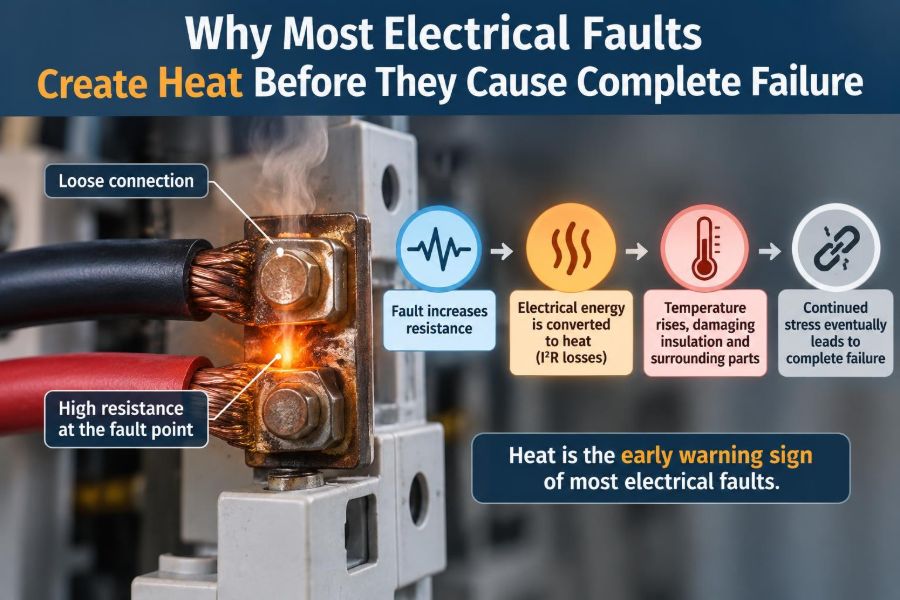

A wall outlet feels warm after a space heater has been running. A motor starts normally but develops a hot, sharp smell near the end of a shift. A breaker trips only after an appliance has been used for several minutes. These situations can seem minor because the equipment still works.
Yet that period of continued operation is often the warning stage of an electrical fault. Many faults do not begin as an instant blackout, a dramatic arc, or a visibly burned component. They begin as unwanted resistance, leakage, imbalance, or poor contact—and those conditions turn electrical energy into heat.
Understanding this sequence helps technicians diagnose problems earlier and helps users recognize when “still working” is not the same as “safe.” Heat is both a symptom and, in many cases, the mechanism that accelerates the damage.
The key is to see an electrical system as a path for controlled energy flow. When that path becomes restricted, diverted, or unstable, the energy does not simply disappear. Much of it appears as heat.
⚡ Electrical Faults Are Usually Progressive
An electrical fault is any unintended condition that changes how a circuit is meant to operate. It may be a loose terminal, cracked insulation, corroded connector, overloaded conductor, damaged winding, or moisture path between conductors.
Some faults do cause immediate failure. A solid short circuit may produce enough current to operate a fuse or circuit breaker almost at once. More commonly, however, the defect begins with limited severity. It raises temperature gradually before it reaches the point where protection operates or a component stops functioning.
This is why early warning signs matter: warmth, discoloration, intermittent operation, an odor from insulation, unexplained breaker trips, or a rising temperature trend in monitored equipment.
🔥 Joule Heating Explains the Basic Mechanism
The central relationship is Joule heating: electrical current passing through resistance produces heat. In simplified form, power converted to heat is expressed as P = I²R, where P is power, I is current, and R is resistance.
Every real conductor has some resistance, so a healthy circuit always produces a small amount of heat. Designers account for this through conductor sizing, insulation ratings, ventilation, and allowable temperature rise.
A fault changes the balance. It may increase resistance at one tiny location, increase current through a conductor, or create a leakage path where heat develops in insulation or contaminated surfaces. The system then generates more heat than it can safely dissipate.
📈 Why Current Has Such a Strong Effect
The squared term in I²R is especially significant. If current doubles while resistance stays the same, heating rises by roughly four times. That is why modest overloads can become serious when sustained.
A cable may survive a brief high-current event because its thermal mass absorbs energy and the protective device responds. The same current over a longer interval can heat copper, terminals, and insulation beyond their intended operating temperatures.
Fault diagnosis therefore requires more than asking whether a circuit is energized. The useful questions are: How much current is flowing? For how long? Where is resistance concentrated? Can the heat escape?
🔩 A Loose Connection Becomes a Small Heater
Loose terminals are one of the clearest examples of heat appearing before complete failure. A connection may still carry current, but reduced contact pressure leaves current flowing through a smaller effective contact area.
That localized resistance produces heat directly at the terminal. As the connection warms, metal can oxidize, springs and screws can lose effective pressure, and the contact area can deteriorate further. The result is a feedback loop: more resistance, more heat, and still more damage.
The conductor insulation a few centimeters away may look acceptable while the terminal itself is severely overheated. This is why checking only wire size or breaker rating cannot confirm that a connection is healthy.
🧲 Contact Resistance Is Not the Same as Wire Resistance
A long conductor has distributed resistance along its length. A poor connection has contact resistance, concentrated at an interface such as a lug, splice, plug blade, relay contact, or busbar joint.
Because the affected area is small, the heat is intensely localized. A connection carrying normal load current can become much hotter than the cable feeding it, even when the cable is correctly sized.
Examples include a receptacle gripping a plug poorly, an aluminum conductor installed without the appropriate connector system, or a stranded wire placed under a terminal in a way that leaves strands unsupported. The circuit may work for a while, but its weak interface is doing unwanted heating work.
🧯 Oxidation Makes Poor Connections Worse
Oxides and corrosion generally conduct less effectively than clean base metal. Moisture, salt air, industrial vapors, and repeated temperature cycling can all degrade a connection surface over time.
Heat accelerates chemical and mechanical aging. In a severe case, oxidation raises contact resistance, resistance raises temperature, and temperature encourages more oxidation. This feedback can continue until a terminal fails open, arcs, or damages adjacent insulation.
Cleaning alone is not always a durable repair. The corrected connection must also have suitable contact pressure, compatible materials, proper torque where specified, and protection from the environment that caused corrosion.
🔌 Overloads Heat the Entire Current Path
An overload means a circuit carries more current than its conductors, connectors, or equipment were intended to carry continuously. Unlike a localized loose connection, overload heating can occur along much of the current path.
A power strip feeding several high-power appliances is a familiar example. The branch circuit breaker may not trip immediately, but plug contacts, flexible cords, and strip components can warm significantly if the load is near or beyond their intended capability.
Protection is designed to limit hazardous overcurrent, not to make every operating condition feel cool. Equipment that routinely runs hot should be evaluated against its rating, installation conditions, duty cycle, and ventilation—not judged only by whether the breaker remains closed.
🧵 Undersized Conductors Have Less Thermal Margin
A smaller conductor has greater resistance per unit length than a larger conductor of the same material. For the same current, that means more voltage drop and more heating.
Extension cords illustrate the issue well. A long, light-duty cord supplying a heavy load can become warm because the cord resistance is high enough to dissipate meaningful power. The load may also receive reduced voltage, which can make some motors draw more current or struggle during starting.
Conductor selection depends on more than current. Length, installation method, ambient temperature, grouping with other cables, insulation temperature rating, and applicable electrical rules all affect the safe choice.
🌡️ Heat Cannot Be Judged by Touch Alone
Touch is a poor measuring instrument. A surface can be hot enough to signal a problem before it feels unbearable, while an internal connection may be much hotter than the accessible enclosure.
Temperature also depends on the material and its surroundings. A metal enclosure conducts heat outward readily; a plastic enclosure may conceal internal heating until deformation or odor becomes apparent.
Where inspection is appropriate and safe, temperature measurement tools can support maintenance decisions. Their readings still need context: load level, emissivity settings for infrared measurements, ambient temperature, and comparison with similar components matter.
📷 Thermal Imaging Finds Patterns, Not Just Hot Spots
Infrared thermography can reveal unusually warm terminals, fuses, breakers, bus joints, and motor connections while equipment is under load. Its strength is comparison: a phase connection that is markedly hotter than similar connections deserves investigation.
A thermal image is not a complete diagnosis by itself. Shiny metal can reflect surrounding infrared energy, and a warm item may simply be carrying a legitimately higher load. Follow-up measurements of current, voltage drop, torque condition, and component history are often needed.
Thermal surveys are most useful when repeated over time under comparable load conditions. A trend toward higher temperature is often more informative than one isolated image.
💥 Arcing Produces Intense Local Heat
An arc is electrical current flowing through ionized gas rather than a solid conductor. It can occur when contacts separate under load, when a connection is loose, or when damaged insulation allows a gap to form.
Arcing can produce very high local temperatures, melt metal, carbonize insulation, and create a fire hazard. Yet an intermittent arc may not create enough sustained current to operate an ordinary overcurrent device promptly.
That distinction matters. A breaker primarily responds to overcurrent; it does not directly measure every dangerous heating mechanism. Arc-fault detection equipment, where used and appropriate, addresses a different fault signature than a conventional breaker.
🪵 Carbonized Insulation Can Create a New Path
Many insulating materials degrade when exposed to excessive heat. They can harden, crack, soften, lose dielectric strength, or become carbonized. Carbonized material may conduct better than intact insulation, creating a leakage path where none existed initially.
This can turn a localized terminal problem into a wider insulation failure. A small overheated connector may damage wire insulation, then permit tracking across a surface or between conductors.
Once insulation shows charring, melting, or brittle heat damage, replacing only the visibly failed terminal may be insufficient. The extent of thermal damage must be assessed along the nearby conductor and within the enclosure.
💧 Moisture Creates Leakage Before a Dead Short
Water is not always an immediate low-resistance short circuit. Moisture mixed with dust, salts, or residues can form a partially conductive film across insulation or circuit-board surfaces.
This leakage current may be too small to trip an overcurrent device, yet it can generate localized heat and gradually damage materials. Repeated humidity cycles can make the behavior intermittent, which complicates troubleshooting.
Outdoor boxes, refrigeration equipment, damp basements, and industrial washdown areas need components and enclosures suited to their environment. Sealing matters, but so do drainage, condensation control, cable entry practices, and maintenance.
⚖️ Imbalanced Loads Can Overheat Part of a System
In multi-phase systems, uneven loading can cause one phase conductor, one pole of a protective device, or one winding path to run hotter than the others. The equipment may continue operating while only part of the system is overloaded.
Comparing phase currents is a practical diagnostic step. A notable imbalance can point to uneven single-phase loads, a wiring error, a failing component, or—for motors—an issue involving supply voltage or winding condition.
Balance is not always perfect or necessary, especially where loads naturally vary. The concern is whether the measured imbalance exceeds what the system and equipment can tolerate under actual operating conditions.
🌀 Motors Often Announce Trouble With Temperature
Motors convert electrical energy into mechanical work, but losses appear as heat in windings, bearings, rotor components, and the enclosure. A motor can remain running while its temperature rises due to overload, poor cooling, voltage imbalance, frequent starts, blocked airflow, or bearing friction.
Insulation aging is strongly related to operating temperature, so persistent overheating can shorten winding life long before a motor stops. A motor protection device may eventually trip, but a recurring thermal problem should not be treated as a nuisance reset.
Useful checks include load current on each phase, supply voltage, ventilation condition, driven-load condition, bearing noise, and whether the motor’s duty matches the application.
🧠 Electronic Components Fail Through Different Heat Paths
Electronic equipment often has faults that are subtler than a burned wire. A semiconductor may develop increased leakage current, a capacitor may age, or a solder joint may crack. Each condition can create a small heat source that shifts circuit behavior.
Modern power electronics are especially sensitive to thermal design. Heat sinks, fans, thermal interface materials, airflow paths, and temperature sensing all help keep devices within their operating limits.
A failed cooling fan may not cause instant shutdown. It can first raise internal temperature, then reduce component life, trigger thermal limiting, or cause intermittent faults that disappear when the equipment cools.
🔄 Thermal Cycling Causes Mechanical Fatigue
Conductors, solder, plastics, and terminals expand when heated and contract when cooled. Repeated cycles can loosen joints, fatigue solder connections, crack insulation, and reduce clamping force.
This means heat can be both the result of a fault and the cause of future faults. A connection that is only slightly warm today may experience many expansion cycles, slowly worsening until it becomes a clear hot spot.
Equipment subject to frequent starts, changing loads, outdoor temperature swings, or high-current cycling benefits from installation methods designed to maintain reliable contact over time.
🧱 Poor Ventilation Raises Every Temperature
Not all overheating begins with an electrical defect. A healthy device placed in a sealed cabinet, covered by stored materials, or installed near another heat source may be unable to reject normal operating heat.
High ambient temperature reduces thermal margin. The same current that is acceptable in a cool, ventilated location may push insulation or electronics closer to their limit in a hot enclosure.
Ventilation fixes should be considered carefully. Adding airflow may solve an enclosure heat problem, but it can also introduce dust, moisture, or contaminants. The right solution depends on the equipment and environment.
⏱️ Time Matters as Much as Temperature
Short heating events and sustained heating do not have the same consequences. Protective devices use time-current behavior because conductors and equipment can tolerate some temporary overcurrent better than a prolonged overload.
Likewise, a terminal that briefly warms during a motor start is different from one that remains hot during steady operation. Diagnosis should capture the operating cycle: startup, normal load, peak demand, shutdown, and cooldown.
Intermittent faults often require patience. Recording when a problem occurs—after ten minutes, only in humid weather, only under a certain load—can be more useful than inspecting a system after it has cooled.
🛡️ Protective Devices Have Specific Jobs
Fuses and circuit breakers protect conductors and equipment against certain overcurrent conditions. They are essential, but they are not universal fault detectors.
| Device or method | Primary concern | What it may not reveal by itself |
|---|---|---|
| Fuse or circuit breaker | Overcurrent and short-circuit energy | Some high-resistance connections or intermittent arcs |
| Ground-fault protection | Unintended current to ground | Line-to-line overloads without ground leakage |
| Arc-fault protection | Electrical arcing signatures | Every form of overload or poor cooling |
| Thermal monitoring | Abnormal temperature rise | The electrical root cause without follow-up testing |
Protection must be selected, installed, and tested according to the applicable system design and local requirements. Replacing a repeatedly operating device with a larger rating without correcting the cause can remove a layer of protection while leaving the heating problem in place.
🚫 A Breaker That Does Not Trip Is Not Proof of Safety
A breaker may remain closed because total circuit current is below its trip threshold, even while one connection has dangerously high resistance. The breaker senses current through its mechanism, not the temperature of every terminal in the circuit.
This explains why a warm plug, browned receptacle, or melted connector demands attention even when no protective device has operated. The local fault may be severe but electrically invisible to conventional overcurrent protection.
Never treat repeated warmth as normal merely because the circuit remains energized. The correct response is to remove or reduce the load if safe to do so and arrange qualified evaluation when the cause is uncertain.
🧪 Voltage-Drop Testing Can Expose Resistance
A high-resistance connection often produces an abnormal voltage drop while carrying load. Measuring voltage across a connection, or comparing expected voltage at the source and load, can help identify where electrical energy is being lost.
For example, a connection that should behave nearly like a continuous conductor should not consume a meaningful share of the circuit voltage under normal load. If it does, that lost electrical power is usually becoming heat at or near the connection.
Live electrical measurements involve shock and arc-flash hazards. They should be performed only by people with suitable training, instruments, procedures, and protective measures for the equipment involved.
🧰 Inspection Starts With Safe, Simple Clues
Many problems reveal themselves through noninvasive observations before advanced testing is needed. Look for a pattern rather than relying on one clue.
- Discoloration, melted plastic, brittle insulation, or soot near terminals
- A persistent odor resembling overheated plastic or varnish
- Buzzing, crackling, or intermittent power at plugs and switches
- Equipment that runs hotter, slower, noisier, or less reliably than usual
- Breakers, overloads, or thermal cutouts that operate repeatedly
Do not open energized panels, tighten live connections, or handle damaged wiring casually. For fixed wiring, high-energy equipment, or signs of burning, the safest action is to isolate power when possible and involve a qualified electrical professional.
🔧 Correct Torque Is an Electrical Requirement
Terminals are mechanical interfaces with electrical consequences. Too little tightening can leave insufficient contact pressure; excessive tightening can damage threads, deform conductors, or compromise a connector.
Manufacturer torque specifications, appropriate tools, conductor preparation, and compatible lugs are part of making a reliable low-resistance joint. This is particularly important in panels, switchgear, battery systems, and high-current DC equipment.
Torque is not a substitute for inspection. A connection can meet torque at installation and still degrade later because of vibration, corrosion, thermal cycling, or improper conductor selection.
🔋 DC Systems Have Their Own Heating Risks
Direct-current systems such as battery banks, solar installations, vehicle wiring, and DC drives can produce substantial heating at poor connections. High current at relatively low voltage makes connection resistance especially consequential.
DC arcs can also be persistent because the current does not naturally cross zero each cycle as alternating current does. Components used for switching and protecting DC circuits must be rated for the voltage, current, and interruption duty involved.
Battery terminals deserve particular attention. Corrosion, loose hardware, undersized cables, and inappropriate fusing can produce heat during charging or high-demand operation even when the system appears to function normally.
🏠 Everyday Warning Signs Deserve Proportionate Action
Not every warm device is defective. Chargers, transformers, motors, and dimmers may become warm in normal use. The concern increases when heat is new, excessive, localized, accompanied by odor or discoloration, or linked to unreliable operation.
A plug that fits loosely, a switch that crackles, or an outlet faceplate that becomes noticeably hot under ordinary load is not a do-it-yourself invitation to keep experimenting. Stop using the affected equipment or circuit where practical and have the condition assessed.
For portable appliances, replacing a damaged cord or appliance may be appropriate. For building wiring, panel equipment, or recurring trips, the underlying installation should be investigated rather than bypassed.
🏭 Maintenance Programs Look for Change Over Time
In commercial and industrial settings, preventive maintenance aims to find deterioration before it interrupts production or creates damage. Visual inspections, cleaning, torque verification where appropriate, electrical testing, vibration checks, and thermal surveys can all contribute.
The most useful programs are condition-based rather than ritualistic. A heavily loaded connection in a vibrating, dusty environment may need more attention than an identical component in a stable, clean enclosure.
Documentation matters. Recording load, temperature, repair history, and observed defects makes it easier to distinguish a one-time anomaly from a developing trend.
🧭 Troubleshooting Should Follow Energy Flow
A practical troubleshooting approach is to follow the path from source to load. Start by confirming the symptom and operating conditions, then inspect supply conductors, protective devices, connections, controls, and the load itself.
- Make the situation safe and identify any immediate signs of damage.
- Determine whether heating is localized, distributed, intermittent, or load-dependent.
- Compare current, voltage, and temperature with expected values or similar circuits.
- Inspect and test the suspected point using methods appropriate to the equipment.
- Repair the root cause, then verify performance under realistic load.
Replacing the visibly damaged part without asking why it overheated can lead to repeat failure. A burned terminal may be the root problem, but it may also be the victim of overload, vibration, poor enclosure cooling, or a mismatched connector.
⚠️ Common Responses That Make Faults Worse
Several tempting shortcuts can conceal a problem while increasing risk. They should be avoided.
- Installing a larger fuse or breaker to stop nuisance trips
- Using an extension cord as permanent high-load wiring
- Repeatedly resetting a thermal overload without investigating
- Wrapping a damaged cord with tape instead of replacing it
- Assuming a connection is sound because it looks clean externally
- Ignoring a hot spot because the equipment still operates
These actions do not remove unwanted heat. In some cases, they allow it to continue longer, giving insulation, terminals, and nearby materials more opportunity to deteriorate.
🧑🔧 Know When Qualified Help Is Necessary
Electrical work has hazards that are not obvious from the outside. Panels, service equipment, industrial controls, battery systems, and motor circuits may retain or deliver dangerous energy even after a device appears switched off.
Qualified personnel can apply safe isolation procedures, verify absence of voltage with appropriate instruments, assess arc-flash and shock risks, and interpret test results in the context of the installation. Local codes and workplace rules may also determine who is permitted to perform the work.
Urgent signs include smoke, sparking, a burning odor, melted insulation, severe overheating, repeated unexplained trips, or a damaged service component. In those cases, prioritize isolation and emergency procedures appropriate to the location rather than continued diagnosis.
✅ The Core Principle: Fault Energy Usually Appears as Heat First
Most developing electrical faults do not begin with complete loss of power because the circuit still has some path for current. The path may be resistive, contaminated, loose, overloaded, or partially damaged, but it can continue carrying energy for a time.
That imperfect path converts an increasing share of electrical energy into unwanted heat. Heat then changes materials, loosens contacts, degrades insulation, and can turn a manageable defect into an open circuit, arc fault, equipment failure, or fire hazard.
The practical lesson is simple: treat abnormal heating as evidence to investigate, not as a harmless side effect of equipment that has not failed yet.
When electrical energy starts appearing as unexpected heat, the safest and most effective response is to find the cause before the fault has time to become a complete failure. ⚡🌡️🛠️