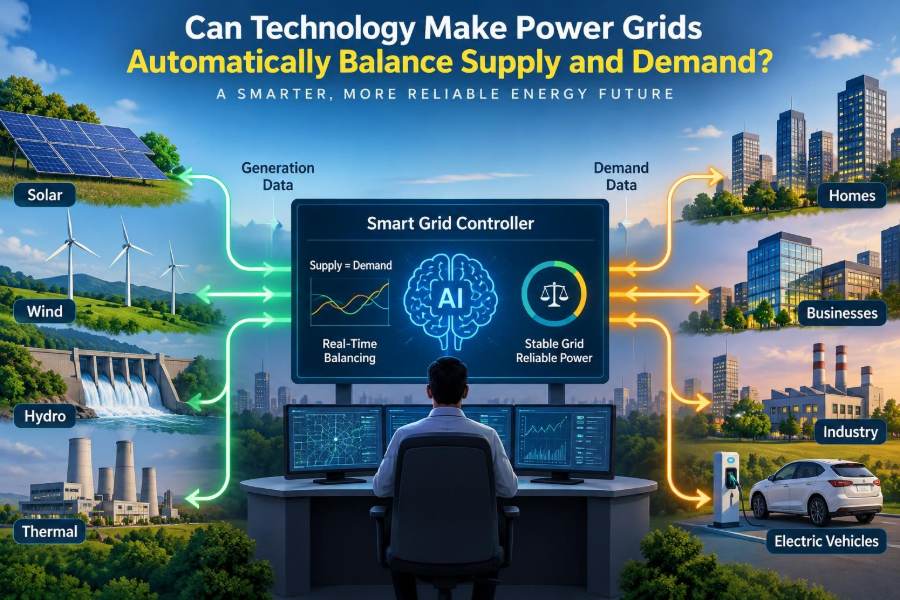

It is a hot evening, air conditioners are running, people are cooking dinner, and factories are still finishing the day’s work. Somewhere far from those homes and businesses, grid operators are watching a basic but unforgiving equation: electricity entering the system must closely match electricity leaving it.
If demand suddenly rises and generation does not follow, grid frequency falls. If too much generation is online, frequency rises. Either condition can damage equipment or, in severe cases, trigger protective actions that disconnect parts of the network.
This balancing task used to depend mainly on large power stations and human operators. Now it also involves wind farms, solar inverters, batteries, smart meters, electric vehicles, weather forecasts, and software making decisions in fractions of a second.
So can technology make a power grid automatically balance supply and demand? Increasingly, yes—but “automatic” does not mean effortless, risk-free, or fully hands-off. It means building a carefully coordinated system of measurement, control, flexible resources, and human oversight.
⚖️ The balance a power system must maintain
An electrical grid is not like a warehouse where unused electricity can simply sit on a shelf. Except for energy held in storage systems, power must be produced at nearly the same moment it is consumed.
Grid balance has two related meanings. Energy balance concerns whether enough electricity is available over minutes, hours, and seasons. power balance concerns whether instantaneous generation and demand are matched closely enough to keep the system stable.
Transmission losses, plant auxiliary loads, and exports to neighboring networks are part of the calculation too. The operator is balancing the entire connected system, not only the appliances visible to customers.
🌀 Why frequency reveals an imbalance
In an AC grid, generators and many loads are tied to a shared nominal frequency, commonly 50 or 60 hertz depending on the region. Frequency is a useful system-wide indicator because a supply-demand mismatch changes the rotational speed of synchronous generators.
When demand exceeds generation, generators slow slightly and frequency tends to decline. When generation exceeds demand, they speed up and frequency tends to increase. The departure may initially be small, but a growing deviation is a warning that the mismatch is not being corrected.
Modern inverter-dominated systems require a more careful interpretation: not every resource has a spinning rotor. Yet frequency remains a central operational signal, and inverter controls can be designed to respond to it.
🏭 How traditional grids stayed in balance
For much of grid history, balancing relied on large, dispatchable plants: hydroelectric stations, thermal plants, and other generators whose output could be adjusted under operator direction. Some units ran steadily, while others were held ready to increase output.
Generators used governors, automatic controls that sense a speed or frequency change and alter mechanical input. A frequency dip, for example, can cause a turbine governor to admit more steam, water, or fuel before an operator has time to issue a detailed instruction.
Control rooms then handled slower corrections, scheduling generators and maintaining reserves. This layered arrangement is still fundamental, even though the assets responding to control signals are changing.
📏 The first requirement: knowing what is happening
Automation is only as capable as its measurements. A grid needs frequent, reliable visibility of generator output, line flows, voltages, frequency, equipment status, and—increasingly—flexible demand and distributed energy resources.
Traditional supervisory control and data acquisition systems, often called SCADA, collect operational data and send commands across substations and power plants. For faster dynamic observation, synchronized phasor measurements can capture voltage and current behavior with precise time stamps.
Measurement is never perfect. Communications can fail, sensors can drift, and some distribution networks remain sparsely monitored. Good automatic control therefore includes validation, fallback modes, and alarms rather than assuming every incoming value is correct.
🧠 From monitoring to automated decisions
Monitoring answers “what is happening?” Automation adds “what should respond?” and, in some cases, sends the response without waiting for a person to approve each small action.
A simple control loop has four parts: measure a condition, compare it with a target, calculate a response, and verify the result. A battery may measure frequency, compare it with a permitted operating band, inject power when frequency is low, and reduce its response as the frequency recovers.
This does not require artificial intelligence. Much of the most valuable automation uses tested control logic, set points, limits, and protection schemes. Advanced optimization and machine learning may improve forecasts or dispatch choices, but they do not replace sound engineering controls.
⏱️ Balancing occurs on several time scales
No single resource is best for every imbalance. Grid control is usually organized by how quickly an action is needed and how long it must be sustained.
| Time scale | Typical purpose | Possible response |
|---|---|---|
| Milliseconds to seconds | Arrest a rapid frequency or voltage disturbance | Inverter response, governors, protection |
| Seconds to minutes | Restore balance after a contingency | Automatic generation control, batteries, fast reserves |
| Minutes to hours | Follow ramps and forecast changes | Dispatchable generation, demand response, storage |
| Hours to seasons | Ensure adequate energy and capacity | Scheduling, fuel planning, long-duration resources |
A battery can react extremely quickly, but its stored energy is limited. A flexible generator may take longer to ramp but can sustain output much longer. Automatic balancing works best when it coordinates a portfolio instead of treating one technology as a universal solution.
🔁 Primary control contains the first disturbance
Primary frequency response is the immediate, local reaction to a frequency change. It is designed to stop the decline or rise from becoming worse after events such as a generator outage or a sudden load loss.
Generator governors traditionally provide this response through droop control: output changes in proportion to frequency deviation. Battery and inverter-based resources can provide a similar service through programmed controls.
Primary response stabilizes the system, but it generally does not return frequency exactly to its target. Resources that responded may be operating away from their preferred set points, so another layer must take over.
🎛️ Secondary control restores the target
Secondary control adjusts selected resources over seconds to minutes to restore nominal frequency and planned interchange between balancing areas. This is often implemented through automatic generation control, or AGC.
AGC sends changing set points to participating generators and other resources. It accounts not only for local frequency but also for scheduled power transfers across tie lines, helping each area carry its intended share of the balancing burden.
For distributed resources, participation requires secure communications, clear operating agreements, and aggregation. Thousands of small devices cannot all be treated like one traditional plant unless software can coordinate their combined behavior.
🗓️ Tertiary control prepares for the next hours
Once the immediate event is controlled, operators and scheduling systems must replenish reserves and prepare for the next expected change. This slower process is sometimes called tertiary control or redispatch.
Consider a forecast showing falling wind output near sunset while household demand is rising. A scheduling tool may charge batteries earlier, commit flexible generation, arrange imports, or procure demand reduction for the evening period.
The value of automation here is not merely speed. It can evaluate many constraints at once: ramp limits, transmission congestion, reserve requirements, fuel restrictions, storage state of charge, and expected weather changes.
🌤️ Variable renewables change the balancing problem
Wind and solar output depends on weather and daylight, so it cannot always be dispatched upward on command in the same way as a fuel-fired plant. Their variability is often predictable in broad terms but uncertain in detail.
A passing cloud bank can alter solar output quickly across a local area. A large weather system can change wind production over several hours. These variations do not make renewable generation unmanageable; they make forecasting, geographic diversity, flexibility, and network planning more valuable.
It is also useful to separate variability from uncertainty. A daily solar pattern is variable but largely expected. A forecasting error is uncertainty, and it creates a larger need for reserves.
🔮 Forecasts give automation time to act
Load forecasting estimates future demand using information such as time of day, season, temperature, holidays, and recent consumption patterns. Renewable forecasting combines weather information with plant characteristics and real-time observations.
No forecast is exact, so grid operators do not schedule only the single most likely outcome. They consider plausible ranges and carry reserves to handle error. A useful automatic system expresses uncertainty instead of presenting a forecast as certainty.
Forecasts also help avoid unnecessary cost. If a hot afternoon is expected, storage can be prepared and flexible demand programs can be scheduled before a shortage becomes an emergency.
🔋 Batteries are fast, flexible, and energy-limited
Grid batteries can charge when supply is plentiful and discharge when demand is high. Their power electronics can respond quickly, making them well suited to frequency regulation, ramp smoothing, and short-duration balancing.
But a battery’s power rating and energy capacity are different. A system may deliver a large amount of power briefly yet be unable to sustain that output for a long shortage. State of charge must therefore be managed deliberately.
A common planning mistake is to count the same battery twice: once as a source of fast reserves and again as guaranteed energy for a later peak. Automated dispatch must preserve enough headroom and stored energy for the services it has promised to provide.
🚗 Electric vehicles can become flexible loads
Electric vehicles can add substantial demand, especially when many drivers plug in after work. Unmanaged charging may coincide with an existing evening peak and increase stress on local transformers and feeders.
Smart charging can shift charging within a driver’s required departure time and energy need. For example, a car plugged in at 6 p.m. and needed at 7 a.m. may not need to begin charging immediately.
Vehicle-to-grid operation could eventually allow some vehicles to export energy, but it adds practical questions: battery wear, customer permission, connection standards, local network limits, compensation, and availability. Flexible charging is generally simpler than assuming every vehicle will serve as a dependable generator.
🏠 Demand response adjusts consumption instead of supply
Demand response pays or incentivizes customers to reduce, shift, or occasionally increase electricity use in response to grid conditions. It treats flexible demand as an operational resource rather than an uncontrollable quantity.
Examples include pre-cooling a building before a peak period, briefly reducing industrial process load, delaying water heating, or shifting data-center tasks where service requirements allow. The customer’s process and comfort limits must remain central.
Automation makes demand response more practical because devices can act on agreed limits without requiring people to constantly watch price signals. It must still be designed transparently; customers should know what may change, when it may happen, and how to override it.
🏢 Buildings can provide quiet flexibility
Commercial buildings contain thermal mass, ventilation systems, pumps, refrigeration, and controls that can often shift small amounts of power for short periods. Individually, one building may have limited impact. Across many sites, the aggregate can be meaningful.
The key is not simply turning equipment off. A good building controller respects temperature, humidity, air quality, equipment cycling limits, and occupancy. Reducing cooling for too long may create a rebound peak when every system turns back on together.
Coordination avoids that rebound. An aggregator can stagger actions across a portfolio so that the grid receives a smoother response while occupants experience little or no disruption.
🌐 Aggregators turn small devices into grid resources
An aggregator coordinates many smaller assets—such as batteries, thermostats, chargers, and backup generators—and offers their combined capability to a utility or market operator.
This is sometimes described as a virtual power plant. It is not a physical station in one location; it is a managed group of distributed resources operating toward a common target.
Aggregation introduces an engineering challenge: advertised capacity must be genuinely deliverable. Devices may be offline, customers may opt out, communications may be delayed, and local distribution constraints may prevent all devices from responding at once.
🔌 Inverters are becoming active grid participants
Solar arrays, batteries, and many modern loads connect through power electronic inverters. Earlier inverter designs often treated the grid as a stable external source and disconnected when conditions moved outside set limits.
Newer control approaches can allow inverters to support voltage, respond to frequency, limit ramps, and ride through certain disturbances when appropriate. These functions can improve resilience, but their settings must align with protection systems and local operating rules.
Grid-following inverters synchronize to an existing voltage waveform. Grid-forming inverters can help establish voltage and frequency behavior, which becomes especially relevant in microgrids and systems with fewer synchronous machines.
🧭 Voltage control is a separate balancing challenge
Power balance and frequency get much attention, but voltage must also stay within acceptable limits. Voltage is influenced by reactive power, network impedance, transformer tap settings, load location, and distributed generation.
A feeder with abundant midday rooftop solar may experience a local voltage rise even when the wider system has enough demand. Conversely, a heavily loaded feeder may suffer a voltage drop. The solution is often local control, not merely more generation somewhere else.
Smart inverters, capacitor banks, voltage regulators, and transformer tap changers can coordinate voltage support. Their interactions must be studied carefully; poorly coordinated controllers can chase one another and cause repeated switching or unstable behavior.
🗺️ Transmission determines whether flexibility is reachable
A surplus of wind power in one area cannot automatically solve a shortage elsewhere if transmission lines are congested or unavailable. The network determines which resources can physically serve which loads.
Automated dispatch must respect thermal line limits, voltage constraints, stability limits, and planned outages. An economically attractive schedule may be infeasible once those constraints are included.
This is why grid balancing is more than matching one total supply number to one total demand number. It is a location-sensitive problem: power must be balanced while flowing safely through a real network.
🏝️ Microgrids show automation at a smaller scale
A microgrid is a local electrical system that can operate connected to the wider grid and, in some designs, separate into islanded operation during an outage. It may combine local generation, storage, critical loads, and controls.
In islanded mode, the microgrid must balance itself. If a large motor starts or solar output drops, its controls need fast resources to maintain frequency and voltage. This makes microgrids a clear illustration of why automation matters.
They are not automatically resilient simply because they have solar panels or batteries. Islanding capability, protection coordination, black-start procedures, load prioritization, and tested controls are all necessary.
🛡️ Protection systems must remain independent and fast
Grid automation is not the same as protection. Protection systems detect faults—such as short circuits—and isolate damaged equipment quickly to protect people and equipment and prevent wider damage.
Some automated balancing actions are deliberately gradual. Fault protection often must act in cycles or fractions of a second. Its logic should not depend on a distant cloud service or a slow optimization platform.
Coordination is essential because changing generation, inverter settings, or network configuration can alter fault currents and power flows. Protection settings that were appropriate for an older grid may need reassessment as distributed energy resources grow.
🧪 Testing matters before controls meet the real grid
An algorithm can look excellent in simulation and still behave poorly in field conditions. Real systems include communication latency, missing data, device saturation, customer overrides, equipment failures, and unexpected combinations of events.
Engineers use staged testing: component tests, hardware-in-the-loop tests, pilot projects, and controlled operational deployment. A hardware-in-the-loop setup can connect real control equipment to a simulated power system, revealing timing and interface issues without risking the live network.
Controllers also need clear fail-safe behavior. When communications disappear, a device should know whether to hold its last set point, revert to local control, disconnect, or follow a predetermined emergency mode.
🔐 Cybersecurity is part of power-system reliability
Greater automation creates more digital entry points: sensors, gateways, remote controllers, cloud interfaces, vendor maintenance connections, and customer devices. A control system that is electrically well designed can still be vulnerable if access is poorly managed.
Basic safeguards include strong authentication, least-privilege access, network segmentation, secure software updates, logging, and incident response procedures. Operational technology—the systems that monitor and control physical equipment—needs protections suited to availability and safety requirements.
Cybersecurity is not a one-time checklist. Asset inventories change, vulnerabilities emerge, and suppliers update products. Resilience also requires the ability to operate safely in a degraded or manual mode if digital systems are unavailable.
👥 Humans still set goals, limits, and priorities
Automation can make frequent adjustments far faster than a human operator. It cannot decide society’s priorities on its own: how much reliability to procure, which customers receive critical-load protection, what privacy rules apply, or how costs are allocated.
Operators also provide judgment during unusual events. A model trained on normal patterns may not understand a regional emergency, a field equipment anomaly, or a rapidly changing restoration situation as well as an experienced team with local context.
The strongest design is usually human-supervised automation. Machines handle repeatable, time-critical control within approved boundaries; people set those boundaries, monitor exceptions, and retain authority for consequential decisions.
💰 Markets and tariffs can support flexibility—or distort it
Technical capability alone does not ensure participation. A battery owner, building manager, or industrial site needs a reason and a workable path to provide flexibility. Tariffs, contracts, and electricity markets can reward useful services such as capacity, energy, or fast frequency response.
Bad incentives can create unwanted synchronized behavior. If every device sees the same simple price signal and responds at precisely the same time, a demand peak may move rather than disappear.
Well-designed programs consider locational needs, response speed, availability, verification, and customer protections. The economic rules should reinforce physical grid needs rather than assume price alone will solve operational problems.
⚠️ Common misconceptions about automatic balancing
- “More data automatically means better control.” Data quality, timing, context, and secure integration matter as much as volume.
- “Batteries eliminate the need for other resources.” They are powerful tools, but duration, charging opportunities, and network limits still matter.
- “Smart meters directly control the whole grid.” They can improve measurement and customer programs, but they are only one part of a much larger control architecture.
- “AI can replace grid engineering.” Optimization can assist decisions, but physical laws, protection requirements, and validated operating limits remain non-negotiable.
- “Automation removes the need for reserves.” Fast automation can deploy reserves more efficiently; it does not remove the need for resources that can respond to uncertainty and failures.
🧩 A practical architecture for a self-balancing grid
A credible automatically balancing grid is not one giant central computer. It is a layered system in which local devices respond quickly, regional controls coordinate resources, and planning tools prepare for conditions further ahead.
A practical architecture usually includes:
- Reliable sensing of frequency, voltage, flows, equipment state, and flexible resource availability.
- Local autonomous controls with bounded settings for fast response.
- Secure communications for coordination, updates, and situational awareness.
- Forecasting and optimization that recognize uncertainty and network constraints.
- Reserves with different speeds and durations.
- Protection systems and manual fallback procedures that remain dependable during failures.
The goal is not perfect prediction. It is a system that detects deviations early, responds proportionately, and recovers safely when assumptions are wrong.
📚 What engineers and professionals should focus on
For students, the topic connects power electronics, control theory, communications, optimization, cybersecurity, and power-system analysis. Understanding only one domain is useful; understanding their interactions is increasingly valuable.
For working professionals, integration is often the hard part. A technically capable device may still fail to provide a grid service because its contract, telemetry, protection settings, interconnection requirements, or distribution constraints are unresolved.
When evaluating a proposed balancing technology, ask practical questions: What variable does it measure? How quickly can it respond? How long can it sustain that response? What happens when communication fails? Does its action create a local voltage or congestion problem? How is performance verified?
✅ The core principle: coordinated flexibility beats a single solution
Technology can make grids far more automatic in balancing supply and demand. Fast controls can arrest disturbances, forecasts can prepare resources, batteries can bridge rapid changes, flexible loads can reshape peaks, and network-aware software can coordinate them.
But no device can repeal the physical requirement for balance, and no algorithm can compensate indefinitely for inadequate energy, capacity, transmission, or protection. Reliable automation depends on diverse resources, clear limits, accurate measurements, secure systems, and practiced human operators.
The most useful question is therefore not whether the grid can become fully automatic. It is which decisions can be safely automated, which resources can provide verified flexibility, and how the whole system behaves when conditions depart from the forecast.
Automatic grid balancing is achievable as a layered, supervised engineering system—not as a single smart machine—and its success depends on coordinating physical infrastructure, digital control, and human judgment. ⚡🔋🌐