
A phone charger marked 20 V can charge a device quickly. A small battery marked 1.5 V can barely light a flashlight. It is tempting to conclude that voltage alone tells us how much electrical power is available.
Then consider a static-electricity spark: it may involve thousands of volts, yet it usually transfers so little energy that it is more startling than destructive. Meanwhile, an ordinary low-voltage car battery can deliver enough current to heat tools, damage wiring, or start an engine.
This apparent contradiction matters in circuit design, electrical safety, power transmission, and everyday troubleshooting. Voltage is crucial, but it is only one part of the electrical picture.
The useful question is not simply, “How high is the voltage?” It is: what current can flow, for how long, through what load, and under what conditions?
⚡ The short answer: voltage alone is not power
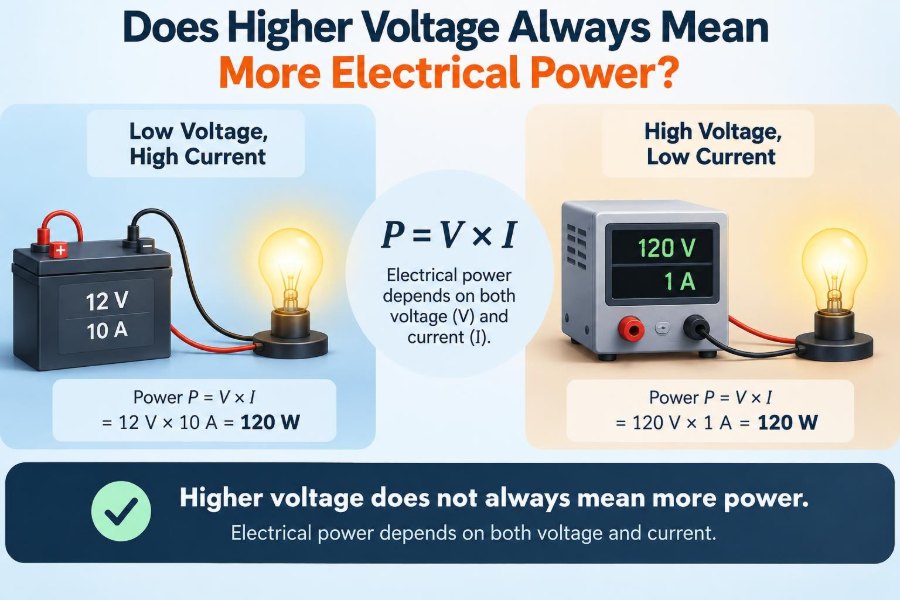
No: higher voltage does not automatically mean more electrical power. Electrical power is the rate at which energy is transferred or converted. For a DC circuit, the basic relationship is P = VI, where P is power in watts, V is voltage in volts, and I is current in amperes.
A source at 100 V delivering 0.01 A supplies 1 W. A source at 12 V delivering 10 A supplies 120 W. The lower-voltage source is delivering far more power in that moment.
🔋 What voltage actually describes
Voltage is an electrical potential difference: the energy available per unit of electric charge between two points. One volt equals one joule of energy per coulomb of charge.
A helpful analogy is water pressure. Higher pressure can create a stronger push, but pressure alone does not say how much water is moving through a pipe. Flow also depends on the pipe, valve opening, and pump capacity.
🌊 Current is the moving charge
Current is the rate of charge flow. One ampere means one coulomb of charge passes a point each second. In the water analogy, it corresponds to flow rate rather than pressure.
Current depends on the circuit. A voltage source may be capable of producing a certain potential difference, but current flows only when there is a conductive path and a load that permits it.
🔢 Reading the power equation correctly
The equation P = VI applies instant by instant. If voltage rises while current remains unchanged, power rises. But current rarely remains unchanged by accident; the resistance, control electronics, and source limits often make it change too.
Two other useful forms come from Ohm’s law, V = IR:
P = I²R, useful when current and resistance are known.P = V²/R, useful for a fixed resistive load.
Each formula describes the same power under the conditions where Ohm’s law is applicable.
🧱 Resistance sets the response of a simple load
Resistance opposes current flow. For a fixed-voltage supply connected to a fixed resistor, current is I = V/R. Raising the voltage therefore raises current as well.
For that specific case, power becomes P = V²/R. Doubling voltage makes the resistor dissipate four times as much power. This is true for an ideal, unchanged resistor—not a universal rule for every device.
🔥 A resistor example with real numbers
Imagine a 10-ohm resistor connected to 10 V. The current is 1 A, and the resistor dissipates 10 W. At 20 V, current becomes 2 A and dissipation becomes 40 W.
The resistor may overheat if it was not rated for 40 W. The lesson is not that voltage always creates more power; it is that a fixed resistance allows more current when the applied voltage increases.
🎛️ Loads are not always fixed resistors
Many practical loads are not ohmic, meaning their current is not directly proportional to voltage. LEDs, motors, batteries, electronic power supplies, and semiconductor circuits all have more complicated behavior.
An LED, for example, needs current control. A small increase in forward voltage can produce a large current increase, so a resistor or driver circuit is normally used to prevent damage.
🌀 Motors change as they run
A motor produces back electromotive force, or back EMF, as it spins. This internally generated voltage opposes the supply and changes the motor current.
At startup, a motor has little or no back EMF and can draw a large current. As it reaches speed, current often falls. Voltage matters, but mechanical load, winding resistance, controller settings, and speed determine the actual electrical power.
🔌 Constant-power devices behave differently
Many modern devices use switching converters to regulate their output. A laptop adapter, for example, may attempt to supply roughly a specified output power over an allowed input-voltage range.
If input voltage decreases, such a device may draw more input current to maintain power, until it reaches a limit. This is why assuming “lower voltage means lower current and lower demand” can be misleading around regulated electronics.
🏭 A power supply has voltage and current limits
A supply label should be read as a capability boundary, not a promise that every connected device receives maximum power. A 12 V, 5 A supply can provide up to about 60 W under suitable conditions.
A small sensor drawing 0.05 A from that supply uses about 0.6 W. The supply’s current rating indicates the maximum it can safely provide; the load determines the current it actually takes.
📉 Internal resistance limits real sources
Real batteries and generators have internal resistance and other limitations. When current rises, part of the source voltage is lost internally, and the terminal voltage can sag.
The source itself also heats internally. This is one reason a battery may measure a healthy voltage with no load yet perform poorly in a high-current tool.
🔋 Battery voltage is not battery capacity
Voltage and capacity describe different things. A battery’s ampere-hour rating roughly describes how much charge it can deliver under stated conditions, while watt-hours estimate stored energy by combining voltage and charge capacity.
A 9 V rectangular battery and a 12 V automotive battery illustrate the distinction. The 9 V battery has a higher nominal voltage than a single cell, but it is generally not designed to deliver the large starting currents an automotive battery can provide.
⏱️ Power and energy answer different questions
Power is the rate of energy transfer, measured in watts. Energy is the total amount transferred over time, commonly measured in watt-hours or joules.
A 100 W appliance running for one hour uses 100 Wh. A 10 W appliance running for ten hours uses the same energy. High voltage may help deliver power efficiently, but it does not by itself reveal how much energy a system stores or consumes.
✨ Why static electricity is high voltage but low energy
A charged person can develop a large voltage relative to ground, especially in dry conditions. However, the capacitance involved is small, so the stored energy is usually limited.
The discharge occurs very quickly, producing a visible or felt spark. Sensitive electronic components can still be harmed because their tiny structures tolerate little voltage, even when the total discharge energy is modest.
🚗 Why low-voltage batteries can be hazardous
Automotive batteries are often called “low voltage,” but they can deliver very high current into a low-resistance fault. A dropped metal tool can create intense heating, sparks, and molten metal.
Low voltage reduces some shock risks in ordinary dry conditions, but it does not eliminate hazards from burns, arcs, battery chemistry, or fire. Treat battery terminals and high-current wiring with respect.
📡 AC circuits require power factor awareness
For sinusoidal AC systems, simple multiplication of RMS voltage and RMS current gives apparent power, measured in volt-amperes (VA). Real power in watts is P = VRMSIRMSPF, where PF is power factor.
Power factor accounts for current that does not produce net energy transfer at the load, often because of inductance, capacitance, or electronic input circuitry. A current reading alone may therefore overstate real power consumption.
🔄 Real, reactive, and apparent power
Real power does useful work or becomes heat. Reactive power moves energy back and forth between the source and magnetic or electric fields. Apparent power represents the combined voltage-current demand that conductors and equipment must carry.
This distinction is particularly relevant for motors, transformers, and large installations. Conductors must be sized for current even if not all of the apparent power becomes useful work.
📈 High voltage helps transmit the same power
For a given power, increasing voltage allows current to decrease: approximately I = P/V when power factor and losses are set aside. Lower current reduces resistive line loss, which follows Ploss = I²R.
This is a central reason electrical grids use high voltages for long-distance transmission. It is not because high voltage magically creates more power; it helps move a given amount of power with less heating in the conductors.
🏙️ Transformers make voltage conversion practical
AC transformers can step voltage up for transmission and down for local distribution. Ideally, input and output power are nearly equal, though real transformers have losses.
If a transformer steps voltage down, current can step up correspondingly. The trade-off preserves power approximately while adapting it to the needs of equipment and safer local wiring arrangements.
🧮 A transmission thought experiment
Suppose a hypothetical line must carry 10 kW. At 100 V, it would need 100 A. At 10,000 V, it would need only 1 A, ignoring power factor and conversion losses.
Because line heating depends on the square of current, the higher-voltage case has dramatically lower line loss for the same conductor resistance. Insulation, clearance, equipment cost, and safety requirements increase at higher voltage, so designers balance competing constraints.
🧯 Higher voltage brings insulation challenges
Voltage stresses insulation and air gaps. At sufficiently high electric fields, insulation can break down and air can ionize, allowing arcs or corona discharge.
That is why high-voltage systems need carefully designed spacing, insulation materials, enclosures, grounding, and maintenance procedures. Efficient transmission does not make high voltage casually safe.
🛡️ Shock hazard depends on more than a voltage label
Voltage can drive current through the body, so it is a major safety concern. Yet the actual hazard depends on the available current, contact path, duration, skin condition, frequency, environment, and whether protective devices operate correctly.
Wet skin and damaged skin can greatly lower resistance. Never use a voltage number alone to judge whether contact is safe, and never test electrical equipment with your body.
🧪 Measuring voltage without measuring power
A multimeter connected across two points has high input resistance, so it can measure voltage while drawing very little current. A voltage reading therefore says little about what a source can deliver under load.
To evaluate power, measure voltage and current under appropriate operating conditions, or use a suitable wattmeter. For mains and high-energy systems, use correctly rated instruments and follow established safety procedures.
🔍 Open-circuit voltage can mislead troubleshooting
A corroded connector or weak battery may show normal voltage with no load. Once a motor, lamp, or electronic device is connected, resistance in the path can cause the voltage to collapse.
A practical diagnostic method is a voltage-drop test performed under load. An unexpected drop across a wire, fuse connection, switch, or ground path indicates unwanted resistance, but testing should be done only with suitable equipment and competence.
💡 LEDs show why a rated voltage is incomplete
An LED datasheet may state a typical forward voltage, but its brightness and safety depend primarily on current. Connecting an LED directly across an unsuitable voltage source can cause excessive current and rapid failure.
A resistor, constant-current driver, or properly designed power supply provides control. The relevant design question is not merely “What voltage is the LED?” but “What current should it receive, and how will that current be limited?”
🔧 Choosing wires, fuses, and connectors
Wire heating is chiefly related to current and conductor resistance, while insulation voltage rating addresses the ability to withstand potential difference. Both ratings matter, and neither substitutes for the other.
- Choose conductor size for expected current, installation conditions, and permitted temperature rise.
- Choose insulation and connectors for the system voltage and environment.
- Use overcurrent protection matched to the wiring and circuit design.
- Do not replace a fuse with a larger one merely to stop it opening.
Local electrical codes and equipment instructions take priority in real installations.
🚫 Common mistake: comparing volts across unrelated devices
Saying that a 48 V system is “more powerful” than a 12 V system is incomplete. Either system may be designed for a wide range of power levels.
A 48 V, 1 A supply provides 48 W. A 12 V, 10 A supply provides 120 W. Compare the voltage and current ratings together, then account for duty cycle, efficiency, and how the load behaves.
⚙️ Common mistake: assuming maximum ratings are normal operation
A label such as “24 V, 10 A” often means the supply can provide up to 10 A, not that it continuously forces 10 A through every device. In a correctly connected circuit, the load determines the current.
Exceptions exist: current sources and current-regulated drivers are deliberately designed to control current. Always identify whether an output is regulated voltage, regulated current, or something more specialized.
🧠 A practical way to analyze any electrical system
When evaluating power, work through a few questions in order:
- What voltage is present at the load during operation?
- What current actually flows?
- Is the supply voltage-regulated, current-limited, or power-limited?
- What type of load is connected: resistive, motor, battery, LED, or electronic converter?
- Are AC power factor, startup current, temperature, and wiring losses relevant?
This approach replaces guesses based on a single number with an engineering view of the whole circuit.
✅ The core principle to remember
Voltage provides the electrical push per unit charge. Current describes how much charge moves. Power emerges from their combination, modified by the load, the source limits, and—in AC circuits—the timing relationship between voltage and current.
Higher voltage can mean higher power for the same resistance, and it can reduce current required to transmit a given power. But it can also accompany tiny currents, limited stored energy, or a device designed to regulate power. Context determines the answer.
Higher voltage is not automatically more power; electrical power depends on voltage, current, and the behavior of the complete circuit. Read ratings together, measure under load when appropriate, and treat every electrical system according to its actual hazards. ⚡🔧