
Picture a hot, still evening: air conditioners remain on, lights come on across the city, and solar production falls rapidly as the sun sets. The electricity system must respond within minutes, even though one of its largest daytime energy sources is fading.
For decades, power grids solved this kind of mismatch mostly by adjusting generators. Coal, gas, hydroelectric, and nuclear plants were scheduled around expected demand, with flexible plants held in reserve for sudden changes.
Renewable energy changes that operating pattern. Wind and solar are valuable, low-carbon sources, but their output depends on weather and daylight rather than on a dispatcher turning a fuel valve.
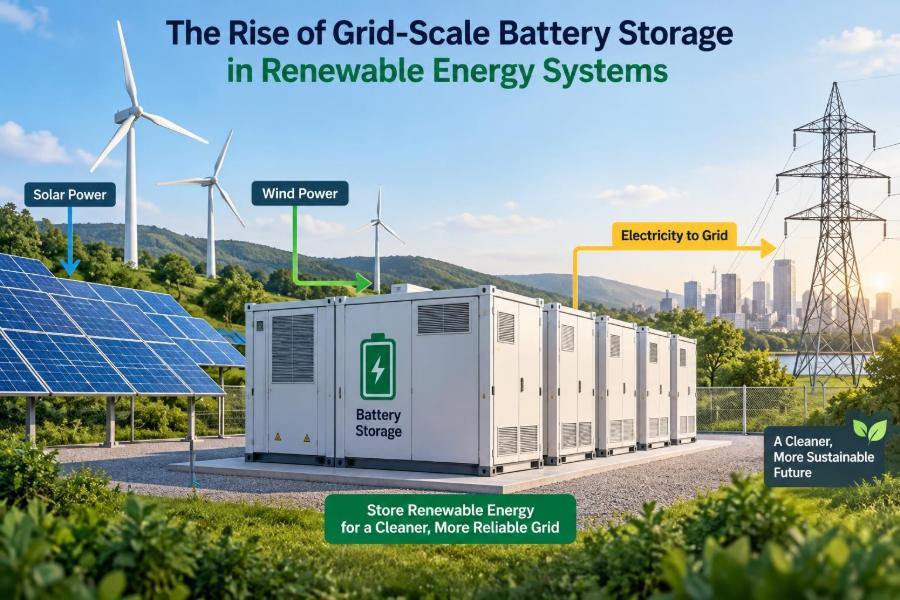
Grid-scale battery storage is becoming a central tool for managing that difference. It does not create electricity; it changes when electricity is delivered, helping the grid use clean generation more effectively while maintaining reliability.
⚡ What Grid-Scale Battery Storage Means
Grid-scale battery storage refers to battery systems connected to the electricity network at utility, transmission, or distribution level. They are much larger than phone batteries, home backup batteries, or electric-vehicle packs, although the underlying electrochemical principles are related.
A typical installation combines battery modules, racks, power-conversion equipment, transformers, control systems, cooling equipment, and safety systems. Together, these components can absorb power from the grid and later return it.
Two ratings matter immediately: power, usually expressed in megawatts (MW), and energy capacity, usually expressed in megawatt-hours (MWh). Power describes how fast a battery can charge or discharge; energy capacity describes how much electricity it can store.
🧠 The Fundamental Idea: Time-Shifting Energy
A battery is best understood as a time-shifting device. It charges when electricity is plentiful or inexpensive and discharges when electricity is scarce, expensive, or especially valuable to grid reliability.
Imagine a solar-rich region at noon. If solar generation exceeds local demand and transmission capacity, some panels may need to reduce output. A nearby battery can charge instead, then discharge into the early-evening peak when solar output has declined.
This simple shift can reduce curtailment, ease stress on conventional generators, and make better use of existing renewable facilities. The value comes from matching supply and demand more closely, not from making energy appear out of nowhere.
🔄 Charging, Discharging, and Round-Trip Losses
During charging, electrical energy is converted into chemical energy. During discharge, the chemical reactions run in the useful direction and the system’s inverter converts battery-side direct current into grid-compatible alternating current.
No battery returns every unit of energy put into it. Losses occur in the cells, cables, thermal-management equipment, and power electronics. The fraction recovered after a complete charge-discharge cycle is called round-trip efficiency.
Efficiency is only one design criterion. A project may still be useful even with losses if it prevents renewable curtailment, supplies fast reserve capacity, or avoids operating a less efficient peaking plant during critical hours.
📏 Why Power and Duration Must Be Separated
Two facilities can have the same MW rating but serve very different purposes. A high-power battery with relatively little stored energy can respond strongly for a short period. A lower-power battery with more stored energy can sustain output longer.
Duration is commonly estimated by dividing usable energy capacity by discharge power. For example, a hypothetical 100 MW system with 400 MWh of usable energy could, under simplified conditions, discharge at full power for about four hours.
Real operation is less neat. Temperature, battery aging, reserve commitments, state-of-charge limits, and inverter constraints affect available output. Engineers therefore plan using operating envelopes rather than a single ideal number.
🌞 Why Variable Renewables Create a Storage Need
Solar power follows a daily pattern, while wind output can change over minutes, hours, and seasons. Demand also changes independently: households, businesses, industrial loads, and weather all shape the load curve.
Variable generation is not automatically unreliable. Grid operators forecast weather, schedule resources, and balance many generators across broad regions. However, higher shares of wind and solar increase the value of flexible resources that can respond rapidly to differences between forecasts and reality.
Batteries are one option among several. Transmission, flexible demand, hydropower, thermal generation, interconnection between regions, and other storage technologies can all contribute.
🌇 The Evening Ramp Challenge
In solar-heavy systems, net demand seen by conventional generators may rise sharply near sunset. This occurs because solar output falls while household demand often rises as people return home, cook, cool buildings, and use appliances.
Battery storage can charge during the solar-rich part of the day and discharge through the ramp. That reduces the rate at which other generators must increase production.
This does not mean batteries eliminate every evening challenge. Their stored energy is finite, so the grid still needs enough generation, transmission, demand response, and long-duration resources for extended high-demand or low-renewable periods.
⚙️ Frequency Regulation: A Fast Grid Service
Grid frequency reflects the balance between generation and demand. When demand suddenly exceeds supply, frequency tends to fall; when generation exceeds demand, it tends to rise. Operators must correct these deviations quickly.
Batteries are well suited to frequency regulation because power electronics can change output extremely quickly. A battery can inject or absorb power without waiting for a turbine, boiler, or engine to change mechanical output.
Fast response does not replace all conventional grid-support functions, but it can improve control performance and reduce the amount of slower reserve that must be held ready.
🛡️ Reserves and Contingency Response
Power systems plan for disturbances such as an unexpected generator trip, a transmission-line outage, or a forecasting error. Reserve services provide capacity that can respond when such events occur.
A battery can be scheduled to hold some energy in reserve instead of using all of it for energy arbitrage. This creates a trade-off: energy retained for reliability cannot simultaneously be sold into another market or used for routine peak reduction.
The control strategy must also preserve room to absorb energy when required. A fully charged battery cannot keep charging, just as an empty battery cannot keep discharging.
🏗️ The Main Parts of a Battery Energy Storage System
A battery energy storage system, often abbreviated BESS, is more than a collection of cells. Reliable operation depends on coordinated electrical, thermal, mechanical, digital, and protection design.
- Battery cells and modules store energy through electrochemical reactions.
- Battery management systems monitor voltage, temperature, current, and cell balance.
- Power conversion systems use inverters to exchange power with the AC grid.
- Transformers and switchgear connect the facility safely at the required voltage.
- Thermal and fire-safety systems manage heat and limit consequences of faults.
- Plant controllers coordinate dispatch with grid requirements and market signals.
🔋 Why Lithium-Ion Dominates Many New Projects
Lithium-ion chemistry is widely used because it combines relatively high energy density, good efficiency, rapid response, and a supply chain developed partly through consumer electronics and electric vehicles. Several lithium-ion chemistries exist, with different trade-offs in energy density, thermal behavior, lifetime, and material use.
For stationary projects, compact size is helpful but not the only priority. Safety behavior, warranty terms, availability, operating temperature, and expected cycling profile may matter just as much.
It is misleading to treat “lithium-ion” as one uniform technology. Project performance depends on the particular cell chemistry, enclosure design, controls, and operating conditions.
🧪 Other Storage Technologies in the Mix
Lithium-ion is not the only path. Pumped-storage hydropower stores energy by moving water between elevations, while flow batteries store energy in liquid electrolytes held in external tanks. Other concepts include compressed-air storage, thermal storage, gravity-based systems, sodium-based batteries, and hydrogen pathways.
Different technologies may fit different durations, sites, climates, and duty cycles. A system designed for rapid, frequent response does not necessarily need the same characteristics as one intended to shift energy across many hours.
Technology selection should start with the grid problem to be solved, not with a preferred device. The question is not simply “Which battery is best?” but “What capability is missing, for how long, and how often?”
🗺️ Where Batteries Connect to the Grid
Large batteries may connect to the transmission network, to a distribution feeder, or directly beside a renewable generator. Location can be as important as total capacity.
A transmission-connected battery may support a wider region and participate in wholesale services. A distribution-connected battery may relieve a constrained substation or feeder, delaying costly network upgrades.
Co-located solar or wind projects can share some infrastructure and reduce curtailment, but they also need careful controls. The battery may charge from the renewable plant, from the wider grid, or both, depending on its interconnection agreement and operating rules.
🧩 Standalone, Co-Located, and Hybrid Designs
A standalone battery has its own grid connection and can charge or discharge according to system needs. It may be placed where congestion, demand growth, or reliability needs are greatest.
A co-located battery shares a site with generation, commonly solar. This can make use of available land and interconnection equipment, although a shared connection can impose export and import limits.
A hybrid plant coordinates multiple technologies as one operational asset. For example, solar may supply daytime energy while storage shapes the plant’s output into a smoother, more dispatchable delivery profile.
📈 Energy Arbitrage and Its Limits
Energy arbitrage means charging when prices are lower and discharging when prices are higher. Price differences can reflect changing demand, renewable output, fuel costs, network conditions, or scarcity.
Arbitrage can support useful grid behavior, but it is not a guaranteed business case. The battery must cover energy losses, degradation, operating costs, financing costs, and the possibility that price spreads narrow as more flexible resources enter the market.
Revenue stacking—earning from more than one service—can improve project economics, but it requires compatible commitments. A battery cannot promise its full capacity to several services at the same moment without clear dispatch priorities.
🧮 State of Charge Is an Operating Constraint
State of charge (SOC) estimates how much usable energy remains in the battery. Operators manage SOC continuously because it determines whether the asset can provide the service it has been scheduled to deliver.
For a battery providing upward and downward frequency response, staying near the middle of its SOC range may be useful. It leaves room to discharge if the grid needs power and room to charge if the grid has excess power.
SOC estimation is not perfectly simple. It relies on measurements and models, and accuracy can drift with temperature, aging, and changing cell behavior. Conservative operating margins help protect reliability.
📉 Degradation Changes the Long-Term Plan
Battery capacity and power capability decline over time. Degradation is influenced by calendar aging, cycling depth, charging and discharging rates, temperature, time spent at high SOC, and cell chemistry.
Project developers account for this by defining usable operating ranges, planning augmentation, and specifying performance guarantees carefully. Augmentation means adding or replacing battery capacity to maintain a target service level as the original equipment ages.
A common mistake is to evaluate a project using only day-one performance. A sound design examines the expected duty cycle across its full operating life and considers how dispatch choices affect wear.
🌡️ Temperature Control Is Not Optional
Battery cells operate best within defined temperature ranges. High temperatures can accelerate aging and increase safety concerns, while low temperatures can reduce available power and affect charging behavior.
Thermal management may use air or liquid cooling, heaters, ventilation, sensors, and control logic. These systems consume energy, so the site’s auxiliary load is part of real-world performance.
Climate matters. A design that works well in a mild location may need different cooling, insulation, or operating limits in a hot desert, humid coast, or cold interior region.
🔥 Fire Safety Requires Layered Engineering
Battery safety cannot be reduced to one device or one checklist. Cell selection, spacing, enclosure design, fault detection, ventilation, emergency response planning, and maintenance all form part of a layered approach.
In some fault conditions, a cell can enter thermal runaway, a self-heating failure that may spread if not controlled. The likelihood and consequences depend on chemistry, system architecture, fault type, and the effectiveness of mitigation measures.
Projects should be designed with local authorities and emergency responders in mind. Clear site access, monitoring information, isolation procedures, and response plans are practical safety features, not paperwork afterthoughts.
🔌 Inverters and Grid-Forming Capability
Most batteries connect through inverters. These devices control the conversion between DC battery power and AC grid power while meeting voltage, frequency, and protection requirements.
Many inverter-based resources follow an existing grid voltage waveform. Grid-forming inverters are designed to establish or actively support voltage and frequency under specified conditions, which can be valuable as power systems contain fewer synchronous machines.
Grid-forming capability is promising but not a universal switch that solves every stability issue. Its successful use depends on detailed control settings, protection coordination, system strength, and interaction with other equipment.
🧲 Inertia, Stability, and a Changing Grid
Traditional synchronous generators have rotating masses that naturally resist rapid frequency change. Wind and solar plants connected through power electronics do not provide this physical inertia in the same way.
Batteries can deliver very fast controlled power, sometimes described as synthetic or virtual inertia when configured for that purpose. Their response can help stabilize frequency, but it is governed by controls and available energy rather than by stored rotational momentum alone.
Engineers must study the complete system: fault levels, voltage behavior, control interactions, protection settings, and communication delays. Fast equipment can still create problems if controls are poorly coordinated.
🚧 Transmission Congestion and Local Value
Renewable resources are often strongest where population is sparse: sunny deserts, windy plains, or offshore areas. Transmission lines may be unable to carry all available generation to demand centers at particular times.
A battery located near congestion can charge when a line is constrained and discharge later when capacity is available or local demand is higher. This may reduce curtailment and postpone some upgrades.
Storage is not always a substitute for transmission. If a region persistently lacks enough network capacity, a battery may merely shift congestion from one hour to another. Planning must compare alternatives over the relevant time horizon.
🏘️ Distribution-Level Benefits
On local networks, batteries can reduce peak loading on transformers and feeders. If a neighborhood’s evening demand approaches equipment limits, a strategically placed battery can discharge during the few critical hours.
This approach is sometimes called non-wires investment because it can defer or avoid a conventional network upgrade. It works best when the overload is limited in duration and location.
Distribution applications demand detailed local data. A battery that looks valuable using an annual peak may be poorly sized if the constraint occurs only under a particular combination of weather, customer behavior, and equipment outage conditions.
💡 Capacity Value Is Different from Energy Value
Energy value concerns the electricity a battery delivers over time. Capacity value concerns whether the battery can be counted on to contribute during periods when the system is most stressed.
A four-hour battery may be highly useful during an evening peak, yet less suitable if stress conditions extend through a long, low-renewable event. The appropriate duration depends on the system’s risk profile, not on a universal rule.
Reliable capacity assessment must account for charging opportunities. A battery cannot contribute at full output during a peak if it was unable to charge beforehand or if its energy was used for another obligation.
🌧️ Weather Events and Resilience
Batteries can support resilience by providing local power, black-start assistance in some designs, or backup for critical loads when combined with suitable islanding equipment. They can also help manage rapid renewable changes during weather fronts.
However, a grid-connected battery does not automatically keep a building energized during an outage. Safe backup requires transfer equipment, protection schemes, and a clearly designed microgrid or islanding arrangement.
For long outages, battery duration becomes decisive. Pairing storage with local solar, fuel-based generation, demand management, or other resources may extend service, but each arrangement has operational limits.
🧾 Market Rules Shape Battery Behavior
Physical capability does not automatically become revenue. Interconnection requirements, dispatch rules, market products, metering arrangements, and performance penalties determine what services a battery can actually provide.
Poorly designed rules can discourage flexible behavior—for example, by treating charging as ordinary consumption without recognizing the system service later supplied. Conversely, weak performance requirements can overstate dependable capability.
Engineers, regulators, and market designers need a shared view of technical limits. A contract should specify response time, duration, availability, SOC management, testing methods, and consequences when performance cannot be delivered.
🧰 Control Software Makes the Asset Useful
Battery hardware needs intelligent dispatch. A plant controller may receive market schedules, renewable forecasts, grid operator commands, equipment status, and SOC data, then decide how to operate the system within safety limits.
Forecasting matters because charging at the wrong time can leave the battery unavailable for the evening peak. Optimization tools weigh likely prices and grid needs against degradation and contractual commitments.
Automation should not mean blind automation. Operators need visibility, alarms, tested fallback modes, and the ability to understand why the system acted as it did.
🔐 Cybersecurity and Communications Risks
Grid batteries rely on digital controls and communications, making cybersecurity part of electrical reliability. Unauthorized access, corrupted settings, lost communications, or poor network segmentation can impair operation or create unsafe states.
Good practice includes access control, secure update processes, logging, network segmentation, and defined behavior when communications are lost. The exact measures depend on the project’s architecture and regulatory setting.
Cybersecurity is not a one-time commissioning task. Firmware, operating practices, vendor access, and threat conditions change over the life of the asset.
♻️ Materials, Recycling, and Lifecycle Questions
Battery deployment raises legitimate questions about mining, manufacturing energy, transportation, replacement, and end-of-life treatment. These impacts vary by chemistry, supplier practices, location, and how the system is operated.
Recycling can recover valuable materials, but collection systems, process economics, and regulations continue to develop. Reuse in less demanding applications may be possible for some batteries, though testing and safety evaluation are essential.
A balanced lifecycle discussion avoids two extremes: batteries are neither impact-free nor inherently disqualified by their material footprint. Their environmental value depends on the full system they enable and how responsibly they are made, used, and managed.
🧑🔧 Practical Questions for Engineers and Project Teams
Before selecting a technology or size, define the service precisely. “Store renewable energy” is a broad aspiration, not an engineering specification.
- What grid constraint or operational problem is the system solving?
- What power, usable energy, response time, and duration are required?
- How often will the battery cycle, and at what depth of discharge?
- What charging source and interconnection limits apply?
- Which services can occur simultaneously without conflicting?
- How will degradation, augmentation, maintenance, safety, and end-of-life be handled?
Clear answers prevent a familiar failure mode: procuring an impressive battery rating that does not match the actual grid need.
⚠️ Common Misconceptions to Avoid
One misconception is that batteries replace all generation. They do not; they store electricity produced elsewhere and are limited by energy duration. Another is that every battery is equally useful for every service. Power, duration, location, controls, and interconnection determine usefulness.
It is also incorrect to assume that a battery near renewable generation always charges exclusively from that plant. Its electrical and contractual arrangement may permit other charging patterns.
Finally, fast response should not be confused with unlimited resilience. A battery can react in milliseconds yet still run out of stored energy after its designed duration.
🔭 What the Next Phase of Deployment Requires
As storage grows, attention is shifting from installing isolated assets to coordinating fleets of batteries with renewable plants, flexible loads, and stronger transmission networks. The challenge is increasingly one of system design rather than equipment availability alone.
Better forecasting, interoperable controls, clear grid codes, trained emergency responders, transparent performance testing, and thoughtful market rules will all influence outcomes. So will careful attention to local communities, land use, noise, safety, and supply-chain practices.
The most successful projects will be those that treat storage as part of a larger electricity system—not as a standalone cure for every energy problem.
✅ The Core Takeaway: Storage Adds Flexibility
Grid-scale batteries are valuable because modern power systems need flexibility: the ability to absorb surplus electricity, deliver power quickly, support voltage and frequency, and shift energy toward periods of need.
They are particularly effective when their power rating, duration, location, control strategy, and safety design match a clearly defined grid requirement. A short-duration battery can be excellent for fast balancing and peak support, while longer challenges may require a broader portfolio of solutions.
The central engineering principle is straightforward: storage creates the most value when it is designed around the specific time, place, and reliability problem the grid must solve.
Grid-scale batteries will not replace careful grid planning, but they give renewable energy systems a powerful new way to turn variable production into dependable service. 🔋⚡🌍