
A factory conveyor does not always need to run at full speed. A building’s water pump does not need to deliver maximum flow every minute of the day. Yet many motors were traditionally connected directly to the electrical supply, leaving them with only two practical states: on at full speed, or off.
That approach can waste energy, create mechanical stress, and make a process harder to control. It is a little like driving a car with the accelerator fixed to the floor and using only the brakes to regulate speed.
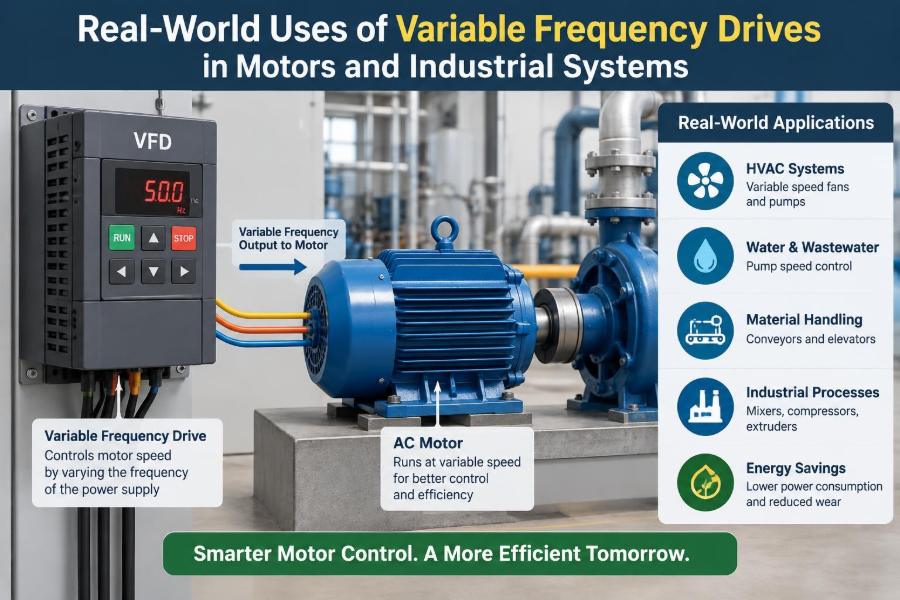
Variable frequency drives, usually called VFDs, give motor-driven equipment a far more useful middle ground. They let operators match motor speed to the actual requirement of a fan, pump, conveyor, mixer, or machine.
VFDs are now common across industrial plants, commercial buildings, utilities, and infrastructure. Understanding where they help—and where they require careful engineering—is valuable for anyone working with electric motors.
⚙️ What a Variable Frequency Drive Does
A VFD is an electronic power controller that changes the frequency and voltage supplied to an AC motor. Because an induction motor’s speed is closely related to supply frequency, changing frequency changes the motor’s operating speed.
The drive first converts incoming AC power to DC, then uses high-speed switching devices to create a controlled AC output. This process is often called an AC-DC-AC conversion.
🧲 Why Frequency Changes Motor Speed
The rotating magnetic field inside an AC motor has a synchronous speed determined mainly by supply frequency and the number of motor poles. A four-pole motor supplied at 50 Hz has a lower synchronous speed than the same motor supplied at 60 Hz.
An induction motor runs slightly below synchronous speed because it needs slip to produce torque. A VFD does not eliminate slip, but it gives the control system a practical way to set speed across a broad operating range.
🔌 The Basic Parts Inside a VFD
Most drives contain a rectifier, a DC bus, an inverter, control electronics, protective functions, and a user interface or communications connection. The rectifier accepts incoming AC; the DC bus smooths and stores energy; the inverter produces a variable-frequency output.
The inverter usually uses pulse-width modulation, or PWM. Rather than creating a perfectly smooth sine wave directly, it switches voltage pulses rapidly enough that the motor responds to their controlled average effect.
📈 Speed Control Is Not the Only Benefit
Speed adjustment is the most visible feature, but a VFD also controls acceleration, deceleration, torque behavior, direction, and fault response. This makes a motor system more adaptable than a basic across-the-line starter.
For example, a conveyor can ramp up gently after a stop instead of abruptly pulling products, belts, and gearboxes into motion. That improvement may matter as much as the speed setting itself.
🌬️ Fans in HVAC Systems
Air-handling units, cooling towers, exhaust systems, and ventilation fans are among the most familiar VFD applications. Building demand changes with occupancy, weather, heat loads, and operating schedules, so fixed fan speed is often unnecessarily rigid.
A drive can respond to duct static pressure, air quality, temperature, or a building automation command. Instead of cycling a fan harshly between full output and zero, the system can maintain the required airflow more steadily.
💧 Pumping Systems and Flow Control
Water supply, wastewater treatment, irrigation, process water, and booster systems frequently use VFD-controlled pumps. When demand falls, reducing pump speed can be preferable to forcing excess flow through a throttling valve.
Valve control is still useful in many systems, especially where precise local control is needed. But where a pump’s duty point varies widely, speed control can reduce unnecessary pressure losses and improve process stability.
📐 Why Pumps and Fans Can Save Significant Energy
For centrifugal pumps and fans, the affinity laws provide a useful approximation: flow changes roughly with speed, pressure changes roughly with the square of speed, and power changes roughly with the cube of speed.
That cubic relationship explains why modest speed reductions can substantially reduce power demand in suitable variable-torque loads. Real results depend on the system curve, equipment efficiency, controls, and operating hours; it should not be treated as a universal savings formula.
🏭 Conveyors and Material Handling
Conveyors move packages, ore, food products, pallets, baggage, and countless other materials. A VFD lets the belt speed match upstream and downstream equipment, preventing accumulation or starvation.
In a packaging line, for instance, a controller may slow an infeed conveyor when a downstream machine pauses. This coordinated response can reduce jams, product damage, and manual intervention.
🍞 Mixers, Extruders, and Process Machines
Food processing, plastics, chemicals, pharmaceuticals, and paper production often require controlled agitation or feed rates. A mixer may need one speed during ingredient addition and another during blending.
VFDs support repeatable recipes because speed can be stored as a setpoint and adjusted automatically. The drive must still be selected for the load: a high-inertia mixer or extruder may demand strong low-speed torque and suitable overload capability.
🏗️ Cranes, Hoists, and Controlled Motion
Hoists, elevators, cranes, and winches need controlled acceleration and deceleration to manage suspended loads. VFDs can provide smooth motion profiles and help reduce mechanical shock.
These are safety-critical applications. A standard general-purpose drive is not automatically appropriate for a hoist; braking, load holding, overspeed protection, functional safety, and applicable machine requirements need dedicated engineering.
❄️ Compressors and Refrigeration Loads
Variable-speed compressors can match cooling or refrigeration capacity to changing demand. This is useful in chilled-water systems, cold storage, process cooling, and heat-pump equipment.
However, compressor operating envelopes matter. Minimum speed, oil return, lubrication, discharge temperature, surge behavior, and manufacturer limits can restrict the usable speed range.
⛏️ Mining, Cement, and Heavy Industry
Large mills, crushers, conveyors, and fans often operate in demanding environments with high power levels and difficult starting conditions. Drives can reduce electrical and mechanical stress during starting while providing process control after startup.
At higher power ratings, medium-voltage drives may be used rather than low-voltage equipment. Their selection involves electrical supply characteristics, harmonic performance, motor insulation, redundancy needs, and maintainability.
🚰 Water and Wastewater Treatment
Treatment plants use motors continuously for pumping, aeration, mixing, screening, and sludge handling. Flow and biological process conditions vary, making fixed-speed operation a poor fit for many duties.
Aeration blowers are a notable example because airflow can be controlled in response to dissolved oxygen measurements. Poorly tuned control can cause unstable cycling, so the sensor, controller, blower, and VFD must work as one system.
🏢 Building Services Beyond Ventilation
Commercial buildings use drives on chilled-water pumps, condenser-water pumps, cooling tower fans, domestic water boosters, and parking-garage exhaust fans. These systems often spend long periods below peak demand.
VFDs also support quieter operation at reduced speed, which can be valuable in offices, hospitals, hotels, and residential buildings. Lower speed does not solve every noise problem, but it can reduce airflow and mechanical noise.
🚜 Agriculture and Irrigation
Farm irrigation systems may face changing pressure and flow requirements across fields, zones, and seasons. A VFD can maintain a target pressure while reducing speed as valves close or demand declines.
Motor and drive enclosures need to suit dust, moisture, temperature, and outdoor installation conditions. Electrical control is useful only if it remains reliable in the actual field environment.
🔋 Soft Starting Compared with Speed Control
A soft starter reduces voltage during motor starting to limit inrush current and mechanical shock. Once the motor reaches operating speed, it generally runs from the fixed-frequency supply.
A VFD can also provide a soft start, but it continues controlling speed during operation. If the application only needs gentler starts and always operates at full speed, a soft starter may be the simpler choice.
| Feature | Soft starter | VFD |
|---|---|---|
| Starting current control | Yes | Yes |
| Continuous speed control | No | Yes |
| Energy reduction on variable-torque loads | Limited | Often possible |
| Output waveform | Line frequency after start | Variable-frequency PWM output |
🚦 Acceleration Ramps Protect Equipment
Starting a motor abruptly can strain couplings, belts, chains, pumps, and driven machinery. A VFD ramp sets how quickly the motor moves from one speed to another.
A ramp that is too fast can still cause overcurrent or mechanical stress. A ramp that is too slow may be unacceptable for process timing, and a vertical load may require braking control rather than a simple deceleration ramp.
🛑 Stopping, Braking, and Regeneration
When a motor decelerates, the driven machine may return energy to the drive. This can raise DC bus voltage, especially with high-inertia loads or overhauling loads such as a descending hoist.
Drives may manage this energy with a longer deceleration time, a braking resistor, a regenerative unit that returns energy to the supply, or a common DC bus arrangement. The correct choice depends on how often and how intensely braking occurs.
🎯 Control Modes: Scalar, Vector, and Servo
Basic volts-per-hertz control, often called scalar control, maintains a suitable relationship between voltage and frequency. It works well for many fans, pumps, and straightforward conveyor duties.
Vector control estimates or measures motor behavior more closely, improving torque control and low-speed performance. Servo systems are typically selected when highly precise position, speed, and dynamic response are required, such as in robotics or indexing machinery.
🧠 Sensors, Feedback, and Automation
A VFD can accept commands from a keypad, analog signal, digital inputs, fieldbus network, programmable logic controller, or building automation system. It can also send speed, current, alarm, temperature, and status data back to operators.
Closed-loop control uses a measurement—such as pressure, flow, level, or tension—to adjust speed automatically. The feedback device must be installed and calibrated correctly; a poor sensor can make an otherwise capable drive behave poorly.
🌀 Motor Cooling at Low Speed
Many motors use a shaft-mounted fan for cooling. When a VFD runs such a motor slowly for extended periods, that fan also turns slowly, reducing airflow over the motor frame.
Constant-torque loads may therefore need a separately powered blower, a larger motor, a restricted low-speed operating period, or a motor designed for inverter duty. Checking only electrical current is not enough to confirm safe thermal operation.
⚡ Harmonics and Power Quality
Because a VFD rectifies AC power, it can draw current in non-sinusoidal pulses. These harmonic currents may affect transformers, generators, cables, and other equipment, particularly where many drives share a supply.
Possible mitigation methods include line reactors, DC chokes, passive filters, active filters, multi-pulse arrangements, or low-harmonic drive designs. The appropriate approach requires a site-specific assessment rather than a one-size-fits-all component choice.
📡 EMC, Cable Effects, and Motor Insulation
PWM output contains rapid voltage transitions. Long motor cables can create reflected-wave voltage peaks that stress motor insulation, particularly with older motors or higher-voltage systems.
Output reactors, sine-wave filters, dV/dt filters, correct cable selection, shielding, grounding, and installation practice can address these concerns. Electromagnetic compatibility, or EMC, also matters when sensitive instrumentation is nearby.
🛡️ Protective Functions Are Valuable but Not Complete
Modern drives commonly provide overcurrent, overload, phase-loss, ground-fault, overtemperature, and stall-related protections. These functions can improve fault visibility and protect equipment when configured correctly.
They do not replace all external protection or safety design. Fuses, circuit breakers, disconnects, motor thermal protection, emergency-stop arrangements, and machine safeguarding must follow the equipment design and applicable requirements.
🔧 Selecting a Drive Starts with the Load
Drive selection should begin with the driven machine, not simply the motor nameplate. A fan, positive-displacement pump, conveyor, crusher, and hoist can have very different torque-versus-speed behavior.
- Variable-torque loads: centrifugal fans and pumps, where torque generally falls as speed falls.
- Constant-torque loads: conveyors, mixers, extruders, and positive-displacement pumps.
- Constant-power regions: some machine tools and winding systems operating above base speed.
- High-inertia loads: large fans, centrifuges, and flywheels that influence acceleration and braking demands.
🏷️ Nameplate Data Is Necessary, Not Sufficient
Motor voltage, current, power, frequency, speed, service factor, insulation class, and duty information are essential inputs. The drive must be compatible with the supply and able to provide required current under actual operating conditions.
Ambient temperature, altitude, enclosure rating, cabinet ventilation, overload duty, cable length, and expected maintenance access also affect selection. A correctly sized drive on paper can still fail if installed in a hot, dusty, poorly ventilated enclosure.
🧰 Commissioning Is Where Performance Becomes Real
Commissioning includes verifying wiring, grounding, motor rotation, parameter settings, acceleration behavior, protective thresholds, control signals, and process response. Auto-tuning, where supported and appropriate, helps the drive model the connected motor.
Before enabling automatic control, test manual operation and confirm safe limits. A pressure loop with reversed feedback action, for example, can command the pump in the wrong direction of correction.
⚠️ Common VFD Application Mistakes
Many issues arise from treating a VFD as a universal plug-in accessory. The equipment is flexible, but its settings and installation details have direct effects on motor life, process behavior, and electrical performance.
- Using a standard motor at low speed without checking cooling.
- Ignoring minimum-flow or minimum-speed limits for pumps and compressors.
- Choosing an acceleration time without considering load inertia.
- Running long unfiltered motor cables without evaluating reflected-wave effects.
- Using incorrect motor nameplate parameters or leaving factory defaults in place.
- Placing a drive in a contaminated or overheated panel without adequate cooling.
🔍 Maintenance and Troubleshooting Practices
Drives benefit from planned inspection. Check cooling fans, heat sinks, cabinet filters, terminal tightness, contamination, alarm history, and signs of capacitor aging according to the manufacturer’s maintenance guidance.
When troubleshooting, separate electrical symptoms from process symptoms. A drive fault may result from a blocked pump, binding conveyor, poor supply quality, loose connection, incorrect parameter, or genuine internal failure.
🌱 When a VFD Is Not the Best Answer
A VFD adds cost, electronics, installation requirements, and possible power-quality concerns. For a small motor that always runs at one speed with few starts, direct-on-line operation may remain entirely sensible.
Likewise, a process may require fixed mechanical speed, or it may be better served by a different motor type, mechanical transmission change, soft starter, or redesigned control strategy. Good engineering starts with the duty, not with a preferred technology.
🧭 The Core Principle: Match Motion to Demand
The central value of a VFD is not merely that it makes a motor turn slower. It lets a motor-driven system deliver the flow, pressure, movement, torque, or process rate that the application actually needs.
That capability can improve control, reduce mechanical shock, lower energy use in suitable loads, and provide better operating information. It also introduces responsibilities: correct sizing, motor compatibility, electrical design, commissioning, and maintenance are all part of a successful installation.
Variable frequency drives are most effective when they are treated as part of the complete motor-and-process system, not as an isolated speed knob. Applied with that perspective, they make industrial motion more controlled, responsive, and practical. ⚡🏭🔧