
Modern electrical power systems are designed around nearly sinusoidal voltage and current waveforms. In an ideal AC system, voltage rises and falls smoothly at a fundamental frequency—commonly 50 Hz or 60 Hz, depending on the country.
Real electrical systems, however, are often far from ideal.
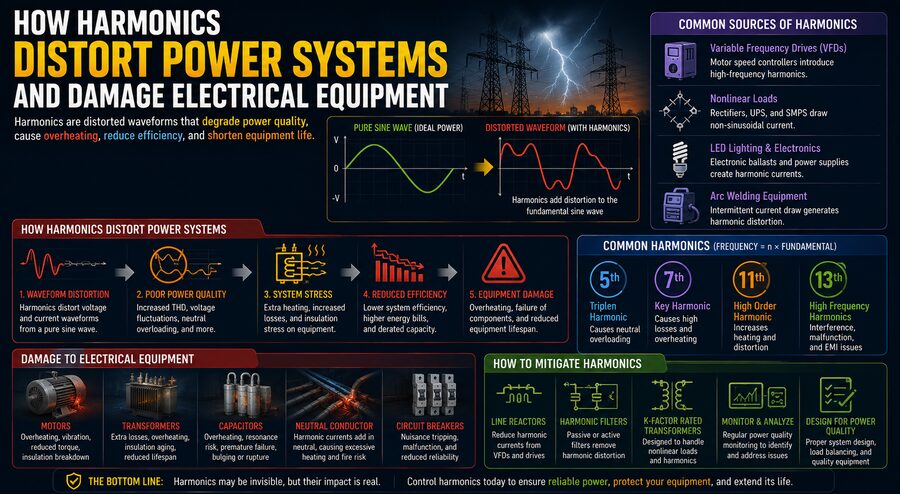
Electronic devices such as variable-frequency drives, computers, LED lighting, battery chargers, uninterruptible power supplies, industrial rectifiers, and other nonlinear loads can draw current in short pulses rather than as a smooth sine wave. These distorted currents create additional frequency components called harmonics. ⚙️🔌
Harmonics can increase heating, overload neutral conductors, interfere with sensitive electronics, reduce transformer capacity, cause capacitor failures, disturb protective equipment, and decrease the overall efficiency of an electrical installation.
Understanding harmonics is therefore essential in industrial facilities, commercial buildings, data centers, renewable-energy systems, and modern power grids.
🌊 What Is an Electrical Harmonic?
A harmonic is a sinusoidal component whose frequency is an integer multiple of the system’s fundamental frequency.
Suppose a power system operates at 50 Hz.
Its harmonics include:
- Fundamental = 50 Hz
- 2nd harmonic = 100 Hz
- 3rd harmonic = 150 Hz
- 5th harmonic = 250 Hz
- 7th harmonic = 350 Hz
For a 60 Hz system:
- Fundamental = 60 Hz
- 3rd harmonic = 180 Hz
- 5th harmonic = 300 Hz
- 7th harmonic = 420 Hz
The fundamental component is the normal operating frequency.
Higher-frequency harmonics combine with it and change the shape of the electrical waveform.
Instead of a smooth sine wave, the current or voltage may become flattened, peaked, notched, or otherwise distorted. 📈
🔍 Where Do Harmonics Come From?
Harmonics are primarily produced by nonlinear electrical loads.
A linear load draws current approximately proportional to the applied voltage.
Traditional resistive heating is a good example.
If the voltage waveform is sinusoidal, the current waveform is also essentially sinusoidal.
A nonlinear load behaves differently.
Its current does not follow the voltage proportionally.
Instead, electronic switching components may draw current only during certain parts of each AC cycle.
This produces a nonsinusoidal current waveform containing harmonic frequencies.
Common harmonic-producing loads include:
- 💻 Computers and servers
- ⚙️ Variable-frequency drives
- 💡 LED drivers
- 🔋 Battery chargers
- 🖥️ Switched-mode power supplies
- 🏭 Industrial rectifiers
- 🚗 EV charging equipment
- ☀️ Solar inverters
- 🔌 UPS systems
As modern electrical installations contain more power electronics, harmonic management becomes increasingly important.
🖥️ Switched-Mode Power Supplies
Computers, monitors, telecommunications equipment, and many other electronic devices use switched-mode power supplies, or SMPS.
These power supplies convert incoming AC electricity into regulated DC voltage.
Traditional designs may draw current mainly near the peaks of the AC voltage waveform.
Instead of drawing smooth current throughout the cycle, they draw short, relatively high-current pulses.
When thousands of electronic devices operate in the same building, their combined effect can create substantial harmonic current.
Modern power-factor-correction circuits can reduce this problem, but harmonic distortion remains an important consideration in large electronic loads.
⚙️ Variable-Frequency Drives
Variable-frequency drives (VFDs) control the speed of AC motors and are widely used in:
- Pumps
- Fans
- Compressors
- Conveyors
- HVAC systems
- Industrial machinery
A typical VFD first converts AC input power into DC using a rectifier.
The DC is then switched electronically to produce variable-frequency output power for the motor.
The input rectifier draws nonlinear current.
Traditional six-pulse drives commonly produce significant:
- 5th harmonics
- 7th harmonics
- 11th harmonics
- 13th harmonics
Large groups of VFDs can therefore become major harmonic sources in factories and commercial facilities.
📐 How Harmonics Distort a Waveform
Any periodic distorted waveform can mathematically be represented as a combination of sinusoidal waves at different frequencies.
This idea comes from Fourier analysis.
For example, a distorted current waveform might contain:
Fundamental current + 3rd harmonic + 5th harmonic + 7th harmonic + higher harmonics
When all these components are added together, the result is the actual distorted waveform measured in the electrical system.
The more significant the harmonic components become, the further the waveform moves away from an ideal sine wave.
📊 Total Harmonic Distortion
Engineers commonly quantify distortion using Total Harmonic Distortion, abbreviated THD.
For voltage, voltage THD compares the combined magnitude of harmonic voltages with the fundamental voltage.
Conceptually:
THD = Harmonic Content ÷ Fundamental Component × 100%
A low THD means the waveform is relatively close to sinusoidal.
A high THD means substantial distortion is present.
Current THD and voltage THD should be interpreted separately because a nonlinear load may draw highly distorted current while the supply voltage remains relatively clean.
⚡ Current Harmonics vs. Voltage Harmonics
Nonlinear loads primarily generate harmonic currents.
Those currents flow through cables, transformers, generators, and other system impedances.
Every electrical conductor has some impedance.
When harmonic current passes through that impedance, it produces harmonic voltage drops.
Therefore:
Nonlinear load → Harmonic current → Voltage drop across system impedance → Voltage distortion
This means one customer’s nonlinear equipment can potentially affect other equipment connected to the same electrical network.
A strong electrical supply with low impedance usually experiences less voltage distortion for a given amount of harmonic current.
🔥 Why Harmonics Cause Additional Heating
One of the most important consequences of harmonic currents is increased heating.
Electrical losses in conductors are related approximately to:
P = I²R
If harmonic currents increase the total RMS current, resistive heating increases.
Higher-frequency currents can also increase effective conductor resistance because of effects such as:
- Skin effect
- Proximity effect
As a result, cables and busbars may run hotter than expected even when the useful fundamental-frequency power appears reasonable.
Excessive heating accelerates insulation aging and can reduce equipment life.
🧲 Transformer Heating
Transformers can be particularly sensitive to harmonics.
Harmonic currents increase copper losses in transformer windings.
Higher-frequency components can also increase eddy-current and stray losses in conductive parts.
This produces extra heat.
A transformer serving many nonlinear loads may therefore need to be derated or specifically designed for harmonic environments.
Some installations use K-rated transformers, which are designed to tolerate greater harmonic-current heating.
However, a K-rated transformer does not remove harmonics.
It is designed to withstand their thermal effects more effectively.
🔥 Neutral Conductor Overheating
Three-phase electrical systems create a particularly important harmonic problem involving the neutral conductor.
Under ideal balanced linear loading, phase currents largely cancel in the neutral.
However, certain harmonics—especially triplen harmonics such as the:
- 3rd
- 9th
- 15th
behave differently.
These harmonic currents from the three phases can be in phase with each other in the neutral conductor.
Instead of canceling, they add.
This means the neutral current can sometimes become unexpectedly large, potentially even exceeding individual phase currents in heavily loaded systems with large nonlinear single-phase loads.
This has historically been a concern in:
- Office buildings
- Data centers
- Lighting systems
- Facilities with many computers
An undersized neutral conductor can overheat and create a fire risk. 🔥
⚙️ Harmonics and Electric Motors
Harmonics can negatively affect motors.
Harmonic voltages create additional magnetic fields inside the machine.
Some harmonic components rotate in directions or at speeds different from the fundamental field.
Possible consequences include:
- Increased motor heating
- Reduced efficiency
- Additional vibration
- Increased acoustic noise
- Torque pulsations
In severe cases, prolonged overheating can shorten winding insulation life.
Motors supplied directly from distorted networks may therefore require careful evaluation.
🧯 Capacitor Damage
Power-factor-correction capacitors are especially vulnerable to harmonic problems.
The reactance of a capacitor decreases as frequency increases.
This means higher-frequency harmonic currents can flow more easily through capacitors.
A capacitor bank designed primarily for fundamental-frequency reactive-power compensation may therefore experience unexpectedly large harmonic currents.
Consequences can include:
- Excessive heating
- Fuse operation
- Bulging capacitors
- Premature failure
- Insulation damage
The problem can become even more serious when resonance occurs.
🎯 What Is Electrical Resonance?
Electrical systems contain both inductance and capacitance.
At certain frequencies, these properties can interact to create resonance.
If the resonant frequency of the electrical network is close to a major harmonic frequency, relatively small harmonic sources can produce large currents or voltages.
For example, adding a capacitor bank may unintentionally create resonance near the 5th harmonic.
The harmonic current can then become greatly amplified.
This may damage:
- Capacitors
- Transformers
- Cables
- Switchgear
Engineers therefore often perform harmonic studies before installing large capacitor banks in facilities with substantial nonlinear loads.
🧰 Protective Device Problems
Harmonics can also affect circuit breakers, relays, and other protection equipment.
Higher RMS current can cause thermal protection devices to operate unexpectedly.
Distorted waveforms can also influence equipment that relies on waveform shape, zero crossings, or frequency measurements.
Modern digital protection systems are generally designed to tolerate many distorted conditions, but severe harmonic environments can still complicate measurement and coordination.
False trips or failure to operate correctly can become serious reliability concerns.
📏 Metering and Measurement Errors
Some older measuring instruments assume that current and voltage are sinusoidal.
When waveforms are distorted, these instruments may produce inaccurate measurements.
Modern true-RMS meters are better suited to nonlinear loads.
A standard averaging meter may incorrectly estimate current when the waveform contains large peaks.
Accurate harmonic analysis often requires dedicated power-quality analyzers capable of measuring:
- Harmonic spectrum
- THD
- RMS current
- Crest factor
- Power factor
Correct measurement is essential before choosing mitigation equipment.
⚖️ Harmonics and Power Factor
Power factor becomes more complicated in systems containing harmonics.
With ideal sinusoidal waveforms, power factor is often associated primarily with the phase angle between voltage and current.
This is called displacement power factor.
With distorted current, another effect appears: distortion power factor.
Therefore, a system may have a reasonably good displacement power factor while still having poor overall true power factor because of harmonic current.
This is one reason simply installing capacitors may not fully solve power-quality problems.
📡 Electromagnetic Interference
Higher-frequency currents can contribute to electromagnetic interference.
Harmonic-rich systems may create interference in:
- Communication lines
- Audio systems
- Instrumentation
- Control circuits
Careful grounding, cable routing, filtering, and shielding may be required where sensitive low-level signals operate near large nonlinear power loads.
Industrial facilities with variable-speed drives often pay close attention to separation between power and instrumentation wiring.
💡 Harmonics in LED Lighting
Modern LED lighting is highly efficient, but its electronic drivers can create nonlinear current.
High-quality drivers include power-factor correction and harmonic-control circuitry.
Lower-quality devices may produce much more distorted current.
When thousands of LED fixtures are installed in a large commercial building, even relatively small harmonic contributions from each fixture can accumulate.
Lighting-system harmonic performance should therefore be considered in large installations.
🚗 Electric Vehicle Chargers
EV chargers use power-electronic converters to transfer energy from the grid into vehicle batteries.
Poorly designed chargers could create significant harmonic current.
Modern charging equipment typically incorporates control techniques intended to maintain good power factor and low distortion.
However, as large numbers of chargers are connected to parking facilities, depots, and distribution networks, engineers increasingly analyze their collective power-quality impact. 🔋⚡
☀️ Solar and Battery Inverters
Solar photovoltaic systems and battery energy-storage systems rely on inverters.
These devices convert DC electricity into AC electricity synchronized with the grid.
Modern grid-connected inverters generally use sophisticated switching and filtering to limit harmonic output.
Nevertheless, large concentrations of inverter-based resources can create complex harmonic interactions with network impedance.
Utility engineers may therefore perform detailed studies before connecting large renewable-energy installations.
🏭 Harmonics in Industrial Plants
Industrial facilities are particularly exposed because they often contain many large nonlinear loads.
Examples include:
- Variable-frequency drives
- Welding equipment
- Rectifiers
- Furnaces
- UPS systems
- Large power converters
The result can be substantial harmonic current throughout the facility.
Problems may first appear as:
- Transformer overheating
- Capacitor failures
- Unexplained breaker trips
- Excessive neutral current
- Equipment noise
- Poor power factor
A power-quality survey can help determine whether harmonics are responsible.
🧪 Harmonic Spectrum Analysis
Engineers do not look only at overall THD.
They often analyze the harmonic spectrum.
A spectrum shows the magnitude of each harmonic order.
For example:
- 3rd harmonic = 12%
- 5th harmonic = 18%
- 7th harmonic = 9%
- 11th harmonic = 4%
Knowing which harmonics dominate helps engineers identify likely sources and choose the correct mitigation method.
A filter designed for one harmonic frequency may have little effect on another.
🧹 Passive Harmonic Filters
One common mitigation technique is a passive harmonic filter.
Passive filters use components such as:
- Inductors
- Capacitors
- Resistors
These components are tuned to provide a low-impedance path for selected harmonic frequencies.
Instead of allowing harmonic current to flow through the broader electrical system, the filter diverts much of it locally.
Passive filters can be effective and relatively simple.
However, they must be carefully designed to avoid unwanted resonance with the electrical network.
🤖 Active Harmonic Filters
An active harmonic filter uses power electronics to measure distorted current and inject compensating current.
Conceptually:
Load creates harmonic current → Active filter generates opposite harmonic current → Harmonics partially cancel
Unlike a passive filter tuned to a few frequencies, an active filter can often respond dynamically to multiple harmonic orders.
This makes active filtering attractive for facilities where loads change frequently.
Active filters are more complex and typically more expensive, but they can provide highly flexible correction.
🔩 Line Reactors and DC Chokes
Variable-frequency drives can often be improved using line reactors or DC-link chokes.
These inductive components smooth current and reduce the sharp current peaks drawn by the rectifier.
This can reduce harmonic distortion while also limiting electrical transients.
They are relatively simple mitigation tools for motor-drive applications.
⚙️ Multipulse Rectifiers
Large industrial drives may use 12-pulse, 18-pulse, or higher-pulse rectifier systems.
These use transformer phase shifting and multiple rectifier bridges.
The harmonic currents produced by one bridge partially cancel those produced by another.
Compared with a basic six-pulse rectifier, multipulse systems can significantly reduce important lower-order harmonics.
However, they require additional transformer complexity and physical space.
🔄 Active Front Ends
Modern motor drives can use active front-end converters.
Instead of a simple diode rectifier, the input stage contains controlled semiconductor switches.
These converters can shape input current to be much closer to sinusoidal.
Benefits may include:
- Lower harmonic distortion
- Improved power factor
- Regenerative braking capability
The disadvantages include additional cost, switching complexity, and potential high-frequency electromagnetic interference.
🧰 Harmonic Mitigating Transformers
Special transformer winding configurations can also reduce certain harmonic effects.
For example, phase-shifting transformers can cause harmonic components from separate groups of loads to partially cancel.
Transformers with appropriate connections can also help manage triplen harmonic currents.
These solutions are most effective when considered during the electrical system’s original design.
📏 Oversizing Conductors and Equipment
Sometimes harmonics cannot be eliminated economically.
Engineers may instead design equipment to tolerate their effects.
This can involve:
- Larger neutral conductors
- Derated transformers
- Larger cables
- Higher-rated switchgear
- Additional cooling
This approach does not improve waveform quality, but it can prevent overheating and premature failure.
It is often combined with other mitigation methods.
🔍 Power Quality Monitoring
Because harmonic problems may change as equipment is added or removed, many facilities use continuous power-quality monitoring.
Meters can track:
- THD
- Harmonic spectrum
- Voltage
- Current
- Power factor
- Demand
- Transients
Long-term monitoring can reveal whether distortion increases during specific production shifts or when particular machines operate.
This helps engineers locate harmonic sources systematically.
📚 Standards and Harmonic Limits
Electrical industries use technical standards to control acceptable harmonic levels.
One widely referenced framework is IEEE 519, which provides recommendations and limits related to harmonic control at the interface between users and electric utility systems.
Other regional and equipment-specific standards may also apply.
Importantly, allowable harmonic levels depend on where measurements are made and on the electrical system characteristics.
Engineers should therefore use the appropriate current edition of the governing standard rather than applying a single THD number universally.
🧠 Why Harmonics Are More Important Today
Decades ago, many electrical loads consisted primarily of:
- Incandescent lighting
- Induction motors
- Resistive heaters
These were comparatively linear.
Modern electrical systems contain enormous quantities of switching electronics.
Almost every modern device contains some type of power converter.
As electrification expands through:
- EV charging
- Renewable energy
- Data centers
- Industrial automation
- Battery storage
- Efficient electronic lighting
harmonic management becomes increasingly important.
🖥️ Data Centers and Harmonics
Data centers can contain thousands of servers, UPS systems, power supplies, cooling drives, and electronic loads.
Although modern server power supplies usually include power-factor-correction circuitry, aggregate harmonic performance remains an important design consideration.
Electrical engineers may evaluate:
- Transformer loading
- Neutral current
- UPS compatibility
- Generator operation
- Harmonic interaction
Reliable power quality is especially important because even short disturbances can affect critical digital infrastructure.
🔌 Generator Systems and Harmonics
Backup generators can be more sensitive to nonlinear loads than a strong utility grid.
Generators often have higher source impedance.
Therefore, the same harmonic current can create greater voltage distortion when a facility operates on generator power.
A building might appear to function normally on utility supply but experience distorted voltage when transferred to an emergency generator.
Engineers therefore evaluate generator capacity and alternator characteristics when serving significant nonlinear loads.
🔥 How Harmonics Shorten Equipment Life
Electrical insulation ages more rapidly at elevated temperatures.
If harmonics increase transformer, motor, cable, or capacitor temperature, equipment can experience accelerated thermal aging.
The damage may not be immediate.
Instead, equipment may fail years earlier than expected.
This makes harmonic problems particularly dangerous because the connection between waveform distortion and eventual failure is not always obvious.
Preventing unnecessary heating can improve both reliability and asset life.
⚠️ Signs of a Possible Harmonic Problem
Common warning signs can include:
- Transformers running unusually hot
- Neutral conductors carrying high current
- Capacitor banks failing repeatedly
- Circuit breakers tripping without obvious overload
- Motors producing excess noise
- Poor true power factor
- Distorted voltage measurements
- Electronic equipment behaving unpredictably
These symptoms do not automatically prove harmonics are responsible.
A proper power-quality measurement campaign is needed to identify the cause.
🛠️ A Practical Harmonic Mitigation Strategy
A typical engineering approach follows several stages:
- Measure the electrical system using suitable power-quality instruments.
- Identify dominant harmonic frequencies and their sources.
- Determine whether voltage or current distortion exceeds acceptable levels.
- Model resonance risks if capacitors or large filters are involved.
- Select mitigation equipment such as reactors, filters, or improved converters.
- Verify the solution with measurements after installation.
Simply installing a harmonic filter without first understanding the system can sometimes make the problem worse.
🌍 Efficiency and Sustainability
Harmonics are also an energy-efficiency issue.
Additional current creates losses in:
- Transformers
- Cables
- Motors
- Switchgear
These losses become heat.
Reducing harmonic current can therefore lower wasted energy and reduce cooling requirements.
At large industrial facilities or data centers, even modest improvements in electrical efficiency can have meaningful financial and environmental benefits. 🌱⚡
✨ Conclusion
Harmonics distort power systems by adding higher-frequency components to the normal 50 Hz or 60 Hz electrical waveform.
They are primarily generated by nonlinear loads, especially equipment containing rectifiers, switching power supplies, and power-electronic converters.
Devices such as variable-frequency drives, computers, LED lighting, EV chargers, UPS systems, and industrial converters can draw current in pulses rather than as smooth sine waves.
These harmonic currents flow through the electrical network and create additional voltage distortion.
The consequences can include:
- 🔥 Transformer and cable overheating
- ⚡ Excessive neutral current
- 🧯 Capacitor failures
- ⚙️ Motor heating and vibration
- 🚨 Unwanted protective-device operation
- 📉 Reduced power-system efficiency
- 📡 Interference with sensitive equipment
Resonance can make the problem even more severe by amplifying specific harmonic frequencies.
Engineers control harmonics using a combination of passive filters, active filters, line reactors, multipulse rectifiers, active front ends, specialized transformers, appropriate conductor sizing, and power-quality monitoring.
The most effective solution begins with measurement.
By identifying which harmonics exist, where they originate, and how they interact with system impedance, engineers can design targeted mitigation instead of treating distortion as a mysterious electrical problem.
As modern power systems become increasingly dominated by electronic converters, renewable-energy inverters, battery systems, EV chargers, and digital equipment, harmonic control will continue to grow in importance.
Ultimately, harmonics demonstrate that electrical power quality depends on more than simply having the correct voltage. The shape, frequency content, and quality of the waveform can directly affect how efficiently, safely, and reliably electrical equipment operates. ⚡🏭