
Electricity is essential to modern life, but it can become dangerous when current flows through an unintended path. A damaged wire, failed appliance, lightning strike, insulation breakdown, or electrical fault can place hazardous voltage on metal enclosures and other conductive surfaces.
A properly designed grounding system helps control these dangers. ⚡🛡️
Grounding provides intentional electrical connections between equipment, electrical systems, and the earth or another reference point. Its purpose is not simply to “send electricity into the ground.” Instead, grounding works together with bonding, protective conductors, circuit breakers, fuses, surge-protection devices, and system design to reduce shock hazards, clear electrical faults, stabilize voltage, and protect equipment.
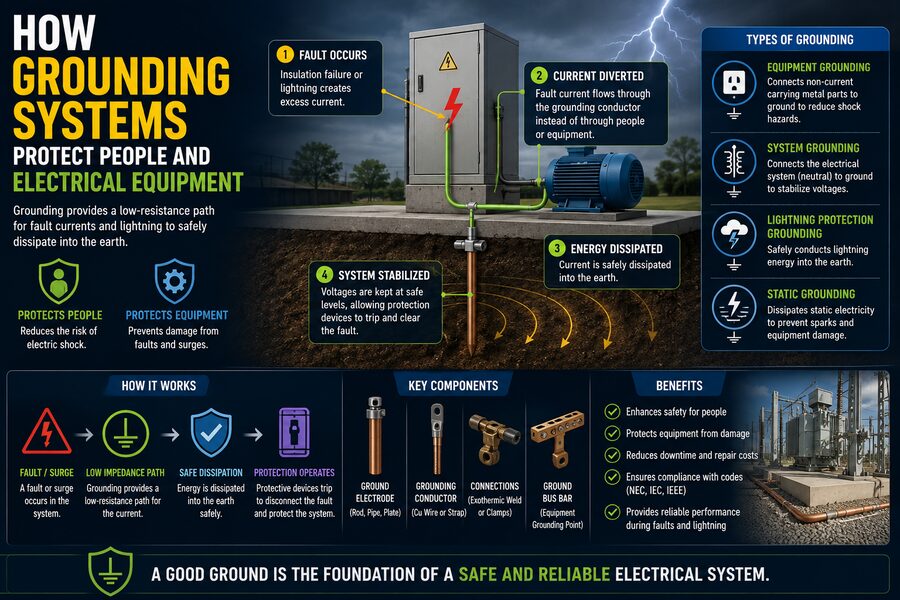
When a fault occurs, the grounding and bonding system can provide a controlled path for fault current. That current can then cause protective devices to disconnect power quickly.
Grounding therefore plays a crucial role in both human safety and electrical-system reliability. 🧑🔧⚙️
🌍 What Is Electrical Grounding?
Electrical grounding means intentionally connecting part of an electrical system to a reference potential.
In many installations, that reference is associated with the earth through a grounding electrode system.
Grounding may involve components such as:
- ground rods,
- metal water piping where permitted,
- concrete-encased electrodes,
- grounding conductors,
- equipment grounding conductors,
- grounding bars,
- building steel.
However, several related concepts are often casually grouped together under the word “grounding.”
Two especially important ideas are:
System grounding — connecting a point in the electrical system, such as the neutral, to ground.
Equipment grounding and bonding — connecting exposed conductive equipment parts together so fault current has a low-impedance return path.
Understanding this distinction helps explain how grounding protects people.
🧑🔧 Why Metal Equipment Can Become Dangerous
Consider a washing machine with a metal cabinet.
Normally, energized electrical conductors are insulated from the cabinet.
But suppose insulation inside the machine fails and a live conductor touches the metal enclosure.
Without an effective protective path, the cabinet could become energized.
A person touching the machine while also touching a grounded surface might provide a path for current through the body. ⚠️
Electrical current passing through the human body can cause:
- painful shock,
- involuntary muscle contraction,
- burns,
- respiratory problems,
- dangerous heart rhythms,
- fatal injury.
The purpose of equipment grounding and bonding is to prevent exposed metal from remaining at a dangerous voltage for long.
🔄 How a Ground-Fault Path Works
When a live conductor contacts a properly bonded metal enclosure, fault current can travel through the equipment grounding path back toward the electrical source.
A simplified fault path may look like:
Live conductor
      ↓
Metal enclosure
      ↓
Equipment grounding conductor
      ↓
Bonding point / source
      ↓
Large fault current
      ↓
Circuit breaker trips
The goal is to create a path with low enough impedance that substantial fault current flows.
That high fault current causes the fuse or circuit breaker to open rapidly.
Once the protective device opens, dangerous voltage is removed from the faulty equipment.
This is an important point:
The safety benefit is not simply that current goes into the earth. The critical function is providing an effective fault-current path that lets protective devices disconnect the circuit. ⚡➡️🛑
🧱 What Is Bonding?
Bonding means intentionally connecting conductive parts together so they remain at approximately the same electrical potential and can carry fault current safely.
Examples may include bonding:
- metal electrical panels,
- conduit,
- equipment frames,
- cable trays,
- structural metal,
- certain piping systems.
Imagine two large metal cabinets sitting beside each other.
If one becomes energized during a fault while the other remains at ground potential, touching both could expose a person to a dangerous voltage difference.
Bonding connects them electrically, reducing unwanted voltage differences and helping create a continuous fault-current path.
Grounding and bonding work closely together, but they are not identical. 🔗
🛑 How Circuit Breakers Depend on the Grounding Path
A standard circuit breaker operates when current becomes too large.
Suppose a circuit is protected by a breaker rated for a certain current.
If a live conductor touches a metal enclosure and there is a low-impedance grounding path, fault current can rise sharply.
The breaker detects this excessive current and trips.
Without an effective grounding or bonding path, the fault current might remain too small to trip the breaker quickly.
The metal enclosure could therefore stay energized.
This illustrates why simply having a breaker is not enough.
The electrical installation must provide the breaker with the conditions needed to detect and interrupt a fault. ⚙️
🧪 Why the Earth Alone Is Often Not the Main Fault Path
A common misconception is that a ground rod beside a building carries most fault current directly through the soil until a breaker trips.
In many common low-voltage electrical systems, soil has too much impedance to serve as the primary path for clearing ordinary line-to-case faults efficiently.
Instead, the equipment grounding and bonding conductors provide a metallic return path toward the source.
The grounding electrode system still has important functions, including:
- establishing a reference to earth,
- helping manage lightning and surge effects,
- limiting certain voltage differences,
- supporting overall system grounding.
But the equipment grounding conductor is often the key component for rapidly clearing ordinary equipment faults.
🌩️ Grounding and Lightning Protection
Lightning can produce enormous voltages and currents.
A direct or nearby lightning strike can induce damaging surges in:
- electrical wiring,
- communication cables,
- antennas,
- building systems.
Grounding systems can help provide paths for lightning-related current and reduce dangerous potential differences.
Dedicated lightning-protection systems may include:
- air terminals,
- down conductors,
- grounding electrodes,
- bonding connections.
Their goal is to guide lightning current through intentional conductive paths rather than allowing it to pass unpredictably through building materials.
🌩️➡️🌍
However, grounding alone does not guarantee that electronics will survive a lightning event.
Surge protection is also important.
🔌 Surge Protective Devices and Grounding
A surge protective device, or SPD, helps limit temporary overvoltages.
Surges may come from:
- lightning,
- utility switching,
- large motors,
- transformers,
- industrial equipment.
An SPD diverts or limits excess electrical energy.
Its effectiveness depends partly on proper installation and short, low-impedance connections.
Poor grounding or long conductor paths can reduce surge-protection performance.
Sensitive equipment such as:
- computers,
- servers,
- industrial controllers,
- communication systems,
- medical electronics
can benefit from coordinated grounding, bonding, and surge protection. 💻🛡️
⚖️ Grounding Helps Stabilize System Voltage
Grounding also provides an electrical reference.
In many power systems, one conductor or point is intentionally grounded.
For example, the neutral point of a transformer may be connected to ground.
This helps establish predictable voltage relationships between conductors and earth.
Without proper system grounding, electrical voltages could shift unpredictably because of:
- capacitive coupling,
- insulation faults,
- lightning,
- static buildup.
Stable voltage references make electrical systems easier to protect and operate safely.
🧵 What Is an Equipment Grounding Conductor?
An equipment grounding conductor connects exposed conductive parts of equipment to the system’s grounding and bonding network.
Depending on the installation, this may be:
- a dedicated copper or aluminum conductor,
- metallic conduit,
- cable armor,
- another approved conductive path.
Its purpose is to carry fault current safely.
In many wiring systems, equipment grounding conductors are identified using green insulation or bare metal, although exact identification requirements depend on applicable electrical codes and standards.
These conductors should not normally carry load current during normal operation.
They become important when something goes wrong. 🚨
⚪ What Is the Neutral Conductor?
The neutral and the equipment grounding conductor perform different jobs.
The neutral typically carries normal return current during operation.
The equipment grounding conductor normally does not.
This distinction is essential.
At specific points in a power system, neutral and ground may be intentionally bonded according to system design and electrical-code requirements.
But downstream connections must be handled correctly.
Improper neutral-to-ground bonding in the wrong location can create current on metal equipment, conduit, piping, or other unintended paths.
That can introduce shock risk and electromagnetic interference.
🏠 Grounding in Residential Electrical Systems
In a typical home, grounding and bonding help protect appliances and electrical equipment such as:
- refrigerators,
- washing machines,
- ovens,
- air conditioners,
- metal electrical panels.
Three-prong receptacles include a grounding contact.
When a properly grounded appliance is plugged in, its exposed metal frame is connected to the equipment grounding system.
If an internal live conductor touches the frame, the resulting fault current can help trip the protective device.
This is one reason removing or defeating the grounding pin on a plug can be dangerous. 🔌⚠️
🧰 Double-Insulated Equipment
Not every appliance needs a grounding conductor.
Some handheld tools and small appliances are designed as double-insulated equipment.
These devices use additional layers of electrical insulation so exposed conductive parts are not expected to become energized during a single insulation failure.
Such equipment may use two-prong plugs even when operating from mains voltage.
This demonstrates an important engineering principle:
Grounding is one safety method, but electrical safety can also be achieved through properly designed insulation and isolation.
💧 Why GFCIs Provide Additional Shock Protection
Grounding is important, but it does not protect against every possible electric shock.
Suppose a person contacts an energized conductor directly.
The current flowing through the body may be dangerous but still too small to trip a normal circuit breaker quickly.
A Ground-Fault Circuit Interrupter (GFCI)—also called an RCD or similar term in many regions—detects a small imbalance between outgoing and returning current.
If some current is flowing through an unintended path, such as a person’s body, the device can disconnect power rapidly.
This is why such protection is especially important in locations such as:
- bathrooms,
- kitchens,
- outdoor areas,
- construction sites,
- other wet or high-risk environments.
💧⚡🛑
Grounding and residual-current protection complement each other rather than replacing one another.
🏭 Grounding in Industrial Facilities
Industrial plants contain much larger and more complex electrical systems.
Grounding may be required for:
- motors,
- switchgear,
- transformers,
- control cabinets,
- variable-frequency drives,
- instrumentation,
- process equipment.
A reliable grounding network helps improve:
- personnel safety,
- fault clearing,
- surge protection,
- electromagnetic compatibility,
- measurement stability.
Industrial systems may use extensive grounding grids beneath substations or process areas.
These grids distribute fault and lightning currents through multiple interconnected conductors and electrodes.
⚡ Step and Touch Potential
High-current electrical faults can create voltage differences across the ground itself.
Two important safety concepts are step potential and touch potential.
👣 Step Potential
Step potential is the voltage difference between two points on the ground separated by a person’s footsteps.
If a large fault current enters the earth, voltage may be much higher near the grounding point than farther away.
A person standing across two different potentials can experience current through the legs.
✋ Touch Potential
Touch potential occurs when a person touches grounded equipment while standing on ground at a different voltage.
Substation grounding grids are carefully engineered to limit these hazardous voltage differences.
This is especially important where very large fault currents are possible.
📡 Grounding and Electronic Noise
Grounding is also important for signal integrity.
Sensitive electronic systems operate with very small voltages.
Unwanted currents and voltage differences can introduce:
- hum,
- measurement errors,
- communication problems,
- unstable sensor readings.
Audio systems, laboratories, industrial instrumentation, and data centers may require carefully planned grounding and bonding.
However, simply adding more ground connections is not always better.
Poorly planned connections can produce ground loops, where unwanted current circulates through multiple conductive paths. 🔄
These currents can create noise and interference.
🔁 What Is a Ground Loop?
Imagine two pieces of electronic equipment connected by a signal cable.
Both are also grounded at different physical locations.
If the two ground points are at slightly different electrical potentials, current can flow through the signal shield or interconnecting cable.
This circulating current may produce:
- audible hum,
- distorted measurements,
- communication errors.
Ground-loop problems are especially common in audio, instrumentation, and control systems.
Engineers may reduce them through:
- proper bonding,
- differential signaling,
- isolation,
- careful cable routing,
- appropriate grounding architecture.
The solution depends on the system.
🚗 Grounding in Vehicles Works Differently
Cars typically do not use the earth as their everyday electrical reference while driving.
Instead, the metal chassis often serves as a common return path for the vehicle’s low-voltage electrical system.
The battery negative terminal is commonly connected to the chassis.
Electrical devices can therefore complete their circuits through the vehicle body.
This is another example showing that “ground” can mean an electrical reference or common conductor—not necessarily literal soil. 🚗🔋
✈️ Grounding in Aircraft
Aircraft also cannot rely on the earth during flight.
Their electrical systems use the aircraft structure and carefully designed bonding networks as reference and return paths.
Bonding is especially important for:
- lightning protection,
- static charge control,
- avionics,
- fuel-system safety,
- electromagnetic compatibility.
Aircraft demonstrate that grounding principles are really about controlled electrical potential and current paths, not merely physical connection to the ground beneath us. ✈️⚡
🧯 Static Electricity and Grounding
Grounding is also used to control static electricity.
Static charge can accumulate when materials:
- rub together,
- move through pipes,
- transfer liquids,
- handle powders.
In ordinary life, static electricity may produce a small spark.
In industrial environments containing flammable gases or vapors, that spark can be dangerous.
Fuel-transfer operations commonly use bonding and grounding to reduce voltage differences between equipment.
For example, connecting a tanker truck and receiving equipment helps keep them at similar electrical potential during fuel transfer. ⛽⚡
🏥 Grounding in Sensitive Facilities
Hospitals, laboratories, data centers, and industrial control environments may require specialized grounding practices.
Hospitals must manage electrical safety around patients who may be particularly vulnerable to electric shock.
Data centers need reliable equipment grounding, bonding, and surge protection for large numbers of servers.
Laboratories may use sensitive measurement equipment that can be affected by small ground voltage differences.
The exact grounding system is therefore designed according to both safety requirements and equipment performance needs.
🔩 Ground Rods and Grounding Electrodes
A common grounding electrode is a metal rod driven into the earth.
But a single rod is only one possible method.
Grounding electrode systems may also use:
- multiple rods,
- plates,
- rings,
- building foundations,
- buried conductors,
- structural steel,
- other approved electrodes.
Soil characteristics strongly influence grounding-electrode resistance.
Important factors include:
- soil moisture,
- mineral content,
- temperature,
- electrode depth,
- electrode spacing.
Dry rocky soil may provide much higher resistance than moist conductive soil.
🧪 Why Ground Resistance Is Measured
Electrical professionals can measure grounding-system resistance using specialized test equipment.
Testing can help determine whether a grounding electrode installation is performing as intended.
Common methods include:
- fall-of-potential testing,
- clamp-based measurements,
- selective testing.
The appropriate test depends on the installation.
Critical facilities may periodically test grounding systems because corrosion, construction activity, soil changes, or damaged connections can degrade performance over time. 🔍
🔧 Connections Must Remain Reliable
A grounding system is only as good as its electrical connections.
Loose, corroded, or broken connections can increase impedance and reduce fault-current performance.
Important connections may use:
- mechanical clamps,
- compression connectors,
- welded joints,
- exothermic welding.
Outdoor and buried connections must withstand moisture, chemicals, corrosion, and temperature changes.
Inspection and maintenance can therefore be essential, particularly in industrial and high-power installations.
⚠️ Common Grounding Problems
Electrical grounding systems can become ineffective through several mistakes.
Examples include:
- missing grounding conductors,
- broken ground pins,
- loose connections,
- corrosion,
- incorrect neutral-ground bonding,
- undersized conductors,
- improper electrode installation,
- unauthorized wiring modifications.
Another dangerous mistake is assuming that any metal object is automatically a safe ground.
A random pipe, structure, or conductive surface may not provide an approved or reliable fault-current path.
Electrical grounding should follow applicable codes and professional design practices.
🏗️ Grounding Must Be Designed as a System
A ground rod by itself does not create complete electrical safety.
A successful installation coordinates many elements:
Source grounding
Equipment bonding
Grounding conductors
Protective devices
Grounding electrodes
Surge protection
Residual-current protection where required
All of these components must work together.
A fault current needs a predictable path.
A breaker needs enough current to trip.
Exposed metal needs reliable bonding.
Lightning and surge energy need carefully controlled paths.
People need protection from dangerous touch voltages. 🛡️
👷 Why Electrical Codes Matter
Electrical grounding is heavily regulated because incorrect installations can cause serious injury, fires, or equipment damage.
Rules differ between countries and applications.
Electrical codes specify requirements related to:
- conductor size,
- bonding,
- electrode systems,
- breaker protection,
- installation methods,
- special environments.
Qualified electricians and electrical engineers use these standards when designing and installing systems.
Grounding should not be modified casually, especially in mains-voltage or high-energy installations.
🧠 Grounding Does More Than “Send Electricity Away”
The most important concept to understand is that grounding is not a magical drain where unwanted electricity disappears.
Electrical current always follows complete circuits and available conductive paths.
Grounding systems are designed to control those paths and voltage relationships.
During an equipment fault, bonding and equipment grounding help return current to the source so protective devices operate.
During lightning or surge events, grounding helps manage energy and potential differences.
In electronic systems, grounding provides a reference voltage and can support signal integrity.
In industrial facilities, it can also control static charge and dangerous step or touch voltages.
⚡ Protecting People and Equipment Through Controlled Current Paths
A grounding system quietly performs one of the most important safety functions in electrical engineering.
When everything operates normally, grounding conductors may carry little or no current.
But when insulation fails, lightning strikes, static charge accumulates, or a conductor contacts exposed metal, the grounding and bonding network becomes critically important. ⚠️
It helps:
- keep exposed conductive parts at safer potentials,
- provide low-impedance fault-current paths,
- allow breakers and fuses to disconnect faults,
- stabilize system voltages,
- support surge and lightning protection,
- protect sensitive equipment,
- control static electricity.
The central engineering principle is straightforward:
Grounding protects people and equipment by creating intentional, low-impedance electrical connections that control fault currents and dangerous voltage differences rather than allowing electricity to take unpredictable paths. ⚡🛡️🌍
A safe electrical system therefore depends not on grounding alone, but on the coordinated operation of grounding, bonding, insulation, circuit protection, and good electrical design.
When those systems work together correctly, a fault that could otherwise energize a metal enclosure or damage expensive equipment can instead be detected, controlled, and disconnected before it becomes a larger hazard.