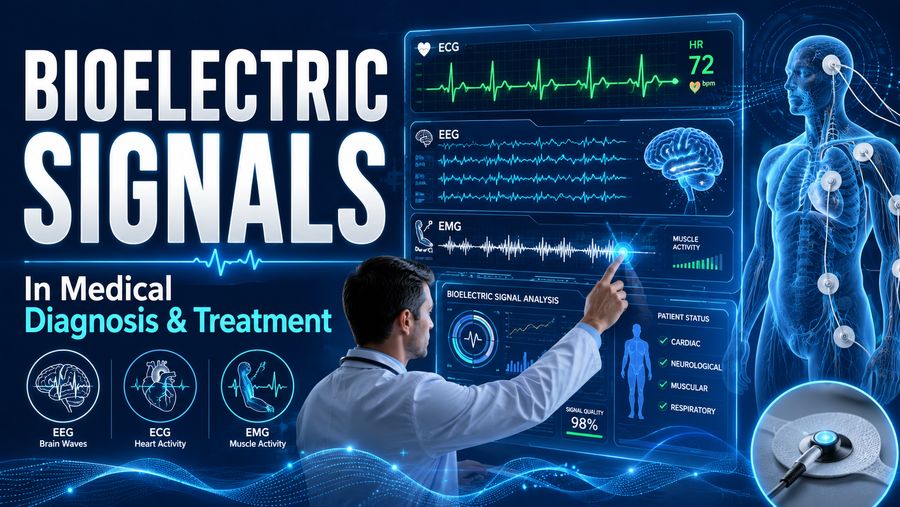

The human body is not only a biological system—it is also an electrical one. Every heartbeat, muscle contraction, nerve impulse, and many brain activities depend on tiny electrical changes occurring within cells and tissues. These measurable electrical activities are known as bioelectric signals. 🧠❤️⚡
Modern medicine uses bioelectric signals to observe how organs are functioning, identify abnormalities, monitor patients, guide treatment, and even control advanced medical devices. Familiar technologies such as the electrocardiogram (ECG) and electroencephalogram (EEG) are based on the detection of electrical activity produced naturally by the body.
Beyond diagnosis, electrical stimulation is increasingly used therapeutically. Pacemakers regulate abnormal heart rhythms, deep brain stimulation can help manage certain movement disorders, and neurostimulation technologies may reduce chronic pain or restore some lost functions.
As sensors, artificial intelligence, wearable electronics, and biomedical engineering continue to improve, bioelectric medicine is becoming an increasingly important part of healthcare. 🏥🔬
🧬 What Are Bioelectric Signals?
Bioelectric signals are electrical potentials or currents produced by biological processes inside the body.
Human cells maintain differences in electrical charge across their membranes. Specialized cells—particularly neurons and muscle cells—can rapidly change these electrical conditions.
These changes allow cells to communicate and coordinate important bodily functions.
For example:
- 🧠 Neurons transmit electrical impulses through the nervous system.
- ❤️ Heart muscle cells produce coordinated electrical activity that controls heartbeat.
- 💪 Skeletal muscles respond to nerve signals by generating electrical activity during contraction.
- 👁️ Eye movement produces measurable electrical changes around the eyes.
- 🫁 Changes in body tissues can alter electrical impedance and provide physiological information.
Medical equipment can detect some of these signals using electrodes or specialized sensors placed on or within the body.
⚡ How Are Bioelectric Signals Generated?
Every living cell has an electrical voltage across its membrane called the membrane potential.
This voltage exists because charged particles called ions are distributed differently inside and outside cells.
Important ions include:
- Sodium
- Potassium
- Calcium
- Chloride
Cell membranes contain ion channels that control how these particles move.
When neurons or muscle cells become activated, ion channels open and close. This temporarily changes the membrane voltage and may produce an action potential.
An action potential is a rapid electrical signal that can travel along a nerve or trigger muscle contraction.
Millions of these cellular electrical events collectively produce signals that can sometimes be measured from the body’s surface.
❤️ 1. Electrocardiography (ECG)
One of the most widely used applications of bioelectric signals is the electrocardiogram, commonly called ECG or EKG.
An ECG records the electrical activity associated with each heartbeat.
Electrodes placed on the chest and limbs detect small voltage changes produced as electrical impulses travel through the heart.
🩺 What Can an ECG Detect?
Doctors may use ECG recordings to identify or investigate:
- Abnormal heart rhythms
- Atrial fibrillation
- Bradycardia
- Tachycardia
- Conduction abnormalities
- Evidence associated with heart attacks
- Certain electrolyte disturbances
- Effects of some medications
An ECG can also help monitor patients before, during, or after certain medical procedures.
Because the test is fast, non-invasive, and widely available, it is one of the most important diagnostic tools in cardiology. ❤️
🧠 2. Electroencephalography (EEG)
An electroencephalogram, or EEG, records electrical activity produced by the brain.
Small electrodes are placed on the scalp to detect voltage fluctuations associated mainly with synchronized activity in populations of neurons.
🔬 Medical Uses of EEG
EEG is commonly used when evaluating conditions such as:
- Epilepsy and seizures
- Unexplained loss of consciousness
- Certain sleep disorders
- Encephalopathies
- Some forms of brain dysfunction
- Brain activity in critically ill patients
EEG can also be used during sleep studies and neurological monitoring.
Different patterns of brain activity can help medical professionals understand whether brain function is normal or abnormal.
💪 3. Electromyography (EMG)
Electromyography, or EMG, measures electrical activity associated with muscles.
Muscle fibers generate electrical signals when they are activated by nerves. These signals can be recorded using surface electrodes or, in some tests, specialized needle electrodes.
🦾 What Is EMG Used For?
EMG may help evaluate:
- Muscle weakness
- Muscle disorders
- Peripheral nerve injuries
- Neuromuscular diseases
- Nerve compression
- Disorders affecting communication between nerves and muscles
Doctors often combine EMG with nerve conduction studies to investigate whether symptoms originate from muscles, nerves, or neuromuscular connections.
👁️ 4. Electrooculography (EOG)
Electrooculography measures electrical potentials related to eye movement.
The eye behaves somewhat like an electrical dipole, with voltage differences between different regions.
When the eyes move, electrodes placed near them can detect changes in the electrical field.
EOG may be used in:
- Sleep studies
- Eye movement analysis
- Human-computer interaction research
- Assistive technologies
- Neurological investigations
During sleep studies, EOG is especially valuable for identifying rapid eye movement (REM) sleep. 😴
🧠 5. Nerve Conduction Signals
Nerves transmit information through electrical impulses.
Doctors can examine peripheral nerve function using nerve conduction studies.
During these tests, a nerve is stimulated electrically while sensors measure how quickly and effectively the signal travels.
Abnormal conduction can indicate nerve damage or disease.
Such tests may help evaluate conditions involving:
- Carpal tunnel syndrome
- Peripheral neuropathy
- Nerve injury
- Certain neuromuscular disorders
Signal speed, amplitude, and timing can provide valuable information about nerve health.
📊 Bioelectric Signals and Medical Monitoring
Bioelectric signals are not limited to one-time diagnostic tests.
They can also be monitored continuously.
Hospital monitoring systems may track ECG signals around the clock to detect dangerous rhythm changes.
Modern wearable devices can also record certain electrical or physiological signals outside hospitals.
Examples include:
- Smartwatches with ECG capabilities
- Portable heart monitors
- Holter monitors
- Wearable biosensors
- Remote cardiac monitoring devices
These technologies are helping healthcare move toward more continuous and personalized monitoring. ⌚❤️
However, consumer wearables should not automatically be considered substitutes for professional medical testing.
⚙️ How Bioelectric Signals Are Processed
Signals generated by the body are usually extremely small.
For example, electrical signals detected on the skin may be measured in millivolts or microvolts.
Medical devices therefore require sophisticated signal-processing systems.
A typical process may involve:
Body signal → Electrodes → Amplification → Filtering → Digital conversion → Signal analysis → Clinical interpretation
🔊 Amplification
Because signals are weak, electronic amplifiers increase their strength.
🧹 Filtering
Electrical noise can come from:
- Power lines
- Muscle movement
- Poor electrode contact
- Electronic equipment
- Patient motion
Filters help remove unwanted interference.
💻 Digital Processing
Modern systems convert signals into digital information that computers can analyze.
Algorithms can then identify patterns, calculate measurements, or highlight possible abnormalities.
🤖 Artificial Intelligence and Bioelectric Signal Analysis
Artificial intelligence is becoming increasingly important in the interpretation of biomedical signals.
Machine-learning systems can analyze large amounts of ECG, EEG, EMG, and other physiological data.
Possible applications include:
- Detecting abnormal heart rhythms
- Identifying seizure patterns
- Classifying sleep stages
- Recognizing muscle activation patterns
- Predicting certain clinical events
- Assisting healthcare professionals with signal interpretation
AI may be particularly useful when continuous monitoring produces enormous amounts of data.
Instead of requiring a clinician to manually inspect every second of a recording, an algorithm can highlight segments that deserve closer attention. 🤖📈
However, AI-generated interpretations still require careful validation and appropriate clinical oversight.
💊 The Role of Bioelectricity in Medical Treatment
Bioelectricity is useful not only for diagnosing disease but also for treating it.
Modern medicine can deliberately deliver controlled electrical impulses to influence nerves, muscles, or organs.
These therapies are sometimes grouped under terms such as electrical stimulation, neuromodulation, or bioelectronic medicine.
❤️ 1. Cardiac Pacemakers
A pacemaker is one of the best-known therapeutic applications of electrical stimulation.
The device monitors the heart’s electrical activity and can deliver electrical impulses when the heart is beating too slowly or when certain rhythm problems occur.
Pacemakers generally consist of:
- A pulse generator
- Battery and electronics
- Leads or electrodes, depending on device design
- Software that monitors cardiac activity
Modern pacemakers can adjust their operation according to the patient’s physiological needs.
For millions of patients, electrical pacing can help maintain an appropriate heart rhythm. ❤️⚡
🚨 2. Implantable Cardioverter-Defibrillators
An implantable cardioverter-defibrillator, or ICD, continuously monitors the heart’s electrical rhythm.
If a dangerous ventricular rhythm is detected, the device may provide electrical therapy intended to restore a safer rhythm.
Depending on the situation and device, treatment may include pacing or an electrical shock.
ICDs demonstrate how bioelectric monitoring and electrical treatment can operate together within the same medical device.
🧠 3. Deep Brain Stimulation
Deep brain stimulation (DBS) uses surgically implanted electrodes to deliver controlled electrical stimulation to selected regions of the brain.
DBS may be considered for certain patients with neurological conditions such as:
- Parkinson’s disease
- Essential tremor
- Dystonia
It may also be used or investigated in other conditions under specialized circumstances.
The electrical stimulation changes activity within specific neural circuits.
DBS does not simply “turn off” a disease. Instead, it modifies abnormal patterns of neural activity to help reduce certain symptoms in appropriately selected patients.
🔌 4. Spinal Cord Stimulation
Spinal cord stimulation is a type of neuromodulation used in selected patients with certain chronic pain conditions.
A device delivers electrical pulses near the spinal cord.
These electrical signals can alter the way pain information is processed by the nervous system.
The effectiveness varies among individuals, so patients are carefully evaluated before permanent implantation.
🧠 5. Vagus Nerve Stimulation
The vagus nerve connects the brain with several organs throughout the body.
Vagus nerve stimulation involves delivering electrical impulses to this nerve using an implanted or, in some applications, external device.
It may be used for selected patients with conditions such as certain forms of epilepsy. Some forms are also used in specific cases of treatment-resistant depression.
Researchers continue studying vagus nerve stimulation for additional medical applications.
💪 6. Functional Electrical Stimulation
Functional electrical stimulation (FES) applies electrical pulses to nerves or muscles to produce useful movements.
It may be used in rehabilitation for some people affected by neurological injuries or disorders.
For example, electrical stimulation may help activate muscles involved in:
- Walking
- Hand movement
- Cycling exercises
- Maintaining muscle conditioning
FES is particularly interesting because it connects electrical engineering with rehabilitation medicine and biomechanics. 🦿⚡
🏃 7. Transcutaneous Electrical Nerve Stimulation
Transcutaneous electrical nerve stimulation (TENS) delivers low-voltage electrical stimulation through electrodes placed on the skin.
It is commonly used as a non-invasive approach for managing certain types of pain.
Its effectiveness can vary depending on the condition and individual.
TENS devices should be used according to appropriate medical advice and product safety instructions, particularly in people with implanted electronic devices or other health concerns.
🦾 Bioelectric Signals in Prosthetic Limbs
One of the most exciting uses of bioelectric signals involves advanced prosthetic devices.
When a person attempts to move a remaining muscle, that muscle can generate measurable electrical activity.
EMG sensors can detect these signals and translate them into commands.
For example:
Muscle signal → Sensor → Signal processor → Movement command → Prosthetic hand moves
This allows some users to control prosthetic hands, arms, or other devices using their own muscle activity. 🦾
Advanced research is also exploring systems capable of providing sensory feedback to users.
Such technologies could eventually create prostheses that interact much more naturally with the nervous system.
🧠 Brain-Computer Interfaces
A brain-computer interface (BCI) creates a direct communication pathway between brain activity and an external device.
Some BCIs use EEG recordings from the scalp, while experimental or clinical systems may use electrodes placed closer to or within brain tissue.
Potential applications include helping people with severe paralysis to:
- Control a computer cursor
- Select letters
- Operate assistive devices
- Communicate
- Control robotic systems
BCI technology remains an active area of research, but progress demonstrates how biological electrical activity can potentially be translated into useful digital commands. 💻🧠
🧬 Bioelectricity and Regenerative Medicine
Researchers are also investigating whether electrical signals influence tissue repair, development, and regeneration.
Cells respond not only to chemical signals but also to electrical environments.
Research areas include:
- Wound healing
- Bone growth
- Tissue regeneration
- Cellular migration
- Developmental biology
Electrical stimulation is already used in certain medical applications involving bone healing and rehabilitation, while broader regenerative uses remain areas of continuing investigation.
This field may eventually contribute to new approaches in tissue engineering and regenerative medicine. 🔬🧬
📡 Wearable Bioelectric Sensors
Advances in flexible electronics and miniaturized sensors are making it possible to record bioelectric signals using increasingly compact devices.
Future wearable systems may monitor:
- Heart electrical activity ❤️
- Muscle activity 💪
- Sleep patterns 😴
- Neurological signals 🧠
- Physical rehabilitation progress 🦿
Some experimental sensors can be integrated into clothing, adhesive patches, headsets, or soft electronic materials.
Continuous monitoring could allow health problems to be identified earlier than with occasional hospital measurements.
🩹 Electronic Skin and Flexible Sensors
Researchers are developing extremely thin, flexible sensors sometimes described as electronic skin.
These systems can conform to the human body and potentially measure physiological activity while causing minimal discomfort.
Flexible electronics may eventually support long-term monitoring of patients at home.
They could also help improve:
- Rehabilitation
- Sports medicine
- Elderly care
- Remote patient monitoring
- Human-machine interfaces
⚠️ Challenges of Using Bioelectric Signals
Although bioelectric technologies offer enormous potential, several challenges remain.
🔊 Signal Noise
Bioelectric signals are often extremely weak.
Movement, nearby electronics, muscles, and environmental electrical interference can distort recordings.
Accurate analysis requires careful sensor placement and signal processing.
👤 Individual Differences
Bioelectric signals differ between people.
Age, health conditions, medications, anatomy, activity level, and other factors may affect measurements.
Medical systems must account for this natural variability.
🔐 Privacy and Security
Continuous physiological monitoring can generate highly sensitive health information.
Medical systems must protect this data against unauthorized access.
As wearable and connected health technologies grow, cybersecurity will become increasingly important.
🔋 Power Requirements
Implanted medical devices require reliable energy sources.
Some devices depend on batteries that may eventually need replacement.
Researchers are exploring methods such as wireless charging, more efficient electronics, and energy-harvesting technologies.
⚖️ Clinical Validation
A device that performs well in a laboratory is not automatically suitable for medical use.
Diagnostic and therapeutic technologies require rigorous clinical testing to demonstrate safety, effectiveness, and reliability.
🌟 Advantages of Bioelectric Medicine
The use of electrical signals offers several important medical advantages.
These can include:
- ✅ Non-invasive or minimally invasive monitoring
- ✅ Real-time physiological information
- ✅ Early detection of abnormalities
- ✅ Continuous patient monitoring
- ✅ Personalized therapies
- ✅ Precise stimulation of specific nerves or tissues
- ✅ Integration with wearable technology
- ✅ Improved rehabilitation possibilities
- ✅ Potential control of prosthetic and assistive devices
The combination of sensors, medical electronics, artificial intelligence, and neuroscience is making these systems increasingly sophisticated.
🔮 The Future of Bioelectric Diagnosis and Treatment
Bioelectric medicine is likely to become even more important as healthcare becomes more connected and personalized.
Future technologies may combine multiple biological signals simultaneously.
For example, a wearable system might continuously analyze:
ECG + Muscle Activity + Movement + Temperature + Oxygen Levels + AI Analysis
Such systems could recognize changes before a patient notices symptoms.
Implanted devices may also become more intelligent.
Instead of continuously stimulating tissue at a fixed setting, future systems could operate as closed-loop devices.
A closed-loop system could:
- 📡 Measure a biological signal.
- 🧠 Analyze the signal.
- ⚡ Detect an abnormal condition.
- 🔌 Deliver precisely targeted stimulation.
- 📊 Measure the body’s response.
- 🔄 Automatically adjust treatment.
This approach is already influencing areas such as cardiac rhythm management and neurological stimulation.
The long-term vision is personalized bioelectronic treatment that responds dynamically to each patient’s physiological condition.
❓ Frequently Asked Questions About Bioelectric Signals
What is a bioelectric signal?
A bioelectric signal is an electrical signal generated by biological activity within cells, tissues, nerves, muscles, or organs.
What are common examples of bioelectric signals?
Common medical examples include ECG signals from the heart, EEG signals associated with brain activity, EMG signals from muscles, and electrical signals related to nerve conduction.
How are bioelectric signals measured?
They are typically detected with electrodes or specialized sensors. The weak electrical signals are amplified, filtered, digitized, and analyzed using medical equipment.
Are bioelectric tests painful?
Many tests, such as standard ECG and scalp EEG recordings, are non-invasive and generally painless. Some procedures, such as needle EMG or implanted electrodes, are more invasive and are performed by trained healthcare professionals.
Can electrical signals be used to treat disease?
Yes. Pacemakers, defibrillators, deep brain stimulation, spinal cord stimulation, vagus nerve stimulation, and several rehabilitation technologies use controlled electrical stimulation as part of treatment.
Can AI analyze bioelectric signals?
Yes. AI and machine-learning systems can assist with identifying patterns in ECG, EEG, EMG, and other physiological data. Clinical interpretation and appropriate validation remain important.
🎯 Conclusion
Bioelectric signals provide a remarkable window into how the human body functions. ⚡🧠❤️ Electrical activity generated by the heart, brain, nerves, muscles, and other tissues can reveal information that may be difficult or impossible to obtain through observation alone.
Technologies such as ECG, EEG, EMG, and nerve conduction studies have already become essential components of modern medicine. At the same time, therapeutic technologies including pacemakers, neurostimulators, functional electrical stimulation systems, and advanced prosthetic interfaces demonstrate that electricity can be used not only to observe biological activity but also to influence it.
The future of bioelectric medicine could be even more transformative. Wearable sensors, artificial intelligence, brain-computer interfaces, flexible electronics, and closed-loop implants may enable healthcare systems that continuously monitor patients and adapt treatments according to real-time physiological signals. 🔬🤖
Bioelectric medicine sits at the intersection of biology, neuroscience, electronics, engineering, and artificial intelligence. As these disciplines continue to advance together, bioelectric technologies may play an increasingly important role in earlier diagnosis, personalized treatment, rehabilitation, and human-machine interaction.