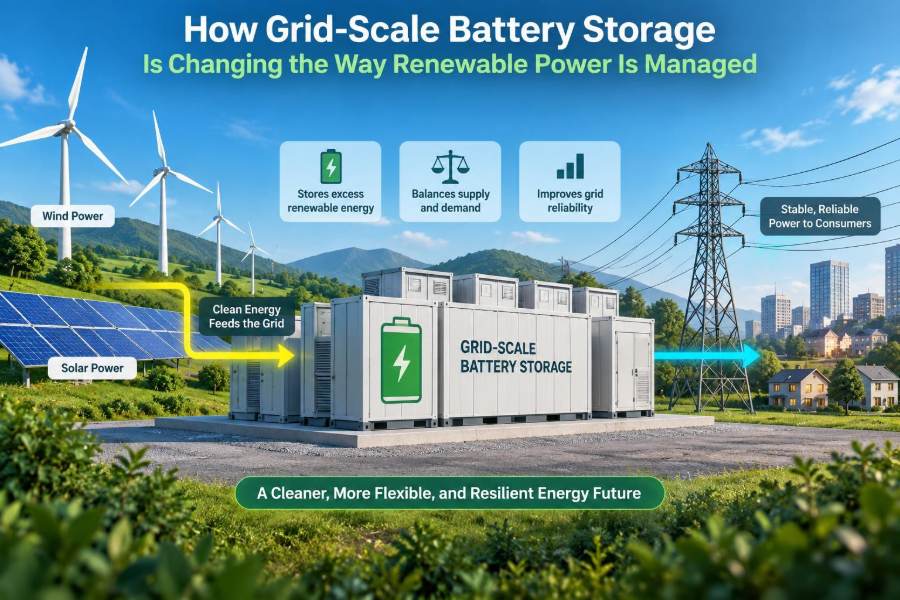

Picture a hot summer evening. Air conditioners are still running, lights are coming on, and demand for electricity is rising. Yet the solar panels that supplied abundant power at midday are producing less every minute.
For decades, power systems solved this kind of mismatch by starting generators that burn fuel or by keeping large plants operating below their maximum output. That approach can work, but it is often slow, costly, and carbon-intensive.
Grid-scale batteries are changing the choices available to system operators. They can absorb electricity when it is plentiful, hold it briefly, and return it when the grid needs support. The idea sounds simple; operating it safely and economically across an entire power network is not.
Understanding battery energy storage systems helps explain why renewable power is no longer managed only by controlling generation. Increasingly, it is managed by controlling when energy moves.
⚡ The Basic Mismatch Between Supply and Demand
Electric grids must maintain a near-instant balance between generation and consumption. If demand suddenly exceeds supply, frequency falls. If supply exceeds demand, frequency rises. Either condition can damage equipment or trigger protective actions if it becomes severe.
Wind and solar generation depend on weather and time of day, while electricity use follows human activity. This creates a timing problem rather than a simple energy problem: a region may have plenty of solar energy at noon and need more electricity after sunset.
🔋 What Grid-Scale Battery Storage Means
A grid-scale battery energy storage system, often called BESS, is a large installation connected to the transmission or distribution network. It typically includes battery racks, power conversion equipment, transformers, control systems, cooling equipment, and fire-safety infrastructure.
Unlike a phone battery, its main job is not necessarily to run for days. Many systems are designed to deliver substantial power for a limited duration, commonly measured in hours. Both the power rating and stored-energy rating matter.
📏 Power and Energy Are Different Ratings
Power, measured in watts or megawatts, describes how quickly a battery can charge or discharge. Energy, measured in watt-hours or megawatt-hours, describes how much electricity it can store.
A 100 MW battery can supply 100 MW at a given moment. If it holds 400 MWh of usable energy, it could theoretically sustain that output for about four hours, subject to operating limits and losses. This distinction is essential when evaluating what a project can actually do.
🌞 Moving Solar Energy Beyond Midday
Solar output often peaks when demand is moderate, especially in places with many rooftop and utility-scale solar installations. Without enough flexible demand or storage, operators may have to reduce solar output, a practice known as curtailment.
Batteries can charge during that surplus period and discharge later. They do not create additional solar energy, but they can shift useful energy into hours when it has more value to the grid and to consumers.
🌬️ Making Wind Output Easier to Use
Wind power can change over minutes or hours as weather systems pass. Forecasting has improved, but forecasts do not remove uncertainty. A battery can respond far faster than a conventional thermal plant when actual wind production differs from the expected schedule.
This does not mean storage makes wind perfectly predictable. A battery has finite energy, so a long wind lull can exhaust it. It is most effective as one element of a broader portfolio that includes transmission, forecasting, flexible demand, and diverse generation.
⏱️ Fast Frequency Response
Grid frequency is an immediate indicator of supply-demand balance. Battery inverters can detect frequency deviations and adjust output in fractions of a second, depending on the control design and grid rules.
This fast response is valuable after a generator trips or a large load changes abruptly. Batteries can inject power during an under-frequency event or absorb power during an over-frequency event, helping arrest the disturbance while slower resources respond.
🎛️ The Inverter Is More Than a Charger
Batteries store direct current, but most grids operate with alternating current. A bidirectional inverter converts AC to DC while charging and DC to AC while discharging.
Modern inverters can also control reactive power, voltage, ramp rates, and the shape of their output. Their software settings therefore have system-level consequences. A battery is not merely a container of energy; it is a controllable power-electronics resource.
🧭 Grid-Following and Grid-Forming Operation
Many inverters are grid-following: they measure an existing voltage waveform and synchronize their output to it. This works well when conventional generators or other strong voltage sources establish the grid reference.
Grid-forming inverters can actively establish a voltage and frequency reference under specified conditions. They are receiving increasing attention as power systems include more inverter-based resources, although their design, protection coordination, and operating requirements are more complex.
📉 Reducing Renewable Curtailment
Curtailment occurs when available renewable generation is deliberately reduced because the network cannot accept it, demand is too low, or operating limits would be exceeded. It is not always avoidable, and it is not automatically a failure of planning.
Storage can reduce curtailment by charging at the constrained location or during the surplus period. Its effectiveness depends on duration, available interconnection capacity, local network constraints, and whether the battery has enough unused capacity at the right time.
🌇 Serving the Evening Peak
The transition from late afternoon to evening can be difficult in solar-rich regions. Solar production declines while households, businesses, lighting, and cooling loads may increase. Operators call the resulting steep change in net demand a ramp.
Batteries can discharge through part of this period, reducing how quickly other generators must increase output. This can lower reliance on peaking units, but only if the batteries were charged earlier and retained sufficient state of charge.
🛢️ Replacing Some Peaker-Plant Duties
Peaking plants are generators used mainly during high-demand periods or emergencies. They often operate for relatively few hours, so their capital and fuel costs are spread over limited output.
A battery can cover certain peak periods with rapid response and no fuel combustion at the site. However, it is not a universal replacement: a multi-day heat wave, extended low-renewable period, or prolonged outage may require resources with much longer energy duration.
🧮 Energy Arbitrage and Its Limits
One battery business model is energy arbitrage: charge when electricity is less expensive and discharge when it is more expensive. Price differences may reflect demand, fuel costs, congestion, or renewable availability.
Arbitrage is constrained by round-trip efficiency, degradation, market charges, and uncertainty. A battery cannot profit simply because prices differ; the difference must exceed the costs associated with buying, storing, and later delivering the energy.
🧰 One Asset, Several Grid Services
Storage projects may earn value from more than one service, sometimes called value stacking. The same battery could provide frequency response, capacity support, voltage control, congestion relief, and energy shifting at different times.
The services must be compatible. A battery committed to reserve power cannot simultaneously spend all of its stored energy on arbitrage. Dispatch software must preserve enough energy and power headroom for each contracted obligation.
🏙️ Deferring Local Network Upgrades
A growing neighborhood, industrial site, or data center can overload a feeder or substation during only a few peak hours each year. Traditionally, the utility may reinforce wires, transformers, or substations to meet that peak.
A strategically located battery can sometimes discharge during those hours and defer a physical upgrade. This is location-specific: a battery on the wrong side of a constrained line may provide little relief, even if it has ample capacity.
🗺️ Location Can Matter More Than Size
A large battery at a transmission hub may help the overall system, while a smaller battery near a congested distribution feeder may solve a local voltage or thermal problem. Electrical distance, protection zones, and power-flow patterns all affect usefulness.
Project planning therefore begins with network studies, not simply a search for cheap land. Engineers examine fault levels, thermal limits, voltage behavior, interconnection requirements, and expected generation and load patterns.
🔌 Transmission Congestion and Bottled-Up Power
Transmission lines have finite capacity. When a windy or sunny region produces more power than its export lines can carry, renewable facilities may be constrained even though demand exists elsewhere.
Storage near the constrained generation can absorb energy until the line has available capacity or local demand rises. Storage near the load can also reduce imports during a congested period. These are different solutions to different power-flow problems.
🔄 Charging Is Not Free of Losses
Every storage cycle loses some energy in battery cells, inverters, transformers, cooling systems, and auxiliary equipment. The ratio of energy delivered to energy used for charging is called round-trip efficiency.
Losses do not make storage pointless. They mean stored electricity should be used where its timing value, reliability value, or network value justifies the energy penalty. Treating a battery as a lossless time machine leads to poor analysis.
🧪 Why Lithium-Ion Dominates Today
Lithium-ion technology is widely used for grid storage because it combines relatively high efficiency, fast response, modular construction, and a mature supply chain. Different lithium-ion chemistries have different trade-offs in energy density, thermal behavior, cost, and cycle life.
Dominance does not mean permanence. Project developers also evaluate sodium-ion, flow batteries, compressed-air concepts, pumped storage, thermal storage, and other approaches, especially where long duration or different safety characteristics are required.
🧱 Duration Determines the Job
Shorter-duration batteries are well suited to fast balancing and brief peaks. Longer-duration systems can shift energy across longer portions of a day and may contribute more during extended renewable shortfalls.
| Storage characteristic | Often suited to | Key constraint |
|---|---|---|
| High power, short duration | Frequency response and rapid ramps | Limited sustained energy |
| Multi-hour duration | Evening peaks and solar shifting | Must be charged before dispatch |
| Long duration | Longer weather-related gaps | Technology and cost vary widely |
Duration alone is not enough. Availability, location, seasonal conditions, and the ability to recharge all determine whether stored energy will be there when needed.
📊 State of Charge Is an Operational Constraint
State of charge, or SOC, describes how full a battery is. Operators generally keep SOC within defined limits rather than using every possible fraction of stored energy.
A battery held nearly full can discharge but has little room to absorb excess generation. A nearly empty battery can charge but cannot provide much upward reserve. Good dispatch keeps an appropriate buffer for expected grid conditions.
📈 Degradation Changes the Economics
Battery capacity and power capability decline over time through calendar aging, cycling, temperature exposure, and operating conditions. High temperatures, extreme SOC ranges, and demanding cycles can accelerate wear.
Developers model degradation and may augment a project by adding modules later. Dispatch decisions also reflect degradation cost: using a battery for every small price opportunity may not be worthwhile if it shortens useful life without providing comparable value.
🌡️ Thermal Management and Safety
Battery cells generate heat during charging and discharging. Thermal management keeps cell temperatures within a suitable range, supporting performance, longevity, and safety.
Faults can create thermal runaway, a self-heating failure that can spread in some battery systems. Risk management includes cell selection, enclosure design, detection, ventilation or suppression strategies, separation distances, emergency planning, and coordination with local responders.
🚒 Safety Design Requires More Than Equipment
Safe operation depends on procedures as well as hardware. Operators need clear alarms, remote monitoring, maintenance plans, incident response protocols, and training for personnel who may work near energized DC and AC equipment.
Codes and local requirements vary by jurisdiction and evolve with experience. Engineers should avoid assuming that a design accepted in one location automatically satisfies another authority having jurisdiction.
🧑💻 Software Decides When the Battery Acts
Energy management systems collect forecasts, market signals, SOC data, equipment limits, and grid commands. They determine whether the battery should charge, discharge, remain available as reserve, or provide reactive power.
Optimization is not just a revenue problem. It must honor warranties, safety limits, interconnection agreements, dispatch instructions, and physical limits. Poor controls can leave a battery empty before the period when the grid needs it most.
🔐 Cybersecurity Is Part of Reliability
Grid batteries rely on communications networks, programmable controllers, supervisory systems, and vendor software. That connectivity enables remote operation but introduces cybersecurity risks.
Defensive practice includes access control, network segmentation, logging, patch management, secure remote access, and tested recovery procedures. Cybersecurity should be considered during architecture design, not added as an afterthought once the site is operating.
🏛️ Markets and Rules Shape Deployment
The technical ability to provide a service does not guarantee that a battery can be paid for it. Market rules define products, settlement intervals, performance obligations, and whether storage may participate in particular services.
Interconnection processes, permitting, land-use decisions, and utility planning rules also affect project timelines. Regulatory design can either recognize the flexibility storage provides or unintentionally limit it through outdated resource categories.
⚖️ Environmental Trade-Offs Remain
Battery storage can help integrate low-carbon electricity, but its environmental footprint includes mineral extraction, manufacturing, transport, cooling loads, and end-of-life handling. The impacts depend on chemistry, supply chain, operating pattern, and the electricity used to charge it.
A responsible assessment considers the whole system. Charging primarily from surplus renewable power can produce a different outcome from charging during periods dominated by high-emission generation. Recycling and reuse pathways are developing, but they do not remove the need for careful material management.
👷 Skills Electrical Engineers Need
Battery projects combine power systems, power electronics, protection, communications, controls, civil design, safety engineering, and commercial operations. Electrical engineers may work on interconnection studies, relay coordination, inverter settings, SCADA integration, commissioning, or asset performance.
- Understand per-unit quantities, load flow, short-circuit studies, and protection fundamentals.
- Learn how inverter controls differ from rotating-machine behavior.
- Read one-line diagrams and distinguish AC equipment from high-voltage DC battery architecture.
- Practice interpreting power, energy, SOC, efficiency, and degradation data together.
🛠️ A Practical Example of Daily Dispatch
Consider a hypothetical 50 MW, four-hour battery near a solar-rich city. During a clear spring afternoon, it charges while local solar output is high and a transmission corridor is crowded.
Later, as solar production falls and demand rises, it discharges for part of the evening peak. It may also reserve some capacity for frequency response rather than selling every stored megawatt-hour immediately. The best schedule depends on forecasts, network limits, contracts, and equipment condition.
🚫 Common Misconceptions About Storage
One misconception is that batteries replace all generation. They do not; they shift and stabilize electricity, and they require charging energy. Another is that any battery automatically improves reliability. A poorly located, poorly controlled, or depleted battery may offer little help in a specific contingency.
It is also misleading to compare storage only by installed megawatts. A meaningful comparison includes duration, response capability, availability, location, degradation assumptions, and the grid service being discussed.
🔭 The Shift From Energy Supply to Energy Flexibility
Traditional planning focused heavily on building enough generation to meet peak demand. Systems with high shares of wind and solar also require flexibility: the ability to change output, consumption, or power flows as conditions change.
Batteries provide one form of flexibility. Demand response, interregional transmission, flexible generation, improved forecasting, and smart charging of electric vehicles can complement them. The strongest designs avoid expecting one technology to solve every timing problem.
🧩 The Core Principle: Store Value, Not Just Electrons
Grid-scale batteries matter because electricity has different operational value at different moments and locations. A megawatt-hour that would otherwise be curtailed may become highly useful several hours later during a constrained evening peak.
The technology is most effective when its power rating, duration, location, control strategy, safety design, and market role match a clearly identified grid need. Storage is not a substitute for planning; it is a powerful tool within better planning.
Grid-scale battery storage is changing renewable-power management by giving electricity systems a practical way to respond to time, location, and uncertainty instead of treating generation and demand as fixed. As grids become cleaner and more dynamic, that flexibility will remain central to reliable operation. 🔋⚡🌍