
Flip a switch in a kitchen, plug in a laptop at work, or charge an electric vehicle overnight, and electricity seems to arrive instantly. The wires inside the building are visible. Everything before them usually is not.
Somewhere, generators are turning mechanical energy into electrical energy. At the same moment, a large, coordinated network is moving that power across long distances, routing it through substations, reducing its voltage near customers, and constantly responding to changing demand.
This system is easy to take for granted because its success is measured by its invisibility. When it works, lights stay on, equipment runs, and digital services remain available without anyone needing to think about the path electricity took.
Understanding that path reveals why the grid is far more than a collection of poles and cables—and why electrical engineers, planners, operators, technicians, and many other specialists are needed to make it work safely.
⚡ Electricity Begins as Generated Power
A power plant converts another form of energy into electricity. A steam turbine may be driven by heat from fuel or nuclear reactions; a hydroelectric turbine is driven by water; a wind turbine is driven by moving air. Solar photovoltaic panels take a different route, producing electricity directly from sunlight.
Most large generators produce alternating current, or AC. In an AC system, voltage and current reverse direction repeatedly. AC became central to bulk power systems because transformers can efficiently change its voltage, which makes long-distance transmission practical.
🏭 A Plant Is One Source, Not the Whole Supply
It is tempting to picture one nearby plant supplying one town. Modern power systems usually work differently. Many generators feed a shared network, and electricity consumed in an area may be supported by a mix of local and distant sources.
The mix changes throughout the day. A gas-fired unit may increase output quickly when demand rises, while wind and solar output vary with weather. Hydroelectric stations, batteries, and other flexible resources can also help balance supply and demand, depending on the system.
🔄 Why the Grid Must Balance Every Moment
Electricity is difficult and costly to store at grid scale compared with many fuels. Although storage is growing, much of the electricity generated must still be used almost as soon as it is produced.
That means generation and consumption must be closely balanced at all times. If demand suddenly exceeds supply, system frequency tends to fall. If supply is greater than demand, frequency tends to rise. Grid operators and automated controls act to keep frequency near its nominal value.
This is one reason a power grid is a continuously managed physical system, not simply a one-way delivery pipeline.
📈 Demand Changes More Than Most People Notice
Demand, often called electrical load, follows human activity. Homes may use more power in the evening. Offices, factories, transit systems, and commercial buildings create other daily patterns. Hot or cold weather can add substantial air-conditioning or heating load.
Engineers forecast demand using weather expectations, calendar patterns, known industrial activity, and historical behavior. Forecasts are never perfect, so operators also need reserves: capacity that can respond when demand or generation differs from expectations.
⬆️ Stepping Up Voltage for the Long Journey
Generator voltage is generally increased before power enters the transmission network. A step-up transformer raises voltage so the same amount of power can be carried with lower current.
The reason is basic but powerful. Heating loss in a conductor is approximately proportional to the square of current: P_loss = I²R. For a given power transfer, raising voltage permits lower current. Lower current reduces resistive heating and allows more economical use of conductors.
🗼 Transmission Lines Move Bulk Power
The high-voltage transmission system is the grid’s long-distance transport layer. Its towers, overhead conductors, underground cables, switching stations, and substations connect major generation areas with cities, industrial centers, and regional networks.
Transmission routes may cross hundreds of kilometers, but distance alone does not define their value. A line can also provide alternate paths during equipment outages, connect renewable resources in remote locations, or relieve overloads on older corridors.
🧭 Electricity Follows Physics, Not a Shipping Label
Unlike a package, electrical power is not ordinarily assigned to one customer and tracked along one exclusive wire. In an interconnected AC network, power flows over all available paths according to voltage angles, line impedances, and network conditions.
That creates an engineering challenge: adding a line, losing a generator, or changing output in one area can alter flows elsewhere. Operators use power-flow studies and real-time measurements to understand these interactions before a line becomes overloaded.
🔗 Interconnection Makes the Grid Stronger—and More Complex
Interconnecting regions allows them to share generation, reserves, and transmission paths. A region with surplus generation may support another region facing high demand or an unexpected outage.
Interconnection also means disturbances can spread if they are not contained. Protective systems, operating limits, and coordinated planning are therefore essential. More connections can improve resilience, but only when the network is designed and operated for the new power flows they create.
🏗️ Substations Are the Grid’s Control Junctions
A substation is not merely a place where wires meet. It may transform voltage, connect or separate circuits, measure electrical quantities, protect equipment, control reactive power, and communicate with a control center.
Some substations sit beside generating stations. Others transfer power between transmission lines, supply a city, or feed local distribution networks. Their equipment can include transformers, circuit breakers, disconnect switches, instrument transformers, surge arresters, busbars, and protective relays.
🔻 Voltage Comes Down in Stages
Power usually moves through several voltage levels rather than dropping directly from transmission voltage to a wall outlet. A transmission substation may reduce voltage to a subtransmission or distribution level. Later, a distribution substation reduces it again for local feeders.
Near homes and small businesses, a distribution transformer makes one final reduction to the service voltage used by building wiring. The exact voltages and arrangements vary by country, utility, customer type, and local network design.
🏘️ Distribution Is the Last-Mile Network
The distribution system is the part of the grid most people recognize: neighborhood poles, overhead wires, pad-mounted cabinets, street transformers, and underground cable routes. It carries power from distribution substations to individual customers.
Distribution networks have different priorities from transmission networks. They must serve many small connection points, fit safely into streets and property boundaries, tolerate weather and vegetation risks, and allow crews to isolate faults without disconnecting an unnecessarily large area.
🔌 The Service Transformer Reaches the Customer
A distribution transformer near a building converts local feeder voltage into usable service voltage. It may be mounted on a pole, placed in a ground-level enclosure, or installed within a larger commercial facility.
From there, a service conductor reaches the meter and main electrical panel. The meter records energy use, usually in kilowatt-hours. The panel contains protective devices that divide the building into circuits for lighting, outlets, appliances, motors, and other loads.
🏠 A House Is a Tiny Electrical System
Inside a home, branch circuits deliver power to specific rooms or equipment. Circuit breakers protect conductors from excessive current, while grounding and bonding help manage fault conditions and reduce shock hazards when correctly designed and maintained.
Household wiring is the endpoint of a much larger chain, but it is not electrically isolated from it. A disturbance on the wider system can affect voltage at a customer connection, while a large collection of household devices can influence local demand patterns.
🏢 Large Customers May Connect Differently
Factories, hospitals, data centers, campuses, rail systems, and large commercial facilities may receive service at medium or high voltage rather than ordinary building service voltage. They often own transformers, switchgear, protection systems, and internal distribution equipment.
This arrangement can be efficient for large loads, but it comes with responsibility. Customer-owned equipment must coordinate with the utility system so a fault inside the facility does not create unnecessary disruption beyond its boundary.
🧰 Transformers Change Voltage, Not Frequency
A transformer works through electromagnetic induction. Alternating current in one winding creates a changing magnetic field in its core, inducing voltage in another winding. The turns ratio determines whether voltage is stepped up or stepped down.
A common misunderstanding is that transformers “create” extra power. They do not. Real transformers have losses, and their purpose is to exchange voltage and current in a way that supports efficient transfer. In normal operation, frequency remains the same across the transformer.
🧱 Lines Have Limits Beyond Their Nameplate Voltage
Every line and cable has operating constraints. Excessive current can heat conductors, increase sag in overhead lines, degrade insulation, or shorten equipment life. Voltage limits, stability limits, and protection settings can constrain transfers too.
A line that looks lightly loaded on a map may still be critical. Its available capacity can depend on ambient temperature, wind, the condition of parallel lines, planned maintenance, and the need to preserve safe operation after another component fails.
🛡️ Protection Clears Faults Quickly
Faults occur when electricity takes an unintended path, such as when a tree contacts an overhead line, insulation fails, or equipment is damaged. Fault current can be extremely high, so the system must detect and isolate the affected section rapidly.
Protective relays examine quantities such as current, voltage, frequency, phase angle, and the direction of power flow. If conditions indicate a fault, a relay commands a circuit breaker to open. Protection is carefully coordinated so the smallest practical section is disconnected.
⚙️ Circuit Breakers Do More Than Switch Loads
Switching ordinary current is not the same as interrupting fault current. When breaker contacts separate under high current, an electric arc can form. High-voltage circuit breakers are designed to extinguish that arc safely using technologies suited to their voltage class and application.
Disconnect switches serve a different purpose. They provide a visible isolation point for maintenance but generally are not intended to interrupt substantial load or fault current. Confusing these functions would create a serious safety risk.
📡 Control Rooms See the Network in Real Time
Grid control centers collect measurements from substations and other field devices through supervisory control and data acquisition, commonly called SCADA. Operators can view equipment status, flows, voltages, alarms, and other conditions across a wide area.
They use this information to schedule generation, direct switching, respond to equipment problems, and maintain operating margins. Automation assists with fast actions, but human operators remain essential for judgment, coordination, and unusual conditions.
🌡️ Voltage Needs Its Own Management
Frequency mainly reflects the balance of real power generation and load. Voltage depends strongly on local conditions and on reactive power, a component of AC power associated with electric and magnetic fields in equipment such as motors, transformers, and lines.
Capacitor banks, reactors, transformer tap changers, generator excitation systems, and power-electronic devices can help control voltage. Poor voltage control can lead to inefficient operation, equipment problems, or, in severe cases, a wider system disturbance.
🔋 Batteries Change the Grid’s Options
Battery energy storage systems can charge when electricity is abundant and discharge when it is needed. They can also respond rapidly to certain grid conditions, helping with frequency support, local congestion, or the smoothing of variable generation.
They are not a universal substitute for all transmission, generation, or long-duration energy needs. Their value depends on energy capacity, power rating, duration, location, controls, economics, and the specific problem they are meant to solve.
🌬️ Wind and Solar Require New Planning Questions
Wind and solar resources are often located where weather and land conditions are favorable, not where demand is concentrated. Connecting them can require new transmission, upgraded substations, and studies of how output changes affect system flows.
Power-electronic inverters also behave differently from traditional large synchronous generators. Engineers consider issues such as fault response, voltage control, system strength, and stable operation as the generation mix changes. These are design questions, not arguments against any one technology.
🧠 Electrical Engineers Design the Physical Network
Power engineers determine equipment ratings, conductor sizes, transformer connections, grounding methods, insulation requirements, protection schemes, and control strategies. They model normal operation and abnormal scenarios before equipment is installed.
The work spans many specialties. Transmission engineers plan long-distance corridors; distribution engineers design local feeders; protection engineers develop relay logic; substation engineers specify physical layouts and control systems; and studies engineers analyze load flow, short circuits, harmonics, and stability.
🗺️ Planning Starts Years Before Construction
Building grid infrastructure involves more than selecting hardware. Planners estimate future load, assess generation changes, identify constraints, consider land and environmental requirements, evaluate alternatives, and coordinate with regulators, communities, and equipment suppliers.
A prudent plan also examines contingencies. A widely used concept is the ability to withstand the outage of a single major component without violating critical limits, often referred to as N-1 planning. The appropriate criterion and implementation depend on the system and governing rules.
👷 Many Professionals Keep Power Moving
Electrical engineers are central, but they are not alone. Civil engineers design foundations and structures. Environmental specialists assess impacts. Communications and cybersecurity teams protect operational technology. Lineworkers, electricians, relay technicians, operators, inspectors, and maintenance crews turn designs into reliable daily service.
Reliable electricity is therefore a team outcome. It combines design discipline, field skill, operating procedures, spare parts, training, and clear communication during routine work and emergencies.
🚧 Outages Have Different Causes and Different Fixes
An outage may begin with weather damage, vehicle impact, equipment failure, vegetation contact, wildfire precautions, construction activity, a transmission constraint, or an issue inside a customer’s own installation. The visible symptom—no power—does not reveal the underlying cause.
Restoration begins with safety. Crews isolate damaged sections, verify conditions, reroute power where possible, repair equipment, and restore customers in an order shaped by network configuration and critical services. Faster restoration is valuable, but unsafe or poorly coordinated switching is not an acceptable shortcut.
🌳 Resilience Is More Than Building Stronger Poles
Resilience is the ability to prepare for, withstand, respond to, and recover from disruptive events. Stronger structures can help, but so can vegetation management, sectionalizing devices, undergrounding in suitable locations, alternate supply paths, spare transformers, and well-practiced emergency procedures.
Each option has trade-offs. Underground cables can be less exposed to some weather events but may be expensive and slower to repair. Redundant lines improve options but require land, investment, and ongoing maintenance. Good engineering compares risks rather than assuming one answer fits everywhere.
💻 The Grid Is Also a Digital System
Modern substations and control centers rely on sensors, communications networks, software, and remotely operated equipment. Digital systems can improve visibility and speed, but they introduce cybersecurity and data-quality concerns.
Operational technology must be designed so that authorized staff can act reliably while unauthorized access, corrupted data, and communication failures are managed. Cybersecurity is not separate from reliability; in a connected grid, it is part of reliable system design.
🔌 Distributed Energy Changes the Direction of Flow
Rooftop solar, community solar, batteries, electric vehicles, and small generators can place energy resources close to customers. At certain times, a neighborhood may export power back toward the distribution system instead of receiving it in the traditional one-way pattern.
This can reduce some local demand and provide useful flexibility, but it also changes protection coordination, voltage regulation, forecasting, and equipment loading. Distribution engineers increasingly treat local networks as active systems rather than passive delivery branches.
🚗 Electrification Raises Both Load and Opportunity
Electric vehicles, heat pumps, and electric industrial processes can increase electricity demand. If many devices charge or operate at the same time, they can create local peaks that strain transformers or feeders even when the broader grid has enough generation.
Managed charging, time-varying rates where available, energy efficiency, and local upgrades can reduce those peaks. The goal is not simply to add capacity everywhere; it is to match demand patterns, network capability, and customer needs intelligently.
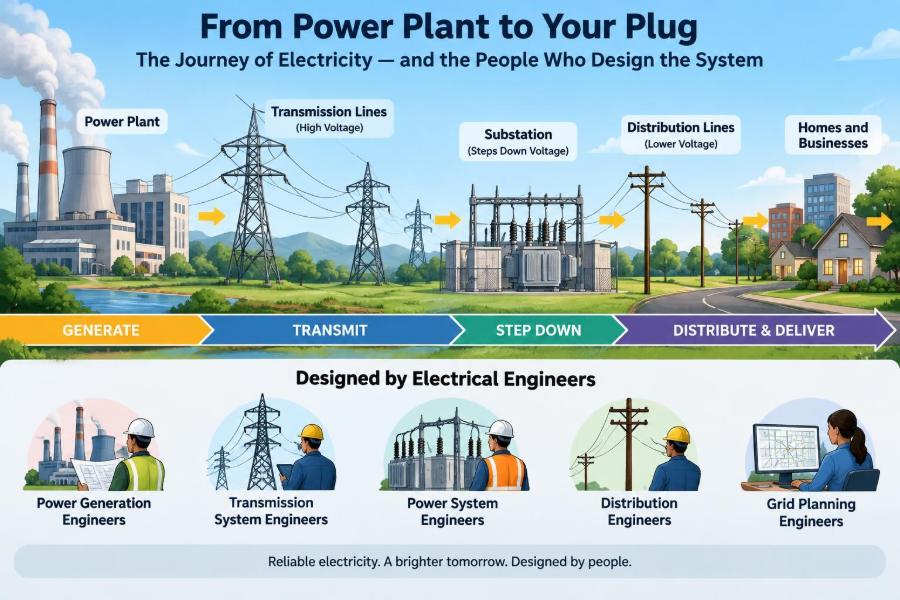
📐 A Simple Path From Generator to Device
The actual network contains loops, branches, alternate routes, and control equipment, but this simplified sequence captures the main layers:
- A generator produces electrical power.
- A step-up transformer raises voltage.
- Transmission lines carry bulk power across the network.
- Substations switch circuits and reduce voltage in stages.
- Distribution feeders deliver power through local areas.
- A service transformer supplies a building.
- The meter, panel, and branch circuits deliver electricity to equipment.
At every stage, engineers must account for capacity, losses, voltage, protection, safety, maintenance access, and what happens when something fails.
🧪 What Engineers Study Before Making Changes
Before connecting a new generator, large factory, battery, or neighborhood, engineers perform studies. These may estimate expected power flows, calculate fault current, examine voltage performance, identify harmonic distortion, and test how protection responds to credible faults.
Computer models are indispensable, but their results depend on assumptions and accurate data. Engineers validate models against field measurements where possible and revisit them as equipment, loads, controls, and generation patterns evolve.
⚠️ Common Misunderstandings About Power Delivery
- “Electricity travels only from the nearest plant.” In a network, power uses multiple paths and is supplied by the interconnected system.
- “Higher voltage is automatically more dangerous only because it is larger.” Electrical hazards depend on the complete situation, including available fault energy, current path, equipment, and exposure. All electrical work requires proper procedures.
- “A bigger generator alone solves reliability.” Delivery also depends on transmission paths, substations, distribution equipment, protection, fuel or energy availability, and operations.
- “Smart-grid technology removes physical constraints.” Better sensing and control help, but conductors, transformers, and switchgear still have thermal and electrical limits.
🎓 Building Skills for Power-System Work
Students entering power engineering benefit from a strong foundation in circuit analysis, electromagnetics, three-phase AC systems, machines, power electronics, control systems, and numerical methods. Just as valuable are careful documentation, clear communication, and respect for safety procedures.
Working professionals often deepen their expertise in a particular area—protection, planning, operations, renewable integration, distribution automation, or high-voltage equipment—while learning enough about adjacent disciplines to coordinate effectively. The grid rewards systems thinking.
🧭 The Core Principle: Delivery Is a Coordinated System
Electricity does not simply leave a plant and travel down a single wire to a customer. It enters a managed network in which voltage is transformed, routes are shared, faults are isolated, supply and demand are balanced, and thousands of assets must operate within limits.
The engineers who design this system are solving connected problems: efficiency versus cost, redundancy versus land use, fast automation versus secure control, and new resources versus established equipment. Their work makes reliable power possible not through one invention, but through disciplined coordination across the whole system.
The power grid succeeds when generation, transmission, distribution, protection, control, and people work together as one carefully engineered system. The next time a device powers on, there is an entire network—and an entire profession—behind that ordinary moment. ⚡🗼🔌