
The lights go out, a refrigerator falls silent, and the familiar background hum of a building disappears. For a few seconds, the question is usually simple: is this a blown fuse, a neighborhood outage, or something much larger?
When power returns, it can feel as though someone simply flipped a switch. In reality, restoration is a carefully controlled sequence involving protective devices, field crews, control rooms, generators, substations, and the customers connected to them.
Restoring electricity too quickly or in the wrong order can damage equipment, endanger workers, and turn a local disturbance into a wider outage. The goal is not merely to energize wires again; it is to rebuild a stable, balanced electrical system.
Understanding the process helps students see how power-system theory works in practice and helps professionals recognize why safe restoration procedures are deliberately methodical.
🔌 A Power System Must Stay in Balance
An alternating-current power system operates only when generation and demand are closely matched. Generators add real power, loads consume it, and the system frequency reflects the balance between them.
If demand suddenly exceeds available generation, frequency falls. If generation exceeds demand, frequency rises. Protection and control systems respond because large deviations can damage machinery or cause further equipment to disconnect.
⚡ An Outage Is Not Always a Total Blackout
A power failure may affect one circuit, one building, part of a distribution network, or an entire interconnected grid. The restoration approach depends heavily on this scope.
A tripped branch circuit may be restored by identifying a local fault. A regional event may require coordinated recovery across transmission lines, power plants, and multiple distribution substations. Treating every outage as equivalent leads to poor decisions.
🛡️ Protection Operates Before Restoration Begins
Protective relays continuously measure quantities such as current, voltage, frequency, and impedance. When they detect conditions consistent with a short circuit, equipment failure, or abnormal power flow, they command circuit breakers to open.
This interruption is a success, not a failure of the protection system. A breaker isolates the faulty section so healthy equipment has a chance to remain energized. Restoration starts by understanding why the protection operated.
🔍 Finding the Fault Comes Before Closing a Breaker
A breaker should never be repeatedly reclosed just because customers are without power. Re-energizing a permanent fault can create an arc, worsen damage, or expose crews working nearby to danger.
Operators review relay targets, event records, alarms, weather reports, and switching status. Field personnel may inspect lines, transformers, cable terminations, or switchgear before declaring a section safe to energize.
🌩️ Temporary Faults and Permanent Faults Differ
Some overhead-line faults are temporary. A tree branch may touch a conductor briefly, or lightning may create a momentary flashover across insulation. Automatic reclosing can restore service after the fault clears.
A broken conductor, failed insulator, damaged cable, or fallen tree is different: the fault remains. Utilities configure automatic reclosing cautiously because a rapid reclose is useful only when the system has reason to expect the fault was transient.
🧠 Control Rooms Build a Clear System Picture
Grid and utility control rooms use supervisory control and data acquisition, often called SCADA, to receive equipment status and measurements from remote sites. Operators can see whether breakers are open, whether busbars are energized, and how loading is changing.
SCADA is powerful, but it is not perfect knowledge. Communication failures, incorrect indications, and incomplete field information are possible. Operators confirm critical switching states through approved procedures rather than relying on one screen alone.
🗺️ Isolation Creates a Safe Restoration Boundary
Once the likely faulted area is known, operators isolate it using breakers, disconnectors, switches, or sectionalizers. The aim is to keep the damaged portion de-energized while restoring unaffected customers from another available source.
Distribution networks are often designed with normally open tie points. A healthy feeder may be transferred through such a tie, provided the alternate feeder has sufficient capacity and the switching arrangement will not unintentionally parallel sources.
🔒 Lockout, Tagging, and Visible Isolation Protect People
Before crews work on equipment, they follow formal safety rules for isolation, lockout or tagging, verification of absence of voltage, and grounding where required. Exact procedures vary by organization, jurisdiction, and equipment type.
The essential principle is universal: an open control-room indication is not proof that a work location is safe. Stored energy, backfeed, induced voltage, and incorrect switching are real hazards that must be addressed locally.
🔋 Backfeed Is a Hidden Restoration Hazard
Backfeed occurs when a normally de-energized circuit becomes energized from an unintended source. Common sources include customer generators, photovoltaic systems, battery inverters, capacitor banks, or another feeder connected through an overlooked tie.
Modern distributed energy resources make system visibility more complex. Approved interconnection equipment is designed to disconnect under abnormal grid conditions, but crews still verify isolation and grounding instead of assuming every local source has opened.
🏥 Critical Loads Receive Special Planning
Hospitals, emergency services, water and wastewater facilities, communications sites, and some industrial processes may need continuity plans beyond ordinary utility restoration. Many use standby generators, uninterruptible power supplies, or both.
A UPS bridges a short interruption using stored energy, while a generator can support longer operation after starting. Neither removes the need for careful coordination: generator capacity, fuel, transfer switching, and load priorities all matter.
🔄 Automatic Transfer Switches Manage Standby Supply
An automatic transfer switch senses loss of the normal source and transfers selected loads to a standby source after suitable checks. When utility power returns, it can retransfer according to its programmed sequence.
Most arrangements avoid connecting the generator and utility together unless the installation is specifically designed for closed-transition or parallel operation. Uncontrolled paralleling can produce damaging currents and dangerous out-of-sync connections.
🏭 Generation Cannot Be Added Like a Light Switch
Large generators require auxiliary power, operating staff or automated sequences, fuel or energy availability, and stable mechanical conditions. A unit that has shut down may need time before it can safely produce power again.
During major restoration, operators prefer generation that can start without support from the wider grid. This capability is called black start, and it is central to recovering from a widespread blackout.
🌑 Black Start Rebuilds a Dead Network
A black-start-capable resource might be a hydroelectric unit, a small diesel generator, a combustion turbine, or another source able to start from local stored energy. It first energizes essential local equipment, then supports progressively larger sections.
The process is unlike normal operations. There may be no strong interconnected grid to stabilize voltage and frequency, so each new line, transformer, or load is added with deliberate assessment.
🧲 Energizing Transformers Requires Care
When a transformer is energized, its magnetic core may draw a brief but very large magnetizing inrush current. Protection systems are designed to distinguish normal inrush characteristics from an internal transformer fault, but switching plans still account for this behavior.
Energizing too many transformers at once can cause voltage depression or unwanted relay operation. Restoring one element at a time makes the system response easier to observe and control.
📈 Transmission Lines Can Raise Voltage When Lightly Loaded
Long high-voltage lines do not behave like simple wires. Their capacitance can cause voltage to rise at the receiving end when the line is energized with little load, an effect associated with line charging and the Ferranti effect.
Operators manage this with controlled switching, shunt reactors, generator reactive-power control, and other voltage-control equipment. A line being energized does not automatically mean its voltage is acceptable.
🧭 Frequency Is Restored by Matching Real Power
Frequency control depends primarily on the balance of real power, measured in watts. Adding demand without sufficient generation pulls frequency downward; adding generation without enough demand pushes it upward.
Operators often restore load in blocks while observing frequency response. Generator governors provide an initial response, while higher-level controls and dispatch decisions refine the balance over time.
🔌 Voltage Depends on Reactive Power
Voltage control is closely linked to reactive power, measured in vars. Inductive equipment such as motors and transformers needs magnetizing current, while capacitors and some power-electronic devices can supply reactive support.
Real and reactive power are related but not interchangeable. A system can have enough megawatts to serve demand yet still face unacceptable voltage if reactive-power support is inadequate at the right location.
🎛️ Synchronizing Prevents Violent Connections
Before connecting two energized islands, operators check voltage magnitude, frequency, phase sequence, and phase angle. Synchronizing equipment helps confirm that the systems are sufficiently matched before a breaker closes.
Closing out of synchronism can create severe transient torque in rotating machines and large current flows. This is why synchronization is a formal step, not an intuitive judgment based on lights being on at both ends.
🏝️ Intentional Islanding Can Keep Some Loads Alive
An electrical island is a section of system operating separately from the main grid with its own generation and load balance. Islanding may occur unintentionally during a disturbance or intentionally where approved controls support it.
Microgrids can use intentional islanding to serve selected facilities during an upstream outage. Their protection, controls, grounding, and reconnection logic must be designed for island operation; ordinary grid-connected equipment cannot simply be assumed to work safely alone.
🧩 Load Shedding Can Prevent a Worse Collapse
If generation is insufficient, automatically or manually disconnecting selected loads may preserve the remaining system. This is called load shedding. It is disruptive, but it can prevent frequency from falling far enough to trip more generators.
Restoration later reverses this logic: load is picked up gradually, with priority determined by system conditions and local planning. A stable smaller system is safer than an overloaded larger one.
🏘️ Distribution Restoration Is a Capacity Problem
After a feeder outage, a neighboring feeder may have a path to supply some customers. It may not have enough thermal capacity, voltage margin, or protective coordination margin to supply everyone.
Engineers consider conductor ratings, transformer loading, expected diversity of customer demand, fault-current levels, and voltage drop. A tie switch that physically connects two feeders is not automatically a permission to transfer the full load.
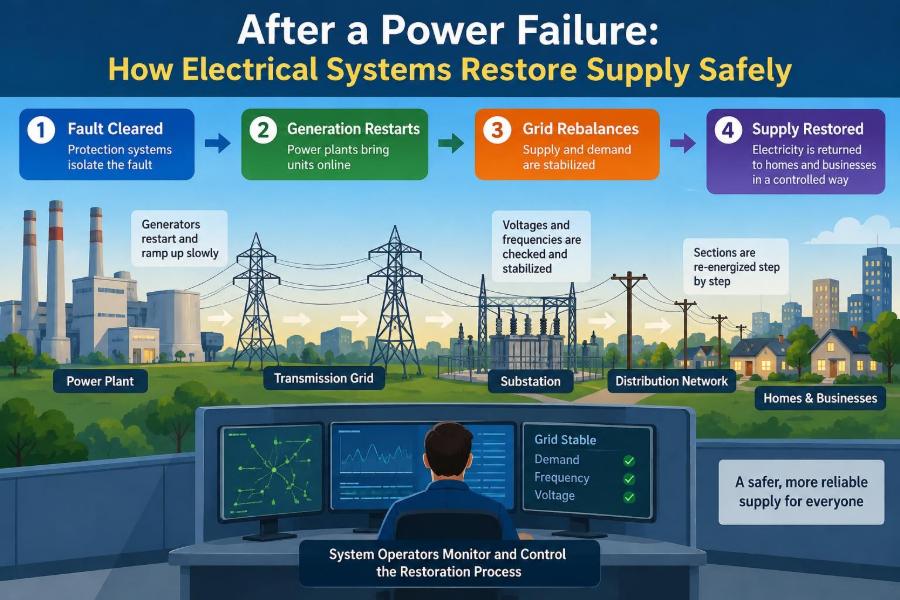
🚦 Restoration Follows an Operating Sequence
Exact sequences are site-specific and must be approved by the responsible utility or facility. Conceptually, a safe plan usually follows this order:
- Stabilize the remaining energized system.
- Identify and isolate the faulted section.
- Establish verified worker protection and switching boundaries.
- Restore sources, transmission paths, and substations in a controlled order.
- Add load gradually while monitoring frequency, voltage, and equipment loading.
- Reconnect islands only after synchronization checks.
Written switching orders, independent checks, and clear communications reduce the risk that a correct plan is executed incorrectly.
📞 Communication Is Part of Electrical Safety
During restoration, dispatchers, control-room operators, field crews, plant operators, and large customers may all need coordinated information. Ambiguous instructions can create as much risk as an equipment defect.
Good practice includes identifying the exact device, location, position, and intended action; repeating critical instructions; and recording switching status. Terminology may differ among organizations, so local operating language and procedures matter.
🧯 Common Restoration Mistakes to Avoid
Many restoration errors arise from pressure to return service quickly. The following shortcuts are especially dangerous:
- Resetting a tripped breaker repeatedly without fault investigation.
- Assuming a circuit is dead because one source was opened.
- Adding large motor loads before voltage and frequency are stable.
- Transferring load without checking alternate-source capacity.
- Closing a tie that unintentionally parallels two live sources.
- Relying on verbal assumptions instead of confirmed switching status.
Speed matters to customers, but safe, verified restoration is faster than recovering from a second incident.
🏠 What Building Occupants Should Do
For occupants, the safest response is usually simple: avoid operating damaged electrical equipment, keep generator exhaust outdoors and away from openings, and do not use improvised connections to feed a building panel.
When supply returns, high-demand appliances may restart together. Facilities can reduce this surge by staggering large loads where controls permit. If breakers continue to trip, unusual odors appear, or equipment is wet or damaged, qualified personnel should inspect it.
🔧 What Electrical Professionals Document
Restoration is also a learning opportunity. Event records, relay data, breaker operations, weather conditions, communications logs, and field observations can reveal whether equipment performed as intended.
Post-event review may lead to vegetation work, revised protection settings, additional sectionalizing, better spare-equipment planning, or improved operating procedures. The purpose is not simply to assign blame; it is to make the next disturbance less disruptive.
🌱 Distributed Energy Changes the Restoration Picture
Solar inverters, batteries, electric vehicles, and controllable loads can support resilience, but they add operating complexity. Their behavior during voltage or frequency disturbances depends on interconnection settings, local controls, and the applicable technical requirements.
For example, a battery may support a building while isolated from the grid, yet it must not energize utility lines unless the system is specifically designed and authorized to do so. Visibility and coordination become increasingly valuable as local resources grow.
🧪 Training Turns Procedures Into Reliable Actions
Operators and crews prepare through drills, simulator exercises, switching practice, and review of unusual events. Training helps people recognize abnormal conditions without turning rare emergencies into improvisation.
Engineering students can learn the same mindset by connecting circuit theory to operating constraints: a breaker has a duty, a transformer has inrush, a line has capacitance, and every switching action changes the network.
📋 A Practical Way to Think Through Restoration
Whether the system is a laboratory panel, industrial plant, campus network, or utility grid, ask four questions before restoring supply: What failed? What remains energized? Who could be exposed? What will change when this device closes?
Those questions do not replace formal procedures or qualified supervision. They do, however, encourage the disciplined reasoning behind safe electrical operations.
🏁 The Core Principle: Restore Stability Before Service
Reliable restoration combines protection, fault isolation, worker safety, source availability, voltage control, frequency control, and clear communication. It is a controlled reconstruction of a connected system, not a race to close breakers.
Customers understandably focus on when power will return. Electrical professionals must focus first on whether each restored section is safe, adequately supplied, properly protected, and compatible with the rest of the network.
After a power failure, the safest restoration is the one that rebuilds electrical stability step by deliberate step before reconnecting every possible load. That discipline protects people, limits equipment damage, and gives the system its best chance of returning to normal service. ⚡🛡️🔌