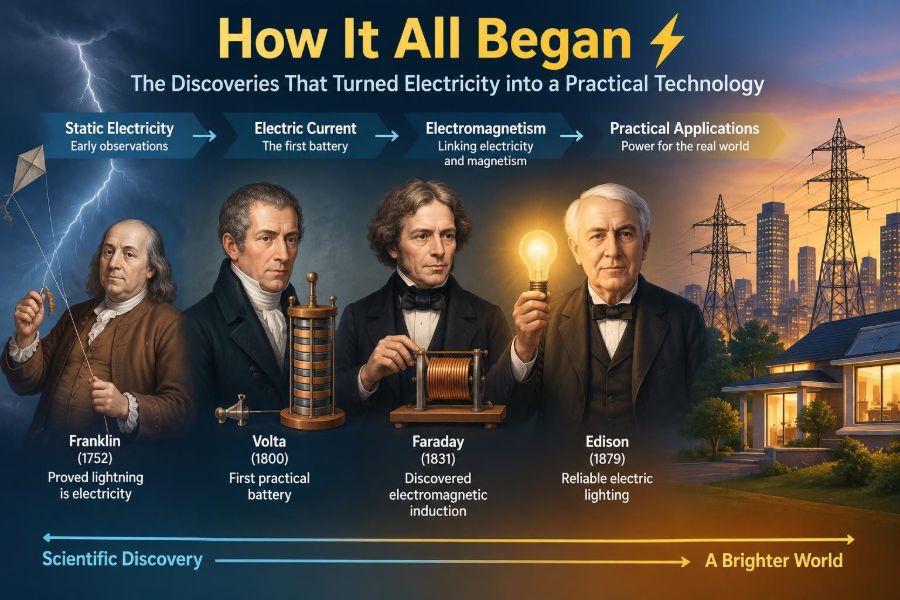

A phone charging beside a bed, a train pulling away from a platform, and a refrigerator quietly maintaining a safe temperature all depend on a chain of ideas that took centuries to build. Electricity was not “invented” in one dramatic moment. It became useful only after people learned how to observe it, describe it, generate it, control it, and deliver it safely.
That distinction matters for electrical engineers. A surprising laboratory effect is not yet a technology. Technology begins when an effect can be reproduced, measured, designed around, and connected to a human need.
The history is also more practical than it first appears. Many modern engineering decisions—choosing between voltage levels, separating signal from power, using insulation, protecting circuits from faults, and standardizing equipment—grew from early struggles to make electricity reliable.
Follow the discoveries in sequence and a clear pattern emerges: each breakthrough solved a constraint left by the previous one. The result was not merely electric light, but the electrical systems that shape modern life.
🧲 Electricity Was a Natural Phenomenon Before It Was a Tool
Long before formal electrical science, people encountered static electricity. Rubbing amber with cloth can make it attract light objects; the Greek word for amber, elektron, helped give electricity its name. Lightning, electric fish, and sparks from friction showed that nature could produce striking effects.
These observations did not yet offer a dependable source of energy. Static charge is usually high in voltage but carries very little total energy. A spark can be visible and startling, yet it cannot continuously power a lamp or turn a motor.
The first practical lesson was subtle: engineers need more than an interesting effect. They need a controllable supply, a path for current, and a useful conversion of electrical energy into light, motion, heat, or information.
🔍 Careful Experiments Turned Curiosity into Knowledge
Early experimenters began separating electrical phenomena from superstition and spectacle. William Gilbert’s work around 1600 distinguished the attraction caused by rubbed materials from magnetism, helping establish that they were related only in limited ways.
As instruments improved, investigators could compare effects instead of simply reporting them. They asked whether material, surface condition, humidity, shape, or distance changed the result. That habit—changing one variable while observing another—is still central to engineering test work.
Reproducibility was the real advance. If a result appears only occasionally, it cannot anchor a practical design. Reliable experiments turned “something happened” into knowledge that another person could test, improve, and apply.
⚡ Charge Became a Measurable Physical Quantity
The idea of electric charge gave electrical effects a useful conceptual foundation. Charge is a property of matter that produces electric forces. Objects can carry positive or negative charge, and unlike charges attract while like charges repel.
Charles-Augustin de Coulomb quantified the force between charged bodies in the late eighteenth century. The exact mathematical relationship matters because it showed that electrical force was not mysterious: it changed predictably with charge and separation.
For a modern reader, charge can be viewed as the “amount” being moved in a circuit. It is measured in coulombs. Current, by contrast, describes how quickly charge passes a point. That distinction later made circuit analysis possible.
⚖️ Potential Difference Explained Why Charge Moves
Charge alone does not explain a working circuit. Charges move when there is a difference in electric potential, commonly called voltage. A useful analogy is water at different heights: the height difference can drive water through a pipe, just as voltage can drive charge through a conductor.
The analogy has limits. Electrons are not simply water, and electrical circuits involve fields that establish themselves throughout the system. Still, it captures an essential engineering question: what source maintains the potential difference?
A battery has two terminals at different potentials because of internal chemical reactions. Connect a suitable external path, and current can flow. Without a complete path, a voltage may exist, but continuous useful current does not.
🫙 Leyden Jars Stored Electrical Charge
In the eighteenth century, the Leyden jar provided one of the first ways to store an appreciable amount of electrical charge. It consisted essentially of conductors separated by an insulating material, a structure that anticipates the modern capacitor.
The jar made electrical experiments more repeatable. Instead of relying only on a momentary charge generated by rubbing materials, experimenters could collect charge and release it later through a circuit.
Capacitors remain fundamental. They smooth power supplies, store energy briefly, shape signals, start some motors, and help manage voltage transients. The Leyden jar did not power cities, but it introduced the vital notion that electrical energy could be accumulated and controlled.
🐸 Galvani’s Observation Raised the Question of Current
Luigi Galvani observed that frog muscles could twitch when contacted by metals under certain conditions. He interpreted this as evidence of “animal electricity.” His explanation was incomplete, but the observation prompted a productive scientific dispute.
The important engineering value of such disagreement is that it exposes what must be tested. Was the source inside the animal, in the metal contact, or in the surrounding chemistry? Later work showed that material combinations and chemical reactions could create a sustained electrical effect.
Galvani’s experiments linked electricity with biology as well. Nerves and muscles use electrochemical processes, though their operation is more complex than a simple metal circuit. The episode illustrates how an imperfect theory can still lead to a crucial discovery.
🔋 Volta Built the First Continuous Source
Alessandro Volta responded by constructing the voltaic pile around 1800. Alternating layers of dissimilar metals, separated by material moistened with an electrolyte, produced a continuing potential difference. It was the first widely recognized source capable of driving current continuously.
This was a decisive transition. Electrostatic machines could produce high-voltage discharges, but the pile provided sustained current, which made chemical decomposition, heating, magnetic effects, and systematic measurement far easier.
Every battery still follows the broad principle: chemical reactions separate charge and establish voltage between terminals. Real batteries differ enormously in materials, capacity, safety, rechargeability, and current capability, but Volta’s pile established the basic electrochemical route to usable electrical power.
🧪 Electrolysis Revealed Electricity’s Chemical Power
Once continuous current was available, researchers could pass it through liquids and observe chemical changes. This process, electrolysis, separates or transforms substances using electrical energy. It demonstrated that electricity could drive more than sparks and shocks.
Michael Faraday’s laws of electrolysis connected the amount of chemical change to the amount of charge passed. That connection was important because it made electrical action measurable in material terms.
Electrochemistry now supports electroplating, metal refining, battery manufacturing, corrosion studies, and industrial chemical production. It also taught an enduring lesson: electrical systems often exchange energy with other physical domains, including chemistry, heat, light, and mechanical motion.
🧭 Ørsted Connected Electricity and Magnetism
In 1820, Hans Christian Ørsted observed that a current-carrying wire could deflect a nearby compass needle. This showed that electric current produces a magnetic field. It was a bridge between phenomena previously treated as separate.
The effect may sound modest, but it transformed the prospects for practical devices. A current could now create a controllable force without direct mechanical contact. Reverse the current, and the magnetic influence reverses too.
That principle underlies relays, loudspeakers, motors, actuators, magnetic sensors, and many measurement instruments. It also means that current paths matter physically: conductor layout can influence nearby circuits through magnetic coupling.
🌀 Ampère Made Electromagnetic Forces Quantitative
André-Marie Ampère investigated how currents interact with one another. He showed that parallel current-carrying conductors can attract or repel depending on current direction, and he developed a mathematical description of magnetic effects caused by current.
Quantification made design possible. Engineers could estimate how coil turns, current, geometry, and air gaps affected magnetic force rather than relying exclusively on trial and error.
Electromagnets became especially useful because they could be switched. A permanent magnet is always active; an electromagnet can be energized only when needed, although its coil consumes power and may require thermal management. This controllability helped make electrical machinery practical.
🧲 Soft Iron Made Electromagnets Stronger and More Useful
A coil carrying current creates a magnetic field, but placing soft iron in or near the coil can concentrate the field and strengthen the electromagnet. Soft magnetic materials can be magnetized readily and lose most of that magnetization when the field is removed.
This behavior suited practical devices. Strong attraction could operate a bell, switch, valve, or mechanical linkage, then release when current stopped. Early telegraph equipment depended heavily on this reliable conversion of electrical signals into motion.
Core materials are never a free upgrade. Changing magnetic fields can induce unwanted currents inside a conductive core, causing heating. Laminated steel and ferrite materials are later solutions to reduce such losses in appropriate frequency ranges.
🧠 Faraday Discovered Electromagnetic Induction
Faraday’s 1831 experiments established electromagnetic induction: changing magnetic conditions can produce an electromotive force, or induced voltage, in a conductor. Moving a magnet near a coil is one familiar demonstration, but motion is not the only route. A changing current in a nearby coil can also do it.
The key word is changing. A steady magnetic field alone does not continuously induce voltage in a stationary loop. Engineers therefore create changing magnetic flux through rotation, switching, or alternating current.
Induction opened the route to generators and transformers. It is among the most consequential discoveries in the history of technology because it enables efficient conversion and transfer of electrical energy without a direct conductive connection between coils.
⚙️ Generators Converted Motion into Electricity
A generator uses mechanical work to create electrical energy. In a simple arrangement, a conductor or coil moves through a magnetic field, producing an induced voltage. The mechanical input may come from a steam turbine, water turbine, wind turbine, engine, or hand crank.
The generator is not creating energy from nothing. It converts energy from another source, and the mechanical prime mover must supply torque against the electrical load. When more electrical power is demanded, more mechanical input is generally required.
This principle made large-scale electricity possible because mechanical energy can be produced centrally and converted into a form that travels through conductors. It also remains the foundation of much utility-scale generation.
🔄 Motors Completed the Energy Conversion Pair
If a generator turns motion into electricity, an electric motor turns electricity into motion. Current in conductors experiences forces in a magnetic field, and carefully arranged fields can create continuous torque on a rotating shaft.
Motors made electricity visibly useful in factories. Instead of distributing mechanical power from one steam engine through long shafts and belts, a facility could place motors near individual machines. This improved layout flexibility and made staged automation more feasible.
Motors come with trade-offs. Starting current, speed control, heat, insulation, and mechanical loading all matter. Modern drives use power electronics for precise control, but their basic operation rests on the nineteenth-century discovery that electrical and mechanical energy are reversible partners.
📜 Ohm’s Law Made Circuit Behavior Predictable
Georg Ohm described a relationship between voltage, current, and resistance for many conductive materials under stable conditions: V = IR. Voltage is V, current is I, and resistance is R. This compact expression is a starting point, not a universal rule.
For example, a metallic resistor often behaves approximately ohmically over a useful operating range. A filament lamp, diode, battery, and transistor do not maintain one fixed resistance under all conditions. Temperature, polarity, and operating point can change their behavior.
Even so, Ohm’s law gave engineers a shared language for sizing conductors, calculating voltage drop, selecting resistors, and diagnosing faults. It converted circuit design from intuition alone into calculation plus verification.
🌡️ Resistance Brought Both Useful Heat and Unwanted Loss
When current flows through resistance, electrical energy can become heat. The power dissipated in a resistor can be expressed as P = I²R, which explains why current deserves special attention in power systems: doubling current increases this heating effect by four for the same resistance.
Heating is useful in toasters, furnaces, electric heaters, and fuses. In cables, transformer windings, and motor coils, it is usually an unwanted loss that can damage insulation or shorten component life.
Practical design therefore considers conductor size, cooling, duty cycle, connection quality, and ambient temperature. A wire that seems adequate in open air may overheat when bundled with others or enclosed in a poorly ventilated panel.
💡 Electric Light Needed a Durable, Controlled Load
Electric lighting existed in forms such as arc lamps before the familiar incandescent lamp. Arc lamps produced intense light by sustaining an arc between electrodes, which made them suitable for some large spaces and outdoor uses but less convenient for ordinary rooms.
Incandescent lamps required a filament that could glow without failing immediately, a suitable enclosure, and practical manufacturing methods. Their development involved many improvements rather than a single isolated invention.
Lighting mattered because it created a compelling reason to build distribution systems. A lamp is also a useful engineering load: it reveals poor contacts, voltage variation, and overloads quickly. Later lighting technologies improved efficiency, but illumination helped establish electricity as a daily service.
📡 The Telegraph Proved Signals Could Travel Far
Electrical power is only one application. Telegraph systems showed that electrical circuits could carry information across long distances. An operator opened and closed a circuit in coded patterns, and a receiver converted those changes into marks, sounds, or mechanical action.
Long lines introduced problems that remain recognizable today: resistance caused voltage drop, leakage through imperfect insulation weakened signals, and capacitance affected rapid changes. The line was not merely a passive wire; its physical properties shaped the message.
The telegraph established practices that later communication systems inherited: standardized codes, repeaters, switching networks, fault finding, and disciplined installation. It made the value of electrical connectivity visible long before digital networks.
☎️ Telephones Required Faithful Analog Signals
Telephones extended the idea of communication from coded pulses to continuously varying sound. A microphone converted sound pressure into a changing electrical signal, while a receiver converted that signal back into motion and sound.
This demanded more than simple on/off switching. The system needed to preserve enough of the waveform to make speech understandable. Frequency response, noise, attenuation, and impedance became practical concerns.
Telephone engineering encouraged a deeper understanding of circuits operating with changing signals. The same concern for signal integrity appears in audio equipment, sensors, radio systems, data links, and high-speed digital electronics, even though the details differ.
🔌 Direct Current Worked, but Distribution Was Difficult
Early local power systems often used direct current, or DC. DC can be excellent for batteries, electronics, electrochemical processes, and certain motors. Its challenge in early distribution was economical voltage conversion over a network.
For a given power demand, delivering power at lower voltage requires higher current. Higher current increases conductor heating losses and requires larger, more expensive conductors. Raising voltage reduces current for the same power, but safe and practical voltage conversion was essential.
Early DC networks therefore tended to serve relatively limited areas around generating stations. This was not evidence that DC was inherently obsolete; it reflected the available conversion technology and the requirements of the time.
〰️ Alternating Current Made Transformation Practical
Alternating current, or AC, reverses direction periodically. Its crucial historical advantage was that transformers could change AC voltage efficiently using electromagnetic induction. That allowed high-voltage transmission and lower-voltage distribution closer to users.
The logic is straightforward: transmit a given amount of power at higher voltage, use lower current, and reduce resistive line losses. Then step the voltage down for local equipment. Higher voltage also demands more robust insulation, clearance, and protective design.
AC did not win because it was universally superior in every application. It fit a system problem exceptionally well: moving large amounts of power over substantial distances with the equipment then available.
🧱 Transformers Linked Power Systems Together
A transformer has at least two windings magnetically coupled through a core. Alternating current in one winding creates changing magnetic flux, inducing voltage in the other. The turns ratio determines whether the transformer steps voltage up or down.
Because the windings are electrically separate, transformers can also provide isolation. That can improve safety and help manage grounding arrangements, although isolation alone does not remove every electrical hazard.
Transformers made layered grids possible: generation voltage, transmission voltage, substation voltage, and utilization voltage could each be chosen for a different task. They are a powerful example of how a component can solve a system-level constraint rather than merely improve one device.
⚔️ The Current Systems Debate Was Really a Systems Debate
The historical competition between AC and DC distribution is often simplified into a story of rival inventors. The more useful engineering interpretation is that competing systems had different strengths, limitations, business models, and safety challenges.
AC networks benefited from transformers and practical long-distance distribution. DC served important applications and remains essential in electronics, battery storage, rail systems, electrolysis, and some modern high-voltage transmission links.
The takeaway is not that one current type defeated the other forever. Good engineering asks what the source, load, distance, conversion equipment, controllability needs, and safety requirements demand. A technology choice is meaningful only in its operating context.
🏗️ Power Stations Turned Devices into Infrastructure
A practical electrical service requires more than a generator. It needs prime movers, controls, conductors, substations, meters, switching equipment, maintenance procedures, and operators who can respond to faults.
As networks grew, engineers had to coordinate generator frequency, voltage regulation, load changes, and reserve capacity. Power systems became interconnected machines whose parts influence one another. A local disturbance can propagate if protection and operational controls do not limit it.
This shift from apparatus to infrastructure changed electrical engineering. The discipline expanded beyond inventing components to planning dependable systems over decades, balancing efficiency, resilience, cost, environmental constraints, and public safety.
🛡️ Insulation, Grounding, and Protection Made Electricity Usable
Electrical technology could not become ordinary household and workplace infrastructure without safety practices. Insulation keeps current on its intended path. Enclosures limit access to live parts. Grounding and bonding help create predictable fault-current paths and reduce hazardous touch voltages under defined conditions.
Fuses and circuit breakers interrupt excessive current before conductors or equipment overheat severely. Protective relays in larger systems detect abnormal conditions and command breakers to isolate the faulted section.
No single measure is sufficient. A circuit breaker does not make exposed conductors safe, and insulation can age or be damaged. Effective safety comes from layered design, correct installation, inspection, and compliance with applicable local codes and procedures.
📏 Standards Made Interconnection Routine
Early electrical systems suffered when voltages, connectors, frequencies, symbols, and installation methods varied widely. Standardization reduced uncertainty. A replacement component, meter, appliance, or protective device could be designed to work within an agreed framework.
Standards also support safety and testing. They define ratings, marking practices, performance expectations, and methods for comparing equipment. However, a standard is not a substitute for engineering judgment; equipment still has to be selected for its actual environment and duty.
For students, circuit symbols and unit conventions may seem like classroom formalities. In professional work, shared conventions prevent wiring errors, misunderstandings, and costly incompatibility across drawings, teams, and suppliers.
📐 Measurement Turned Electrical Work into Engineering
Voltage, current, resistance, power, frequency, insulation resistance, waveform quality, and temperature each reveal a different part of system behavior. The invention and refinement of meters allowed engineers to test assumptions instead of guessing.
A measurement is meaningful only when its method fits the situation. A multimeter inserted incorrectly can create a short circuit; a probe may not be rated for the circuit category or voltage; and a reading can be misleading if the instrument alters the circuit.
Good troubleshooting starts with a model of what should happen, then gathers evidence safely. Compare expected and observed values, isolate variables, and verify after repair. This disciplined approach is a direct descendant of the experimental tradition that built electrical science.
🌐 Electronics Added Control, Computation, and Precision
Power systems made electricity widely available, but electronics made it highly controllable. Vacuum tubes, then semiconductor devices such as diodes, transistors, and integrated circuits, allowed small signals to switch, amplify, regulate, and process other signals.
A transistor can act as a controlled switch or amplifier. That ability enabled computers, digital communication, automation, sensing, and compact power conversion. Modern electrical engineering therefore spans enormous power levels, from microscopic device structures to continental grids.
The connection to the early history is direct. Electronics still depends on controlled charge motion, voltage differences, material behavior, electromagnetic fields, and measurement. New components changed scale and capability, not the underlying need for sound physical reasoning.
🔧 What the History Teaches a Modern Engineer
The progression from amber to grid is not a parade of isolated heroes or dates. It is a record of constraints being recognized and solved: no stored charge, then capacitors; no continuous source, then batteries; no conversion method, then induction; no economical delivery, then transformers and networks.
That pattern is useful when facing contemporary problems. Ask what prevents an effect from becoming a dependable system. Is the limitation energy density, thermal loss, noise, switching speed, manufacturability, cost, maintenance, interoperability, or safety?
- Start with physical principles, but test them under real operating conditions.
- Distinguish a working demonstration from a scalable, maintainable product.
- Design protection and measurement into the system rather than adding them as afterthoughts.
- Evaluate competing technologies by requirements, not by slogans or historical reputation.
The core principle is that practical electricity emerged when discovery, measurement, energy conversion, distribution, and safety were engineered together.
Electricity became a practical technology not when people first saw a spark, but when they learned to make electrical behavior repeatable, useful, and trustworthy at human scale. That same combination of curiosity and disciplined design continues to power the next generation of engineering. ⚡🔧🌍